Mastering Lower Extremity Deformity & Hip Pathology: Orthopaedic Board Review | Part 15

Key Takeaway
Lower extremity deformity correction in orthopaedics involves precise surgical planning using principles like the Center of Rotation of Angulation (CORA) and mechanical axis alignment. This includes managing conditions such as Slipped Capital Femoral Epiphysis (SCFE), septic hip sequelae, and rotational deformities through osteotomies and specialized fixation to restore biomechanics and limb function.
Mastering Lower Extremity Deformity & Hip Pathology: Orthopaedic Board Review | Part 15
Comprehensive 100-Question Exam
00:00
Start Quiz
Question 1
A 13-year-old boy presents with severe groin pain and inability to bear weight. Radiographs demonstrate a severe slipped capital femoral epiphysis (SCFE) with a slip angle of 60 degrees. The surgeon performs an open surgical dislocation and a subcapital realignment (modified Dunn procedure). What is the primary blood supply at critical risk during the subcapital osteotomy, requiring the careful creation of a retinacular flap?
Explanation
Question 2
When correcting a lower extremity angular deformity, if the osteotomy is performed at a level different from the center of rotation of angulation (CORA) but the hinges of the fixator are placed exactly at the CORA, what secondary effect will occur during correction?
Explanation
Question 3
A 7-year-old boy with Legg-Calvé-Perthes disease demonstrates a 'hinge abduction' on dynamic arthrography, causing significant mechanical restriction and pain. Which of the following is the most appropriate surgical management?
Explanation
Question 4
During tibial lengthening over a nail (LON) using a circular fixator, a patient develops a progressive equinus contracture despite daily physical therapy. Which of the following is the most appropriate initial management?
Explanation
Question 5
Which of the following pelvic osteotomies used for developmental dysplasia of the hip (DDH) is an incomplete, volume-reducing osteotomy that hinges on the triradiate cartilage?
Explanation
Question 6
A 3-year-old girl is diagnosed with infantile Blount disease (Langenskiöld stage III). Conservative management with knee-ankle-foot orthoses (KAFOs) has failed, and the deformity is progressive. What is the most appropriate surgical intervention?
Explanation
Question 7
A 28-year-old male athlete presents with anterior groin pain worsened by deep hip flexion. Radiographs reveal a crossover sign, a prominent ischial spine sign, and a positive posterior wall sign. Which type of femoroacetabular impingement (FAI) is most strongly suggested by these findings?
Explanation
Question 8
When utilizing a hexapod circular fixator (e.g., Taylor Spatial Frame) to correct a complex multi-planar tibial deformity, what parameter is essential for the software to establish the 'origin' from which all corrections are calculated?
Explanation
Question 9
A 12-year-old boy undergoes in situ pinning with a single screw for a stable slipped capital femoral epiphysis (SCFE). Two years later, he presents with limited hip internal rotation and a positive impingement test. The screw is radiographically extra-articular. What is the most likely cause of his symptoms?
Explanation
Question 10
According to Ilizarov's principles of distraction osteogenesis, what is the optimal rate of distraction to balance robust bone regeneration with soft tissue accommodation in a healthy adult tibia?
Explanation
Question 11
A 22-year-old female undergoes a Bernese periacetabular osteotomy (PAO) for symptomatic hip dysplasia. Postoperatively, she demonstrates weakness in ankle dorsiflexion and great toe extension. Which nerve was most likely injured during the procedure?
Explanation
Question 12
A 45-year-old man with an Ilizarov frame for a tibial non-union presents with localized pain, erythema, and soft tissue tenting at a tensioned wire site. There is no purulent drainage. What is the most appropriate initial step in management?
Explanation
Question 13
A 35-year-old man on chronic corticosteroids presents with bilateral hip pain. MRI shows Ficat stage II avascular necrosis (AVN) of both femoral heads involving 20% of the weight-bearing surface, with no evidence of subchondral collapse. What is the most appropriate surgical management?
Explanation
Question 14
A 9-year-old boy presents with idiopathic bilateral genu valgum. Standing radiographs show the mechanical axis falls in the lateral zone 3 of the knee. Tension-band plating (guided growth) is planned. Where should the plates be placed to correct the deformity?
Explanation
Question 15
A 5-year-old child presents with a severe limp. Radiographs reveal complete resorption of the right femoral head and neck with a high-riding trochanter (Choi type IV) as a sequela of neonatal MRSA septic arthritis. Which salvage procedure provides the most stable fulcrum for ambulation and equalizes leg length?
Explanation
Question 16
In evaluating a normal lower extremity via long standing radiographs, the mechanical axis deviation (MAD) is typically located in which position relative to the center of the knee joint?
Explanation
Question 17
A 30-year-old woman with developmental hip dysplasia complains of lateral hip pain. Radiographs reveal a lateral center edge angle (LCEA) of 15 degrees. Which of the following findings would make her a POOR candidate for a Bernese periacetabular osteotomy (PAO)?
Explanation
Question 18
A 1-year-old is diagnosed with Aitken Class A proximal focal femoral deficiency (PFFD). The femoral head is present in the acetabulum, but a severe subtrochanteric varus pseudarthrosis is identified. What is the most important early surgical intervention to optimize the extremity for future lengthening?
Explanation
Question 19
During an open reduction and subcapital realignment (modified Dunn procedure) for a severe slipped capital femoral epiphysis (SCFE), how is the surgical approach optimized to protect the medial femoral circumflex artery (MFCA)?
Explanation
Question 20
When applying a circular external fixator to the proximal tibia, placing transverse wires carries a risk of neurovascular injury. To safely avoid the common peroneal nerve laterally, a lateral-to-medial wire should be optimally inserted in which manner?
Explanation
Question 21
When performing a corrective osteotomy for a uniplanar tibial deformity, what is the geometric consequence of placing the osteotomy and the hinge at a level distant from the Center of Rotation of Angulation (CORA)?
Explanation
Question 22
A 4-year-old child presents with a waddling gait and a painless limp. Radiographs reveal a decreased neck-shaft angle and a vertically oriented proximal femoral physis. Measurement of the Hilgenreiner epiphyseal angle (HEA) is 65 degrees. What is the most appropriate management?
Explanation
Question 23
A 4-year-old girl with residual acetabular dysplasia requires a pelvic osteotomy. The surgeon plans a redirectional osteotomy that hinges at the pubic symphysis. Which of the following osteotomies is described?
Explanation
Question 24
A 13-year-old obese boy presents with severe right hip pain and inability to bear weight after a minor fall 2 days ago. Radiographs confirm a slipped capital femoral epiphysis. According to the Loder classification, what is his primary risk for the most devastating complication of this specific type of slip?
Explanation
Question 25
During preoperative planning for a distal femoral varus deformity, the mechanical lateral distal femoral angle (mLDFA) and the mechanical proximal tibial angle (mPTA) are measured. What are the normal population averages for these respective angles?
Explanation
Question 26
A patient with a multiplanar tibial deformity is treated with a hexapod external fixator. Following the initial correction schedule, a residual 5-degree varus deformity is noted. To generate a residual correction program, which of the following frame parameters MUST be updated in the software?
Explanation
Question 27
A 3-year-old girl weighing above the 95th percentile presents with bilateral genu varum. Standing radiographs demonstrate a metaphyseal-diaphyseal angle (Drennan's angle) of 18 degrees and medial metaphyseal beaking. What is the most appropriate initial treatment?
Explanation
Question 28
An 8-year-old boy is diagnosed with Legg-Calve-Perthes disease. Radiographs show that 40% of the lateral pillar height is maintained. According to the Herring lateral pillar classification, what is his classification and associated prognosis?
Explanation
Question 29
A 45-year-old man with a history of high-dose corticosteroid use presents with groin pain. Hip radiographs show a crescent sign without flattening of the femoral head. What is the Ficat and Arlet stage of his disease?
Explanation
Question 30
In the context of distraction osteogenesis via the Ilizarov method, what is the optimal latency period prior to initiating distraction after the corticotomy?
Explanation
Question 31
An AP pelvis radiograph of a 25-year-old man with groin pain reveals the anterior wall of the acetabulum crossing over the posterior wall before reaching the lateral sourcil. What underlying pathomorphology does this crossover sign indicate?
Explanation
Question 32
A 55-year-old female with adult sequelae of DDH is scheduled for a total hip arthroplasty. Her preoperative radiograph shows the femoral head is superiorly displaced by 60% of the normal pelvic height. According to the Crowe classification, what type of DDH does she have?
Explanation
Question 33
During an acute correction of a severe valgus deformity of the proximal tibia using a closing wedge osteotomy, the patient develops a foot drop postoperatively. Which structure is most likely compromised?
Explanation
Question 34
A 10-year-old boy undergoes placement of a tension-band construct (eight-Plate) on the medial distal femur for a valgus deformity. Which of the following is the mechanism of action of this device?
Explanation
Question 35
A newborn is diagnosed with congenital femoral deficiency. Radiographs reveal a complete absence of the proximal femur, including the femoral head, and no acetabular development. Which class does this represent in the Aitken classification?
Explanation
Question 36
In a patient with Legg-Calve-Perthes disease, which of the following is considered a head at risk sign as described by Catterall?
Explanation
Question 37
When performing a deformity correction, if the osteotomy and the axis of correction of angulation (ACA) are both located exactly at the center of rotation of angulation (CORA), what is the expected geometric outcome?
Explanation
Question 38
A 6-week-old infant is treated with a Pavlik harness for developmental dysplasia of the hip. At the two-week follow-up, the parents report the infant has stopped kicking the affected leg. On exam, there is absent active knee extension. Which of the following positioning errors most likely caused this complication?
Explanation
Question 39
According to the Loder classification, an unstable slipped capital femoral epiphysis (SCFE) is defined by which of the following criteria, and carries what primary complication risk?
Explanation
Question 40
In the Herring lateral pillar classification for Legg-Calvé-Perthes disease, a Type B hip is characterized by:
Explanation
Question 41
The Bernese periacetabular osteotomy (PAO) involves multiple bone cuts to reorient the acetabulum. Which of the following pelvic structures is deliberately left intact to maintain pelvic ring stability?
Explanation
Question 42
In distraction osteogenesis using the Ilizarov method, what is the primary biological consequence of initiating distraction with a latency period of less than 3 days?
Explanation
Question 43
A 4-year-old child with infantile Blount's disease is noted to have a permanent metaphyseal-epiphyseal bony bridge on imaging. This complete medial physeal bar corresponds to which Langenskiöld stage?
Explanation
Question 44
Cam-type femoroacetabular impingement (FAI) is most commonly characterized by abnormal bone morphology in which specific region of the proximal femur?
Explanation
Question 45
When performing a medial opening wedge high tibial osteotomy (HTO) for varus gonarthrosis, failing to make the anterior gap smaller than the posterior gap will typically result in which unintended sagittal plane deformity?
Explanation
Question 46
In a patient with congenital coxa vara, surgical intervention (such as a valgus producing subtrochanteric osteotomy) is generally indicated when the Hilgenreiner epiphyseal angle (HEA) exceeds what threshold?
Explanation
Question 47
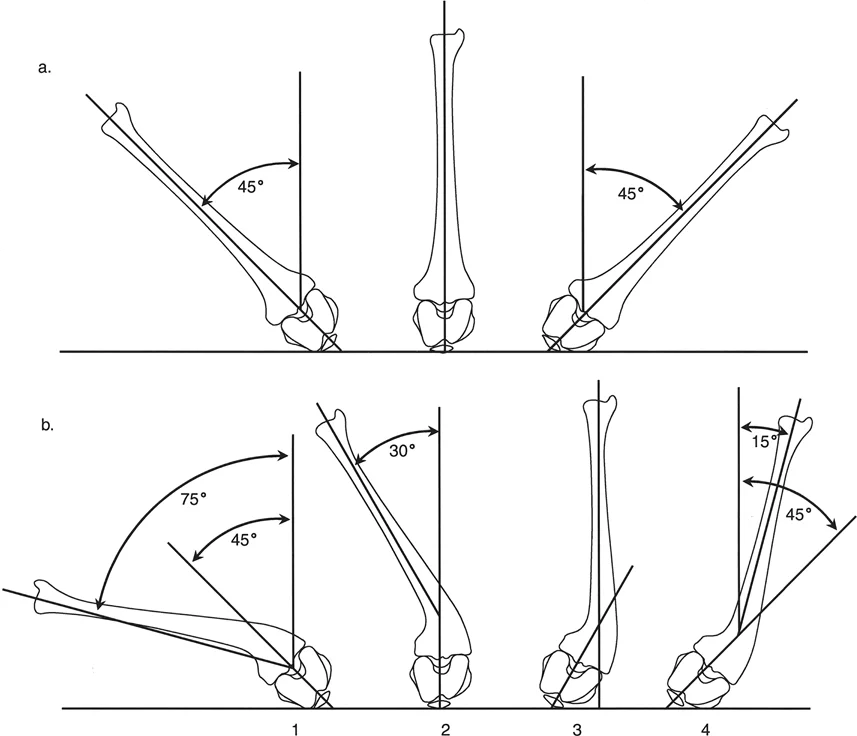
During a lower extremity deformity correction, the osteotomy is made proximal to the CORA, but the axis of correction of angulation (ACA) is placed exactly at the CORA. What is the resulting mechanical effect upon correction?
Explanation
Question 48
When performing a closed reduction and spica casting for developmental dysplasia of the hip (DDH), the 'safe zone' of Ramsey defines the range between:
Explanation
Question 49
Prophylactic in situ pinning of the contralateral asymptomatic hip in a patient with a unilateral slipped capital femoral epiphysis (SCFE) is most strongly indicated in which of the following scenarios?
Explanation
Question 50
In the treatment of Legg-Calvé-Perthes disease, surgical containment yields the most significant improvement in radiographic outcomes compared to nonoperative treatment in which specific patient population?
Explanation
Question 51
On an anteroposterior radiograph of the pelvis, the 'cross-over sign' is indicative of which acetabular morphology?
Explanation
Question 52
A 22-year-old female presents with symptomatic genu valgum. A lateral opening-wedge distal femoral osteotomy is planned. Compared to a medial closing-wedge osteotomy, what is a primary biomechanical or anatomic advantage of the lateral opening-wedge technique?
Explanation
Question 53
The Taylor Spatial Frame utilizes a specialized software program to calculate strut adjustments based on a 6-axis deformity analysis. Which of the following is NOT a required radiographic or clinical parameter for the software to generate a prescription?
Explanation
Question 54
In the Ficat and Arlet classification for avascular necrosis (osteonecrosis) of the femoral head, the defining radiographic feature of Stage III disease is:
Explanation
Question 55
A 7-year-old boy undergoes temporary hemiepiphysiodesis using tension band plates for genu valgum. Following complete correction and implant removal, the family should be counseled that the risk of 'rebound deformity' is highest in which demographic?
Explanation
Question 56
When planning a corrective osteotomy for a lower extremity deformity, if the osteotomy is performed at a level different from the Center of Rotation of Angulation (CORA) but the correction axis passes through the CORA, what is the expected resulting deformity?
Explanation
Question 57
A 12-year-old obese male presents with acute-on-chronic left hip pain and inability to bear weight. Radiographs confirm an unstable slipped capital femoral epiphysis (SCFE). What is the most significant risk factor for developing avascular necrosis (AVN) following surgical fixation?
Explanation
Question 58
A 4-year-old girl is diagnosed with Langenskiöld stage III infantile Blount's disease. What is the most appropriate management?
Explanation
Question 59
In a 7-year-old boy with Legg-Calvé-Perthes disease, which of the following radiographic "head-at-risk" signs (Catterall) suggests a poor prognosis and potential need for surgical containment?
Explanation
Question 60
A neonate presents with an anteromedial bowing of the tibia, a shortened leg, and an absent lateral ray of the foot. Radiographs confirm fibular hemimelia. Which associated ligamentous deficiency is most commonly seen in the knee of this patient?
Explanation
Question 61
A 24-year-old male hockey player presents with anterior groin pain exacerbated by hip flexion and internal rotation. Imaging demonstrates a "pistol grip" deformity and an alpha angle of 65 degrees. The primary pathomechanical process in this condition involves:
Explanation
Question 62
During distraction osteogenesis using an external fixator for a 5 cm tibial lengthening, a patient develops an equinus contracture. What is the most appropriate initial management?
Explanation
Question 63
A 16-year-old female presents with persistent lateral hip pain. Radiographs show a lateral center edge angle (LCEA) of 15 degrees and a Tönnis angle of 18 degrees with an intact Shenton's line. Joint space is preserved. What is the most appropriate surgical treatment?
Explanation
Question 64
A 12-year-old boy presents with progressive bilateral genu valgum. Mechanical axis deviation is lateral to the center of the knee. What is the most appropriate site and technique for guided growth (hemiepiphysiodesis) to correct the deformity?
Explanation
Question 65
A 35-year-old female on chronic corticosteroids for SLE presents with groin pain. MRI reveals bilateral femoral head avascular necrosis (Ficat Stage II). What is the primary rationale for performing a core decompression?
Explanation
Question 66
To maximize the stiffness of a unilateral external fixator applied for a tibial shaft fracture, which of the following modifications is most effective?
Explanation
Question 67
A 5-year-old boy presents with a painless limp and a positive Trendelenburg sign. Radiographs show a neck-shaft angle of 90 degrees and an inverted Y-shaped radiolucency in the inferior femoral neck. What is the most appropriate surgical treatment?
Explanation
Question 68
According to Ilizarov principles of distraction osteogenesis, what is the optimal rate and rhythm for bone lengthening?
Explanation
Question 69
A 70-year-old woman presents with recurrent posterior dislocations 6 months following a primary total hip arthroplasty via a posterior approach. Radiographs show a well-fixed cup with 10 degrees of anteversion and 45 degrees of abduction, and a well-fixed stem with 5 degrees of retroversion. What is the most appropriate definitive management?
Explanation
Question 70
A 4-year-old child with Osteogenesis Imperfecta presents with severe anterior bowing of bilateral femurs preventing ambulation. What is the gold standard surgical management to correct the deformity and prevent further fractures?
Explanation
Question 71
A 13-year-old boy undergoes in situ pinning of a stable, moderate left SCFE. One year later, he presents with progressive stiffness and pain in the left hip. Examination reveals severe global restriction of hip motion. Radiographs show joint space narrowing and subchondral sclerosis without focal collapse. What is the most likely diagnosis?
Explanation
Question 72
When using a hexapod circular fixator for deformity correction, accurate data entry into the software is crucial. Which parameter specifically dictates the spatial relationship between the reference ring and the bone segment it attaches to?
Explanation
Question 73
A 4-week-old female infant has a positive Ortolani test on the right hip. An ultrasound is performed. What alpha angle measurement is considered the threshold for a normal hip (Graf Type I)?
Explanation
Question 74
A 5-year-old boy presents with progressive, asymmetric hypertrophy of his right lower extremity, cutaneous capillary malformations (port-wine stains), and varicose veins. Which condition is the most likely diagnosis?
Explanation
Question 75
In metal-on-metal hip resurfacing arthroplasty, which patient demographic and anatomical profile has the highest risk of early failure and adverse local tissue reaction (ALTR)?
Explanation
Question 76
According to the principles of deformity correction (Paley's Rule 1), if an osteotomy and the correction hinge are both placed exactly at the Center of Rotation of Angulation (CORA), what is the resulting effect on the bone segments after realignment?
Explanation
Question 77
A 28-year-old hockey player presents with groin pain worsened by deep hip flexion and internal rotation. Radiographs display an alpha angle of 65 degrees. What is the primary pathomechanism of cartilage damage in this specific condition?
Explanation
Question 78
In the evaluation of a 7-year-old boy with Legg-Calvé-Perthes disease, the Herring lateral pillar classification dictates prognosis and treatment. Which of the following radiographic findings correctly defines a Herring Group C classification?
Explanation
Question 79
When analyzing the mechanical axis of the lower extremity for deformity planning, what is the accepted normal range for the mechanical lateral distal femoral angle (mLDFA)?
Explanation
Question 80
A patient presents with severe genu varum. Standing long-leg radiographs show a mechanical axis deviation (MAD) falling completely medial to the medial tibial plateau (Zone 3). During an acute correction using a high tibial opening wedge osteotomy, what is the primary soft tissue structure at risk?
Explanation
Question 81
A 13-year-old obese male sustains an acute-on-chronic slipped capital femoral epiphysis (SCFE) and is unable to bear weight even with crutches. He is treated with single in situ screw fixation. What is the most devastating, yet relatively common, complication specifically associated with this variant of SCFE?
Explanation
Question 82
A 14-year-old female undergoes femoral lengthening using distraction osteogenesis. During the consolidation phase, her surgeon calculates the External Fixator Index (EFI). How is the EFI defined?
Explanation
Question 83
A 35-year-old female with secondary osteoarthritis due to severe developmental dysplasia of the hip (Crowe Type IV) requires a total hip arthroplasty. To successfully place the acetabular cup in the true acetabulum and safely reduce the hip, which adjunctive procedure is most frequently required?
Explanation
Question 84
When programming a Taylor Spatial Frame (hexapod fixator) for multiplanar lower extremity deformity correction, what does the "mounting parameter" mathematically communicate to the software?

Explanation
Question 85
A 4-year-old boy presents with a limp, right hip pain, a temperature of 38.6°C (101.5°F), and refusal to bear weight. His laboratory values show WBC 14,000/mm³, ESR 45 mm/hr, and CRP 25 mg/L. According to Kocher's criteria, what is the approximate probability of this child having septic arthritis?
Explanation
Question 86
According to Paley's osteotomy rules, if the osteotomy is executed at a level separate from the CORA, and the correction hinge is placed directly at the osteotomy site, what is the biomechanical outcome upon correction of the angulation?
Explanation
Question 87
A 42-year-old male with chronic corticosteroid use presents with significant groin pain. Plain radiographs are completely normal. MRI reveals a serpiginous low-signal intensity line in the anterosuperior femoral head on T1-weighted sequences. What is the most appropriate initial surgical management?
Explanation
Question 88
The Paley multiplier method provides accurate predictions of leg length discrepancy (LLD) at skeletal maturity. At what specific age is the skeletal multiplier for girls exactly 2.0?
Explanation
Question 89
When planning a deformity correction using a circular fixator, the surgeon places the hinge at the center of rotation of angulation (CORA) but performs the osteotomy at a different level. According to Paley's osteotomy rules, what is the expected outcome at the osteotomy site?
Explanation
Question 90
A 5-year-old girl with developmental dysplasia of the hip (DDH) requires a pelvic osteotomy. The surgeon plans an incomplete osteotomy through the ilium, hinging on the triradiate cartilage, to reduce the acetabular volume and improve anterior and lateral coverage. Which osteotomy is described?
Explanation
Question 91
A 4-year-old child presents with severe infantile Blount disease. Radiographs show a Langenskiöld stage IV lesion with a prominent medial metaphyseal beak and a step-off in the epiphysis. What is the most appropriate surgical management?
Explanation
Question 92
A 28-year-old male athlete presents with anterior groin pain. Imaging reveals a CAM-type femoroacetabular impingement. At which clock-face location on the femoral head-neck junction is the maximum CAM deformity most commonly located?
Explanation
Question 93
A 12-year-old obese male presents with a unilateral stable slipped capital femoral epiphysis (SCFE). Which of the following is the strongest clinical indication for prophylactic in situ pinning of the contralateral asymptomatic hip?
Explanation
Question 94
A 5-year-old boy is evaluated for a painless waddling gait. Radiographs show developmental coxa vara. The Hilgenreiner's epiphyseal angle (HEA) is measured at 65 degrees. What is the most appropriate management?
Explanation
Question 95
A 45-year-old male presents with early-onset hip osteoarthritis. He has a history of Legg-Calvé-Perthes disease as a child. Radiographs show an enlarged, flat femoral head that is congruent with a similarly flattened acetabulum. This presentation most closely correlates with which Stulberg classification from childhood?
Explanation
Question 96
Review the lower extremity deformity shown.
When analyzing a diaphyseal deformity with two distinct centers of rotation of angulation (CORAs), which of the following mechanical axis lines must be established to determine the intervening segment's true axis?
Explanation
Question 97
A 2-year-old child with Proximal Focal Femoral Deficiency (PFFD) has a severely short femur, but a normal, stable knee and ankle. The foot is at the level of the contralateral knee. To optimize the child for a functional prosthesis, the surgeon considers a Van Nes rotationplasty. What critical prerequisite must be met for this procedure to be successful?
Explanation
Question 98
When applying a hexapod circular external fixator for complex lower extremity deformity correction, accurately inputting mounting parameters is essential. Which of the following defines the "axial translation" mounting parameter?
Explanation
Question 99
A 6-month-old girl undergoes closed reduction and spica casting for developmental dysplasia of the hip. Which of the following positions during casting is most heavily associated with the development of iatrogenic avascular necrosis (AVN) of the femoral head?
Explanation
Question 100
A 16-year-old patient presents with a combined leg length discrepancy and complex femoral deformity. A proximal femoral osteotomy and external fixation are performed.
When distracting a fixator over a newly formed regenerate in the proximal femur, what soft tissue structure is at highest risk of causing an apex-anterior (procurvatum) and varus bowing of the regenerate?
Explanation
None
