ABOS Orthopedic Board Review: Lower Limb Deformity Correction, Gait, & Guided Growth | Part 11
20 Jun 2026
55 min read
44 Views

Key Takeaway
Lower extremity deformity correction involves understanding Paley's rules, CORA, mechanical axis deviation, and sagittal plane analysis. Key aspects include gait biomechanics, joint orientation angles (mLDFA, MPTA), and pediatric guided growth principles like Heuter-Volkmann and Wolff's laws for effective surgical planning and outcomes.
ABOS Orthopedic Board Review: Lower Limb Deformity Correction, Gait, & Guided Growth | Part 11
Comprehensive 100-Question Exam
00:00
Start Quiz
Question 1
If an osteotomy and the hinge are both placed exactly at the Center of Rotation of Angulation (CORA), what is the geometric result of the deformity correction?
Explanation
According to Paley's Rule 1 of osteotomy, if the osteotomy and hinge are both at the CORA, the deformity corrects by angulation without translation. This perfectly realigns the mechanical axis.
Question 2
During a normal gait cycle, maximal electromyographic activity of the ankle dorsiflexors (e.g., anterior tibialis) occurs during which phase?
Explanation
The anterior tibialis contracts eccentrically from initial contact to the loading response to smoothly lower the foot to the ground and prevent 'foot slap'. This represents its maximal activity during the gait cycle.
Question 3
After successful correction of idiopathic genu valgum with a tension band plate (guided growth), what is the most significant risk factor for rebound deformity after implant removal?
Explanation
Younger age (especially girls <10 and boys <12) and significant remaining skeletal growth are the primary risk factors for rebound deformity following implant removal. Close monitoring until skeletal maturity is required.
Question 4
Which of the following is an absolute contraindication to tension band plating (guided growth) for infantile Blount disease?
Explanation
Langenskiöld stages V and VI involve physeal bar formation, meaning the medial physis is closed or severely tethered. Guided growth relies on an open, functional physis and will fail if a physeal bar is present.
Question 5
A 7-year-old child with spastic diplegic cerebral palsy presents with a crouch gait. Which of the following kinematic findings is most characteristic of this pattern?
Explanation
Crouch gait is characterized by excessive hip and knee flexion and excessive ankle dorsiflexion during the stance phase. This is often due to hamstring/psoas tightness and calf weakness.
Question 6
When evaluating a standing long-leg AP radiograph, the mechanical axis line falls 25 mm medial to the center of the knee joint. What is the primary deformity?
Explanation
A mechanical axis passing medial to the center of the knee joint indicates a varus deformity. This shifts the weight-bearing axis medially, increasing compressive forces on the medial compartment.
Question 7
The Paley multiplier method is used to predict leg length discrepancy at maturity. What demographic variable is the standard multiplier strictly dependent upon?
Explanation
The Paley multiplier method is primarily based on chronological age and sex. It is a simple and highly accurate tool for predicting limb length discrepancy at maturity, avoiding the need for bone age calculations in most congenital cases.
Question 8
What is the primary advantage of a hexapod external fixator (e.g., Taylor Spatial Frame) over acute corrective osteotomy and internal fixation for a severe multidirectional tibial deformity?
Explanation
Hexapod frames allow for gradual, precise correction of complex multi-planar deformities. Their primary advantage is the ability to adjust the correction trajectory in the clinic via software input without additional surgery.
Question 9
A patient exhibits a compensated Trendelenburg gait. Which kinematic adaptation is most typically observed during the stance phase on the affected side?
Explanation
In a compensated Trendelenburg gait, the patient leans their trunk laterally over the affected hip during stance. This shifts the center of gravity closer to the hip joint center, reducing the moment arm and the demand on the weak abductor muscles.
Question 10
During distraction osteogenesis of the femur at a rate of 1 mm/day, radiographs at 3 weeks reveal premature consolidation of the regenerate bone. What is the most appropriate next step?
Explanation
Premature consolidation means the bone has healed completely before the desired length was achieved. The treatment requires returning to the operating room to recut the bone (re-osteotomy) before distraction can resume.
Question 11
In a patient with Aitken Class A proximal focal femoral deficiency (PFFD), what is the most typical associated lower extremity anomaly?
Explanation
PFFD is highly associated with fibular hemimelia, occurring in up to 70-80% of cases. These patients also frequently present with ACL deficiency and lateral ray foot deficiencies.
Question 12
During Ilizarov distraction osteogenesis, radiographs are taken.
If the regenerate bone appears cystic and thin, what modification to the distraction protocol is most appropriate?
If the regenerate bone appears cystic and thin, what modification to the distraction protocol is most appropriate?
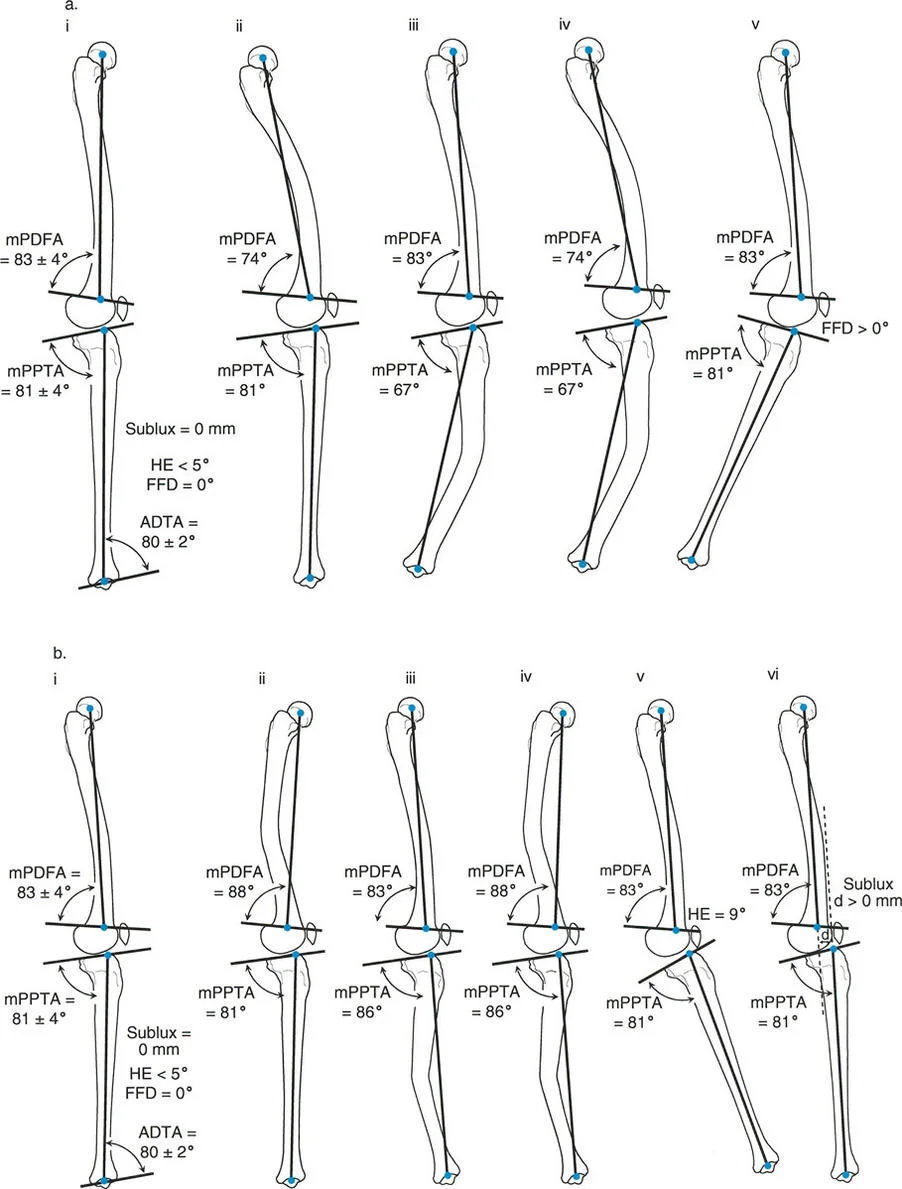
Explanation
Poor, cystic, or sparse regenerate bone indicates that osteogenesis is not keeping pace with the mechanical distraction. The rate of distraction should be decreased to allow bone mineralization to catch up.
Question 13
According to Paley's rules of deformity correction (Rule 2), if the osteotomy is made at a level separate from the CORA, but the hinge is placed on the transverse bisector line passing through the CORA, what is the geometric outcome?
Explanation
Paley's Rule 2 states that if the hinge is at the CORA but the osteotomy is at a different level, the correction will result in angulation along with translation. This successfully realigns the mechanical axis but displaces the bone ends.
Question 14
A patient with cerebral palsy presents with a stiff-knee gait, visibly dragging the toe during the swing phase. Which of the following is the most common underlying cause?
Explanation
Stiff-knee gait in CP is primarily caused by overactivity or spasticity of the rectus femoris during the swing phase. This prevents the necessary knee flexion required for foot clearance.
Question 15
What is the most common cause of tension band plate screw breakage during guided growth for angular deformity correction?
Explanation
If guided growth plates are left in place long after the deformity has corrected, continued physeal growth generates massive forces. This can eventually lead to screw bending or breakage, necessitating timely removal or exchange.
Question 16
When performing fixator-assisted nailing (FAN) for tibial deformity correction, what is the primary role of the temporary external fixator?
Explanation
In FAN, an external fixator is used temporarily intraoperatively to achieve and strictly maintain the anatomic reduction. This provides a stable trajectory while the intramedullary canal is reamed and the nail is inserted.
Question 17
During normal human walking, the vertical ground reaction force (GRF) exhibits a characteristic pattern. Which of the following best describes this pattern during the stance phase?
Explanation
The normal vertical ground reaction force is bimodal ('m-shaped'). The first peak corresponds to weight acceptance (loading response), and the second peak corresponds to push-off (terminal stance).
Question 18
During extensive tibial lengthening, the patient develops a new-onset clawing of the lesser toes. This most likely represents stretching and irritation of which nerve?
Explanation
Clawing of the toes during tibial lengthening typically indicates a stretch injury to the tibial nerve. This causes dysfunction of the intrinsic foot musculature, leading to an intrinsic minus foot posture.
Question 19
What is the generally accepted maximum percentage of lengthening of a single bone segment before the risk of severe complications (e.g., joint subluxation, nerve injury) increases exponentially?
Explanation
Lengthening a bone by more than 15-20% of its original length significantly increases complication rates. These include adjacent joint subluxation, severe soft tissue contractures, and neurovascular compromise.
Question 20
A 10-year-old girl has a projected leg length discrepancy of 4 cm at maturity and is deemed a candidate for percutaneous epiphysiodesis. Which imaging parameter is most critical for accurate timing of the procedure?
Explanation
An AP radiograph of the left hand and wrist is required to determine bone age (via the Greulich and Pyle atlas). Accurate bone age determination is the most critical factor for predicting remaining growth and timing an epiphysiodesis.
Question 21
A 12-year-old boy is undergoing deformity correction for a mid-diaphyseal tibial procurvatum deformity. According to Paley's Rule 1 of osteotomy, if the osteotomy and the axis of correction of angulation (ACA) are both located at the center of rotation of angulation (CORA), what will be the radiographic outcome of the correction?
Explanation
Osteotomy Rule 1 states that when the osteotomy and the ACA are placed at the CORA, pure angulation occurs. The mechanical and anatomical axes are realigned without any translation at the osteotomy site.
Question 22
A 4-year-old girl is diagnosed with unilateral infantile Blount disease (Langenskiold stage II). Which of the following is the most appropriate rationale for utilizing a tension band plate (guided growth) on the proximal lateral tibia?
Explanation
Guided growth utilizes a tension band plate to compress the lateral physis, relying on the Hueter-Volkmann principle where increased compressive forces inhibit physeal growth. This allows the relatively normal medial physis to 'catch up' and correct the varus deformity.
Question 23
A 7-year-old boy with spastic diplegic cerebral palsy underwent a fractional lengthening of the Achilles tendons bilaterally one year ago. He now presents with a worsening gait, walking with increased knee flexion during the stance phase. What is the primary cause of this iatrogenic gait abnormality?
Explanation
Overlengthening the Achilles tendon in a patient with cerebral palsy destroys the plantarflexion-knee extension couple. Without a competent gastroc-soleus complex to control forward advancement of the tibia (second rocker), the tibia collapses forward, leading to an iatrogenic crouch gait.
Question 24
An 8-year-old girl presents with a congenital femoral deficiency. Her current leg length discrepancy (LLD) is 3.0 cm. Using the Paley Multiplier method, and knowing the multiplier for a girl at age 8 is approximately 1.5, what is her predicted LLD at skeletal maturity?
Explanation
The Paley Multiplier method predicts limb length discrepancy at maturity by multiplying the current discrepancy by a chronological age- and sex-specific multiplier. In this case, 3.0 cm x 1.5 = 4.5 cm.
Question 25
During computerized gait analysis of a patient with cerebral palsy, the kinematic data reveals severely diminished peak knee flexion during the swing phase. Electromyography (EMG) demonstrates continuous firing of the rectus femoris. What is the most appropriate surgical intervention to address this specific abnormality?
Explanation
Continuous firing of the rectus femoris during the swing phase causes a 'stiff-knee gait' by preventing normal knee flexion. Transferring the rectus femoris distally converts it from a knee extensor to a knee flexor, improving swing-phase clearance.
Question 26
A surgeon is planning a tibial osteotomy
based on Osteotomy Rule 2. If the axis of correction of angulation (ACA) is at the center of rotation of angulation (CORA), but the osteotomy is performed at a different level, what is the expected geometric outcome?
based on Osteotomy Rule 2. If the axis of correction of angulation (ACA) is at the center of rotation of angulation (CORA), but the osteotomy is performed at a different level, what is the expected geometric outcome?
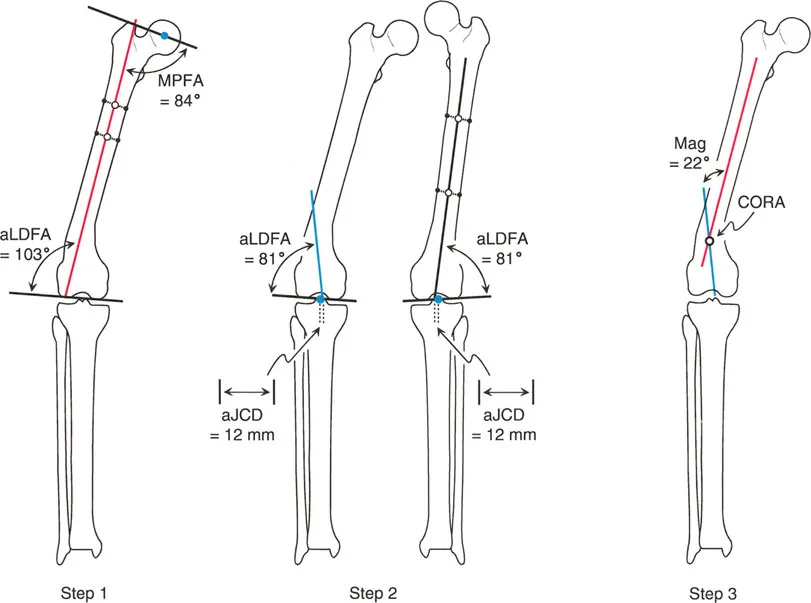
Explanation
According to Osteotomy Rule 2, when the ACA is at the CORA but the osteotomy is made at a different level (e.g., to cut through better metaphyseal bone), the mechanical axis is successfully restored. However, this correction requires both angulation and translation to occur at the osteotomy site.
Question 27
During the normal gait cycle, the vertical ground reaction force (vGRF) curve demonstrates a characteristic 'M' shape or two-peak pattern. In which phases of the gait cycle do these two peak vertical forces occur?
Explanation
The two peaks of the vertical ground reaction force curve occur during loading response (weight acceptance) and terminal stance (push-off). During mid-stance, the vGRF dips as the body's center of mass reaches its highest point.
Question 28
A 13-year-old girl undergoes tension band plating for idiopathic genu valgum. Following successful correction to a neutral mechanical axis, the plates are removed. What is the most common complication observed in the first two years post-removal?
Explanation
Rebound deformity (recurrence of the original deformity) is the most common complication after hardware removal following guided growth, particularly in younger children with significant remaining growth. For this reason, some surgeons slightly overcorrect the deformity prior to removal.
Question 29
A 9-year-old boy is undergoing a 5-cm tibial lengthening via distraction osteogenesis with a circular external fixator. During the consolidation phase, he develops a fixed equinus contracture. What biomechanical factor makes the ankle most susceptible to this specific contracture during tibial lengthening?
Explanation
Ankle equinus is the most common joint contracture during tibial lengthening. The strong gastrocnemius-soleus complex resists stretching more than the anterior compartment muscles, pulling the foot into plantarflexion unless prevented by aggressive physical therapy or extending the frame to the foot.
Question 30
During the initial phase of the gait cycle (first rocker), the foot transitions from heel strike to a foot-flat position. Which muscle performs the primary eccentric contraction to control this motion and prevent 'foot slap'?
Explanation
The anterior tibialis fires eccentrically from heel strike (initial contact) to foot flat (loading response) to smoothly lower the forefoot to the ground. Failure of this mechanism leads to a 'foot slap' gait.
Question 31
A patient with severe unilateral hip osteoarthritis walks with a classic uncompensated Trendelenburg lurch, shifting their torso over the affected hip during the stance phase. What is the primary biomechanical advantage of this compensatory gait mechanism?
Explanation
Shifting the trunk over the affected hip during stance (an abductor lurch) brings the center of gravity closer to the hip joint center. This significantly decreases the body weight moment arm, reducing the torque requirement on the weak or painful abductor muscles and thereby decreasing the total hip joint reaction force.
Question 32
An orthopaedic surgeon uses a Taylor Spatial Frame (TSF)
to correct a complex multidirectional lower limb deformity. The software program requires the surgeon to define a 'reference fragment'. The mathematical algorithm utilized by the TSF to calculate strut adjustments is based on which of the following kinematic principles?
to correct a complex multidirectional lower limb deformity. The software program requires the surgeon to define a 'reference fragment'. The mathematical algorithm utilized by the TSF to calculate strut adjustments is based on which of the following kinematic principles?
Explanation
The Taylor Spatial Frame is a hexapod external fixator based on the Stewart-Gough platform. It provides 6 degrees of freedom, allowing simultaneous correction of angulation, translation, rotation, and length via a web-based software algorithm.
Question 33
A full-length standing AP radiograph of the lower extremities is obtained to evaluate a patient's deformity. The mechanical lateral distal femoral angle (mLDFA) is measured at 99 degrees, and the medial proximal tibial angle (MPTA) is measured at 87 degrees. What is the correct interpretation of these radiographic findings?
Explanation
The normal mLDFA is approximately 87-88 degrees (range 85-90). An mLDFA of 99 degrees indicates an abnormally large lateral angle, meaning the distal femur is in varus. The normal MPTA is also approximately 87 degrees, so the tibia is normal.
Question 34
A 16-year-old male with a 6-cm post-traumatic femoral length discrepancy is undergoing lengthening over a nail (LON). Compared to classic Ilizarov lengthening using only an external fixator, what is the primary advantage of the LON technique?
Explanation
Lengthening over a nail (LON) allows the external fixator to be removed immediately after the distraction phase is completed, with the intramedullary nail locked to support the bone during the prolonged consolidation phase. This dramatically reduces the time the patient must wear the external frame.
Question 35
During distraction osteogenesis, plain radiographs are monitored to evaluate the 'regenerate' bone. At approximately what time post-osteotomy does the regenerate bone typically first become visible on standard radiographs, and what is its characteristic appearance?
Explanation
Regenerate bone typically becomes visible on radiographs 2 to 3 weeks after the start of distraction. It characteristically appears as columns of new bone with a central radiolucent 'fibrous interzone' where active distraction and histiogenesis are occurring.
Question 36
A 25-year-old female undergoes acute correction of a severe valgus deformity of the proximal tibia utilizing an opening wedge osteotomy. In the recovery room, she is found to have a dense foot drop and numbness in the first web space. What is the most appropriate initial management?
Explanation
Acute correction of a severe valgus deformity stretches the common peroneal nerve on the lateral side. The immediate treatment for an acute post-operative nerve palsy in this setting is to release the correction (close the wedge or adjust the frame) and flex the knee to relieve nerve tension before irreversible damage occurs.
Question 37
During normal human gait, six distinct determinants function to minimize the vertical and horizontal displacement of the body's center of gravity, thereby reducing energy expenditure. Which of the following is NOT one of the classic determinants of gait described by Saunders et al.?
Explanation
The six classic determinants of gait are: pelvic rotation, pelvic tilt, knee flexion in stance, foot mechanisms (ankle and foot interactions), and lateral displacement of the pelvis. 'Foot drop in the swing phase' is a pathologic finding, not a normal determinant that conserves energy.
Question 38
A 10-year-old girl with a history of a physeal fracture develops a 4 cm leg length discrepancy and is treated with a circular external fixator for tibial lengthening. Four weeks into the distraction phase, she complains of increasing pain, redness, and a small amount of purulent drainage at a single proximal wire site. She is afebrile. Based on the Checketts-burns classification, what is the best initial management?
Explanation
Superficial pin site infections are extremely common during external fixation. The initial management for a localized, superficial infection (erythema, localized drainage, no systemic signs) is aggressive local pin site care and a course of oral antibiotics. Removal of the wire is reserved for refractory cases or deep infections.
Question 39
When analyzing gait kinematics, what is the normal relationship between walking speed, cadence, and step length in a healthy adult?
Explanation
Walking speed is the product of cadence (steps per minute) and step length. In a healthy adult, increasing walking speed is accomplished by increasing both the cadence and the step length simultaneously.
Question 40
A surgeon is planning a deformity correction. The center of rotation of angulation (CORA) is determined to be at the level of the tibial tubercle. The surgeon performs the osteotomy at the distal tibial metaphysis, while keeping the axis of correction of angulation (ACA) at the distal metaphysis as well (Osteotomy Rule 3). What will be the alignment outcome of the mechanical axis?
Explanation
According to Osteotomy Rule 3, if the osteotomy and the ACA are both placed at a level different from the CORA, the angulation will be corrected, but the mechanical axes of the proximal and distal segments will end up parallel to each other with a translation displacement (axis deviation).
Question 41
A 14-year-old patient presents with a severe mid-diaphyseal tibial deformity. Preoperative planning determines the center of rotation of angulation (CORA). According to Paley's osteotomy rules, if the osteotomy is performed proximal to the CORA, but the hinge is placed directly on the CORA, what is the resulting biomechanical effect on the mechanical axis?
Explanation
According to Osteotomy Rule 2, when the hinge is placed on the CORA but the osteotomy is at a different level, the result is angulation and translation at the osteotomy site. This translation is necessary to achieve collinear realignment of the mechanical axes.
Question 42
A 7-year-old child successfully undergoes medial hemiepiphysiodesis of the distal femur and proximal tibia using tension-band plates for genu valgum. The plates are removed upon achieving neutral alignment. Which of the following underlying diagnoses is associated with the highest rate of "rebound deformity" requiring repeat intervention?
Explanation
Patients with metabolic bone diseases, particularly X-linked hypophosphatemic rickets, have a significantly higher rate of rebound angular deformity after hardware removal in guided growth compared to idiopathic cases. Consequently, some surgeons recommend leaving the implants in place or intentionally overcorrecting these patients.
Question 43
A 12-year-old boy with spastic diplegic cerebral palsy presents with an increasingly severe crouch gait. He underwent bilateral isolated Achilles tendon lengthenings at age 6 for toe-walking. Physical examination reveals hip and knee flexion contractures of 25 degrees bilaterally and excessive ankle dorsiflexion. Which of the following surgical strategies is most appropriate?
Explanation
Crouch gait in this scenario was exacerbated by prior isolated Achilles lengthenings, leading to excessive dorsiflexion and uncontrolled forward progression of the tibia. Proper management must address the knee and hip flexion contractures (hamstrings/psoas) and osseous deformities (distal femoral extension osteotomy) while avoiding further weakening of the plantarflexors.
Question 44
During the normal human gait cycle, the primary muscle active at the ankle during the loading response (initial contact to opposite toe-off) is the tibialis anterior. What is the primary biomechanical function of the tibialis anterior during this specific phase?
Explanation
During the loading response, the ground reaction force creates a rapid plantarflexion moment. The tibialis anterior fires eccentrically to decelerate the foot and prevent a "slap" onto the ground.
Question 45
When planning a Taylor Spatial Frame (TSF) or similar hexapod circular fixator application, the "reference fragment" must be carefully defined. What does the reference fragment represent in the software planning of the hexapod system?
Explanation
In hexapod systems, the reference fragment is the bone segment considered stationary, and it is anatomically aligned with the reference ring (usually the proximal or larger segment). The software calculates the strut adjustments to move the "corresponding fragment" into alignment with this reference.
Question 46
A 15-year-old patient is undergoing distraction osteogenesis for a 4 cm tibial leg length discrepancy using an Ilizarov circular fixator. At the 4-week clinic visit, radiographs show premature consolidation of the regenerate bone at the osteotomy site. Which of the following technical errors most likely contributed to this complication?
Explanation
Premature consolidation occurs when the bone heals faster than it is pulled apart, most commonly due to a distraction rate that is too slow (e.g., 0.5 mm/day) or a latency period that is too long. The standard distraction rate is typically 1 mm/day divided into 4 increments.
Question 47
A 10-year-old obese male presents with severe left genu varum. Radiographs reveal depression of the medial tibial plateau, a physeal step-off, and an epiphyseal-metaphyseal angle of 25 degrees. This is consistent with Langenskiöld Stage V Blount disease. What is the most appropriate definitive management?
Explanation
In late-onset or severe infantile Blount disease (Langenskiöld Stage V or VI), a complete bony bridge (physeal bar) has formed across the medial physis. Management requires physeal bar resection, elevation of the depressed medial plateau, and a metaphyseal osteotomy to correct the mechanical axis.
Question 48
A patient with severe right hip osteoarthritis exhibits a classic uncompensated Trendelenburg gait. However, after physical therapy, the patient develops a "compensated" Trendelenburg gait. What kinematic change defines this compensation during the stance phase on the affected right leg?
Explanation
In a compensated Trendelenburg gait (abductor lurch), the patient laterally flexes the trunk over the stance (affected) leg. This shifts the center of mass closer to the hip joint center, reducing the moment arm and the work required by the weak hip abductors.
Question 49
A 26-year-old undergoes a medial opening-wedge high tibial osteotomy (HTO) for isolated medial compartment gonarthrosis with varus alignment. Postoperatively, what unintended sagittal plane alteration and patellofemoral change are most commonly associated with this specific procedure?
Explanation
Medial opening-wedge HTO predictably increases the posterior tibial slope because the anterior medial cortex is narrower than the posterior medial cortex. It also relatively shortens the patellar tendon distance to the joint line, resulting in patella baja.
Question 50
During a femoral lengthening procedure utilizing an external fixator, a 13-year-old patient develops significant resistance to knee flexion. By week 6, the patient has a rigid 30-degree knee extension contracture. Which soft tissue structure is primarily responsible for this specific contracture during femoral lengthening?
Explanation
During femoral lengthening, the quadriceps mechanism (specifically the rectus femoris) and the iliotibial band are highly susceptible to tethering and contracture. This typically presents as loss of knee flexion (an extension contracture).
Question 51
A 9-year-old girl presents with a congenital leg length discrepancy (LLD). Her current discrepancy is 3 cm. According to the Paley Multiplier Method, the multiplier for a girl at age 9 is 1.4. Assuming no surgical intervention, what is her anticipated LLD at skeletal maturity?
Explanation
The Paley Multiplier Method predicts limb length discrepancy at maturity by multiplying the current discrepancy by an age- and gender-specific multiplier. For this patient: 3 cm x 1.4 = 4.2 cm.
Question 52
A 4-year-old child with Neurofibromatosis Type 1 presents with anterolateral bowing of the tibia and an established pseudarthrosis. Previous cast immobilizations have failed. What surgical approach utilizes deformity correction principles with the highest rate of achieving union and preventing refracture in this condition?
Explanation
Congenital pseudarthrosis of the tibia (CPT) requires aggressive resection of the hamartomatous periosteum/bone. The gold standard involves intramedullary fixation (e.g., Fassier-Duval rod) combined with compression via an Ilizarov external fixator or robust bone grafting (often with BMP).
Question 53
In deformity planning, Rule 3 of Paley's osteotomy rules states that if the osteotomy and the hinge are both placed away from the CORA (Center of Rotation of Angulation), what is the expected geometric outcome?
Explanation
Osteotomy Rule 3 states that if the hinge and the osteotomy are both placed at a level other than the CORA, the mechanical axes will remain parallel but will not be collinear. This introduces a secondary translation deformity.
Question 54
A patient with a common peroneal nerve palsy exhibits a "steppage" gait. Kinematic analysis of this patient's gait cycle will demonstrate which primary abnormality during the swing phase that necessitates this compensatory mechanism?
Explanation
A common peroneal nerve palsy results in weakness of the tibialis anterior, causing a drop foot (excessive passive ankle plantarflexion during swing). To prevent the toes from dragging on the ground, the patient compensates by exaggerating hip and knee flexion (steppage gait).
Question 55
A 28-year-old male is undergoing assessment for varus malalignment of the lower extremity. A full-length standing AP radiograph reveals the Mechanical Axis Deviation (MAD) is significantly medial to the knee joint center. The mechanical Lateral Distal Femoral Angle (mLDFA) is 88 degrees (normal 87-89 deg), and the Medial Proximal Tibial Angle (MPTA) is 79 degrees (normal 85-90 deg). What is the primary source of the varus deformity?
Explanation
The malalignment test identifies the source of deviation. Here, the mLDFA is normal, indicating the femur is not the primary source. The MPTA is abnormally low (<85 degrees), confirming the varus deformity originates in the proximal tibia.
Question 56
A 16-year-old female presents with a 4 cm femur length discrepancy. You plan to perform "lengthening over a nail" (LON). What is the primary theoretical advantage of this technique compared to classic Ilizarov external fixation alone, and what is its most feared complication?
Explanation
Lengthening over a nail (LON) allows the external fixator to be removed immediately after the distraction phase, as the intramedullary nail supports the regenerate bone during the consolidation phase. The most significant risk is deep intramedullary infection, as pin tract infections can track down to the nail.
Question 57
A 24-year-old female presents with severe lateral compartment knee pain and a valgus deformity. The mechanical axis passes through the lateral compartment, and the deformity is localized to the distal femur (abnormal mLDFA). You decide to perform a lateral opening-wedge distal femoral osteotomy. How will this specific procedure affect the patient's limb length?
Explanation
A lateral opening-wedge distal femoral osteotomy adds bone graft/void filler to the lateral aspect of the femur, thereby increasing the overall length of the limb. In contrast, a medial closing-wedge osteotomy would decrease limb length.
Question 58
A 5-year-old with cerebral palsy undergoes instrumented gait analysis. Dynamic electromyography (EMG) reveals prolonged, continuous activity of the rectus femoris during the swing phase. Clinically, what gait deviation is most directly caused by this specific muscle overactivity?
Explanation
Overactivity or spasticity of the rectus femoris during the swing phase prevents the knee from flexing adequately to clear the foot. This manifests clinically as a stiff-knee gait, characterized by reduced peak knee flexion during swing.
Question 59
A newborn is evaluated for a congenitally short lower extremity. Radiographs reveal absence of the fibula, anteromedial bowing of the tibia, a severe equinovalgus foot, and the absence of the lateral 3 rays of the foot (Fibular Hemimelia, Paley Type 4). The projected leg length discrepancy at skeletal maturity is 22 cm. What is the most widely recommended functional management strategy for this specific clinical picture?
Explanation
In severe fibular hemimelia with a non-functional foot (missing rays, severe rigid equinovalgus) and a massive predicted limb length discrepancy (>20 cm), multiple lengthening procedures carry high complication rates and poor foot function. Early Syme amputation provides an excellent end-bearing stump for highly functional prosthetic wear.
Question 60
The Hueter-Volkmann principle is the biomechanical foundation for using a tension-band plate (eight-plate) for guided growth in pediatric angular deformities. Which of the following statements best describes this law?
Explanation
The Hueter-Volkmann law dictates that increased mechanical compression across an active growth plate inhibits growth, whereas distraction or decreased compression stimulates it. A tension-band plate placed on the convex side of a deformity tethers that side (compression), allowing the concave side to continue growing and correct the angle.
Question 61
When planning a lower limb deformity correction, what is the expected mechanical consequence if an osteotomy and angulation are performed at a level separate from the Center of Rotation of Angulation (CORA) without adding any compensatory translation?
Explanation
According to the osteotomy rules, if the osteotomy is performed away from the CORA and only angulation is corrected, a secondary translation deformity will be created. To prevent this, simultaneous translation must be performed, or the hinge must be placed directly on the CORA.
Question 62
During a gait analysis, a patient exhibits a 'steppage' gait with a pronounced foot drop during the swing phase. Which nerve and corresponding muscle group are most likely deficient?
Explanation
Foot drop and a steppage gait occur due to the inability to dorsiflex the ankle during the swing phase. This is caused by dysfunction of the deep peroneal nerve, which innervates the tibialis anterior and other ankle dorsiflexors.
Question 63
An 8-year-old boy presents with severe, symptomatic idiopathic genu valgum. His bone age is equivalent to his chronological age. Which of the following is the most appropriate, minimally invasive surgical intervention to gradually correct this deformity?
Explanation
For a growing child with symptomatic genu valgum, guided growth via medial distal femoral hemiepiphysiodesis tethers the medial physis while allowing lateral growth. This gradually corrects the valgus alignment over time.
Question 64
A 14-year-old girl is undergoing a 4 cm tibial lengthening using a circular external fixator. During the distraction phase, she is at highest risk for developing an equinus contracture. Which of the following is the most effective prophylactic intraoperative measure to prevent this complication?
Explanation
Tibial lengthening severely tensions the gastrocnemius-soleus complex, risking a resistant equinus contracture. Extending the fixator to include the foot rigidly maintains the ankle in neutral during the lengthening process.
Question 65
In distraction osteogenesis using the Ilizarov method, what is the generally accepted optimal rate and rhythm of distraction for a standard diaphyseal corticotomy?
Explanation
Ilizarov's fundamental research demonstrated that continuous or high-frequency distraction optimizes bone regenerate quality. The standard clinical protocol is 1 mm per day divided into four 0.25 mm increments.
Question 66
When using the Paley Multiplier Method to predict leg length discrepancy (LLD) at skeletal maturity, the multiplier coefficient is primarily determined by the patient's:
Explanation
The Paley Multiplier Method relies on chronological age and gender to find the specific multiplier coefficient. This coefficient is then multiplied by the current LLD to accurately predict the discrepancy at skeletal maturity.
Question 67
A 3-year-old boy is diagnosed with Langenskiold stage III infantile Blount's disease. Non-operative management with knee-ankle-foot orthoses (KAFOs) has failed. What is the most appropriate definitive management?
Explanation
For advanced infantile Blount's disease (Langenskiold stage III or higher) that has failed bracing, surgical realignment via a proximal tibial and fibular osteotomy is indicated to restore normal mechanical alignment and unload the medial physis.
Question 68
During gait observation, a patient demonstrates a backward lurch of the trunk immediately following heel strike. This specific compensatory mechanism is indicative of weakness in which muscle, and occurs during which phase of the gait cycle?
Explanation
A backward trunk lean (gluteus maximus lurch) occurs during the loading response phase to move the center of gravity posterior to the hip joint. This mechanically maintains hip extension, compensating for a weak gluteus maximus.
Question 69
In a normal lower extremity, the Mechanical Axis Deviation (MAD) is typically defined as the mechanical axis line passing through which location at the level of the knee?
Explanation
In a normal limb, the mechanical axis passes slightly medial to the center of the knee joint. The normal Mechanical Axis Deviation (MAD) is generally accepted to be roughly 1 to 8 mm medial to the exact center of the joint.
Question 70
Following hardware removal after successful deformity correction via tension-band plating (guided growth), rebound deformity is a known complication. This phenomenon is most frequently observed in which patient population?
Explanation
Rebound deformity after hardware removal is significantly more common in younger patients and those with pathologic causes of deformity, such as skeletal dysplasias, hypophosphatemic rickets, or metabolic bone diseases.
Question 71
When planning a corrective osteotomy, you desire to perfectly correct an angular deformity without intentionally lengthening or shortening the limb segment. Where must the axis of rotation (hinge) be positioned?
Explanation
To achieve angular correction without length change (a neutral wedge), the hinge must be placed at the central longitudinal axis of the bone. Hinging at the concave cortex lengthens (opening wedge), while hinging at the convex cortex shortens (closing wedge).
Question 72
A 15-year-old male is undergoing proximal tibial lengthening. Two weeks into the distraction phase, he reports new-onset numbness on the dorsum of his foot and weakness in great toe extension. What is the most appropriate initial management?
Explanation
Numbness and extensor hallucis longus weakness indicate early deep peroneal nerve stretch palsy. The initial step is to immediately halt the distraction; if symptoms do not improve, slight shortening of the frame is indicated.
Question 73
A patient with profound triceps surae weakness undergoes computerized gait analysis. Which of the following kinematic abnormalities is most likely to be identified during the stance phase?
Explanation
The triceps surae (calf muscles) are responsible for ankle plantarflexion, which elevates the heel during terminal stance. Weakness results in prolonged heel contact, excessive dorsiflexion, and a 'calcaneal' or delayed heel-off gait.
Question 74
The use of an eight-Plate (tension-band plate) for hemiepiphysiodesis corrects angular limb deformities by tethering one side of the physis. Which physiological principle provides the theoretical foundation for this technique?
Explanation
The Hueter-Volkmann principle states that increased mechanical compression across a physis slows its growth, while reduced compression accelerates it. Tension-band plating relies on this principle to selectively slow growth on the tethered side.
Question 75
A 12-year-old girl requires an epiphysiodesis for a predicted leg length discrepancy of 3.5 cm. To accurately calculate the timing of the procedure using the Green-Anderson growth remaining charts, bone age is determined using which standard imaging modality?
Explanation
The Greulich and Pyle atlas, which is commonly used to determine bone age for the Green-Anderson charts, is based on a standard anteroposterior (AP) radiograph of the left hand and wrist.
Question 76
A 45-year-old active female presents with isolated, symptomatic lateral compartment knee osteoarthritis and a 12-degree valgus mechanical axis deviation. The optimal surgical procedure to unload the lateral compartment is:
Explanation
For valgus deformities localized to the femur causing lateral compartment overload, a distal femoral osteotomy (classically a medial closing-wedge or lateral opening-wedge) is the treatment of choice. Tibial osteotomies for large valgus deformities can induce problematic joint line obliquity.
Question 77
During distraction osteogenesis, what is the primary biological purpose of the 5- to 7-day 'latency period' strictly observed prior to initiating distraction?
Explanation
The latency period allows the fracture hematoma to organize, mesenchymal stem cells to migrate and proliferate, and a delicate capillary network to form. Distracting too early disrupts this initial critical phase of bone healing.
Question 78
Normal human walking gait is traditionally divided into stance and swing phases. In a healthy adult walking at a self-selected pace, the stance phase comprises approximately what percentage of the entire gait cycle?
Explanation
During a normal gait cycle, the stance phase (foot in contact with the ground) constitutes approximately 60% of the cycle, while the swing phase accounts for the remaining 40%.
Question 79
A 10-year-old boy is undergoing femoral lengthening with an external fixator. Radiographs at 4 weeks demonstrate rigid bridging bone across the distraction gap, preventing further mechanical lengthening despite turning the struts. What is the most appropriate management for this premature consolidation?
Explanation
Premature consolidation occurs when the bone heals faster than the distraction rate. If mechanical manipulation (osteoclasis) fails or bridging is advanced, a repeat surgical corticotomy is required to resume lengthening.
Question 80
A 7-year-old child with spastic diplegic cerebral palsy presents with a 'crouch gait'. During the stance phase of gait analysis, what classic combination of lower extremity joint positions is diagnostic of this gait pattern?
Explanation
Crouch gait is characterized by excessive hip and knee flexion combined with excessive ankle dorsiflexion during the stance phase. This is often seen in cerebral palsy following isolated Achilles tendon lengthening without addressing hamstring/psoas spasticity.
Question 81
According to the principles of deformity correction, what is the expected outcome if the osteotomy is made at a level different from the Center of Rotation of Angulation (CORA), but the hinge is placed exactly at the CORA?
Explanation
This describes Osteotomy Rule 2. When the hinge is at the CORA but the osteotomy is at a different level, the bone ends will angulate and undergo translation at the osteotomy site to achieve collinear realignment of the axes.
Question 82
During the loading response phase of the normal gait cycle, which muscle group contracts eccentrically to control the descent of the foot and prevent a 'foot slap'?
Explanation
During the loading response (heel strike to foot flat), the ankle dorsiflexors, primarily the tibialis anterior, contract eccentrically. This controlled lengthening lowers the forefoot smoothly to the ground.
Question 83
A 10-year-old boy presents with severe bilateral genu valgum. You perform guided growth using tension band plates. Which of the following is an expected radiographic finding indicating the hardware is actively altering growth?
Explanation
As the physis grows on the side opposite the tension band plate, the tethered side acts as a hinge. This causes the screws, which are initially parallel, to diverge as angular correction is achieved.
Question 84
A patient is undergoing evaluation for a varus deformity of the lower extremity. Which of the following correctly describes the normal mechanical axis of the lower limb?
Explanation
The mechanical axis of the lower limb connects the center of the femoral head to the center of the ankle plafond. In a normal limb, it passes slightly medial (about 8-10 mm) to the center of the knee joint.
Question 85
A 7-year-old child with spastic diplegic cerebral palsy presents with a crouch gait. Kinematic analysis reveals increased knee flexion during stance. What is the most common iatrogenic cause of this gait pattern in this patient population?
Explanation
Crouch gait in cerebral palsy is heavily dependent on an incompetent plantarflexor-knee extension couple. Over-lengthening the Achilles tendon causes calcaneal stance and exacerbates crouch by removing the plantarflexor restraint on anterior tibial advancement.
Question 86
In deformity planning, if an osteotomy and the hinge are both placed exactly at the Center of Rotation of Angulation (CORA), which of the following best describes the correction (Osteotomy Rule 1)?
Explanation
Osteotomy Rule 1 states that if both the osteotomy and the hinge (axis of correction) are located at the CORA, the mechanical axes will realign perfectly with pure angulation and no displacement (translation) of the bone ends.
Question 87
A 12-year-old girl undergoes temporary hemiepiphysiodesis for genu varum. Following complete correction, the plates are removed. Her parents should be counseled about which of the following potential complications regarding longitudinal growth?
Explanation
Rebound growth is a well-documented phenomenon following the removal of tension band plates, particularly in younger children with significant growth remaining. Close follow-up is necessary to monitor for recurrence.
Question 88
During gait analysis, a patient exhibits a significant "pelvic drop" on the swing side. Weakness in which of the following muscles during the stance phase of the contralateral leg is most likely responsible?
Explanation
This describes a Trendelenburg gait. The gluteus medius and minimus (hip abductors) on the stance leg must contract to stabilize the pelvis and prevent it from dropping on the contralateral (swing) side.
Question 89
When performing an opening wedge high tibial osteotomy (HTO) for medial compartment osteoarthritis with a varus deformity, what is a common unintended consequence on the sagittal profile of the tibia?
Explanation
Opening wedge HTOs tend to increase the posterior tibial slope if the gap is opened equally anteriorly and posteriorly, because the proximal tibia is triangular (narrower anteriorly). To maintain the native slope, the gap must be larger posteromedially than anteromedially.
Question 90
Which phase of the normal gait cycle requires the maximum amount of hip extension?
Explanation
Maximum hip extension (approximately 10 to 20 degrees) occurs at the end of terminal stance, just before initial contact of the contralateral limb (pre-swing). This facilitates forward progression of the body.
Question 91
A surgeon is using the multiplier method (Paley) to predict leg length discrepancy at maturity for a congenital femoral deficiency. The multiplier for the child's specific age is 1.5, and the current discrepancy is 3 cm. Assuming constant inhibition, what is the predicted discrepancy at skeletal maturity?
Explanation
Using the Paley multiplier method for congenital deformities, the predicted discrepancy at maturity is calculated by multiplying the current discrepancy by the age-and-sex-specific multiplier. Thus, 3 cm x 1.5 = 4.5 cm.
Question 92
You are assessing a patient's long-leg alignment radiograph. The Joint Line Convergence Angle (JLCA) is measured at 8 degrees (normal is 0-2 degrees) in a varus knee. What does this abnormally increased JLCA suggest?
Explanation
An abnormally large JLCA indicates that the knee joint lines are not parallel. This points to an intra-articular source of deformity, such as asymmetric cartilage loss, subchondral bone collapse, or lateral collateral ligament laxity.
Question 93
Distraction osteogenesis is planned for a 15-year-old with a 5 cm post-traumatic tibial shortening. According to Ilizarov principles, what is the optimal rate and rhythm of distraction?
Explanation
The optimal rate of distraction for bone regenerate is approximately 1.0 mm per day. Dividing this into frequent, small increments (e.g., 0.25 mm four times a day) provides the optimal rhythm to encourage ossification while minimizing soft tissue complications.
Question 94
A patient presents with a 'stiff-knee gait' following a severe traumatic brain injury. During the swing phase, the knee fails to flex adequately. Overactivity of which muscle is the primary culprit and can be evaluated using dynamic electromyography (EMG)?
Explanation
Stiff-knee gait is typically caused by overactivity or spasticity of the rectus femoris during the swing phase, which actively prevents normal knee flexion. This is often treated with a rectus femoris transfer or release.
Question 95
In the correction of complex lower limb deformities using a Taylor Spatial Frame (TSF), a 'residual' program is sometimes required. What is the most common clinical reason for needing a residual TSF program?
Explanation
The TSF relies on precise input of mounting parameters. Inaccuracies in measuring these parameters, or dynamic shifts of the reference fragments during treatment, often require running a 'residual' program to recalculate and achieve final precise correction.
Question 96
A 14-year-old boy is scheduled for femoral lengthening over an intramedullary nail (LON). Compared to classic circular external fixation alone, what is the primary advantage of the LON technique?
Explanation
Lengthening over a nail (LON) allows the external fixator to be removed immediately after the distraction phase is completed, as the internal nail supports the regenerate. This drastically reduces the external fixation index (time the patient spends in the frame).
Question 97
When evaluating a deformity using the mechanical axis planning method, where is the Center of Rotation of Angulation (CORA) physically located on the radiograph?
Explanation
The CORA is geometrically defined as the specific point where the proximal mechanical axis line and the distal mechanical axis line of the deformed bone intersect.
Question 98
A 5-year-old with achondroplasia is being evaluated for bilateral genu varum. Guided growth with tension band plates is considered. What unique anatomical consideration in achondroplasia affects the success of this procedure?
Explanation
Patients with skeletal dysplasias like achondroplasia have intrinsically abnormal and slower physeal growth. While guided growth can still be utilized, it takes significantly longer to achieve correction compared to idiopathic deformities.
Question 99
During normal human gait, maximum knee flexion during the swing phase reaches approximately what angle to allow for adequate foot clearance?
Explanation
During the initial and mid-swing phases of the normal gait cycle, the knee flexes to a maximum of approximately 60 degrees. This flexion, combined with ankle dorsiflexion and hip flexion, is critical for adequate foot clearance.
None
Previous ChapterMasterclass: Corrective Surgery for Pediatric Cavus Foot De…
Next Chapter Cracking 11 Pediatric Cases: The Bar with Contralateral Gui…

Medically Verified Content by
Prof. Dr. Mohammed Hutaif Clinic
Consultant Orthopedic & Spine Surgeon