Factitious Hand Syndromes: Comprehensive Diagnosis and Management
Key Takeaway
Factitious hand syndromes present a complex diagnostic challenge for orthopedic surgeons. Characterized by self-inflicted injuries, prolonged edema, or unexplained deformities, these conditions require a high index of suspicion. Management relies on ruling out organic pathology, utilizing diagnostic casting to confirm self-mutilation, and integrating psychiatric care. This guide details the clinical evaluation, Grunert’s classification, and the strategic use of immobilization to differentiate factitious disorders from true organic disease.
Comprehensive Introduction and Patho-Epidemiology
Factitious hand syndromes represent one of the most perplexing, resource-intensive, and emotionally taxing diagnostic dilemmas encountered in the practice of orthopedic surgery. These conditions encompass a broad spectrum of self-induced upper extremity pathologies where patients intentionally produce, feign, or exaggerate physical symptoms. Unlike malingering, in which the patient is consciously motivated by tangible secondary gains such as financial compensation, opioid acquisition, or the evasion of legal and occupational responsibilities, patients with factitious disorders are driven by a profound, subconscious psychological need to assume the "sick role." This primary gain—garnering sympathy, medical attention, and nurturing—creates a treacherous clinical landscape where the orthopedic hand surgeon's natural inclination to intervene structurally can lead to devastating iatrogenic morbidity.
The epidemiology of factitious hand disorders is notoriously difficult to quantify, largely due to the secretive nature of the pathology, the high rate of misdiagnosis, and the tendency of these patients to abruptly abandon care (elopement) when confronted. However, literature suggests a strong predilection for young to middle-aged females, frequently unmarried, who possess a background in healthcare or allied medical professions (e.g., nurses, phlebotomists, medical technicians). This medical literacy enables them to manipulate wounds, inject foreign substances, or apply tourniquets in a manner that closely mimics organic disease, effectively deceiving even seasoned clinicians. Conversely, specific sub-phenotypes, such as pachydermodactyly (obsessive-compulsive knuckle rubbing) and severe self-mutilation (often associated with borderline personality disorder or psychosis), demonstrate a higher incidence in young males.
Understanding the psychological underpinnings through established frameworks is essential for the orthopedic surgeon. Grunert et al. provided a foundational classification by identifying three distinct physical presentations: self-mutilation and wound manipulation, factitious edema, and bizarre finger/hand deformities. Furthermore, utilizing the Minnesota Multiphasic Personality Inventory (MMPI), researchers have stratified these patients into two primary psychological profiles that directly dictate prognosis. The "Emotionally Dependent" group typically presents with edema or conversion-type contractures and generally exhibits a favorable response to non-confrontational behavioral treatment. In stark contrast, the "Angry, Hostile, and Self-Mutilating" group frequently presents with severe wound manipulation, caustic injections, or amputations. This latter cohort possesses a dismal prognosis, is highly resistant to psychiatric intervention, and poses the highest risk for catastrophic complications if the surgeon attempts complex reconstructive procedures.
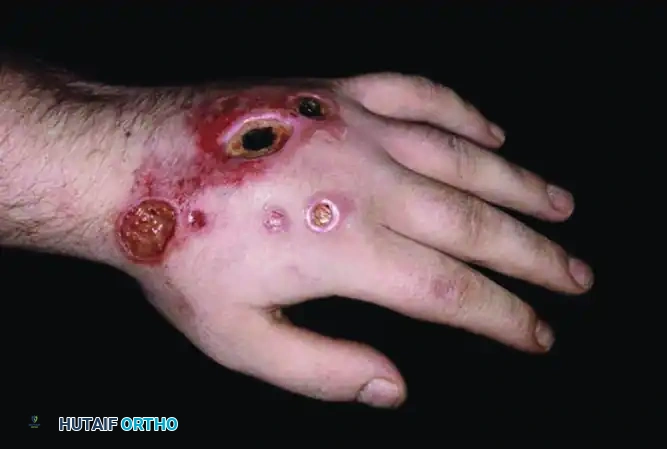
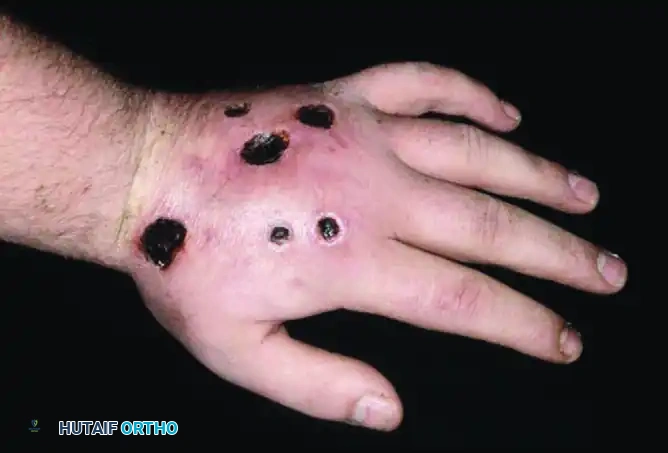
FIGURE 70-16 A: A 22-year-old man who developed severe, geometrically distinct lesions that would not heal after trivial trauma at work. The unnatural, punched-out appearance of these wounds is highly suspicious for self-inflicted thermal injury (presumed cigarette burns).
Clinical Phenotypes and Diagnostic Overlap
The clinical manifestations of factitious hand syndromes are limited only by the patient's imagination and tolerance for pain. Secretan syndrome, originally described in 1901 as "hard edema" of the dorsum of the hand, is now widely recognized in many instances as a factitious disorder induced by repetitive blunt trauma or the covert use of a proximal tourniquet. Patients may also present with factitious ulcerations characterized by geometric, unnatural borders that defy dermatomal or vascular distributions, often resulting from chemical applications, repetitive excoriation, or thermal injuries. Subcutaneous emphysema, presenting as sudden swelling with palpable crepitus in the absence of penetrating trauma or necrotizing infection, is typically achieved by the patient injecting air into the fascial planes using a hypodermic needle. Distinguishing these factitious presentations from conversion disorder (where symptoms are not consciously produced) and somatic symptom disorder is paramount, as the management paradigm shifts dramatically from purely structural orthopedic reconstruction to a delicate balance of diagnostic exclusion and psychiatric integration.
Detailed Surgical Anatomy and Biomechanics
To effectively diagnose and manage factitious hand syndromes, the orthopedic surgeon must possess an intimate understanding of upper extremity anatomy, specifically focusing on how self-inflicted trauma disrupts normal biomechanical and physiological processes. The pathophysiology of factitious disorders often capitalizes on the unique anatomical vulnerabilities of the hand and wrist. Recognizing these patterns allows the surgeon to differentiate between organic disease and intentional manipulation.
The Venous and Lymphatic Networks
The dorsal aspect of the hand is uniquely susceptible to factitious edema due to its anatomical composition. Unlike the volar skin, which is firmly tethered to the underlying palmar aponeurosis by robust fascial septa, the dorsal skin is highly compliant and overlies a loose areolar connective tissue matrix. This space accommodates the expansive dorsal venous network and the primary lymphatic drainage channels of the digits. When a patient covertly applies a proximal tourniquet (e.g., a rubber band, hair tie, or tight string around the forearm or wrist), they selectively occlude the low-pressure venous and lymphatic return while allowing the high-pressure arterial inflow to persist. This hemodynamic mismatch rapidly engorges the dorsal loose areolar tissue, leading to profound, non-pitting, brawny edema. Over time, the protein-rich lymphatic fluid incites a severe inflammatory cascade, resulting in peritendinous fibrosis around the extensor digitorum communis tendons—the hallmark of factitious Secretan syndrome.
Fascial Spaces and Foreign Body Injections
Patients who self-inject foreign substances (e.g., saliva, feces, paint thinner, or particulate matter) frequently utilize the easily accessible subcutaneous spaces or the synovial sheaths of the hand. The anatomy of the flexor tendon sheaths and the deep fascial spaces (thenar, midpalmar, and Parona's space) dictates the proximal spread of these factitious infections. A patient injecting contaminated material into the index finger flexor sheath will present with Kanavel's signs localized to that digit. However, an injection into the small finger or thumb may rapidly track proximally into the radial or ulnar bursae, crossing the carpal tunnel into Parona's space in the distal forearm. The orthopedic surgeon must recognize that the chemical necrosis and polymicrobial suppuration resulting from these injections do not respect normal anatomical boundaries, often requiring extensile exposures that traverse multiple zones of the hand and forearm to achieve adequate source control.
Biomechanics of Factitious Contractures
Factitious deformities, such as the clenched-fist syndrome or psycho-flexed hand, present a profound biomechanical anomaly. In organic contractures (e.g., Dupuytren's disease, ischemic contracture, or spasticity), there is a definable anatomical or neurological etiology driving the imbalance between the intrinsic and extrinsic musculature. In factitious clenched-fist syndrome, the patient consciously or subconsciously co-contracts the extrinsic flexors (flexor digitorum profundus and superficialis) and the intrinsic muscles, overpowering the extensor mechanism. Prolonged maintenance of this abnormal posture leads to secondary organic changes: the volar plates of the metacarpophalangeal (MCP) and proximal interphalangeal (PIP) joints become rigidly contracted, the collateral ligaments shorten, and the articular cartilage may undergo pressure necrosis. Attempting to passively correct these deformities often elicits paradoxical resistance from the patient, a clinical sign that should immediately raise suspicion for a non-organic etiology.
Exhaustive Indications and Contraindications
The decision-making process in factitious hand syndromes is inherently paradoxical. In traditional orthopedic surgery, the identification of a structural deficit or non-healing wound is an absolute indication for reconstructive intervention. In factitious disorders, however, definitive surgical reconstruction is almost universally contraindicated until the underlying psychiatric pathology is stabilized. The surgeon's role is strictly limited to diagnostic confirmation, prevention of iatrogenic harm, and the emergent management of limb-threatening or life-threatening complications.
Indications for Intervention
Intervention in factitious hand syndromes is categorized into two distinct pathways: diagnostic procedures (primarily casting) and emergent complication management. Diagnostic casting is indicated when there is a high index of suspicion for factitious edema, non-healing geometric wounds, or unexplained contractures that have failed to respond to standard outpatient therapy. Emergent surgical debridement is indicated for the sequelae of self-mutilation, including deep space infections, septic arthritis, compartment syndrome secondary to massive fluid injection, and the presence of necrotizing soft tissue infections.
Contraindications to Surgery
The absolute contraindications in factitious hand syndromes revolve around definitive, complex reconstructive procedures. Performing a free tissue transfer, pedicled flap, tendon graft, or nerve reconstruction in a patient with an active, unmanaged factitious disorder is a violation of the "do no harm" principle. These patients will invariably sabotage the reconstruction, leading to catastrophic flap failure, deep space infection, and further loss of limb function.
| Intervention Category | Strict Indications | Absolute Contraindications | Relative Contraindications |
|---|---|---|---|
| Diagnostic Casting | Unexplained chronic dorsal edema; geometric non-healing ulcers; suspected clenched-fist syndrome; wounds that heal under dressings but break down when exposed. | Active necrotizing infection requiring immediate debridement; uncompensated compartment syndrome. | Severe claustrophobia; documented allergy to casting materials (requires alternative rigid splinting). |
| Operative Debridement | Purulent tenosynovitis; septic arthritis; deep fascial space abscesses; injection of caustic/toxic chemicals; necrotizing fasciitis. | Clean, non-infected factitious ulcers (these should be managed with diagnostic casting). | Superficial excoriations without signs of deep tissue involvement. |
| Complex Reconstruction | ONLY indicated after prolonged, documented psychiatric remission and multidisciplinary clearance (exceedingly rare). | Active factitious disorder; ongoing wound manipulation; hostile/self-mutilating psychological profile. | Emotionally dependent profile currently undergoing early phases of psychotherapy. |
| Amputation/Revision | Irreversible, life-threatening sepsis; unsalvageable necrotic limb secondary to prolonged covert tourniquet. | Patient requests amputation for bizarre, non-organic pain or minor deformities. | Replantation of self-amputated digits (highly controversial, generally contraindicated due to sabotage risk). |
Pre-Operative Planning, Templating, and Patient Positioning
Pre-operative planning for a patient with a suspected factitious hand syndrome requires a fundamental shift in the surgeon's mindset. The preparation is less about templating hardware or designing flap geometry, and more about exhaustive investigative work, meticulous documentation, and strategic multidisciplinary coordination. The orthopedic surgeon must act as a medical detective, compiling a comprehensive timeline of the patient's presentation to identify inconsistencies that hallmark the disease.
The "Chart Biopsy" and Diagnostic Workup
Before any physical intervention, an exhaustive review of the patient's medical records—often termed a "chart biopsy"—is mandatory. Patients with factitious disorders are frequently "wandering patients" (Munchausen syndrome) who traverse multiple hospital systems, accumulating vast, fragmented medical records. The surgeon must meticulously rule out organic etiologies that can mimic factitious presentations. This includes a comprehensive rheumatologic panel to exclude atypical inflammatory arthropathies, vascular studies (arterial and venous duplex ultrasound) to rule out thoracic outlet syndrome or deep vein thrombosis, and electromyography/nerve conduction studies (EMG/NCS) to evaluate for peripheral neuropathies or complex regional pain syndrome (CRPS). Only when the organic workup is exhaustively negative, yet the severe pathology persists, should the diagnostic casting protocol or psychiatric confrontation be initiated.
Planning for Diagnostic Casting
When planning for diagnostic casting, the surgeon must anticipate the patient's attempts to defeat the intervention. The cast cannot merely be a standard immobilization device; it must be a tamper-proof fortress. Templating involves deciding the extent of the cast. For unexplained hand edema, a short-arm cast is insufficient, as the patient will simply apply a tourniquet proximal to the cast edge, continuing to induce distal swelling. Therefore, a long-arm cast extending proximal to the elbow is mandatory. The surgeon must also plan the materials: fiberglass is strictly preferred over plaster of Paris due to its superior tensile strength and resistance to patient manipulation or water degradation.
Patient Positioning and Operating Room Setup
For patients requiring emergent surgical debridement of factitious infections or chemical injections, standard upper extremity positioning is utilized. The patient is positioned supine with the affected extremity extended on a radiolucent hand table. A pneumatic tourniquet is placed proximally on the brachium, but the surgeon must be cautious; if the patient has been applying covert tourniquets, the underlying tissues may already be ischemic, and prolonged intraoperative tourniquet time should be minimized. The operating room must be prepared for extensile exposures, requiring a full hand and micro-instrumentation set, copious volumes of pulsatile lavage, and diverse culture swabs (aerobic, anaerobic, fungal, and mycobacterial), given the bizarre nature of self-injected contaminants.
Step-by-Step Surgical Approach and Fixation Technique
In the context of factitious hand syndromes, the "surgical approach" primarily refers to two distinct procedural interventions: the application of the Diagnostic Casting Protocol (the gold standard for diagnosis and non-operative management) and the Radical Debridement of factitious deep space infections. Both require meticulous technique and a heightened awareness of the patient's underlying pathology.
Technique 1: The Diagnostic Casting Protocol
The diagnostic cast serves a dual purpose: it acts as an impenetrable physical barrier preventing the patient from manipulating their tissues, and it provides a controlled, unassailable environment to observe the natural physiological healing process.
- Wound Preparation and Debridement: If open, non-healing lesions are present, perform a gentle, sharp bedside debridement of any fibrinous exudate or necrotic tissue to establish a clean wound bed. Apply a non-adherent, antimicrobial dressing, such as silver-impregnated gauze or Xeroform, directly over the lesions.
- Padding and Protection: Apply generous layers of synthetic cast padding. This is a critical step; patients with factitious disorders may intentionally shove objects (e.g., coat hangers, pens) down the cast to create new iatrogenic pressure sores. Extra padding must be placed over vulnerable bony prominences, including the ulnar styloid, radial styloid, and metacarpal heads.
- Positioning: The hand must be immobilized in the intrinsic-plus (safe) position to prevent secondary organic contractures of the collateral ligaments. The wrist is extended 20 to 30 degrees, the MCP joints are flexed 70 to 90 degrees, and the IP joints are fully extended. The thumb is positioned in palmar abduction.
- Application of Rigid Fiberglass: Apply multiple layers of fiberglass casting tape. The cast must extend from the fingertips to the proximal third of the humerus (long-arm cast) to prevent the covert application of proximal constricting bands. The fingertips should be enclosed if wound manipulation of the digits is suspected, leaving only a small window for capillary refill assessment if necessary.
- Tamper-Evident Measures: This is the most vital step of the procedure. The surgeon must implement tamper-evident markings to ensure the cast's integrity. Draw a continuous, complex line across the cast using a permanent marker, or apply a specific, unique pattern of colored fiberglass tape. If the patient attempts to bivalve, remove, and replace the cast, the lines will fail to align perfectly, providing undeniable proof of manipulation.
FIGURE 70-16 B: The same 22-year-old man from Figure A. The lesions demonstrated significant regression and healing under strict cast immobilization. However, the wounds reappeared shortly after cast removal, confirming the diagnosis of a factitious disorder.
Technique 2: Radical Debridement for Factitious Infection
When a patient presents with a deep space infection or compartment syndrome secondary to the injection of foreign materials (e.g., feces, human saliva, paint thinner), emergent surgical debridement is required to prevent limb loss or systemic sepsis.
- Extensile Incisions: Utilize standard, extensile surgical approaches. Brunner zigzag incisions are employed for the volar digits to prevent flexion contractures, while dorsal longitudinal incisions are used for the metacarpals and wrist.
- Identification and Excision of Necrotic Tissue: The surgeon must aggressively excise all necrotic skin, subcutaneous tissue, and devitalized fascia. In cases of chemical injection (e.g., paint thinner), the necrosis may extend far beyond the initial puncture site, tracking along the flexor tendon sheaths into Parona's space. The transverse carpal ligament may need to be released to debride the carpal tunnel thoroughly.
- Copious Irrigation and Culturing: Obtain deep tissue cultures immediately upon entering the infected space. Factitious infections often yield bizarre, polymicrobial flora, including Eikenella corrodens (from self-injected human saliva) or enteric gram-negative rods (from feces). Following culture acquisition, utilize copious pulsatile lavage (frequently exceeding 6 to 9 liters of normal saline) to mechanically clear particulate matter and reduce the bacterial bioburden.
- Wound Management: The wounds must absolutely be left open. Primary closure in the setting of a factitious infection is a recipe for disaster. Negative pressure wound therapy (NPWT) can be utilized to manage exudate and promote granulation, but only if the patient is under strict, continuous psychiatric observation (e.g., a 1:1 sitter), as they may tamper with the sponge or tubing. Otherwise, a bulky, rigid, tamper-proof dressing must be applied.
Complications, Incidence Rates, and Salvage Management
The complication profile of factitious hand syndromes is unique in that the primary morbidity is often self-inflicted, but the most devastating long-term outcomes are frequently iatrogenic—resulting from the well-intentioned but misguided interventions of the surgical team. The incidence of complications is exceptionally high, particularly in the "Angry, Hostile, and Self-Mutilating" cohort, where the drive to destroy tissue supersedes any instinct for self-preservation.
Iatrogenic and Surgical Complications
The most tragic complications occur when a surgeon fails to recognize the factitious nature of the disorder and proceeds with complex reconstruction. Attempting a pedicled groin flap, cross-finger flap, or free tissue transfer to cover a factitious ulcer will almost certainly result in the patient avulsing the flap, injecting toxic substances into the vascular pedicle, or applying a tourniquet to induce flap necrosis. The incidence of flap failure in active factitious disorders approaches 100%. Furthermore, repeated unnecessary surgical explorations (e.g., multiple carpal tunnel releases for non-organic pain) lead to severe perineural fibrosis, chronic regional pain syndrome (CRPS), and irreversible loss of hand function.
Disease-Specific Complications
The natural history of unmanaged factitious hand syndromes is grim. Chronic, covert tourniquet application leads to irreversible lymphatic damage, resulting in permanent elephantiasis-like changes to the upper extremity. Repeated injections into the joint spaces cause fulminant septic arthritis, rapidly progressing to osteomyelitis and total joint destruction. In the most severe cases, patients may present with self-induced amputations of digits or the entire hand. Replantation in these scenarios is highly controversial; most authoritative guidelines consider self-amputation an absolute contraindication to replantation due to the near-certainty of postoperative sabotage and the high risk of life-threatening sepsis.
| Complication | Estimated Incidence in Factitious Cohort | Etiology / Mechanism | Salvage Management & Mitigation Strategy |
|---|---|---|---|
| Iatrogenic Flap Failure | > 90% (if attempted during active phase) | Patient sabotage (avulsion, injection of pedicle, covert tourniquet). | Immediate debridement of necrotic flap; apply diagnostic cast; strictly avoid further complex reconstruction; heal by secondary intention. |
| Irreversible Joint Contracture | 40 - 60% (Clenched-fist syndrome) | Prolonged abnormal posturing leading to volar plate and collateral ligament fibrosis. | Serial casting under anesthesia; extensive hand therapy; surgical release ONLY if psychiatric remission is definitively established. |
| Refractory Osteomyelitis | 20 - 30% | Repeated self-injection of contaminated material (feces, saliva) into deep spaces. | Radical bone debridement; placement of antibiotic spacers; long-term IV antibiotics; potential ray amputation if source control fails. |
| Iatrogenic Pressure Sores | 10 - 15% | Patient intentionally shoves foreign objects down the diagnostic cast. | Bivalve cast to inspect; treat ulcers locally; reapply new cast with enhanced padding and stricter tamper-evident markings. |
| Self-Amputation | < 5% (Highest in psychotic/hostile profiles) | Direct mechanical destruction or prolonged, severe tourniquet ischemia. | Revision amputation to achieve clean margins; psychiatric admission; strictly avoid replantation attempts. |
Phased Post-Operative Rehabilitation Protocols
The management of factitious hand syndromes extends far beyond the operating room or the casting bay. It requires a highly coordinated, multidisciplinary paradigm involving orthopedic surgery, psychiatry, clinical psychology, and specialized hand therapy. The rehabilitation protocol is less about physical tissue remodeling and more about psychological reintegration and the delicate management of the patient's psyche.
Phase I: The Confrontation Dilemma and Cast Immobilization
Once the diagnosis is confirmed—typically when a chronic wound miraculously heals inside a tamper-proof cast, only to recur immediately upon cast removal—the medical team faces the "Confrontation Dilemma." Historically, surgeons would directly accuse the patient of self-harm. This confrontational approach is now considered obsolete and counterproductive; it almost universally leads to anger, vehement denial, and the patient abruptly leaving against medical advice (AMA) to seek care from another unsuspecting surgeon, perpetuating the cycle of morbidity.
The currently favored, evidence-based approach is the "Non-Confrontational" or "Face-Saving" strategy. The diagnosis is presented as a subconscious or stress-related condition. The surgeon might state: "The cast proved that your body has a remarkable, perfect ability to heal when it is protected. However, it seems that severe stress or subconscious habits during your sleep are causing the wounds to return when the cast is off. To help your body continue to heal, we are going to involve a stress-management specialist to work alongside us." This approach allows the patient to accept psychiatric help without the devastating humiliation of being "caught," preserving the therapeutic alliance.
Phase II: Supervised Mobilization and Hand Therapy
Hand therapy must be prescribed with extreme caution and clear communication between the surgeon and the therapist. The occupational or physical therapist serves as the "eyes and ears" of the surgical team, as they spend significantly more time with the patient and are often the first to notice inconsistencies in the patient's presentation or signs of recurrent self-mutilation.
Therapy sessions should focus on objective, measurable goals rather than subjective pain reports. Therapists should utilize tools like the Jamar dynamometer to assess grip strength, looking for the classic "bell-shaped curve" of submaximal, inconsistent effort that is often seen in factitious and conversion disorders. Passive range of motion exercises are critical for preventing organic contractures in patients with clenched-fist syndromes. Crucially, the therapist must never leave the patient unattended with sharp instruments, splinting materials, or chemicals that could be used for self-harm.
Phase III: Long-Term Psychiatric Integration
The ultimate prognosis for factitious hand syndromes remains guarded and is entirely dependent on the success of psychiatric intervention. The orthopedic surgeon must transition from the primary provider to a supportive role, managing only the organic sequelae of the disease while the psychiatrist addresses the root cause. While the emotionally dependent cohort may achieve long-term remission with intensive psychotherapy, cognitive-behavioral therapy (CBT), and behavioral modification, the hostile/self-mutilating cohort frequently progresses to severe, irreversible disability. The orthopedic surgeon's primary goal throughout this arduous process is to adhere strictly to the Hippocratic oath: "First, do no harm." By avoiding unnecessary surgery, managing acute infectious complications, and gently guiding the patient toward definitive psychiatric care, the surgeon provides the highest standard of care for this incredibly challenging patient population.
Summary of Landmark Literature and Clinical Guidelines
The orthopedic management of factitious hand syndromes is built upon a foundation of historical observations and modern psychiatric-surgical integration. Familiarity with this landmark literature is essential for board examinations and clinical mastery.
- Secretan, M. (1901): Authored the original description of "hard edema" of the dorsum of the hand. While Secretan initially attributed this to post-traumatic peritendinous fibrosis, modern literature (including works by Smith and others in the 1970s) reclassified the vast majority of these cases as factitious in origin, typically secondary to covert tourniquet application or self-inflicted blunt trauma.
- Louis, D. S., & Lamp, M. K. (1984): Published seminal work on the "Clenched Fist Syndrome." They detailed the biomechanical impossibility of the deformity without active patient co-contraction and highlighted the paradoxical resistance encountered during passive extension. Their work established the standard for conservative management and the avoidance of surgical release in these patients.
- Grunert, B. K., et al. (1991): Provided the definitive psychological and physical classification system for factitious hand disorders. By utilizing the MMPI, Grunert successfully stratified patients into the "Emotionally Dependent" and "Hostile/Self-Mutilating" cohorts, providing orthopedic surgeons with a predictive tool for treatment outcomes and the risk of iatrogenic complications.
- Phelps, D. B., et al. (1977): Authored critical guidelines on the diagnostic casting protocol. Their work demonstrated that rigid, tamper-proof immobilization is the most definitive diagnostic tool available to the orthopedic surgeon, effectively differentiating organic non-healing wounds from active factitious manipulation.
- Current Clinical Guidelines (ASSH / AAOS): Modern guidelines strongly emphasize the multidisciplinary approach. They universally condemn direct, hostile confrontation of the patient and explicitly contraindicate complex reconstructive procedures (e.g., free flaps, replantation of self-amputated digits) in the setting of an active, unmanaged factitious disorder. The focus remains steadfast on diagnostic exclusion, complication management, and psychiatric referral via the face-saving technique.
This academic synthesis is based on established protocols from Hutaifortho's Operative Orthopaedics and has been medically reviewed by Prof. Dr. Mohammed Hutaif, Consultant Orthopedic & Spine Surgeon. It is designed to assist orthopedic residents, fellows, and practicing surgeons in surgical preparation and board reviews (AAOS, FRCS, Arab Board).
