PIP Joint Dislocations: Comprehensive Guide to Anatomy, Biomechanics & Management
Key Takeaway
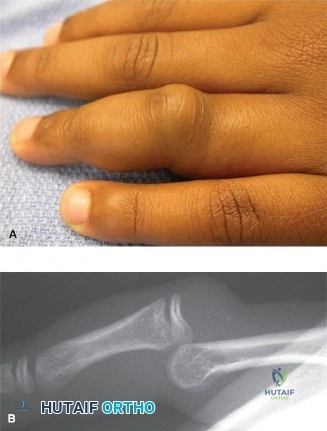
PIP joint dislocations are common hand injuries, often from sports. These finger joint dislocations involve disruption to static stabilizers like the volar plate and collateral ligaments, and dynamic tendons. Biomechanics differ: dorsal (hyperextension, volar plate rupture) is most common, while palmar, lateral, and rotatory types result from distinct forces.
A 28-year-old rugby player presents to the Emergency Department following a hyperextension injury to his index finger. He complains of pain and swelling at the PIP joint. Radiographs show a dorsal subluxation of the middle phalanx relative to the proximal phalanx with a small (<20%) avulsion fragment of the volar base. After successful closed reduction, you assess the joint. What are your criteria for deciding between continuing non-operative management versus proceeding to surgery?
Candidate: I would assess the joint's stability through a full arc of motion. If it is stable throughout the functional arc—typically between 30 and 70 degrees of flexion—I would treat it non-operatively with a dorsal blocking splint. Surgery is indicated if the joint remains unstable after reduction, if the avulsion fragment is large, or if the dislocation is irreducible.
Failing to emphasize the "stable arc of motion." Many candidates simply say "if it's stable," without defining what that means in the context of a PIP joint. Additionally, failing to mention the size of the avulsion fragment (the "20-30% rule") indicates a lack of clinical precision required at the FRCS level.
The decision is based on a dynamic assessment of stability post-reduction. I define 'stable' as a joint that does not subluxate through a functional arc of 30° to 70° of flexion.
Non-operative: Indicated if the joint is stable through this arc, with a small (<20-30%) volar lip avulsion.
Operative: Indicated if:
1. There is persistent instability (re-subluxation) within the functional arc.
2. The avulsion fragment is >30% of the articular surface (impacting stability).
3. The joint is irreducible due to soft tissue (volar plate) interposition.
I would use a dorsal blocking splint for conservative management and consider ORIF or volar plate arthroplasty if unstable.
You are performing surgery for a chronic, unstable dorsal PIP fracture-dislocation. You have decided that the articular surface loss is too great for simple fixation. What salvage procedure might you consider to restore stability and joint surface, and what graft is commonly used?
Candidate: For a chronic, large articular defect where the joint is unstable, I would consider a hemi-hamate arthroplasty. This procedure uses a bone graft harvested from the hamate to reconstruct the missing volar lip of the middle phalanx, providing both a stable base and an articular surface.
Struggling to name specific advanced reconstructive techniques. Some candidates suggest simple fusion or arthrodesis immediately, missing the opportunity to discuss joint-preserving procedures like the hemi-hamate autograft.
In cases of significant volar lip bone loss where the joint is chronically unstable or incongruent, the hemi-hamate autograft arthroplasty is the gold standard for joint preservation. The volar articular surface of the hamate serves as an excellent anatomical match for the base of the middle phalanx due to its similar curvature. The graft is fixed with screws to the middle phalanx, restoring the congruent articular surface and re-anchoring the volar plate to prevent future dorsal subluxation.
