Orthopedic Anatomy 2026 MCQs: Board Review Questions & Answers (Part 1)
Key Takeaway
Your ultimate guide to Orthopedic Anatomy 2026 MCQs: Board Review Questions & Answers (Part 1) starts here. Top-rated Orthopedic Anatomy 2026 MCQs bank. Practice with clinical case questions, orthopedic surgery board review, and evidence-based answers updated for 2026.
Orthopedic Anatomy 2026 MCQs: Board Review Questions & Answers (Part 1)
Comprehensive 100-Question Exam
00:00
Start Quiz
Question 1
A patient has right shoulder pain. Figure 1a shows a gadolinium-enhanced transverse MRI scan at the level of the coracoid. Figure 1b shows an arthroscopic view of the anterior structures from a posterior portal. These images reveal which of the following findings?
Explanation
Question 2
What muscle attaches to the site shown by the arrow in Figure 2?
Explanation
Question 3
Figures 3a and 3b show the inversion stress radiographs of a patient's ankle. What is the most likely ligament injury pattern?
Explanation
Question 4
Posterior sternoclavicular dislocations are most commonly associated with which of the following complications?
Explanation
Question 5
An AP radiograph of the pelvis is shown in Figure 4. What muscle attaches to the avulsed fragment of bone identified by the arrow?
Explanation
Question 6
A patient with an acromioclavicular dislocation has a very prominent distal clavicle. Examination reveals that the deformity increases rather than reduces with an isometric shoulder shrug. Which of the following structures is most likely intact?
Explanation
Question 7
Figures 5a and 5b show axial and coronal MRI images of the left ankle of a patient with lateral ankle pain. What is the most likely diagnosis?
Explanation
Question 8
Which of the following anatomic structures is often difficult to visualize during elbow arthroscopy?
Explanation
Question 9
The quadrilateral space in the shoulder contains which of the following structures?
Explanation
Question 10
Based on the MRI scan shown in Figure 6, the abnormal signal is seen in what carpal bone?
Explanation
Question 11
The recurrent motor branch of the median nerve innervates which of the following muscles?
Explanation
Question 12
Which of the following nerves innervates the muscle that originates from the middle third of the dorsal surface of the lateral border of the scapula, as shown in Figure 7?
Explanation
Question 13
Based on the MR arthrogram of the elbow shown in Figure 8, which of the following structures is torn?
Explanation
Question 14
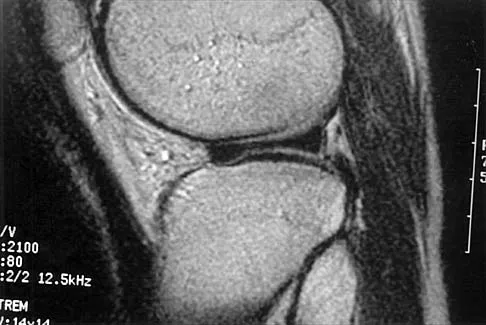
A 26-year-old man has recurrent right knee pain. Figures 9a and 9b show consecutive sagittal T2-weighted MRI scans, and Figure 9c shows a coronal T1-weighted MRI scan. What is the most likely diagnosis?
Explanation
Question 15
The gluteus maximus is innervated by which of the following nerves?
Explanation
Question 16
The dorsal (Thompson) approach to the proximal forearm uses which of the following intermuscular intervals?
Explanation
Question 17
A 45-year-old man who smokes reports the rapid onset of color changes and coolness in the fingers. Examination shows an abnormal Allen test. Plain radiographs of the hand and wrist are normal. Which of the following studies will best aid in diagnosis?
Explanation
Question 18
A purulent flexor tenosynovitis of the thumb may communicate with the small finger flexor through which of the following structures?
Explanation
Question 19
Which of the following nerves travels with the deep palmar arch?
Explanation
Question 20
Figures 10a through 10c show the plain radiograph and MRI scans of a 41-year-old man who has right hip pain. What is the most likely diagnosis?
Explanation
Question 21
Figure 11 shows the anatomic dissection of the medial side of the knee joint after removal of the superficial fascia. The arrow is pointing to what structure?
Explanation
Question 22
Figure 12 shows a lateral radiograph of the elbow. What is the most likely diagnosis?
Explanation
Question 23
Which of the following nerves is most likely responsible for symptoms associated with plantar fasciitis?
Explanation
Question 24
A 16-year-old cheerleader reports an ache in the right shoulder and arm that is worse after activity. She denies any history of acute trauma. Examination reveals a positive sulcus sign and an AP glide test with a posterior and anterior apprehension sign. To confirm a diagnosis of multidirectional instability, which of the following imaging studies is most appropriate?
Explanation
Question 25
Which of the following findings is seen in the chest radiograph shown in Figure 13?
Explanation
Question 26
In the anterior approach to the hip (Smith-Petersen), the superficial surgical interval relies on an internervous plane. Which of the following describes the innervation of the muscles defining this plane?
Explanation
Question 27
A 35-year-old overhead athlete presents with posterior shoulder pain and weakness in external rotation. An MRI shows atrophy of the teres minor. Entrapment of a nerve in the quadrilateral space is suspected. Which of the following structures forms the superior border of this space?
Explanation
Question 28
During reconstruction of the posterolateral corner (PLC) of the knee, identifying the insertion of the popliteofibular ligament is critical. To which specific anatomical aspect of the fibula does this ligament attach?
Explanation
Question 29
A patient undergoes open carpal tunnel release. Postoperatively, they exhibit profound weakness in thumb opposition but normal thumb interphalangeal joint flexion. The recurrent motor branch of the median nerve was likely injured. This branch typically enters the thenar musculature via which of the following variations?
Explanation
Question 30
A patient presents with acquired adult flatfoot deformity resulting from posterior tibial tendon insufficiency. The secondary static stabilizer of the medial longitudinal arch is often attenuated. Which of the following bands of the calcaneonavicular (spring) ligament complex is the strongest and most critical for arch support?
Explanation
Question 31
A 24-year-old gymnast sustains a traumatic tear of the triangular fibrocartilage complex (TFCC). Arthroscopy reveals a tear in the central articular disc. What is the healing potential of this specific region, and what is its vascular supply?
Explanation
Question 32
When placing C2 pedicle screws during posterior cervical fusion, the trajectory must avoid the vertebral foramen. At the C2 level, what is the typical anatomical relationship of the vertebral artery to the pedicle/pars?
Explanation
Question 33
A patient develops posterolateral rotatory instability (PLRI) of the elbow following a dislocation. The primary deficient structure originates on the lateral epicondyle and inserts on which of the following structures?
Explanation
Question 34
During an anterolateral approach to the distal tibia, the superficial peroneal nerve is at risk. At what average distance proximal to the lateral malleolus does this nerve pierce the crural fascia to become subcutaneous?
Explanation
Question 35
During the ilioinguinal approach to the acetabulum, severe bleeding occurs over the superior pubic ramus near the symphysis. This is most likely due to an injury to the "corona mortis," which is an anastomosis between which of the following vessel systems?
Explanation
Question 36
An elderly patient sustains a displaced femoral neck fracture, risking avascular necrosis. The primary blood supply to the adult femoral head is derived from the lateral epiphyseal artery. This vessel is a terminal branch of which artery?
Explanation
Question 37
A weightlifter tears his pectoralis major tendon at its insertion. Surgical repair is planned. Which of the following accurately describes the anatomy of the pectoralis major tendon insertion on the humerus?
Explanation
Question 38
A patient develops compartment syndrome of the lower leg. The surgeon performs a dual-incision four-compartment fasciotomy. Which of the following nerves is located within the deep posterior compartment?
Explanation
Question 39
The scaphoid bone is highly susceptible to nonunion following a fracture due to its unique intraosseous blood supply. The major blood supply enters the scaphoid through its dorsal ridge and is a branch of which artery?
Explanation
Question 40
A patient presents with inability to form an "OK" sign with their thumb and index finger, but they have no sensory deficits in the hand. Compression of the anterior interosseous nerve (AIN) is suspected. Which of the following muscles is uniquely innervated by the AIN?
Explanation
Question 41
A patient sustains a midfoot crush injury. Radiographs show widening of the space between the first and second metatarsals. The Lisfranc ligament is likely ruptured. What are the specific osseous attachments of this ligament?
Explanation
Question 42
During arthroscopic meniscectomy, understanding the differences between the medial and lateral menisci is crucial to avoid complications. Which of the following is a characteristic feature of the lateral meniscus compared to the medial meniscus?
Explanation
Question 43
A patient complains of deep gluteal pain radiating down the posterior thigh. MRI shows no lumbar disc herniation. The patient has a known anatomic variation where a portion of the sciatic nerve pierces the piriformis muscle. Which component of the nerve typically pierces the muscle in this variant?
Explanation
Question 44
A 45-year-old man presents with severe radicular pain radiating down the anterior aspect of his right thigh to the knee, accompanied by weakness in knee extension. An MRI reveals a far lateral (extraforaminal) disc herniation at the L3-L4 level. Which nerve root is most likely compressed?
Explanation
Question 45
A volleyball player presents with painless weakness in external rotation of the shoulder. Examination reveals atrophy isolated to the infraspinatus fossa. An MRI demonstrates a paralabral cyst. Where is the cyst most likely located to cause this specific presentation?
Explanation
Question 46
A 28-year-old overhead athlete presents with poorly localized posterior shoulder pain and paresthesias over the lateral deltoid. MRI reveals isolated atrophy of the teres minor. Which anatomic structures form the boundaries of the space where the affected nerve is most likely compressed?
Explanation
Question 47
During surgical reconstruction of the posterolateral corner (PLC) of the knee, the surgeon isolates the popliteofibular ligament. Which of the following accurately describes its true anatomic attachments?
Explanation
Question 48
During a posterior approach to the hip for total hip arthroplasty, the surgeon meticulously manages the short external rotators. Which tendon, if left intact, directly protects the deep branch of the medial femoral circumflex artery from iatrogenic injury?
Explanation
Question 49
A 45-year-old woman presents with dorsal radial wrist pain. Physical examination reveals tenderness just distal to Lister's tubercle. Ultrasound confirms tenosynovitis of the third extensor compartment. Which of the following muscles acts as the primary motor for the tendon located in this compartment?
Explanation
Question 50
When placing an iliosacral screw into the S1 vertebral body for pelvic ring fixation, anterior misplacement of the screw out of the sacral ala places which nerve root at greatest risk of direct injury?
Explanation
Question 51
A patient undergoes a tarsal tunnel release. The surgeon makes a curved incision posterior to the medial malleolus. Proceeding strictly from anterior to posterior, what is the correct anatomical order of the structures encountered beneath the flexor retinaculum?
Explanation
Question 52
During an anterior (Henry) approach to the diaphyseal radius, the supinator is reflected to expose the bone. Deep in the proximal forearm, the anterior interosseous nerve (AIN) is identified running alongside the anterior interosseous artery. From which parent vessel does the anterior interosseous artery directly branch?
Explanation
Question 53
A 32-year-old man presents with chronic elbow instability. Examination reveals apprehension during supination, valgus stress, and axial loading of the elbow. Which structure is most likely deficient, and what is its normal anatomic insertion site?
Explanation
Question 54
A 35-year-old professional volleyball player presents with painless shoulder weakness. Examination reveals isolated profound atrophy of the infraspinatus with completely preserved supraspinatus muscle bulk. Where is the most likely anatomic site of nerve entrapment?
Explanation
Question 55
During an ilioinguinal approach for an anterior column acetabular fracture, vigorous arterial bleeding is encountered when dissecting over the superior pubic ramus. This bleeding most likely originates from an anastomosis between which two vascular systems?
Explanation
Question 56
The distal tibiofibular syndesmosis provides critical structural stability to the ankle mortise. Which of its component ligaments is biomechanically the strongest and provides the greatest resistance to lateral displacement of the fibula?
Explanation
Question 57
During surgical exploration for a complex flexor tendon laceration in zone II of the index finger, the surgeon must vent some pulleys to facilitate tendon glide. Which annular pulleys are considered the most critical to preserve or reconstruct to prevent significant bowstringing?
Explanation
Question 58
In a 12-year-old boy undergoing in situ pinning for a slipped capital femoral epiphysis (SCFE), the surgeon must avoid the terminal branches of the medial femoral circumflex artery. These crucial retinacular vessels typically penetrate the proximal femur at which anatomic location?
Explanation
Question 59
A 35-year-old male is undergoing open reduction and internal fixation of a capitellum fracture using the Kocher approach. To safely access the joint and protect the posterior interosseous nerve (PIN), the dissection must utilize which of the following internervous planes?
Explanation
Question 60
A 72-year-old female sustains a displaced femoral neck fracture. Which of the following arterial structures provides the primary blood supply to the adult femoral head and is most at risk of disruption in this injury?
Explanation
Question 61
A 28-year-old overhead athlete presents with vague posterior shoulder pain and numbness over the lateral deltoid. MRI reveals severe isolated atrophy of the teres minor. Which of the following neurovascular bundles is most likely compressed in the quadrilateral space?
Explanation
Question 62
During a primary total hip arthroplasty using the direct anterior (Smith-Petersen) approach, the surgeon exploits an internervous plane between two muscles. Which of the following accurately describes this plane?
Explanation
Question 63
A 45-year-old avid cyclist presents with intrinsic muscle weakness and numbness in his ring and small fingers. He is diagnosed with handlebar palsy due to compression in Guyon's canal. Which of the following structures forms the anatomic roof of this canal?
Explanation
Question 64
While performing a tarsal tunnel release, the surgeon identifies the structures passing posterior to the medial malleolus. What anatomical structure is located immediately posterior to the flexor digitorum longus (FDL) tendon?
Explanation
Question 65
During ankle arthroscopy, establishment of the posterolateral portal places a specific neurovascular bundle at highest risk of iatrogenic injury. Which of the following structures is most vulnerable?
Explanation
Question 66
A patient suffers a severe forearm crush injury and subsequently demonstrates an inability to make the 'OK' sign, exhibiting extended distal interphalangeal joints of the thumb and index finger. This specific nerve palsy represents denervation to which muscle group?
Explanation
Question 67
A spinal surgeon is placing L4 pedicle screws for a lumbar fusion. If the right L4 pedicle screw breaches the medial pedicle wall, which neural structure is at greatest immediate risk of injury?
Explanation
Question 68
A 22-year-old soccer player undergoes arthroscopic meniscal repair for a bucket-handle tear. The success of meniscal repair relies heavily on the vascularity of the peripheral rim. The primary blood supply to the peripheral third of the meniscus arises from which vessels?
Explanation
Question 69
Biomechanical understanding of the anterior cruciate ligament (ACL) is critical for anatomic reconstruction. The ACL is divided into the anteromedial (AM) and posterolateral (PL) bundles. During normal knee kinematics, when is the AM bundle tightest?
Explanation
Question 70
When evaluating a posterior cruciate ligament (PCL) injury on MRI, a radiologist must closely inspect its origin and insertion. Which of the following describes the correct anatomic femoral origin of the PCL?
Explanation
Question 71
A trauma surgeon is performing an anterolateral approach to the distal humerus for a complex fracture. Knowledge of the radial nerve's course is crucial. At approximately what distance proximal to the lateral epicondyle does the radial nerve pierce the lateral intermuscular septum to enter the anterior compartment?
Explanation
Question 72
During wrist arthroscopy for triangular fibrocartilage complex (TFCC) evaluation, the standard 3-4 portal is established. This portal is placed between which two extensor tendon compartments?
Explanation
Question 73
During an anterior (Henry) approach to the radius, the surgeon enters the internervous plane in the proximal forearm. Which two nerves innervate the muscles that define this superficial proximal interval?
Explanation
Question 74
A 28-year-old sustains a displaced talar neck fracture. Which of the following blood vessels provides the primary blood supply to the talar body, placing it at high risk for avascular necrosis?
Explanation
Question 75
When reconstructing the posterolateral corner (PLC) of the knee, a surgeon isolates the primary static restraint to varus opening at 30 degrees of knee flexion. What are the origin and insertion of this structure?
Explanation
Question 76
A patient presents with vague posterior shoulder pain and isolated weakness of the teres minor and deltoid. MRI reveals a paralabral cyst compressing structures within the quadrilateral space. Which of the following correctly describes the anatomical borders of this space?
Explanation
Question 77
During flexor tendon repair in Zone II, preservation or reconstruction of the pulley system is crucial to prevent mechanical bowstringing. Which of the following pulleys arise directly from the periosteum of the proximal and middle phalanges, respectively?
Explanation
Question 78
A primary total hip arthroplasty is performed using the direct anterior approach (Smith-Petersen). Which internervous plane is utilized during the superficial dissection of this surgical approach?
Explanation
Question 79
A 32-year-old elite volleyball player presents with isolated weakness in external rotation of the dominant shoulder. Physical examination reveals isolated atrophy of the infraspinatus with no supraspinatus involvement. Where is the most likely location of nerve compression?
Explanation
Question 80
A 45-year-old undergoes an anterolateral approach to the distal tibia for a pilon fracture. During deep dissection, which neurovascular bundle is at risk and must be carefully retracted medially along with the anterior compartment musculature?
Explanation
Question 81
A surgeon is utilizing a direct lateral approach to the fibula for an ORIF of a distal third shaft fracture. The superficial peroneal nerve is at risk as it exits the deep fascia to become subcutaneous. On average, at what distance proximal to the tip of the lateral malleolus does this nerve pierce the crural fascia?
Explanation
Question 82
During a posterior approach to the hip (Kocher-Langenbeck), which two muscles form the interval where the deep branch of the medial circumflex femoral artery is most at risk?
Explanation
Question 83
A patient presents with thenar atrophy and inability to oppose the thumb after suffering a distal radius fracture. The affected nerve most commonly branches from the main nerve at which location relative to the transverse carpal ligament?
Explanation
Question 84
When performing an arthroscopic capsular release for adhesive capsulitis, the axillary nerve is most vulnerable at the 6 o'clock position. Approximately how far is the axillary nerve from the inferior glenoid rim in a standard adult shoulder?
Explanation
Question 85
During a transforaminal endoscopic lumbar discectomy at L4-L5, the surgeon utilizes Kambin's triangle as a safe working zone. Which of the following forms the anterior border of this anatomical safe zone?
Explanation
Question 86
A patient requires reconstruction of the posterolateral corner (PLC) of the knee. Regarding the femoral insertions of these structures, where does the popliteus tendon insert relative to the fibular collateral ligament (FCL)?
Explanation
Question 87
During a medial approach to the midfoot for an accessory navicular excision, a tendinous intersection known as the Master knot of Henry is identified. Which of the following accurately describes the relationship of the tendons at this knot?
Explanation
Question 88
A patient presents with an inability to actively extend the fingers at the metacarpophalangeal joints but maintains normal wrist extension with radial deviation. Entrapment of the affected nerve is most likely to occur at the proximal edge of which muscle?
Explanation
None
