
AAOS & ABOS Basic Science MCQs (Set 3): Bone Biology, Biomechanics & Anatomy Review
Comprehensive 100-Question Exam
00:00
Start Quiz
Question 1
What region of the thoracic curve is most dangerous for pedicle screw insertion while performing a posterior fusion for adolescent idiopathic scoliosis?
Explanation
Question 2
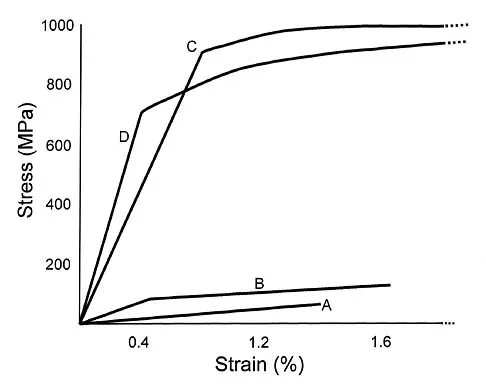
Plots of stress versus strain for four orthopaedic biomaterials are shown in Figure 3. Referring to the figure, what is the correct identification of the curves?
Explanation
Question 3
A 54-year-old woman underwent prophylactic intramedullary fixation for an impending fracture of her right femur secondary to metastatic breast cancer. A bone scan revealed a second lesion in her inferior pubic ramus. Her oncologist has recommended that she receive the intravenous bisphosphonate, zoledronic acid, because the medication would
Explanation
Question 4
What is the known manner in which the growth hormone-insulin-like growth factor-I (GH-IGF-I) system functions to stimulate bone growth?
Explanation
Question 5
During particle-induced osteolysis around implants, what cell secretes most of the interleukin-6 (IL-6)?
Explanation
Question 6
What mechanism is associated with the spontaneous resorption of herniated nucleus pulposus?
Explanation
Question 7
A 68-year-old woman with metastatic breast carcinoma is seen in the emergency department. She appears lethargic, and she reports abdominal pain, nausea, and constipation. An EKG reveals a shortened QT interval. The only physical finding on examination is diffuse hyporeflexia. What is the most appropriate step in management?
Explanation
Question 8
What is the primary role of superficial zone protein (SZP) in articular cartilage?
Explanation
Question 9
Clinical evidence suggests that grafts for replacing a torn anterior cruciate ligament often stretch after surgery. What is the most probable mechanism for this behavior?
Explanation
Question 10
A 60-year-old man with diabetes mellitus is referred for evaluation of nonhealing ulcers of his left foot. Nonsurgical management has failed to provide relief, and a below-the-knee amputation is being considered. Which of the following studies best predicts successful amputation wound healing?
Explanation
Question 11
The wear resistance of ultra-high molecular weight polyethylene can be improved by exposing the polymer to high-energy radiation (eg, gamma or electron beam), followed by a thermal treatment. What is one detrimental side effect of this process?
Explanation
Question 12
Which of the following best characterizes the antigenicity of allograft bone?
Explanation
Question 13
Which of the following clinical disorders is the result of a mutation in fibroblast growth factor recepter 3 (FGFR3)?
Explanation
Question 14
Which of the following best characterizes bone mineralization?
Explanation
Question 15
What is the main mechanism for nutrition of the adult disk?
Explanation
Question 16
A study is conducted to measure the difference in bone mineral density between postmenopausal women taking a drug treatment versus those taking a placebo. What is the most important result to be reported from this study?
Explanation
Question 17
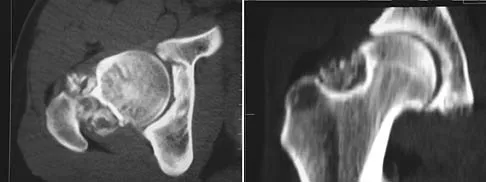
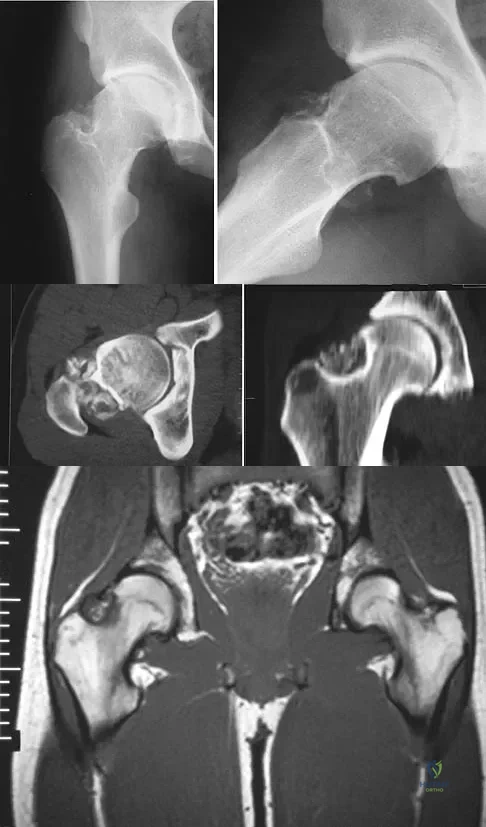
Figures 4a through 4c show the radiographs, CT scans, and T1-weighted MRI scan of a 19-year old man who has had increasing right hip pain and decreasing range of motion for the past several years. He also reports intermittent "locking" of the hip. What is the most likely diagnosis?
Explanation
Question 18
The presence of S100B tumor marker typically corresponds with which of the following as being the most likely source of the metastasis?
Explanation
Question 19
Which of the following accurately describes the biosynthetic materials tricalcium phosphate (TCP) and hydroxyapatite?
Explanation
Question 20
A patient undergoes cartilage implantation requiring amplification of donor cells. Which of the following statements best describes the transplants?
Explanation
Question 21
The load versus deformation curve of the functional spinal unit (FSU) is made up of the neutral zone, the elastic zone, and the plastic zone. What is the plastic zone of the curve believed to represent?
Explanation
Question 22
A knock-out mouse for the Vitamin D receptor has which of the following phenotypes?
Explanation
Question 23
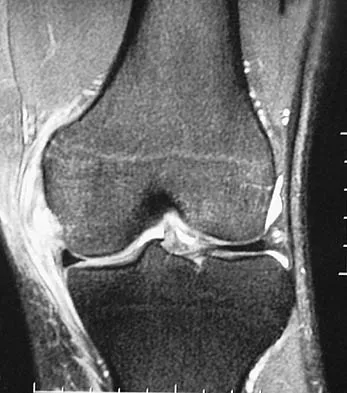
A 30-year-old woman injures her knee while skiing. Based on the MRI scan shown in Figure 5, treatment should consist of
Explanation
Question 24
Intramembranous ossification during fracture repair is characterized by absence of which of the following elements?
Explanation
Question 25
Patients with rheumatoid arthritis may exhibit an increase in viral load for which of the following viruses?
Explanation
Question 26
A mutation in the gene encoding Carbonic Anhydrase II leads to an autosomal recessive form of osteopetrosis. Which of the following best describes the fundamental cellular defect resulting from this mutation?
Explanation
Question 27
In orthopedic biomechanics, bending stiffness of a solid circular implant is proportional to the area moment of inertia. If the radius of a solid intramedullary rod is doubled, the bending stiffness increases by a factor of:
Explanation
Question 28
Sclerostin, a glycoprotein produced primarily by osteocytes, is a critical regulator of bone formation and the target of the monoclonal antibody romosozumab. What is its mechanism of action?
Explanation
Question 29
To improve the wear characteristics of ultra-high-molecular-weight polyethylene (UHMWPE) for total joint arthroplasty, it undergoes highly cross-linking via irradiation followed by remelting. What is the primary biomechanical tradeoff of the remelting process?
Explanation
Question 30
Articular cartilage is divided into specific structural zones. Which of the following best characterizes the superficial (tangential) zone of articular cartilage?
Explanation
Question 31
When comparing a slotted (open-section) intramedullary nail to an unslotted (closed-section) intramedullary nail of the same diameter and wall thickness, what is the primary biomechanical consequence of the slot?
Explanation
Question 32
During skeletal muscle excitation-contraction coupling, the release of intracellular calcium initiates the cross-bridge cycle. To which specific protein does calcium bind to facilitate this process?
Explanation
Question 33
X-linked hypophosphatemic rickets (XLH) is the most common heritable form of rickets. What is the underlying pathophysiology of this condition?
Explanation
Question 34
A surgeon plans to revise a fractured femoral plate but decides to mix a titanium locking plate with stainless steel screws. What is the primary concern regarding galvanic corrosion in this construct?
Explanation
Question 35
Scurvy results from a severe deficiency of Vitamin C, leading to impaired wound healing, weakened capillary walls, and fragile bones. What is the specific biochemical role of Vitamin C in collagen synthesis?
Explanation
Question 36
The pullout strength of an orthopedic cortical screw is directly proportional to several design factors. Which of the following screw parameters most significantly increases its pullout strength?
Explanation
Question 37
Viscoelastic materials, such as ligaments and articular cartilage, exhibit time-dependent mechanical properties. Which of the following correctly describes 'stress relaxation'?
Explanation
Question 38
Understanding normal cervical spine anatomy is crucial during anterior approaches and lateral mass screw placement to avoid iatrogenic injury. The vertebral artery typically enters the transverse foramen at which cervical level?
Explanation
Question 39
Nonsteroidal anti-inflammatory drugs (NSAIDs) have been shown to delay fracture healing in animal models. What is the primary molecular mechanism by which selective COX-2 inhibitors impair bone repair?
Explanation
Question 40
Aggrecan is the most abundant proteoglycan in articular cartilage and is essential for its compressive properties. Which of the following best describes the molecular assembly of aggrecan in the extracellular matrix?
Explanation
Question 41
The insertion of a tendon or ligament into bone, known as a direct enthesis, gradually transitions to dissipate mechanical stress. What is the correct sequential histological arrangement of the four zones from tendon to bone?
Explanation
Question 42
The anterior cruciate ligament (ACL) receives its primary blood supply from which of the following vascular structures?
Explanation
Question 43
Osteocalcin is the most abundant non-collagenous protein in bone matrix and serves as a marker of osteoblast activity. Its ability to bind calcium and regulate mineralization is dependent on a post-translational modification requiring which vitamin?
Explanation
Question 44
Bone Morphogenetic Proteins (BMPs), such as BMP-2 and BMP-7, play pivotal roles in osteoblast differentiation and fracture healing. Which intracellular signaling pathway is primarily activated upon BMP binding to its cell surface receptors?
Explanation
Question 45
During clinical evaluation of glenohumeral instability, understanding the specific capsuloligamentous restraints is required. Which structure provides the primary restraint to inferior translation of the humerus when the arm is adducted in neutral rotation?
Explanation
Question 46
Which of the following cells secretes osteoprotegerin (OPG) to regulate bone resorption?
Explanation
Question 47
In articular cartilage, which zone has the highest concentration of water and collagen, but the lowest concentration of proteoglycans?
Explanation
Question 48
The phenomenon where an orthopaedic biomaterial subjected to a constant load exhibits a progressive increase in strain over time is known as:
Explanation
Question 49
The predominant blood supply to the adult femoral head arises from the deep branch of the medial femoral circumflex artery (MFCA). This vessel courses between which two muscles to reach the joint capsule?
Explanation
Question 50
A solid cylindrical intramedullary nail's resistance to bending is proportional to its area moment of inertia. If the radius of the nail is doubled, its bending stiffness increases by a factor of:
Explanation
Question 51
Which of the following intracellular signaling molecules is directly phosphorylated upon binding of Bone Morphogenetic Protein-2 (BMP-2) to its serine/threonine kinase receptor?
Explanation
Question 52
A patient presents with a foot drop and an inability to evert the foot following a proximal fibular fracture. Sensation is decreased over the anterolateral leg and dorsum of the foot. Which nerve is injured?
Explanation
Question 53
The "working length" of a screw used in orthopaedic fracture fixation is defined as:
Explanation
Question 54
Secondary bone healing differs from primary bone healing primarily due to the formation of:
Explanation
Question 55
Which of the following factors is the primary driving force for galvanic corrosion when two dissimilar metals are implanted in the body?
Explanation
Question 56
Sclerostin, a protein that negatively regulates bone mass, achieves its effect primarily by inhibiting which of the following signaling pathways?
Explanation
Question 57
The posterior interosseous nerve (PIN) enters the posterior compartment of the forearm by passing between the two heads of which muscle?
Explanation
Question 58
The generation of polyethylene wear debris in a standard metal-on-polyethylene total joint arthroplasty most commonly occurs through which mode of wear?
Explanation
Question 59
When comparing typical lumbar vertebrae to typical thoracic vertebrae, the pedicles of the lumbar spine are anatomically oriented in which manner?
Explanation
Question 60
Which enzyme is responsible for the final conversion of 25-hydroxyvitamin D to its most active form, 1,25-dihydroxyvitamin D?
Explanation
Question 61
On a stress-strain curve representing an orthopaedic biomaterial, the area under the elastic region is defined as:
Explanation
Question 62
A patient sustains a traction injury to the upper trunk of the brachial plexus (C5-C6). Which physical exam finding is most likely to be present?
Explanation
Question 63
During physeal growth and endochondral ossification, the primary site of longitudinal growth occurs in which zone of the physis?
Explanation
Question 64
Increasing the working length of a locked plating construct by leaving empty screw holes over the fracture site has what biomechanical effect?
Explanation
Question 65
Teriparatide, a recombinant human parathyroid hormone (PTH) analog, promotes bone formation primarily through which mechanism?
Explanation
Question 66
Pullout strength of a cortical screw is most heavily influenced by which of the following screw design parameters?
Explanation
Question 67
During osteoclast-mediated bone resorption, which of the following enzymes is primarily responsible for the generation of intracellular protons required to acidify the resorption pit?
Explanation
Question 68
A 16-year-old male undergoes a deltopectoral approach for a proximal humerus fracture. Aggressive medial retraction of the conjoined tendon places which of the following nerves at highest risk of injury?
Explanation
Question 69
Which of the following best describes the phenomenon of "creep" in viscoelastic orthopaedic materials?
Explanation
Question 70
The corona mortis, which is at risk of iatrogenic injury during an ilioinguinal approach to the acetabulum, is typically an anastomotic connection between the obturator vessels and which of the following?
Explanation
Question 71
Gamma irradiation of ultra-high molecular weight polyethylene (UHMWPE) in an inert environment (e.g., argon or vacuum) followed by remelting is primarily performed to achieve which of the following?
Explanation
Question 72
In the structural composition of articular cartilage, which molecule is responsible for covalently stabilizing the aggrecan core protein to the hyaluronic acid backbone?
Explanation
Question 73
A patient with a history of recurrent fractures and dense, brittle bones on radiographs is diagnosed with malignant infantile osteopetrosis. This condition is most commonly caused by a loss-of-function mutation affecting which of the following?
Explanation
Question 74
Decreasing the distance between the two innermost screws (closest to the fracture site) in a plate-and-screw construct for a diaphyseal fracture will have which of the following biomechanical effects?
Explanation
Question 75
Nitrogen-containing bisphosphonates (e.g., alendronate, zoledronic acid) inhibit osteoclast function primarily by targeting which of the following enzymes in the mevalonate pathway?
Explanation
Question 76
Which of the following orthopaedic biomaterials has a Young's modulus of elasticity most closely matching that of human cortical bone?
Explanation
Question 77
In the synthesis of Type I collagen, the polypeptide chains form a tight triple helix. This structural conformation fundamentally relies on the presence of which amino acid at every third position?
Explanation
Question 78
The primary vascular supply to the anterior cruciate ligament (ACL) is derived from which of the following arteries?
Explanation
Question 79
Sclerostin is a glycoprotein secreted by osteocytes that serves as a potent negative regulator of bone formation. It achieves this primarily by binding to which of the following cellular targets?
Explanation
Question 80
During a posterolateral approach to the spine for a T10-T11 disc herniation, a major radicular artery is injured, resulting in anterior spinal artery syndrome. This artery (of Adamkiewicz) most frequently enters the spinal canal at which level and on which side?
Explanation
Question 81
When a patient uses a cane in the hand contralateral to an osteoarthritic hip, what is the primary biomechanical reason for the observed reduction in joint reaction force at the affected hip?
Explanation
Question 82
Endochondral ossification is the primary mechanism of bone formation in fracture callus. Which of the following transcription factors is recognized as the master regulator of chondrocyte differentiation in this process?
Explanation
Question 83
Figure 1 displays a stress-strain curve for a typical metallic orthopaedic implant.
The exact point on the curve where the material transitions from completely recoverable elastic deformation to non-recoverable plastic deformation is defined as the:
Explanation
Question 84
Continuous, chronic elevation of parathyroid hormone (PTH) leads to net bone resorption. This resorptive effect is primarily mediated by PTH initially binding to receptors on which cell type?
Explanation
Question 85
Galvanic corrosion in orthopaedic implants occurs under which of the following conditions?
Explanation
Question 86
The primary mechanism of action of denosumab in treating osteoporosis is through binding to and inhibiting which of the following molecules?
Explanation
Question 87
In the context of tendon biomechanics, which of the following best describes the phenomenon of stress relaxation?
Explanation
Question 88
During a volar approach to the forearm for plating a radius fracture, the surgeon must be cautious of the anterior interosseous nerve (AIN). Which of the following muscles is innervated by the AIN?
Explanation
Question 89
A surgeon considers using a titanium screw to secure a stainless steel plate. Which of the following best describes the primary biomechanical and biologic concern regarding this construct?
Explanation
Question 90
During distraction osteogenesis (e.g., Ilizarov technique), new bone is formed primarily through which of the following processes?
Explanation
Question 91
The main blood supply to the adult femoral head is primarily derived from which of the following vessels?
Explanation
Question 92
The torsional strength of a solid intramedullary nail is proportional to its radius raised to which power?
Explanation
Question 93
A patient with severe malnutrition presents with bleeding gums, petechiae, and poor wound healing. A deficiency in which of the following vitamins is responsible for these symptoms by impairing the hydroxylation of proline and lysine in collagen synthesis?
Explanation
Question 94
Parona's space is a potential anatomic space in the distal forearm that can serve as a conduit for deep infections. Which of the following constitutes its dorsal border?
Explanation
Question 95
Which of the following orthopedic materials has a Young's modulus (modulus of elasticity) that most closely matches that of cortical bone?
Explanation
Question 96
Sclerostin is a protein that regulates bone mass. It functions primarily by antagonizing which of the following cellular signaling pathways?
Explanation
Question 97
During a tarsal tunnel release, the surgeon identifies the structures passing posterior to the medial malleolus. Moving from anterior to posterior, what is the correct order of the structures?
Explanation
Question 98
Increasing the inner (root) diameter of a cortical screw primarily improves which of the following mechanical properties?
Explanation
Question 99
Bone morphogenetic proteins (BMPs) initiate intracellular signaling through transmembrane serine/threonine kinase receptors. Which of the following downstream intracellular mediators are primarily activated by BMPs?
Explanation
Question 100
In total joint arthroplasty, the generation of ultra-high molecular weight polyethylene (UHMWPE) wear debris typically incites an inflammatory response that leads to osteolysis. Which of the following cell types is the primary effector responsible for phagocytosing this debris and releasing pro-inflammatory cytokines?
Explanation
None
Detailed Chapters & Topics
Dive deeper into specialized chapters regarding basic-science-2006-set-3-mcqs-4002