AAOS & ABOS Anatomy MCQs (Set 3): Musculoskeletal & Skeletal System Questions | Board Review
Key Takeaway
This high-yield question set (Set 3) for the AAOS, ABOS, and OITE exams focuses on fundamental musculoskeletal anatomy. It covers detailed skeletal system structures, bone identification, and the intricate articulations and ligaments of major joints, crucial for orthopedic knowledge.
AAOS & ABOS Anatomy MCQs (Set 3): Musculoskeletal & Skeletal System Questions | Board Review
Comprehensive 100-Question Exam
00:00
Start Quiz
Question 1
Following a vertebroplasty of L2, cement is noted to protrude directly anterior to the L2 vertebral body. The cement is closest to which of the following structures?
Explanation
Question 2
Figures 28a and 28b show AP and lateral radiographs of the knee. Based on these findings, which of the following structures has most likely been injured?
Explanation
Question 3
A patient who sustained a knife wound to the axilla 4 months ago now has profound interosseous wasting and generalized hand weakness. A brachial plexus injury is likely at which of the following locations in Figure 29?
Explanation
Question 4
During an anterior retroperitoneal approach to the low lumbar spine, the iliac vessels are mobilized along the lateral side, allowing them to be retracted toward the midline. To gain adequate mobility of the common iliac vein for exposure of L5, it is important to identify which of the following structures?
Explanation
Question 5
Figure 30 shows an axial T1-weighted MRI scan of a patient's right shoulder. The arrows are pointing to what normal structure?
Explanation
Question 6
The arthroscopic views shown in Figures 31a and 31b reveal extensive synovitis in the anterolateral corner of the ankle overlying a band of tissue sometimes implicated in soft-tissue impingement of the ankle following a chronic sprain injury. This band is a portion of the
Explanation
Question 7
Figures 32a and 32b show the AP and lateral radiographs of an 11-year-old boy who has a severe limp, a fever, and swelling and tenderness of the thigh. Aspiration of the bone reveals purulent material. The patient has most likely been symptomatic for
Explanation
Question 8
Figure 33 shows the CT scan of a 40-year-old man who injured his left shoulder while skiing. What structure is attached to the bony fragment?
Explanation
Question 9
What structure is located immediately posterior to the capsule at the posterior cruciate ligament tibial insertion?
Explanation
Question 10
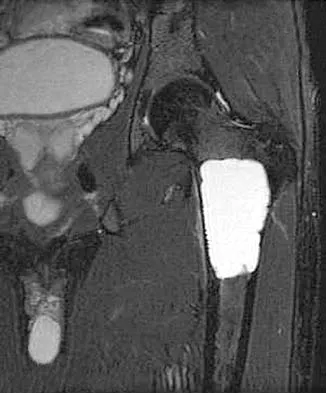
A 21-year-old man has mild but persistent aching pain in his left proximal thigh during impact loading activities. He denies pain at rest and has no other symptoms. Figures 34a through 34e show the radiographs and T1-weighted, T2-weighted, and gadolinium MRI scans of the left hip. What is the most likely diagnosis?
Explanation
Question 11
What nerve is at greatest risk when developing the superficial plane between the tensor fascia lata and sartorious during the anterior (Smith-Peterson) approach to the hip?
Explanation
Question 12
An axial T1-weighted MRI scan of the pelvis is shown in Figure 35. Which of the following structures is enclosed by the circle?
Explanation
Question 13
At the level of the midcalf, the plantaris tendon is found at which of the following locations?
Explanation
Question 14
In the posterior approach to the proximal radius (proximal Thompson approach), the supinator is exposed through the interval between what two muscles?
Explanation
Question 15
Figure 36 shows the hip arthrogram of a newborn. Which of the following structures is enclosed by the circle?
Explanation
Question 16
Figures 37a and 37b show radiographs of a 24-year-old man who has a humeral bone lesion that was found during a screening chest radiograph. He denies any symptoms despite leading a very active lifestyle. What is the most likely diagnosis?
Explanation
Question 17
Figures 38a and 38b show the CT scans of a 64-year-old woman. What is the most likely diagnosis?
Explanation
Question 18
The arrow in Figure 39 is pointing to which of the following ligaments?
Explanation
Question 19
The medial collateral ligament complex of the elbow originates on what portion of the medial epicondyle?
Explanation
Question 20
Figures 40a and 40b show the pre- and postoperative radiographs of an 82-year-old woman with bilateral hip pain who has had staged total hip arthroplasties. To minimize potential injury to the sciatic nerve at the time of surgery, the surgeon should
Explanation
Question 21
Based on the radiographic findings shown in Figure 41, which of the following wrist ligaments is most likely disrupted?
Explanation
Question 22
Which of the following extensor tendons commonly have multiple slips?
Explanation
Question 23
The nerve to the abductor digiti quinti, implicated in some patients who have chronic heel pain, is most commonly a branch of what larger nerve?
Explanation
Question 24
Figure 42 shows the sagittal T2-weighted MRI scan of a patient's right knee. These findings are most commonly seen with a complete tear of the
Explanation
Question 25
Thermal capsulorrhaphy of the inferior glenohumeral ligament can cause iatrogenic injury to which of the following nerves?
Explanation
Question 26
During a deltopectoral approach to the shoulder, the coracoid process may be osteotomized for better exposure. Which nerve is most at risk if the conjoint tendon is forcefully retracted medially?
Explanation
Question 27
During a flatfoot reconstruction, the spring ligament is identified and reefed. Which of the following accurately describes the anatomic attachments of the superomedial calcaneonavicular (spring) ligament?
Explanation
Question 28
A patient presents with isolated weakness in external rotation of the shoulder. An MRI reveals a paralabral cyst in the spinoglenoid notch. Which of the following muscles is most likely affected?
Explanation
Question 29
During a posterolateral corner reconstruction of the knee, the surgeon isolates the popliteus tendon. Where is the femoral attachment of the popliteus tendon located relative to the fibular collateral ligament (FCL)?
Explanation
Question 30
A 25-year-old falls on an outstretched hand and sustains a scaphoid waist fracture. Which of the following best describes the predominant arterial supply to the proximal pole of the scaphoid?
Explanation
Question 31
During an anterior thoracolumbar spine approach, the artery of Adamkiewicz is at risk. From which side and vertebral level does this artery most commonly arise?
Explanation
Question 32
During a surgical approach to the proximal radius, the surgeon identifies the posterior interosseous nerve (PIN). The PIN passes between the two heads of which muscle?
Explanation
Question 33
During a plantar approach to the foot for a compartment release, the surgeon encounters the "Master Knot of Henry." Which two tendons cross at this anatomical landmark?
Explanation
Question 34
A surgeon is performing a surgical dislocation of the hip. To protect the main blood supply to the femoral head, the medial circumflex femoral artery (MCFA) must be protected. The deep branch of the MCFA passes between which two muscles?
Explanation
Question 35
Tears of the triangular fibrocartilage complex (TFCC) often occur in conjunction with distal radius fractures. Which zone of the TFCC is considered avascular and therefore has the poorest healing potential?
Explanation
Question 36
A patient with a traction injury to the lower trunk of the brachial plexus will demonstrate deficits in muscles supplied by which two cords?
Explanation
Question 37
During an ulnar nerve transposition, the surgeon must release Osborne's ligament. This structure spans between the medial epicondyle and which other bony landmark?
Explanation
Question 38
During an ilioinguinal approach to the acetabulum, massive bleeding is encountered near the superior pubic ramus. This is most likely due to injury to the "corona mortis," which is an anastomosis between which two vascular systems?
Explanation
Question 39
When inserting a pedicle screw in the lumbar spine, the traditional starting point is at the intersection of the pars interarticularis, the midpoint of the transverse process, and which other structure?
Explanation
Question 40
A 22-year-old football player sustains a midfoot injury. The Lisfranc ligament is crucial for midfoot stability. What are the true bony attachments of the Lisfranc ligament?
Explanation
Question 41
A patient with an axillary nerve injury following a proximal humerus fracture will most likely show denervation in the deltoid and which other muscle?
Explanation
Question 42
During a distal femoral osteotomy, retractors are placed medially. Which nerve is at greatest risk of injury as it exits the adductor canal?
Explanation
Question 43
A patient complains of lateral leg pain and numbness over the dorsum of the foot following a fibular fracture. The superficial peroneal nerve typically pierces the deep fascia to become subcutaneous at what location?
Explanation
Question 44
During a carpal tunnel release, the recurrent motor branch of the median nerve is inadvertently injured. This will result in weakness of which of the following actions?
Explanation
Question 45
The anterior cruciate ligament (ACL) is composed of two main bundles. Which of the following best describes the function of the anteromedial (AM) bundle?
Explanation
Question 46
In the cervical spine, the vertebral artery typically enters the transverse foramen at which vertebral level?
Explanation
Question 47
When performing an anterolateral approach to the distal humerus, the radial nerve is at risk. Between which two muscles is the radial nerve located as it crosses the lateral intermuscular septum in the distal third of the arm?
Explanation
Question 48
During an anterior thoracolumbar spine approach, segmental arteries are ligated. Unintended ligation of the great radicular artery of Adamkiewicz typically leads to ischemia of which specific spinal cord region?
Explanation
Question 49
During an ilioinguinal approach for an anterior column acetabular fracture, significant hemorrhage occurs superior to the superior pubic ramus. This bleeding is most likely from an anastomosis (corona mortis) between which two vascular systems?
Explanation
Question 50
An MRI of the knee demonstrates an avulsion of the popliteus tendon from its femoral insertion. Where is the normal anatomic footprint of the popliteus tendon on the femur relative to the lateral collateral ligament (LCL) origin?
Explanation
Question 51
A patient develops weak shoulder abduction and external rotation following a posterior fracture-dislocation of the proximal humerus. The injured nerve exits the axilla through a space bounded superiorly by which structure?
Explanation
Question 52
A patient presents with the inability to cross their index and middle fingers. Which muscle group and nerve combination is primarily responsible for this specific action?
Explanation
Question 53
During a surgical release for tarsal tunnel syndrome, the flexor retinaculum is divided. What is the normal anatomic order of structures passing behind the medial malleolus, from anterior to posterior?
Explanation
Question 54
A 45-year-old sustains a displaced subcapital femoral neck fracture. The primary blood supply to the adult femoral head is disrupted. Which vessel is the predominant contributor to this supply?
Explanation
Question 55
A patient exhibits an inability to extend their fingers at the metacarpophalangeal joints but has normal wrist extension following a proximal radius fracture. At what anatomical site is the involved nerve most likely compressed or injured?
Explanation
Question 56
A runner complains of chronic medial heel and arch pain. Examination reveals a positive Tinel's sign posterior to the medial malleolus radiating to the plantar medial foot. Which muscle is innervated by the medial plantar nerve?
Explanation
Question 57
During the insertion of a right-sided pedicle screw at T12, the screw breaches the medial cortex of the pedicle. Which structure is most directly at risk from this errant trajectory?
Explanation
Question 58
In a patient with neurogenic thoracic outlet syndrome caused by a cervical rib, the lower trunk of the brachial plexus is commonly compressed. This lower trunk is formed by the union of which nerve roots?
Explanation
Question 59
A patient develops avascular necrosis of the proximal pole of the scaphoid following a nonunion. The predominant blood supply to the scaphoid enters at which anatomical location?
Explanation
Question 60
During an arthroscopic rotator interval release for adhesive capsulitis, the surgeon must identify the structures comprising the interval. Which two tendons form the superior and inferior borders of the rotator interval, respectively?
Explanation
Question 61
When performing an anterior cervical discectomy and fusion (ACDF), lateral dissection over the uncinate process is limited to avoid injuring the vertebral artery. The vertebral artery typically enters the transverse foramen at which cervical level?
Explanation
Question 62
An orthopedic surgeon is performing an anatomical ACL reconstruction. The anteromedial (AM) bundle of the ACL is tightest in which knee position, and where does it insert on the tibia relative to the posterolateral (PL) bundle?
Explanation
Question 63
A patient presents with proximal forearm pain and weakness in flexing the thumb interphalangeal joint. Compression of the median nerve at the ligament of Struthers involves an aberrant anatomical band connecting the medial epicondyle to what structure?
Explanation
Question 64
A patient has deep gluteal pain radiating down the posterior thigh. The sciatic nerve normally exits the greater sciatic foramen inferior to the piriformis muscle. In a common anatomical variant, a portion of the nerve pierces the piriformis. Which portion typically pierces the muscle?
Explanation
Question 65
A rock climber experiences a sudden "pop" in their ring finger, followed by bowstringing of the flexor tendons. Which annular pulley is located over the proximal phalanx and is considered the most biomechanically critical to prevent this bowstringing?
Explanation
Question 66
During a syndesmotic fixation for an ankle fracture, the surgeon visualizes the anterior inferior tibiofibular ligament (AITFL). At its distal insertion on the fibula, what specific tubercle does the AITFL attach to?
Explanation
Question 67
A 45-year-old woman presents with shoulder pain and an inability to elevate her arm above 90 degrees following a lymph node biopsy in the posterior cervical triangle. Examination reveals lateral winging of the scapula. Which of the following muscles is primarily denervated?
Explanation
Question 68
During open reduction and internal fixation of a medial malleolus fracture, a retractor is placed posterior to the medial malleolus. Which of the following structures is most anterior in the retro-malleolar groove and at highest risk of injury?
Explanation
Question 69
When performing a surgical dislocation of the hip for a femoroacetabular impingement procedure, the deep branch of the medial femoral circumflex artery is protected by preserving which of the following muscles?
Explanation
Question 70
A patient complains of an inability to extend the fingers at the metacarpophalangeal joints but has preserved wrist extension with radial deviation. The sensory examination is completely normal. Compression of the involved nerve most commonly occurs between the two heads of which muscle?
Explanation
Question 71
During placement of an L4 pedicle screw, a lateral breach occurs. Which of the following nerve roots is at greatest risk for direct injury from the misdirected screw?
Explanation
Question 72
The popliteus tendon inserts on the lateral femoral condyle. Relative to the lateral collateral ligament (LCL) insertion on the femur, where is the femoral footprint of the popliteus tendon located?
Explanation
Question 73
During an open carpal tunnel release, the recurrent motor branch of the median nerve is inadvertently transected. Which of the following thumb movements will be most significantly impaired?
Explanation
Question 74
A patient undergoes arthroscopic shoulder surgery for a biceps pulley lesion. The rotator interval is evaluated. Which of the following structures forms the inferior border of the rotator interval?
Explanation
Question 75
A patient sustains a laceration to the palmar aspect of the hand resulting in a "lumbrical plus" posture during attempted finger flexion. Which of the following describes the origin and insertion of the first lumbrical?
Explanation
Question 76
In evaluating a patient with a midfoot injury, the Lisfranc ligament is identified on MRI. This ligament securely connects which two osseous structures?
Explanation
Question 77
During an anterior ilioinguinal approach for an acetabular fracture, significant hemorrhage is encountered posterior to the superior pubic ramus. This bleeding is most likely originating from an anastomosis between which two vascular systems?
Explanation
Question 78
A patient presents with deep gluteal pain and posterior thigh paresthesias. An anatomical variation in the relationship between the sciatic nerve and the piriformis muscle is suspected. In the most common anatomical configuration, how does the sciatic nerve exit the pelvis?
Explanation
Question 79
A 6-year-old boy sustains a posterolateral displaced supracondylar fracture of the humerus. Which neurovascular structures are at the highest risk of being tethered or injured by the proximal fracture fragment?
Explanation
Question 80
A patient requires posterior instrumentation of the cervical spine. To avoid vertebral artery injury during lateral mass screw placement at C5, the surgeon must be aware of the artery's path. Through which transverse foramen does the vertebral artery typically first enter the cervical spine?
Explanation
Question 81
A patient has posterolateral rotatory instability (PLRI) of the elbow. Reconstruction of the lateral ulnar collateral ligament (LUCL) is planned. The LUCL normally originates on the lateral epicondyle and inserts on which of the following structures?
Explanation
Question 82
During a Smith-Petersen anterior approach to the hip, the superficial internervous plane is utilized to access the joint safely. This plane is defined by muscles innervated by which of the following nerve pairs?
Explanation
Question 83
A patient presents with inability to actively extend the fingers at the metacarpophalangeal joints following a proximal forearm fracture, though wrist extension is preserved but deviates radially. Which of the following muscles is typically spared in this specific nerve compression syndrome?
Explanation
Question 84
A 45-year-old male presents with severe radicular leg pain, weakness in great toe extension, and numbness along the dorsum of the foot. An MRI reveals a posterolateral disc herniation at the L4-L5 level. Which nerve root is most likely compressed?
Explanation
Question 85
During a standard deltopectoral approach to the shoulder, the cephalic vein is identified in the interval. The vein is classically retracted in which direction, and for what anatomic reason?
Explanation
Question 86
During a posterior approach to the hip (Kocher-Langenbeck), preservation of the main blood supply to the adult femoral head is critical. To protect the ascending branch of the medial femoral circumflex artery (MFCA), the surgeon should strictly avoid transecting the tendon of the:
Explanation
Question 87
A 22-year-old male sustains a proximal pole scaphoid fracture. The high risk of avascular necrosis in this fracture pattern is due to the retrograde intraosseous blood supply. The primary vascular inflow to the scaphoid enters at which location?
Explanation
Question 88
A 28-year-old volleyball player develops an isolated paralytic ganglion cyst at the spinoglenoid notch. Physical examination is most likely to demonstrate which of the following isolated deficits?
Explanation
Question 89
During a posteromedial surgical approach to the tibial plateau for internal fixation of a shear fracture, the surgeon dissects between the medial head of the gastrocnemius and the popliteus. Which major neurovascular structures are immediately at risk in this deep interval?
Explanation
Question 90
In a Latarjet procedure for recurrent anterior shoulder instability, the conjoint tendon is retracted medially. Excessive medial retraction places which of the following nerves at highest risk as it enters the deep surface of the coracobrachialis?
Explanation
Question 91
A patient with De Quervain's tenosynovitis demonstrates a positive Finkelstein test. The involved tendons form the radial (anterior) border of the anatomical snuffbox. Which of the following tendons forms the ulnar (posterior) border of this space?
Explanation
Question 92
In a severe talar neck fracture (Hawkins Type III), the body of the talus is at high risk for avascular necrosis. The primary blood supply to the talar body enters via the artery of the tarsal canal, which is a direct branch of the:
Explanation
Question 93
When utilizing the volar (Henry) approach to the proximal radius, the surgeon enters the internervous plane between the brachioradialis and the pronator teres. Which nerves supply these two muscles, respectively?
Explanation
Question 94
During posterior spinal fusion, a surgeon evaluates the accuracy of lumbar pedicle screw tracts using a ball-tipped probe. If the medial cortical wall of the L4 pedicle is breached, which anatomic structure is immediately at risk?
Explanation
Question 95
During dissection for a midfoot reconstruction, the surgeon identifies the Master Knot of Henry. Which of the following best describes the anatomic relationship of the tendons at this location?
Explanation
Question 96
A patient suffers a severe compartment syndrome of the anterior leg. Following fasciotomy, the patient has an irreversible loss of function of the deep peroneal nerve. Which of the following sensory deficits will definitively be present?
Explanation
Question 97
A weightlifter presents with vague posterior shoulder pain and selective atrophy of the teres minor muscle on MRI. Compression of the axillary nerve in the quadrilateral space is diagnosed. What are the superior and inferior muscular borders of this space?
Explanation
None
