AAOS Orthopedic Anatomy MCQs (Set 3): Musculoskeletal & Skeletal System | ABOS Board Prep
Key Takeaway
This high-yield question set (Set 3) for the AAOS/ABOS exams focuses on core orthopedic anatomy. It covers detailed musculoskeletal structures, key components of the skeletal system, and clinically vital neurovascular pathways. Enhance your understanding of foundational anatomy crucial for all orthopedic specializations and board preparation.
AAOS Orthopedic Anatomy MCQs (Set 3): Musculoskeletal & Skeletal System | ABOS Board Prep
Comprehensive 100-Question Exam
00:00
Start Quiz
Question 1
A 41-year-old man who plays golf regularly has had ulnar-sided wrist pain for the past several days after striking a tree root with a golf club. Examination reveals significant pain with resisted flexion of the ring and small fingers and tenderness over the hook of the hamate. Which of the following radiographic views would be most helpful in identifying the pathology of this injury?
Explanation
Question 2
What is the primary limiting membrane and mechanical support for the periphery of the physis?
Explanation
Question 3
What normal tissue has a low signal intensity (appears black) on both T1- and T2-weighted images?
Explanation
Question 4
A positive Froment sign indicates weakness of which of the following muscles?
Explanation
Question 5
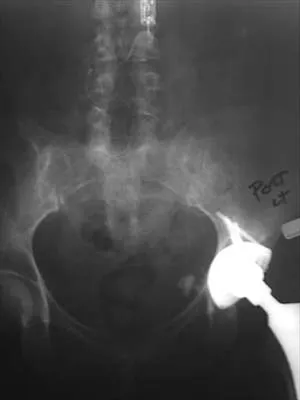
Figure 28 shows an AP radiograph of a 54-year-old woman who underwent lumbar laminectomy and fusion at the L4 and L5 levels with placement of a bone stimulator 8 years ago. She also underwent a left total hip arthroplasty 2 years ago; aspiration of that joint now reveals that it is infected with a gram-positive cocci organism. History is also significant for IV drug use and human immunodeficiency virus (HIV). The patient reports fever, chills, and left flank and abdominal pain. Examination reveals significant pain with resisted left hip flexion and passive hip extension. She also has lumbar hyperlordosis. Which of the following studies would best identify the underlying cause of her infection?
Explanation
Question 6
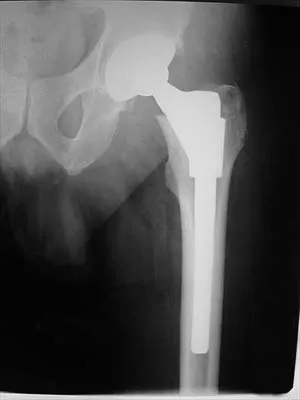
A 55-year-old woman who underwent a left total hip arthroplasty 8 months ago using a modified Hardinger approach reports a persistent painless limp. Examination reveals that when she is not using a cane, she lurches to the left during weight bearing on the left lower extremity. An AP radiograph is shown in Figure 29. Which of the following hip muscle groups should be strengthened to improve the gait abnormality?
Explanation
Question 7
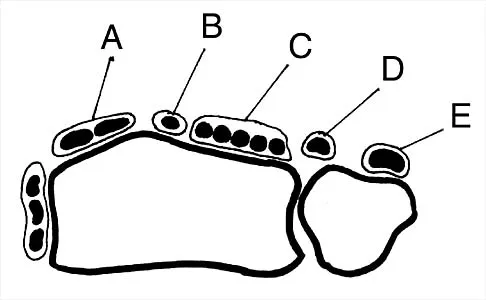
Figure 30 shows an axial cross section of extensor tendon anatomy in zone 7 of the wrist. What letter best depicts the location of the posterior interosseous nerve?
Explanation
Question 8
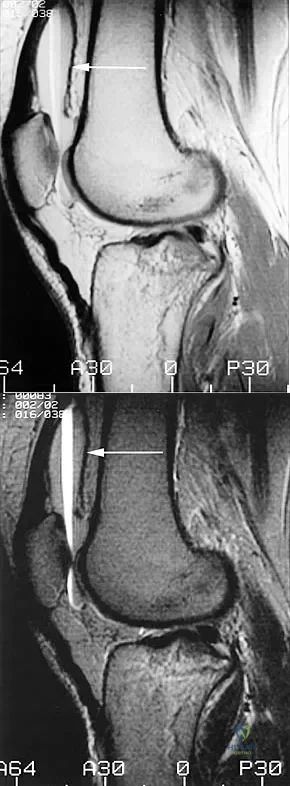
Figures 31a and 31b show the T1- and T2-weighted MRI scans of a patient's knee joint. What is the most likely diagnosis?
Explanation
Question 9
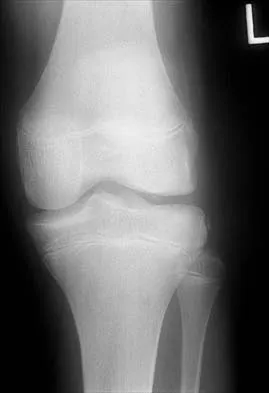
A 15-year-old boy reports feeling a pop and notes sudden giving way of the left knee while playing basketball. He has immediate pain and swelling in the knee. An AP radiograph is shown in Figure 32. A small avulsion fragment from the lateral tibial margin is the only finding. What is the most likely diagnosis?
Explanation
Question 10
What neurovascular structure is most at risk when performing an inside-out repair of the posterior horn of the medial meniscus?
Explanation
Question 11
Figure 33 shows the AP and lateral radiographs of an obese 58-year-old man who underwent a cementless total hip arthroplasty 6 years ago. He reports no pain, and examination reveals a normal gait and painless hip range of motion. What is the most likely diagnosis?
Explanation
Question 12
Which of the following muscles attaches to the coracoid process of the scapula?
Explanation
Question 13
Turf toe typically involves injury to which of the following structures of the great toe?
Explanation
Question 14
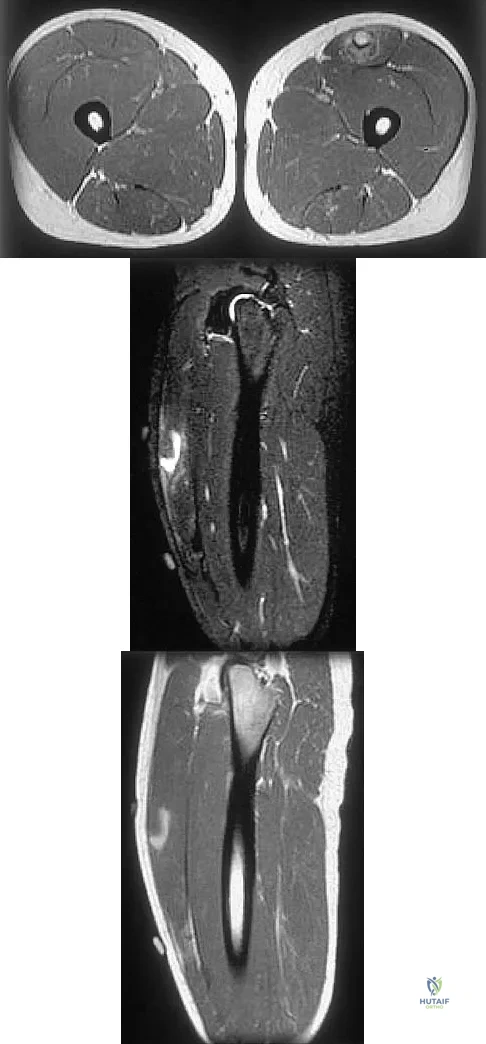
Figures 34a through 34c show an axial proton density (spin echo long TR, short TE) image, a sagittal inversion recovery (STIR) image, and a sagittal T1-weighted (short TR, short TE) image of the left thigh. What is the most likely diagnosis?
Explanation
Question 15
The artery located within the substance of the coracoacromial ligament is a branch of what artery?
Explanation
Question 16
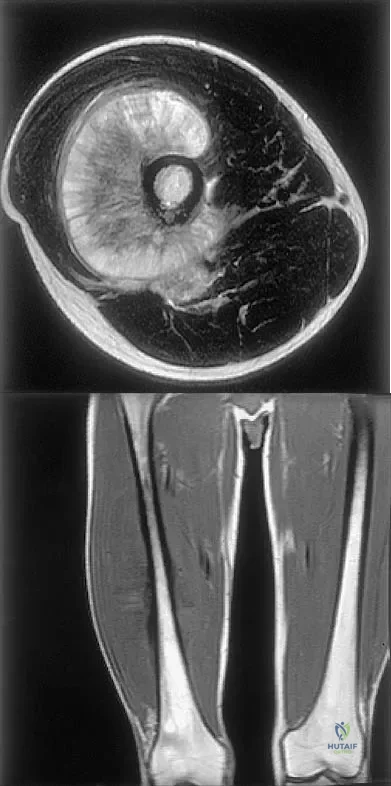
Figures 35a and 35b show the axial T2-weighted and coronal T1-weighted MRI scans of a patient who has enlargement of the right thigh. What is the most likely diagnosis?
Explanation
Question 17
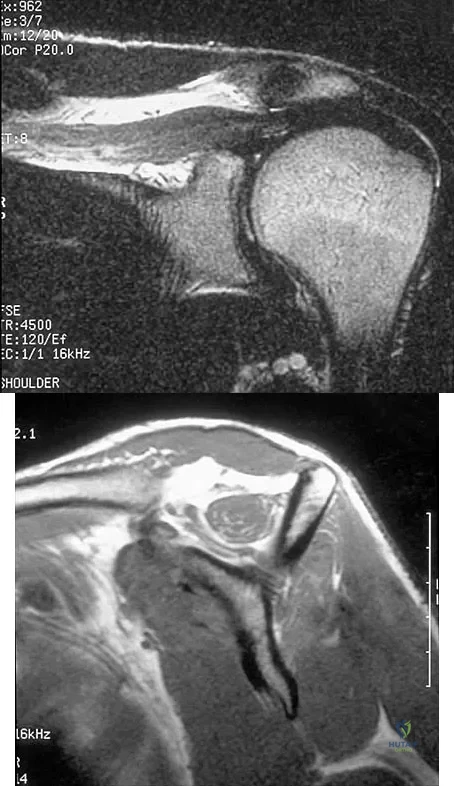
Figures 36a and 36b show the MRI scans of a patient who has shoulder weakness. What is the most likely diagnosis?
Explanation
Question 18
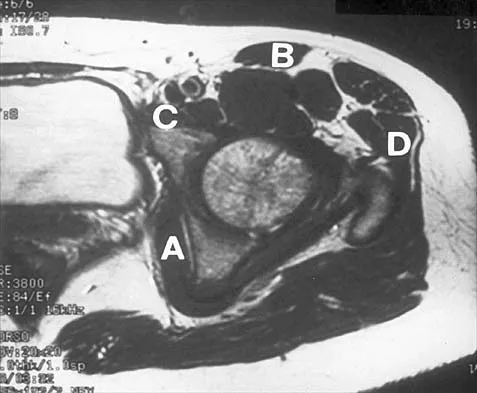
Figure 37 shows the T2-weighted MRI scan of the hip joint. What structure is labeled A?
Explanation
Question 19
The great medullary artery, also known as the Adamkiewicz artery, originates from which of the following arteries?
Explanation
Question 20
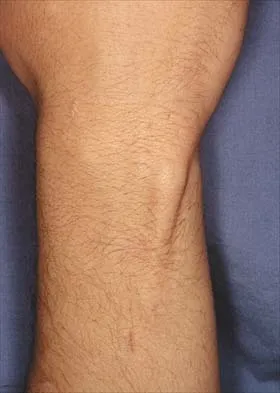
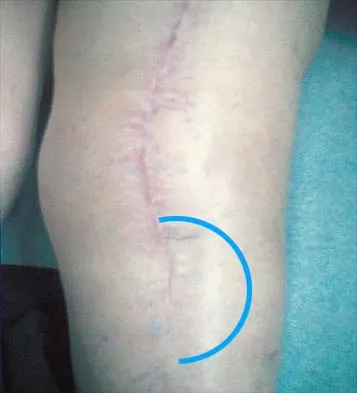
A patient who underwent total knee arthroplasty now reports a loss of sensation in the area circled in Figure 38. This area is innervated by which of the following nerves?
Explanation
Question 21
During an anterior approach to the shoulder, excessive traction on the conjoined tendon is most likely to result in loss of
Explanation
Question 22
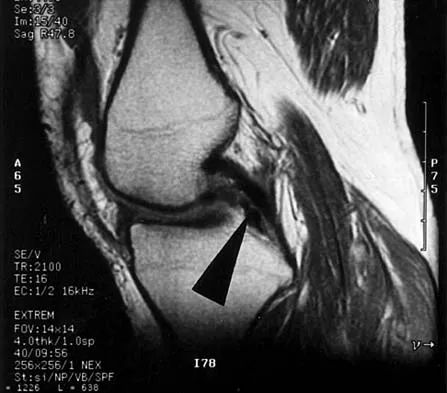
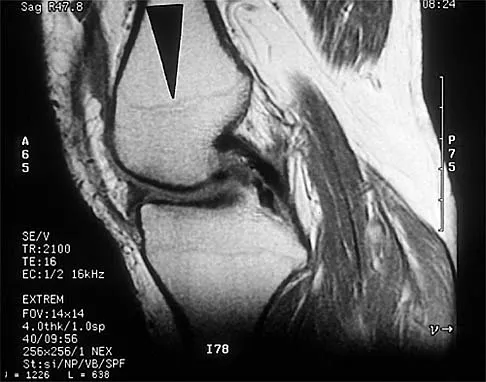
Figure 39 shows the sagittal T1-weighted MRI scan of a 27-year-old man who twisted his knee 2 weeks ago. The arrow is pointing to
Explanation
Question 23
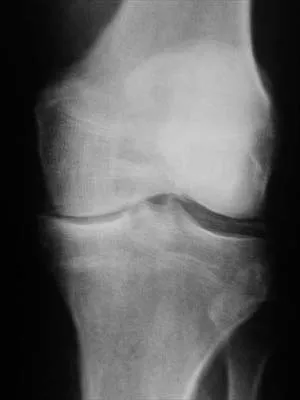
Figure 40 shows the AP radiograph of a 55-year-old man who reports left knee pain. Which of the following conditions is least likely to produce this radiographic presentation?
Explanation
Question 24
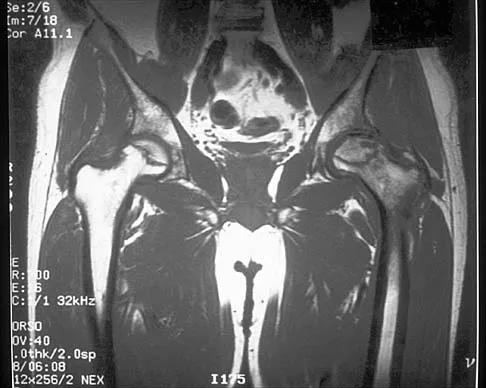
Figure 41 shows the MRI scan of a 39-year-old man who has severe left groin and anterior thigh pain. What is the most likely diagnosis?
Explanation
Question 25
Iliosacral screws placed for stabilization of posterior pelvic ring injuries (eg, sacroiliac dislocation) that exit the sacrum anteriorly are most likely to injure which of the following structures?
Explanation
Question 26
A 28-year-old male sustains a displaced talar neck fracture (Hawkins Type III). Which of the following arteries provides the primary blood supply to the body of the talus, placing it at high risk for avascular necrosis in this injury?
Explanation
Question 27
During a posterior lumbar decompression for spinal stenosis, the surgeon removes a thickened ligament that bridges the laminae of adjacent vertebrae. Which of the following tissues is most abundant in this structure?
Explanation
Question 28
A 24-year-old baseball pitcher presents with vague posterior shoulder pain and fatigue. MRI reveals isolated atrophy of the teres minor muscle. Compression of a nerve within which of the following anatomic spaces is the most likely cause?
Explanation
Question 29
A 45-year-old woman develops a spontaneous rupture of the extensor pollicis longus (EPL) tendon following a nondisplaced distal radius fracture treated in a cast. Around which bony prominence does this tendon normally pivot, making it susceptible to attrition?
Explanation
Question 30
A 22-year-old football player sustains a midfoot injury. Imaging reveals a widening of the space between the first and second metatarsals. The primary stabilizing ligament of this articulation connects the base of the second metatarsal to which of the following structures?
Explanation
Question 31
In a surgical approach to the hip, protecting the medial femoral circumflex artery (MFCA) is critical to prevent iatrogenic avascular necrosis of the femoral head. The deep branch of the MFCA passes between which two muscles?
Explanation
Question 32
A 30-year-old man presents with an inability to cross his fingers and numbness over the volar aspect of his small finger following a deep laceration to his proximal medial forearm. Which cord of the brachial plexus gives rise to the nerve injured in this scenario?
Explanation
Question 33
During knee arthroscopy, a peripheral, longitudinal tear of the medial meniscus is identified in the "red-red" zone. Which of the following arteries provides the primary blood supply to this peripheral portion of the meniscus?
Explanation
Question 34
A patient develops acute compartment syndrome of the anterior leg following a tibia fracture. If left untreated, which of the following functional deficits is most likely to occur?
Explanation
Question 35
An 8-year-old boy sustains a Salter-Harris Type II fracture of the distal radius. The fracture line passes through the growth plate and exits through the metaphysis. Through which histologic zone of the physis does the fracture line primarily propagate?
Explanation
Question 36
A patient presents with a "lumbrical plus" finger after a flexor digitorum profundus (FDP) tendon laceration in zone 1. What is the anatomic origin and insertion of the lumbrical muscle that contributes to this phenomenon?
Explanation
Question 37
A 25-year-old runner suffers an external rotation injury to his right ankle, resulting in a high ankle sprain. Which of the following ligaments is typically the first to tear in a syndesmotic injury?
Explanation
Question 38
A 45-year-old male sustains a Jefferson burst fracture of C1. The stability of the C1-C2 complex depends significantly on the transverse ligament. This ligament attaches to which of the following osseous structures?
Explanation
Question 39
A postmenopausal woman is prescribed a bisphosphonate for osteoporosis. This medication primarily targets osteoclasts. Which of the following describes the microscopic feature by which actively resorbing osteoclasts attach to the bone surface?
Explanation
Question 40
During a SLAP (Superior Labrum Anterior to Posterior) repair, the surgeon focuses on the attachment of the long head of the biceps tendon. The long head of the biceps tendon originates from the supraglenoid tubercle and which of the following structures?
Explanation
Question 41
A patient demonstrates a positive Trendelenburg sign on the right side during the stance phase of gait. This indicates weakness of the right gluteus medius and minimus muscles. Which nerve innervates these muscles?
Explanation
Question 42
A patient has isolated weakness in flexing the interphalangeal joint of the thumb and the distal interphalangeal joint of the index finger. There is no sensory loss. Compression of the involved nerve most commonly occurs at which of the following anatomical structures?
Explanation
Question 43
A 40-year-old male is involved in a high-speed motor vehicle collision and sustains an unstable vertical shear pelvic ring injury. Which of the following ligaments is the strongest and provides the most stability to the posterior pelvic ring?
Explanation
Question 44
The anterior (Smith-Petersen) surgical approach to the hip utilizes a superficial internervous plane. Which two muscles define this plane?
Explanation
Question 45
During anterior cervical spine surgery, care must be taken to avoid injury to the vertebral artery. At which cervical level does the vertebral artery typically first enter the foramen transversarium?
Explanation
Question 46
The axillary nerve and posterior circumflex humeral artery exit the axilla through the quadrangular space. Which of the following accurately describes the borders of this space?
Explanation
Question 47
Surgical dissection in the plantar midfoot requires navigating the Master Knot of Henry. Which of the following describes the correct anatomic relationship at this intersection?
Explanation
Question 48
Salter-Harris fractures typically occur through the weakest portion of the pediatric physis. Which zone of the physis is most frequently implicated as the site of failure?
Explanation
Question 49
During an ilioinguinal or modified Stoppa approach for a pelvic ring injury, the surgeon encounters significant bleeding from the "corona mortis". This structure is an anastomosis between which two vascular systems?
Explanation
Question 50
Which of the following structures is innervated by the anterior interosseous nerve (AIN)?
Explanation
Question 51
The primary blood supply to the adult femoral head is the medial circumflex femoral artery (MCFA). The deep branch of the MCFA consistently courses between which two muscles prior to ascending to the trochanteric fossa?
Explanation
Question 52
Within the deep posterior compartment of the lower leg, the structures pass behind the medial malleolus. Which structure is located most anteriorly and medially in this space?
Explanation
Question 53
The arcade of Frohse is the most common site for entrapment of the posterior interosseous nerve (PIN). Which anatomical structure forms the proximal border of this arcade?
Explanation
Question 54
Which of the following statements accurately describes the Martin-Gruber anastomosis?
Explanation
Question 55
A patient presents with a winged scapula, and physical examination demonstrates isolated weakness of the serratus anterior muscle. Injury to the long thoracic nerve is suspected. Which nerve roots contribute to the formation of this nerve?
Explanation
Question 56
Microscopic analysis of cortical bone demonstrates the presence of Volkmann's canals. What is the primary function of these structures?
Explanation
Question 57
During an ulnar nerve decompression at the wrist, the surgeon releases the volar carpal ligament to open Guyon's canal. Which structures represent the medial and lateral bony borders of this canal?
Explanation
Question 58
On an MRI of the knee, an intact meniscofemoral ligament is identified. The ligament of Wrisberg is characterized by its anatomic relationship to the posterior cruciate ligament (PCL). Which description is correct?
Explanation
Question 59
The volar (Henry) approach to the radius uses an internervous plane between the brachioradialis and the pronator teres proximally. What is the respective nerve supply to these two muscles?
Explanation
Question 60
Fractures of the scaphoid proximal pole are prone to nonunion and avascular necrosis due to its precarious blood supply. From which vessel does the scaphoid receive its primary blood supply, and where does it enter the bone?
Explanation
Question 61
Reconstruction of the medial patellofemoral ligament (MPFL) requires accurate femoral tunnel placement. Where is the anatomic origin of the MPFL on the medial femur?
Explanation
Question 62
During a physical examination, the knee demonstrates increased varus laxity at 30 degrees of flexion but is stable in full extension. Which structure provides the primary restraint to varus stress at 30 degrees of knee flexion?
Explanation
Question 63
In an unstable syndesmotic injury of the ankle, multiple ligamentous structures are disrupted. Which structure provides the greatest resistance to lateral displacement (diastasis) of the distal fibula relative to the tibia?
Explanation
Question 64
During a surgical approach to the anterior shoulder, the musculocutaneous nerve is at risk of iatrogenic injury. At what average distance distal to the coracoid process does this nerve typically pierce its designated muscle?
Explanation
Question 65
The main blood supply to the adult femoral head is derived from the deep branch of the medial femoral circumflex artery. Which anatomic landmarks describe the course of this vessel before it enters the hip capsule?
Explanation
Question 66
The anterior cruciate ligament (ACL) is composed of two primary bundles that exhibit unique tension patterns throughout the arc of knee motion. Which of the following statements correctly describes the biomechanics of these bundles?
Explanation
Question 67
The flexor tendon pulley system of the hand prevents bowstringing of the tendons during digital flexion. Which two pulleys are considered the most critical to the biomechanical function of the digit and must be preserved or reconstructed?
Explanation
Question 68
The scapholunate interosseous ligament (SLIL) provides primary stability to the scapholunate joint. Which anatomic portion of the SLIL is the thickest and most biomechanically critical for preventing diastasis?
Explanation
Question 69
Injury to the posterolateral corner of the knee can result in significant rotatory and varus instability. Which of the following structures is the primary static stabilizer against external tibial rotation at 30 degrees of knee flexion?
Explanation
Question 70
The rotator interval is a critical anatomic space in the anterior shoulder involved in glenohumeral stability. Which of the following structures is NOT found within or bordering the rotator interval?
Explanation
Question 71
During a posterior suboccipital approach to the cervical spine, the surgeon encounters the suboccipital triangle. Which of the following muscles forms the medial border of this anatomic space?
Explanation
Question 72
During an ilioinguinal approach to the acetabulum, severe hemorrhage can occur from tearing the "corona mortis". This structure represents a vascular anastomosis between which two major systems?
Explanation
Question 73
Posterolateral rotatory instability (PLRI) of the elbow presents with a clunk during extension and supination. This condition is primarily caused by insufficiency of which ligamentous structure?
Explanation
Question 74
A 45-year-old overhead athlete presents with isolated weakness in external rotation of the shoulder. Electromyography reveals denervation of the infraspinatus with a normal supraspinatus. Where is the most likely anatomic site of nerve entrapment?
Explanation
Question 75
The Lisfranc ligament is critical for maintaining the structural integrity of the midfoot. Between which two osseous structures does this ligament course?
Explanation
Question 76
Articular cartilage is structurally divided into several distinct zones to handle different mechanical loads. Which zone is characterized by the highest concentration of proteoglycans and the lowest concentration of water?
Explanation
Question 77
The anterior interosseous nerve (AIN) is a purely motor branch that courses through the volar forearm. Which of the following muscles is NOT innervated by the AIN?
Explanation
Question 78
In a Bennett fracture-dislocation of the thumb base, a small volar-ulnar fragment remains anatomically reduced while the shaft displaces. Which structure maintains this fragment in its anatomic position?
Explanation
Question 79
During a four-compartment fasciotomy for acute compartment syndrome of the lower leg, the deep posterior compartment must be completely decompressed. Which of the following muscles is contained within this compartment?
Explanation
Question 80
Talar neck fractures are notorious for carrying a high risk of avascular necrosis of the talar body. The primary blood supply to the talar body enters through the tarsal canal and is typically a branch of which vessel?
Explanation
Question 81
The medial meniscus of the knee is injured more frequently than the lateral meniscus, largely due to its restricted mobility. Which anatomic attachment primarily limits the translation of the medial meniscus during knee motion?
Explanation
Question 82
The volar (Henry) approach to the radius provides safe access to the diaphyseal bone without denervating the overlying musculature. This internervous plane is developed between muscles supplied by which two nerves?
Explanation
Question 83
Osteoblasts regulate bone remodeling by modulating osteoclast activity through the secretion of specific cytokines. Which local factor, produced by osteoblasts, functions as a decoy receptor for RANKL to inhibit osteoclastogenesis?
Explanation
Question 84
A 25-year-old male sustains a direct blow to the anteromedial aspect of his knee, resulting in a posterolateral corner (PLC) injury. During surgical reconstruction, the surgeon must identify the femoral attachments of the LCL and the popliteus tendon. What is the correct anatomical relationship of the popliteus tendon origin relative to the LCL femoral footprint?
Explanation
Question 85
A 22-year-old collegiate baseball pitcher presents with poorly localized posterior shoulder pain and paresthesias over the lateral deltoid. MRI reveals isolated atrophy of the teres minor muscle. The nerve affected in this syndrome passes through a specific anatomic space. Which of the following structures forms the superior boundary of this space?
Explanation
Question 86
During a posterior approach to the hip for a displaced femoral neck fracture, the surgeon carefully dissects the short external rotators. To avoid avascular necrosis of the femoral head in a joint-preserving procedure, the deep branch of the medial femoral circumflex artery (MFCA) must be protected. This vessel consistently runs between which two structures?
Explanation
Question 87
A 45-year-old woman is undergoing shoulder arthroscopy for adhesive capsulitis. The surgeon plans a release of the rotator interval. Which of the following structures are the primary contents of the rotator interval?
Explanation
Question 88
A 35-year-old avid cyclist presents with profound weakness of finger abduction and adduction but normal sensation over the volar small finger. A lesion in Zone II of Guyon's canal is suspected. Which of the following structures forms the floor of Guyon's canal?
Explanation
Question 89
A patient sustained a midshaft humerus fracture and later developed an inability to flex the interphalangeal joint of the thumb and the distal interphalangeal joint of the index finger. The affected nerve typically branches from its parent nerve at which of the following anatomic locations?
Explanation
Question 90
During surgical repair of a bi-malleolar ankle fracture equivalent, the surgeon evaluates the deltoid ligament complex. Which component of the deltoid ligament is the thickest and serves as the primary restraint against lateral translation of the talus?
Explanation
Question 91
A 10-year-old boy falls on his outstretched hand. Radiographs of the elbow reveal a displaced fracture of a secondary ossification center. Based on the typical sequence of elbow ossification, which of the following centers is the last to fuse to the adjacent bone?
Explanation
Question 92
A 40-year-old male sustains a knife wound to the spine resulting in Brown-Séquard syndrome. He exhibits ipsilateral loss of motor function and contralateral loss of pain and temperature sensation. The loss of pain and temperature sensation is due to injury to which spinal cord tract?
Explanation
Question 93
During a primary flexor tendon repair in Zone II, the surgeon must preserve the critical pulley system to prevent flexor tendon bowstringing. Anatomically, where does the A2 pulley originate?
Explanation
Question 94
Salter-Harris fractures typically propagate through the physis, affecting bone growth depending on the severity of the injury. Through which histologic zone of the physis do these fractures classically propagate?
Explanation
Question 95
A retroperitoneal approach to the anterior lumbar spine (L4-L5) is being performed. The surgeon identifies the psoas major muscle. Which of the following describes the correct anatomic relationship of the major nerves of the lumbar plexus relative to the psoas major?
Explanation
Question 96
A 21-year-old man sustains a scaphoid waist fracture. The surgeon opts for percutaneous screw fixation. Which artery provides the primary blood supply to the proximal pole of the scaphoid, making it susceptible to avascular necrosis following this fracture?
Explanation
Question 97
During arthroscopy for a suspected meniscus tear, the surgeon evaluates the peripheral blood supply to determine the healing potential of a repair. What is the primary arterial supply to the peripheral aspects of the medial and lateral menisci?
Explanation
Question 98
A patient presents with tarsal tunnel syndrome. During the surgical release, the flexor retinaculum is divided. What is the most posterior/lateral structure passing beneath the flexor retinaculum behind the medial malleolus?
Explanation
None
