Anatomy Board Review (Set 2): Musculoskeletal & Neurovascular MCQs | AAOS, ABOS Prep
Key Takeaway
This high-yield anatomy question set for AAOS, ABOS, and OITE exams (Set 2) focuses on essential musculoskeletal structures, neurovascular pathways, and regional anatomical landmarks critical for orthopedic practice. Prepare for board success with these foundational concepts.
Anatomy Board Review (Set 2): Musculoskeletal & Neurovascular MCQs | AAOS, ABOS Prep
Comprehensive 100-Question Exam
00:00
Start Quiz
Question 1
Figure 14 shows a lateral radiograph of a knee joint. The bony structure indicated by the arrow is a sesamoid bone that resides in what tendon?
Explanation
Question 2
Talar compression syndrome in ballet dancers typically involves injury to which of the following structures?
Explanation
Question 3
The sartorius muscle is innervated by which of the following nerves?
Explanation
Question 4
Pacinian corpuscles are lamellated nerve endings that are responsible for providing the perception of
Explanation
Question 5
An elite gymnast injured her ankle in an awkward dismount 36 hours ago. Examination reveals weakness on single leg step-up. A clinical photograph of the medial ankle is shown in Figure 15. Plain radiographs are normal. To help confirm the diagnosis, the next step in evaluation should consist of
Explanation
Question 6
Figure 16 shows an axial MRI scan through the knee joint. What structure is identified by the arrow?
Explanation
Question 7
Which of the following nerves is most commonly injured when obtaining a bone graft from the posterior ilium?
Explanation
Question 8
Based on the findings seen in the posteroanterior radiograph of the wrist shown in Figure 17, which of the following structures is torn?
Explanation
Question 9
What tendon has an intra-articular (instrasynovial) location in the knee joint?
Explanation
Question 10
A patient undergoes hip arthroscopy, and the pathology is seen in Figure 18. What is the most likely diagnosis?
Explanation
Question 11
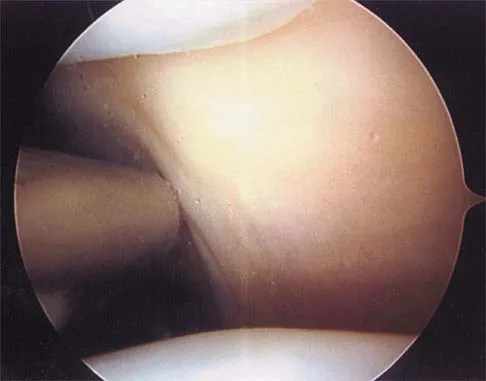
Figure 19 shows an arthroscopic view from the anterior lateral portal of the knee looking into the suprapatella pouch. The use of an electrothermal device during this procedure most commonly causes significant postoperative complications by damaging which of the following structures?
Explanation
Question 12
Figure 20 shows the resting and stress radiographs of a patient who has had pain and feelings of instability after undergoing a total knee arthroplasty 1 year ago. Which of the following ligaments is not functional and is therefore responsible for the patient's symptoms?
Explanation
Question 13
On MRI, a nonsanguinous effusion has what appearance?
Explanation
Question 14
Which of the following illustrations shown in Figures 21a through 21e correctly shows the projection of the sacroiliac joint on the outer table of the ilium?
Explanation
Question 15
In children between the ages of 4 and 8 years, the major blood supply to the femoral head comes from the
Explanation
Question 16
What is the most anatomic location for placement of the femoral tunnel in anterior cruciate ligament reconstruction?
Explanation
Question 17
In the anterior approach (Smith-Petersen) to the hip, dissection is carried out between muscles innervated by the
Explanation
Question 18
What structure is marked Q in the diagram of the brachial plexus shown in Figure 22?
Explanation
Question 19
A sagittal T1-weighted MRI scan of the knee joint is shown in Figure 23. What structure is identified by the arrow?
Explanation
Question 20
Figure 24 shows the arthroscopic view of a patient with ankle impingement syndrome. This is commonly seen after high ankle sprains and represents fibrotic granulation thickening of what structure?
Explanation
Question 21
The modified Brostrom lateral ankle ligamentous reconstruction uses which of the following structures to provide supplementary stabilization?
Explanation
Question 22
Figure 25 shows an arthroscopic thermal capsular shrinkage device being used in the anterior inferior quadrant of a patient with a subluxating shoulder. Which of the following neurologic complications is most frequently reported with this technique?
Explanation
Question 23
A coronal MRI scan through the shoulder joint is shown in Figure 26. The cyst indicated by the arrow will most likely cause compression of what nerve?
Explanation
Question 24
Which of the following ligaments is most commonly involved in posterolateral rotatory instability of the elbow?
Explanation
Question 25
Which of the following anatomic structures is labeled 6 in Figure 27?
Explanation
Question 26
A 24-year-old baseball pitcher presents with right upper extremity numbness and fatigue. Examination reveals a diminished radial pulse with shoulder hyperabduction. The compression is clinically suspected to occur within the interscalene triangle. Which of the following structures is most likely NOT compressed in this specific space?
Explanation
Question 27
A patient presents with the inability to form an "OK" sign, demonstrating a loss of flexion at the thumb interphalangeal joint and index finger distal interphalangeal joint. The affected nerve normally travels distally in the forearm in the interval between which two muscles?
Explanation
Question 28
A 35-year-old male sustains a severe proximal humerus fracture. Follow-up electromyography reveals isolated denervation of the teres minor and deltoid muscles. The affected nerve passes through an anatomic space bordered superiorly by which of the following structures?
Explanation
Question 29
During a posterior approach to the knee for a displaced medial tibial plateau fracture, the surgeon dissects meticulously through the popliteal fossa. What is the correct anatomical sequence of the primary neurovascular structures encountered from superficial (posterior) to deep (anterior)?
Explanation
Question 30
A surgeon is performing a Smith-Petersen approach for an open reduction of a developmental dysplasia of the hip. This anterior approach utilizes a true internervous plane. Which of the following nerve combinations supplies the muscles that define this superficial plane?
Explanation
Question 31
During an inside-out medial meniscus repair, a pure sensory nerve is inadvertently injured. This nerve normally travels through Hunter's canal in the thigh alongside which of the following vessels?
Explanation
Question 32
The superficial peroneal nerve is at risk during a lateral surgical approach to the fibula for fracture fixation. At what average distance proximal to the tip of the lateral malleolus does this nerve typically pierce the crural fascia to become subcutaneous?
Explanation
Question 33
A 28-year-old professional volleyball player presents with isolated weakness in external rotation of the shoulder. Her abduction strength is completely normal (5/5). An MRI is likely to demonstrate a paralabral ganglion cyst compressing a nerve at which of the following locations?
Explanation
Question 34
A 32-year-old male sustains a highly comminuted talar neck fracture. The primary blood supply to the body of the talus, which is now critically disrupted, is derived from the artery of the tarsal canal. This vessel is an anatomic branch of which artery?
Explanation
Question 35
During surgical decompression for recalcitrant intersection syndrome, the surgeon identifies intense tenosynovitis at the crossing point of two muscle bellies over two underlying tendons. The muscle bellies involved in this pathology belong to the:
Explanation
Question 36
A patient is evaluated for an inability to actively extend the fingers at the metacarpophalangeal joints, though wrist extension is maintained with slight radial deviation. The compressed nerve normally enters the posterior forearm by passing between the two heads of which muscle?
Explanation
Question 37
A professional cyclist presents with severe intrinsic muscle weakness of the hand but normal sensation on the palmar aspect of the small finger. The ulnar nerve is diagnosed as compressed selectively in Zone 2 of Guyon's canal. Which of the following structures forms the floor of this specific zone?
Explanation
Question 38
A patient sustains a midshaft humerus fracture. Upon examination, they are unable to extend their wrist or digits. Assuming the lesion is distal to the spiral groove, which of the following muscles is typically the first to regain function during spontaneous nerve recovery?
Explanation
Question 39
During an anterior approach (Smith-Petersen) to the hip, the superficial internervous plane is between the sartorius and the tensor fasciae latae. What are the respective nerve supplies of these muscles?
Explanation
Question 40
During the Henry approach to the proximal radius, the deep dissection requires managing the supinator to expose the bone. To minimize the risk of injury to the posterior interosseous nerve (PIN), how should the supinator be managed?
Explanation
Question 41
Which of the following neurovascular structures pass through the quadrangular space of the shoulder?
Explanation
Question 42
A patient with a severely displaced fibular neck fracture presents with a new foot drop. Physical examination reveals weakness in both ankle dorsiflexion and eversion, as well as numbness over the dorsum of the foot. Which nerve is most likely injured?
Explanation
Question 43
During a posterior approach to the hip (Kocher-Langenbeck), the blood supply to the femoral head via the deep branch of the medial femoral circumflex artery (MFCA) is at risk. Which of the following structures acts as the primary anatomic barrier protecting the MFCA and should generally be preserved?
Explanation
Question 44
A 25-year-old male receives a stab wound to the volar wrist, lacerating the median nerve 2 cm proximal to the carpal tunnel. Assuming no other injuries, which of the following clinical deficits is expected?
Explanation
Question 45
During a lateral extensile approach for open reduction and internal fixation of a calcaneus fracture, the sural nerve is at risk. What is the usual anatomic course of the sural nerve at the level of the lateral malleolus?
Explanation
Question 46
Which muscle is primarily responsible for internal rotation of the tibia on the femur, a motion necessary to 'unlock' the knee from terminal extension?
Explanation
Question 47
A patient sustains a traumatic anterior shoulder dislocation. The most commonly injured nerve in this scenario arises primarily from which of the following roots of the brachial plexus?
Explanation
Question 48
During surgical release of the first dorsal compartment for de Quervain's tenosynovitis, care must be taken to ensure all tendon slips are decompressed. Which of the following best describes the anatomy of this compartment?
Explanation
Question 49
A distal radius fracture is approached via the standard volar flexor carpi radialis (FCR) approach. After incising the FCR sheath and retracting the FCR tendon ulnarly, what is the immediate deep structure that must be identified and mobilized to expose the pronator quadratus?
Explanation
Question 50
A 24-year-old weightlifter presents with right posterior shoulder pain and selective weakness in external rotation. MRI reveals an isolated paralabral cyst located strictly within the spinoglenoid notch. Which of the following muscles is most likely denervated?
Explanation
Question 51
During a posterior approach to the shoulder, the axillary nerve must be identified to prevent iatrogenic injury. Which of the following sets of structures forms the borders of the quadrangular space, through which the axillary nerve exits?
Explanation
Question 52
During an anterior intrapelvic (modified Stoppa) approach for an acetabular fracture, massive bleeding is encountered directly posterior to the superior pubic ramus. This is most likely due to injury to the corona mortis, which represents an anastomosis between which two vascular systems?
Explanation
Question 53
A 65-year-old female sustains a displaced femoral neck fracture. The primary blood supply to the weight-bearing dome of the adult femoral head is at high risk of disruption. Which of the following vessels provides this dominant vascular supply?
Explanation
Question 54
Surgical treatment of a highly comminuted talar neck fracture requires extensive dissection, increasing the risk of avascular necrosis. The dominant blood supply to the body of the talus arises from which of the following arteries?
Explanation
Question 55
The triangular fibrocartilage complex (TFCC) acts as the primary stabilizer of the distal radioulnar joint (DRUJ). The TFCC takes its origin from the ulnar styloid and inserts primarily into which of the following structures?
Explanation
Question 56
A patient is evaluated for posterolateral rotatory instability (PLRI) of the elbow following a dislocation. This condition is primarily associated with incompetence of the lateral ulnar collateral ligament (LUCL). What is the exact distal insertion site of the LUCL?
Explanation
Question 57
A patient presents with high median nerve neuropathy causing weakness in wrist flexion, forearm pronation, and thumb IP flexion. If the site of compression is the ligament of Struthers, this anatomic structure connects the medial epicondyle to what landmark?
Explanation
Question 58
A 22-year-old male sustains a scaphoid waist fracture. The proximal pole is highly susceptible to avascular necrosis due to its retrograde blood flow. Which vessel is the primary source of blood supply to the scaphoid?
Explanation
Question 59
During a plantar approach for an excision of a midfoot mass, dissection proceeds deep near the Master Knot of Henry. Which two tendons cross at this specific anatomic decussation?
Explanation
Question 60
During surgical release of a trigger finger, maximum preservation of the digital flexor sheath is required to prevent tendon bowstringing. Which two annular pulleys are biomechanically the most critical to preserve?
Explanation
Question 61
To safely access the posterior hip joint, an understanding of the relationship between the sciatic nerve and the piriformis muscle is essential. In the normal and most common anatomic arrangement, where does the sciatic nerve pass?
Explanation
Question 62
During anterior cervical corpectomy and fusion, aggressive lateral dissection places the vertebral artery at risk. Ascending from the subclavian artery, the vertebral artery classically enters the foramen transversarium at which cervical level?
Explanation
Question 63
During an anterolateral (Henry) approach to the distal humerus, the brachialis muscle is split to expose the humeral shaft. Which of the following describes the innervation of the medial and lateral portions of the brachialis muscle?
Explanation
Question 64
During an ilioinguinal approach for an acetabular fracture, significant hemorrhage occurs while dissecting near the superior pubic ramus. This is most likely due to a variant anastomotic vessel connecting the external iliac system to which of the following arteries?
Explanation
Question 65
Which of the following arteries typically provides the major blood supply to the anterior lower two-thirds of the spinal cord and most commonly arises on the left side between T8 and L1?
Explanation
Question 66
The deep peroneal nerve supplies the motor innervation to the anterior compartment of the leg. Which of the following muscles is also innervated by the deep peroneal nerve but resides anatomically outside the anterior compartment of the leg?
Explanation
Question 67
A patient sustains a laceration to the deep motor branch of the ulnar nerve at the wrist. Which of the following deficits is expected regarding the lumbrical muscles?
Explanation
Question 68
A 28-year-old overhead athlete presents with posterior shoulder pain and deltoid weakness. An MRI demonstrates isolated atrophy of the teres minor. Entrapment of a nerve in which of the following spaces is most likely responsible?
Explanation
Question 69
At the anatomically critical "Master Knot of Henry" in the plantar midfoot, which of the following relationships is correct?
Explanation
Question 70
During a surgical approach to the medial thigh, the boundaries of the femoral triangle must be respected to avoid neurovascular injury. What structure forms the medial border of the femoral triangle?
Explanation
Question 71
The posterior interosseous nerve (PIN) is most commonly entrapped at the Arcade of Frohse. This anatomic structure represents the proximal fibrous edge of which muscle?
Explanation
Question 72
During an anterior cervical discectomy and fusion (ACDF), lateral dissection carries the risk of injuring the vertebral artery. At which cervical level does the vertebral artery typically first enter the transverse foramen?
Explanation
Question 73
The anterior cruciate ligament (ACL) is composed of two primary bundles that function synergistically throughout the knee's range of motion. In which position of the knee is the anteromedial (AM) bundle most taut?
Explanation
Question 74
The scaphoid is at high risk for avascular necrosis following fracture due to its retrograde blood supply. Which vessel provides the primary blood supply to the proximal pole of the scaphoid?
Explanation
Question 75
During percutaneous pinning of a slipped capital femoral epiphysis (SCFE), the surgeon must avoid the posterosuperior retinacular vessels to prevent osteonecrosis. These vessels are terminal branches of which artery?
Explanation
Question 76
In a severe external rotation ankle injury, the distal tibiofibular syndesmosis may be completely disrupted. Which of the following syndesmotic ligaments provides the greatest mechanical resistance to lateral translation of the fibula?
Explanation
Question 77
The standard deltopectoral approach to the shoulder utilizes a true internervous plane. This plane exists between muscles innervated by which of the following pairs of nerves?
Explanation
Question 78
A patient presents with an inability to form the 'OK' sign, demonstrating extended interphalangeal joints of the thumb and index finger. This deficit localizes to the anterior interosseous nerve (AIN). Which of the following muscles is innervated by this nerve?
Explanation
Question 79
Entrapment of the deep peroneal nerve beneath the inferior extensor retinaculum (anterior tarsal tunnel syndrome) typically results in sensory loss in which of the following distributions?
Explanation
Question 80
A 28-year-old overhead throwing athlete presents with posterior shoulder pain and isolated teres minor atrophy on MRI. Compression of the axillary nerve is suspected in the quadrilateral space. Which structure forms the superior border of this space?
Explanation
Question 81
The main blood supply to the adult femoral head is derived from the medial circumflex femoral artery (MCFA). The deep branch of the MCFA travels to the hip capsule in the interval between which two muscles?
Explanation
Question 82
During a lateral approach to the distal humerus, the radial nerve is identified and mobilized. At what approximate distance proximal to the lateral epicondyle does the radial nerve typically pierce the lateral intermuscular septum to enter the anterior compartment of the arm?
Explanation
Question 83
Which of the following structures is NOT a border or content of the rotator interval?
Explanation
Question 84
The 'master knot of Henry' is a surgically important anatomical landmark in the plantar aspect of the foot. It is characterized by the crossing of which two tendons?
Explanation
Question 85
A patient presents with ulnar nerve palsy secondary to a ganglion cyst compressing Guyon's canal. What structure forms the floor of Guyon's canal?
Explanation
Question 86
The pectoralis major tendon inserts onto the lateral lip of the bicipital groove. Which of the following best describes the anatomical arrangement of its fibers at the insertion site?
Explanation
Question 87
The 'corona mortis' is a vascular anastomosis that is at high risk of injury during anterior intrapelvic approaches. It typically connects the obturator system with which of the following vessel systems?
Explanation
Question 88
The suprascapular nerve is at risk of entrapment at both the suprascapular notch and the spinoglenoid notch. An isolated lesion at the spinoglenoid notch will typically result in which of the following clinical findings?
Explanation
Question 89
Which of the following describes the correct origin and innervation of the 3rd lumbrical muscle in the hand?
Explanation
Question 90
A 45-year-old man presents with neck pain, numbness in the thumb, and weakness in wrist extension. MRI reveals a posterolateral cervical disc herniation at the C5-C6 level. Which nerve root is most likely compressed?
Explanation
Question 91
During a lateral extensile approach to the calcaneus for fracture fixation, the sural nerve is at risk. What is its typical anatomical location relative to the lateral malleolus?
Explanation
Question 92
The Arcade of Frohse is a frequent site of compression for the posterior interosseous nerve (PIN). This structure represents the proximal fibrous edge of which muscle?
Explanation
Question 93
In normal pelvic anatomy, the sciatic nerve typically exits the greater sciatic foramen in what positional relationship to the piriformis muscle?
Explanation
Question 94
Which of the following tendons does NOT pass through the primary compartment of the carpal tunnel?
Explanation
Question 95
A 28-year-old overhead athlete presents with insidious onset of poorly localized posterior shoulder pain and paresthesias over the lateral deltoid. MRI reveals isolated atrophy of the teres minor. The neurovascular structures affected are compressed within an anatomical space. What are the precise borders of this space?
Explanation
Question 96
During an open reconstruction of the posterolateral corner (PLC) of the knee, the surgeon develops an interval between the biceps femoris and the iliotibial band. Which of the following neurovascular structures is at greatest risk during this approach, and what is its correct anatomical relationship?
Explanation
Question 97
A 45-year-old woman undergoes an open carpal tunnel release. Postoperatively, she reports a new inability to palmar abduct her thumb, despite intact sensation over the thenar eminence and volar digits. An iatrogenic injury to the recurrent motor branch of the median nerve is suspected. According to the most common anatomical variation (extraligamentous type), how does this branch course to innervate the thenar muscles?
Explanation
None
