General Orthopedics Board Review 2026: High-Yield MCQs (Set 8)
27 Apr 2026
134 min read
93 Views
Key Takeaway
Your ultimate guide to General Orthopedics Board Review 2026: High-Yield MCQs (Set 8) starts here. Access high-yield General Orthopedics questions for the 2026 board exam. This module (Set 8) covers critical topics including surgical techniques, pathology, and treatment protocols with verified answers.
HY 2026
00:00
Start Quiz
Question 701 High Yield
A healthy 70-year-old man has a swollen knee after undergoing a knee replacement 10 years ago. Aspiration of the knee reveals cloudy, viscous synovial fluid. Laboratory studies show an erythrocyte sedimentation rate of 10 mm/h and a C-reactive protein level of less than 0.5. What is the most likely diagnosis?
Detailed Explanation
Polyethylene wear debris can result in significant synovitis and subsequent cloudy appearing synovial fluid. Typically, laboratory studies show a WBC of less than 30,000/mm3 no left shift. Cytologic examination can reveal intra-articular polyethylene particles. Infected total knee arthroplasty is extremely uncommon in a healthy, immune-competent patient who has a normal preoperative erythrocyte sedimentation rate and C-reactive protein level.
References:
- Barrack RL, Jennings RW, Wolfe MW, Bertot AJ: The value of preoperative aspiration before total knee revision. Clin Orthop 1997;345:8-16.
<span>Question 702</span> <span>High Yield</span>
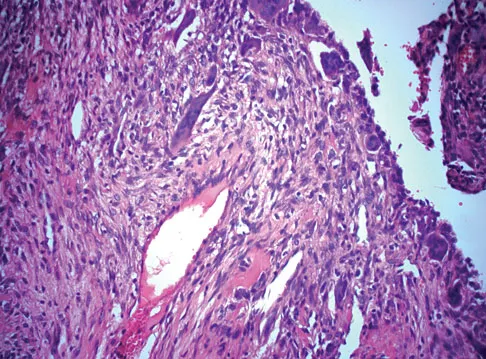
Figures 56a through 56c show the radiograph, CT scan, and biopsy specimen of a 44-year-old man who underwent chemotherapy and radiation therapy for lymphoma of the distal femur 20 years ago. His current problem is most likely related to
<img class="q-img mcq-img" src="/media/upload/general-orthopedics-2026-set-8-mcqs-4063-figure-26.webp"/>
<button class="opt-btn" data-qid="702" onclick="handleSelect(this, '702', 0)">
<span class="opt-char">A</span>
<span>steroid-induced osteonecrosis.</span>
</button>
<button class="opt-btn" data-qid="702" onclick="handleSelect(this, '702', 1)">
<span class="opt-char">B</span>
<span>radiation therapy with secondary malignancy.</span>
</button>
<button class="opt-btn" data-qid="702" onclick="handleSelect(this, '702', 2)">
<span class="opt-char">C</span>
<span>recurrence of the lymphoma.</span>
</button>
<button class="opt-btn" data-qid="702" onclick="handleSelect(this, '702', 3)">
<span class="opt-char">D</span>
<span>radiation osteitis.</span>
</button>
<button class="opt-btn" data-qid="702" onclick="handleSelect(this, '702', 4)">
<span class="opt-char">E</span>
<span>a primary lung tumor.</span>
</button>
<button onclick="toggleExp('702')" style="background:none; border:none; color:#7f8c8d; text-decoration:underline; cursor:pointer;">Show Explanation</button>
<span class="exp-title">Detailed Explanation</span><div markdown="1">The patient has changes consistent with radiation therapy to the femur, including osteopenia and an aggressive appearing neoplasm. The tumor is most likely a radiation-induced sarcoma. This is more likely than recurrent lymphoma at this late date. It is not related to steroid use or a primary lung tumor. Mirra J (ed): Bone Tumors: Clinical, Radiologic and Pathologic Correlations. Philadelphia, PA, Lea and Febiger, 1989, p 353.
<strong>References:</strong><ul><li>Huvos A, Woodard H, Cahan W, et al: Postradiation osteogenic sarcoma of bone and soft tissue. A clinical pathologic study of 66 Patients. Cancer 1985;55:1244.</li></ul>
<span>Question 703</span> <span>High Yield</span>
Figures 57a through 57c show the radiographs of a patient who has pain, discomfort, and a popping sensation localized to the posterior aspect of the knee after undergoing primary left total knee arthroplasty 6 months ago. Examination reveals that the patient is able to ambulate without a limp. There is no significant swelling, erythema, or effusion. Range of motion is 0 degrees to 115 degrees, and a palpable crepitation or snapping is detected at the posterior lateral joint line. What is the most likely diagnosis?
<img class="q-img mcq-img" src="/media/upload/general-orthopedics-2026-set-8-mcqs-4063-figure-2.webp"/>
<button class="opt-btn" data-qid="703" onclick="handleSelect(this, '703', 0)">
<span class="opt-char">A</span>
<span>Popliteal snapping syndrome</span>
</button>
<button class="opt-btn" data-qid="703" onclick="handleSelect(this, '703', 1)">
<span class="opt-char">B</span>
<span>Patellar clunk syndrome</span>
</button>
<button class="opt-btn" data-qid="703" onclick="handleSelect(this, '703', 2)">
<span class="opt-char">C</span>
<span>Subluxation secondary to a tight posterior cruciate ligament</span>
</button>
<button class="opt-btn" data-qid="703" onclick="handleSelect(this, '703', 3)">
<span class="opt-char">D</span>
<span>Soft-tissue irritation secondary to retained polymethylmethacrylate</span>
</button>
<button class="opt-btn" data-qid="703" onclick="handleSelect(this, '703', 4)">
<span class="opt-char">E</span>
<span>Patellar subluxation secondary to a tight lateral retinaculum</span>
</button>
<button onclick="toggleExp('703')" style="background:none; border:none; color:#7f8c8d; text-decoration:underline; cursor:pointer;">Show Explanation</button>
<span class="exp-title">Detailed Explanation</span><div markdown="1">Popliteal snapping syndrome represents the most likely diagnosis. Barnes and Scott noted that the popliteus tendon can be a potential source of internal derangement after total knee arthroplasty. They noted that it can be subluxated anteriorly and posteriorly over a retained lateral femoral condyle osteophyte. Allardyce and associates described the condition as a popliteus condition, snapping as it rolls over a retained lateral femoral condylar osteophyte. Patellar clunk syndrome is a distinct syndrome associated with the patella and has been reported in posterior stabilized knees. In addition to crepitation with range of motion, the patella literally snaps or jumps as the knee is taken from flexion to extension. Beight JL, Yao B, Hozack WJ, et al: The patellar "clunk" syndrome after posterior stabilized total knee arthroplasty. Clin Orthop 1994;299:139-142. Barnes CL, Scott RD: Popliteus tendon dysfunction following total knee arthroplasty. J Arthroplasty 1995;10:543-545.
<strong>References:</strong><ul><li>Allardyce TJ, Scuderi GR, Insall JN: Arthroscopic treatment of popliteus tendon dysfunction following total knee arthroplasty. J Arthroplasty 1997;12:353-355.</li></ul>
