Orthopedic Upper Extremity 2026 MCQs: Board Review Questions & Answers (Part 5)

Key Takeaway
Looking for accurate information on Orthopedic Upper Extremity 2026 MCQs: Board Review Questions & Answers (Part 5)? Top-rated Orthopedic Upper Extremity 2026 MCQs bank. Practice with clinical case questions, orthopedic surgery board review, and evidence-based answers updated for 2026.
Orthopedic Upper Extremity 2026 MCQs: Board Review Questions & Answers (Part 5)
Comprehensive 100-Question Exam
00:00
Start Quiz
Question 1
A 45-year-old woman who recently underwent biopsy of a lymph node in the right posterior cervical triangle now finds it difficult to hold objects overhead and has diffuse aching in the right shoulder region. What is the most likely diagnosis?
Explanation
Question 2
The posterior cord of the brachial plexus terminates into what two main branches?
Explanation
Question 3
Atraumatic neuropathy of the suprascapular nerve usually occurs at what anatomic location?
Explanation
Question 4
A 22-year-old patient underwent successful reduction of a posterolateral elbow dislocation. Management should now consist of
Explanation
Question 5
A 56-year-old woman who underwent axillary node dissection 4 months ago now reports shoulder pain, weakness of forward elevation, and obvious winging of the scapula. What structure has been injured?
Explanation
Question 6
The lateral arm flap is based on what arterial supply?
Explanation
Question 7
A 32-year-old man has a closed oblique displaced fracture at the junction of the lower and middle third of the humeral shaft and a complete radial nerve palsy. Closed reduction is performed and is felt to be acceptable. Management of the radial nerve palsy should consist of
Explanation
Question 8
A 19-year-old man sustains a low-velocity gunshot wound to the forearm. What factor most strongly correlates with the development of compartment syndrome after this injury?
Explanation
Question 9
A 30-year-old farmer undergoes replantation of an above-the-elbow amputation. What form of management is most important following this surgery?
Explanation
Question 10
Figures 44a through 44c show the radiographs of an 18-year-old female soccer player who fell on her outstretched hand 1 day ago. She denies any history of wrist pain. Examination reveals tenderness at the anatomic snuffbox. Management should consist of
Explanation
Question 11
An excessively large radial styloidectomy poses a risk for wrist instability. What ligament is at greatest risk for injury?
Explanation
Question 12
What joint always remains uninvolved in all stages of scapholunate advanced collapse (SLAC) deformity of the wrist?
Explanation
Question 13
Free flap coverage for severe trauma to the upper extremity has the fewest complications when performed within what time period after injury?
Explanation
Question 14
A 54-year-old woman with idiopathic carpal tunnel syndrome undergoes open carpal tunnel release with a flexor tenosynovectomy. The pathology from the tenosynovium is likely to show
Explanation
Question 15
Examination of a 10-year-old girl with a hypoplastic breast and atrophic pectoralis major may also reveal which of the following findings?
Explanation
Question 16
Figures 45a and 45b show the radiographs of a 40-year-old woman with rheumatoid arthritis who is unable to straighten her ring and little fingers. Examination reveals that the fingers can be passively corrected, but she is unable to actively maintain the fingers in extension. Management should consist of
Explanation
Question 17
Figures 46a through 46e show the radiographs of a 22-year-old man who injured his wrist in a motorcycle accident. He has no other injuries. What is the best course of action?
Explanation
Question 18
A 36-year-old nurse has had redness, pain, and small vesicles on the pulp of her middle finger for the past 3 days. Management should consist of
Explanation
Question 19
A 35-year-old man has numbness and tingling in the index, middle, and ring fingers. History reveals that he also has had vague wrist pain and stiffness since being injured in a motorcycle accident 1 year ago. Radiographs are shown in Figures 47a through 47c. Management should consist of
Explanation
Question 20
A 42-year-old woman has persistent thumb pain that she notes is worse with opening jars and turning her car key. Opponens splinting provides some relief, but she is poorly tolerant of the splint. Finkelstein's test is negative, and a carpometacarpal grind test is positive. The radiographs shown in Figures 48a and 48b reveal minimal degenerative changes at the first carpometacarpal joint. What is the best course of action?
Explanation
Question 21
A 45-year-old man sustains a low-velocity gunshot wound to the base of the right thumb. The open wound is allowed to heal by secondary intention, resulting in a contracture of the first web space. Clinical photographs are shown in Figures 49a through 49c. Treatment should now consist of
Explanation
Question 22
The vessel seen in the clinical photographs shown in Figures 50a and 50b (1,2 intercompartmental supraretinacular artery) is being dissected to be used as a source of vascularized bone graft for a patient who is scheduled to undergo internal fixation of a scaphoid nonunion. This vessel is a branch of what artery?
Explanation
Question 23
The flap shown in the clinical photograph seen in Figure 51 is based on what arterial supply?
Explanation
Question 24
A 63-year-old woman who sustained a distal radial fracture 2 months ago now reports that she is unable to achieve active extension of the thumb at the interphalangeal joint. What type of trauma may lead to this clinical finding?
Explanation
Question 25
What radiographic view will best reveal degeneration of the pisotriquetral joint in a patient who is being evaluated for pisotriquetral arthrosis?
Explanation
Question 26
A surgeon is performing an open reduction and internal fixation of a complex capitellar fracture involving the trochlea. The surgical plan requires exposing the radiocapitellar joint. If the surgeon utilizes the Kaplan approach, which of the following describes the correct internervous/intermuscular interval?
Explanation
Question 27
A 68-year-old man presents with chronic right shoulder pain and an inability to actively elevate his arm above 40 degrees. Passive elevation is preserved to 160 degrees. MRI demonstrates a massive, retracted tear of the supraspinatus and infraspinatus with advanced fatty infiltration (Goutallier stage 4), while the subscapularis and teres minor are intact. What is the most reliable surgical option to restore active forward elevation in this patient?
Explanation
Question 28
A 30-year-old man sustains a midshaft humerus fracture resulting in a complete, high radial nerve palsy. After 14 months of observation and serial EMGs showing no signs of reinnervation, tendon transfers are planned. To optimally restore active wrist extension, which of the following is the most standard and reliable donor muscle?
Explanation
Question 29
A 42-year-old woman reports sudden onset of severe, unprovoked left forearm and shoulder pain that lasted for two weeks and has now resolved. However, she currently complains of difficulty writing and an inability to form an 'OK' sign with her thumb and index finger. She has no numbness or tingling. What is the most likely diagnosis and recommended initial management?
Explanation
Question 30
A 45-year-old man complains of chronic right wrist pain 10 years after a fall.
Radiographs reveal a scaphoid nonunion with arthritic changes at the radioscaphoid joint and the capitolunate joint. The radiolunate joint is completely spared. What is the most appropriate surgical treatment?

Explanation
Question 31
A 32-year-old patient presents with a sensation of their elbow 'giving way' and clicking when pushing up from a chair with the forearm supinated. Clinical examination reveals a positive lateral pivot-shift test of the elbow. Deficiency of which of the following structures is the primary cause of this condition?
Explanation
Question 32
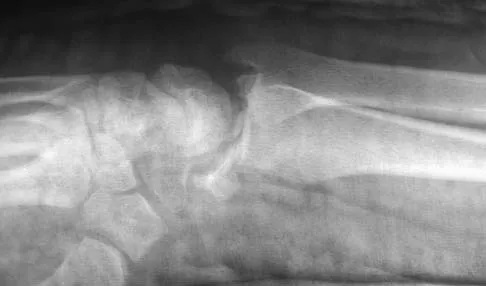
A 55-year-old woman is seen 6 months after undergoing volar locking plate fixation for a displaced distal radius fracture.
She reports a recent, sudden inability to flex the interphalangeal joint of her thumb. She experienced some volar wrist crepitus in the weeks prior. What is the most likely etiology of her new deficit?
Explanation
Question 33
A 35-year-old carpenter presents with worsening dorsal wrist pain. Radiographs show sclerosis and fragmentation of the lunate, with preserved carpal height (no collapse). The patient has a negative ulnar variance of 3 mm. According to the Lichtman classification, the patient has Stage IIIa Kienbock's disease. Which of the following is the most widely accepted surgical intervention for this specific presentation?
Explanation
Question 34
A 24-year-old motorcyclist sustains a severe traction injury to his left brachial plexus. He has a flail, completely insensate left arm. Physical examination also reveals ipsilateral ptosis, miosis, and anhidrosis. The presence of these specific facial and ocular findings most strongly indicates which of the following injury patterns?
Explanation
Question 35
A 22-year-old male sustains a completely displaced midshaft clavicle fracture following a cycling fall. In evaluating whether to proceed with non-operative management versus open reduction and internal fixation (ORIF), which of the following physical examination or radiographic findings is considered an absolute or strong relative indication for immediate ORIF?
Explanation
Question 36
A 40-year-old man falls from a height and sustains a posterolateral elbow dislocation, radial head fracture, and coronoid fracture. Following closed reduction, the joint remains unstable in extension. During operative management, what is the generally recommended sequence of reconstruction to restore elbow stability?
Explanation
Question 37
A 65-year-old woman undergoes open reduction and internal fixation of a distal radius fracture with a volar locking plate. Six months postoperatively, she presents with inability to actively flex the interphalangeal joint of her thumb. Radiographs show the fracture is fully healed. What was the most likely surgical error that led to this complication?
Explanation
Question 38
A 50-year-old manual laborer presents with chronic right wrist pain. Radiographs reveal advanced osteoarthritis involving the radioscaphoid and capitolunate joints, with preservation of the radiolunate joint. Which of the following is the most appropriate motion-preserving surgical treatment?
Explanation
Question 39
A 22-year-old athlete sustains a proximal pole scaphoid fracture. Due to the high risk of nonunion and avascular necrosis, operative fixation is planned. Which surgical approach and fixation strategy is most appropriate for this specific fracture pattern?
Explanation
Question 40
A 28-year-old overhead athlete complains of poorly localized posterior shoulder pain and paresthesias over the lateral deltoid. MRI of the shoulder reveals isolated atrophy and fatty infiltration of the teres minor muscle. Which of the following anatomic structures form the borders of the space where the affected nerve is likely compressed?
Explanation
Question 41
A 45-year-old competitive weightlifter suffers an acute distal biceps tendon rupture. The surgeon utilizes a two-incision technique (modified Boyd-Anderson) to reattach the tendon to the radial tuberosity. Compared to a single anterior incision technique, the two-incision approach is associated with a higher risk of which of the following postoperative complications?
Explanation
Question 42
A 35-year-old man presents with a sense of clicking and instability in his elbow when pushing himself up from a chair. He underwent a lateral epicondylar release for recalcitrant 'tennis elbow' one year ago. On physical examination, with the patient supine and the shoulder flexed, applying an axial load, valgus stress, and supination to the elbow as it is moved from extension to flexion produces a palpable clunk. Deficiency of which of the following structures is most likely responsible for his symptoms?
Explanation
Question 43
A 32-year-old carpenter presents with a 6-month history of central dorsal wrist pain and decreased grip strength. Radiographs reveal sclerosis and early fragmentation of the lunate, but no carpal collapse is noted. Radiographic measurements demonstrate a negative ulnar variance of 3 mm. Which of the following surgical interventions is most appropriate to halt disease progression?
Explanation
Question 44
A 72-year-old man with severe pseudoparalysis and glenohumeral osteoarthritis secondary to a massive, irreparable rotator cuff tear is scheduled for a reverse total shoulder arthroplasty (RTSA). Preoperative evaluation demonstrates absent active external rotation with the arm at the side (positive Hornblower's sign and dropped arm sign). In addition to RTSA, what adjunctive procedure is most appropriate to optimize this patient's postoperative ability to perform activities of daily living?
Explanation
Question 45
A 25-year-old man sustains a closed, distal-third spiral fracture of the humeral shaft (Holstein-Lewis fracture). Upon initial presentation in the emergency department, he exhibits a complete inability to extend his wrist, thumb, and metacarpophalangeal joints, along with numbness in the first dorsal web space. According to current orthopedic guidelines, what is the most appropriate initial management of this injury?
Explanation
Question 46
A 65-year-old female undergoes a reverse total shoulder arthroplasty (RTSA) for a comminuted 4-part proximal humerus fracture. Six months postoperatively, she presents with severe shoulder aching and stiffness, though she lacks systemic symptoms. Laboratory results show a normal ESR and CRP. Joint aspiration cultures grow Cutibacterium acnes after 10 days. Which of the following is true regarding this infection in the setting of shoulder arthroplasty?
Explanation
Question 47
A 42-year-old male construction worker presents with chronic numbness in his small and ring fingers and weakness in grip strength. Exam reveals a positive Froment's sign and intrinsic muscle atrophy. Intraoperatively, during decompression, the ulnar nerve is found to subluxate anteriorly over the medial epicondyle upon elbow flexion. What is the most appropriate surgical management?
Explanation
Question 48
A 30-year-old male presents with chronic radial-sided wrist pain following a remote injury. Radiographs demonstrate a scaphoid nonunion with radioscaphoid and capitolunate arthritis. The radiolunate joint is radiographically preserved. What is the most appropriate surgical intervention for this stage of Scaphoid Nonunion Advanced Collapse (SNAC)?
Explanation
Question 49
A 48-year-old weightlifter feels a 'pop' in his anterior elbow during a heavy deadlift, followed by ecchymosis and weakness in supination. MRI confirms a complete distal biceps tendon avulsion. He opts for surgical repair using a single-incision anterior approach. Which nerve is at greatest risk of iatrogenic injury during the superficial dissection of this specific surgical approach?
Explanation
Question 50
A 6-year-old boy sustains an extension-type Gartland type III supracondylar humerus fracture. Upon initial evaluation, he has an absent radial pulse, but the hand is pink, warm, and has a brisk capillary refill. Following closed reduction and percutaneous pinning, the radial pulse remains absent, but the hand's perfusion status is unchanged (pink and warm). What is the next most appropriate step in management?
Explanation
Question 51
A 24-year-old female gymnast presents with progressive dorsal wrist pain. Radiographs reveal sclerosis of the lunate with no carpal collapse (Lichtman Stage II). Ulnar variance is determined to be negative 3 mm. MRI confirms Kienböck's disease. Which of the following is the most appropriate surgical treatment?
Explanation
Question 52
A 72-year-old male presents with pseudoparalysis of the right shoulder and severe glenohumeral osteoarthritis secondary to massive rotator cuff arthropathy. He is planned for a Grammont-style reverse total shoulder arthroplasty (RTSA). How is the center of rotation biomechanically altered in this implant design compared to the native shoulder?
Explanation
Question 53
A 35-year-old male sustains a 'terrible triad' injury of the elbow (elbow dislocation, radial head fracture, and coronoid fracture). When operating to restore elbow stability, which of the following is the generally accepted sequence of surgical repair?
Explanation
Question 54
A 28-year-old tennis player complains of chronic ulnar-sided wrist pain. MRI confirms a central articular disc tear of the triangular fibrocartilage complex (TFCC) (Palmer Type 1A). Radiographs reveal a positive ulnar variance of 4 mm. Conservative management has failed. What is the most appropriate surgical management?
Explanation
Question 55
A 19-year-old male presents to the trauma bay after a high-speed motor vehicle collision complaining of severe pain at the base of his neck, dysphagia, and a choking sensation. The medial end of the right clavicle is not palpable anteriorly. A CT scan of the chest confirms a posterior sternoclavicular dislocation. As the surgical team prepares for closed reduction in the operating room, which of the following specialist teams must ideally be immediately available?
Explanation
Question 56
A 42-year-old male falls on an outstretched hand and sustains a terrible triad injury of the elbow. Standard surgical protocol dictates repairing structures from deep to superficial to restore elbow stability. Which of the following describes the most appropriate sequence of surgical repair?
Explanation
Question 57
A 65-year-old woman is 6 months status-post open reduction and internal fixation of a distal radius fracture with a volar locking plate. She presents with a sudden inability to actively flex the interphalangeal joint of her thumb. Which of the following surgical errors is most commonly associated with this complication?
Explanation
Question 58
A 24-year-old elite volleyball player complains of vague posterior shoulder pain and weakness with overhead serving. Physical examination reveals atrophy of the infraspinatus but normal bulk of the supraspinatus. There is notable weakness in external rotation but normal abduction. An MRI shows a paralabral cyst. In which of the following anatomic locations is the cyst most likely compressing the involved nerve?
Explanation
Question 59
A 72-year-old female sustains a severe 4-part proximal humerus fracture. She undergoes a reverse total shoulder arthroplasty (RTSA). Which of the following represents the most significant biomechanical advantage of RTSA over an anatomic total shoulder arthroplasty in this specific clinical setting?
Explanation
Question 60
A 21-year-old male fell on an outstretched hand 3 months ago and was treated conservatively for a 'sprained wrist.' He now presents with persistent radial-sided wrist pain. Radiographs reveal a scaphoid waist fracture with cystic changes and 2 mm of displacement. What is the primary blood supply to the proximal pole of the scaphoid, which places it at high risk for avascular necrosis in this fracture pattern?
Explanation
Question 61
A 45-year-old male undergoes surgical repair of an acute distal biceps tendon rupture using a standard 2-incision technique. Postoperatively, he exhibits a specific nerve palsy. Which of the following nerves is at greatest risk during the posterior approach of the 2-incision technique if the forearm is not fully pronated during surgical exposure?
Explanation
Question 62
A 32-year-old male sustains a closed, distal-third spiral fracture of the humeral shaft (Holstein-Lewis fracture). On initial presentation, he has a complete radial nerve palsy. He is treated with functional bracing. Twelve weeks later, there is radiographic evidence of early bridging callus, but the patient still has no clinical or electromyographic (EMG) evidence of radial nerve recovery. What is the most appropriate next step in management?
Explanation
Question 63
A 55-year-old manual laborer presents with chronic, intractable posterior shoulder pain and profound weakness in external rotation. He has a positive Hornblower's sign and a positive dropping sign. MRI demonstrates a massive, retracted, and irreparably atrophic tear of the infraspinatus and teres minor, with an intact subscapularis. Which of the following tendon transfers is most appropriate to restore external rotation in this patient?
Explanation
Question 64
A 28-year-old male sustains a diaphyseal fracture of the middle third of the radius with an associated disruption of the distal radioulnar joint (DRUJ) after a fall. Intraoperatively, after rigid open reduction and internal fixation of the radius, the DRUJ is found to reduce anatomically and is stable in supination, but it readily subluxates when the forearm is placed in pronation. What is the most appropriate management of the DRUJ?
Explanation
Question 65
A 34-year-old carpenter presents with an 8-month history of insidious onset, progressive dorsal wrist pain and limited extension. Radiographs show sclerosis and partial fragmentation of the lunate, with no evidence of carpal collapse or secondary osteoarthritis (Lichtman Stage IIIA). His ulnar variance is negative (-3 mm). Which of the following is the most appropriate surgical intervention?
Explanation
Question 66
A 70-year-old woman with advanced rotator cuff tear arthropathy is scheduled for a reverse total shoulder arthroplasty (RTSA). During preoperative templating and intraoperative execution, which of the following glenosphere positioning strategies is most effective in minimizing the risk of scapular notching?
Explanation
Question 67
A 34-year-old man presents with recurrent clicking, apprehension, and a sensation of 'giving way' in his right elbow, particularly when attempting to push himself out of a chair. Physical examination reveals a positive lateral pivot-shift test of the elbow. Which of the following ligamentous structures is primarily deficient in this specific instability pattern?
Explanation
Question 68
A 55-year-old woman sustained a non-displaced distal radius fracture treated non-operatively in a short arm cast. Eight weeks post-injury, she reports a sudden, painless inability to extend her thumb interphalangeal joint. On examination, she is unable to lift her thumb off the table when the palm is laid flat. What is the most appropriate surgical management to restore thumb kinematics?
Explanation
Question 69
During an open carpal tunnel release, the surgeon carefully dissects the transverse carpal ligament and identifies the recurrent motor branch of the median nerve piercing directly through the substance of the ligament. According to the Lanz classification of median nerve variations, which subtype does this represent?
Explanation
Question 70
A 24-year-old male presents with a displaced fracture involving the proximal pole of the scaphoid. Regarding the surgical management and relevant vascular anatomy, which of the following statements is true?
Explanation
Question 71
A 68-year-old female sustains a 3-part anterior fracture-dislocation of her right proximal humerus after a mechanical fall. Upon presentation in the emergency department, she exhibits decreased sensation over the lateral aspect of her shoulder. Which of the following physical examination findings would most likely accompany this isolated neurological deficit once the fracture is stabilized?
Explanation
Question 72
A 42-year-old male weightlifter feels a sudden 'pop' in his anterior elbow while performing heavy eccentric bicep curls. He presents with ecchymosis in the antecubital fossa and a positive 'hook test.' To restore maximum functional strength, surgical repair should anatomically reattach the tendon to which of the following structures?
Explanation
Question 73
A 55-year-old carpenter presents with a 6-month history of paresthesias in the right small and ulnar half of the ring finger, along with subjective weakness in hand grip. Electromyography confirms a compressive ulnar neuropathy at the elbow. During surgical decompression, the surgeon must systematically release several potential sites of compression. Which of the following anatomic structures is NOT a recognized site of ulnar nerve compression in this region?
Explanation
Question 74
A 32-year-old manual laborer presents with progressive dorsal wrist pain and decreased grip strength. Radiographs demonstrate increased sclerosis of the lunate without carpal collapse or fragmentation, and a negative ulnar variance of 3 mm. MRI confirms avascular necrosis of the lunate. According to the Lichtman classification, this represents Stage II disease. Which of the following surgical interventions is most appropriate for this patient?
Explanation
Question 75
While managing a 28-year-old cyclist who sustained a midshaft clavicle fracture, the orthopedic surgeon reviews the indications for operative intervention. Which of the following is considered an ABSOLUTE indication for open reduction and internal fixation of an acute clavicle fracture?
Explanation
Question 76
A 72-year-old woman is 3 years post Reverse Total Shoulder Arthroplasty (RTSA). Radiographs show Grade 3 scapular notching. Which of the following surgical techniques or implant designs would most effectively minimize the risk of this complication?
Explanation
Question 77
A 22-year-old collegiate baseball pitcher undergoes ulnar collateral ligament (UCL) reconstruction using a palmaris longus autograft via the docking technique. What is the most common complication following this procedure?
Explanation
Question 78
A 45-year-old male falls on an outstretched hand, sustaining a 'terrible triad' injury of the elbow. Intraoperatively, after secure fixation of the coronoid process and stable radial head arthroplasty, the elbow remains unstable and tends to subluxate posteriorly in extension. What is the next most appropriate step in management?
Explanation
Question 79
A 38-year-old weightlifter undergoes a single-incision anterior approach for distal biceps tendon repair using suture anchors. Postoperatively, he notes a new onset of numbness along the radial aspect of his volar forearm. Which of the following nerves is most likely injured, and what is its motor innervation?
Explanation
Question 80
A 28-year-old professional volleyball player presents with insidious onset of right shoulder pain and weakness. Examination reveals isolated atrophy of the infraspinatus muscle with normal bulk of the supraspinatus. MRI demonstrates a paralabral cyst. At which anatomic location is the nerve compression most likely occurring?
Explanation
Question 81
A 55-year-old man presents with a chronic, massive, irreparable posterosuperior rotator cuff tear. He has preserved forward elevation but a severe lack of active external rotation with a positive Hornblower's sign. He undergoes a lower trapezius tendon transfer prolonged with an Achilles tendon allograft. Which of the following nerves must be carefully protected during the harvest and mobilization of the lower trapezius?
Explanation
Question 82
A 62-year-old woman sustains a displaced 3-part proximal humerus fracture. The orthopaedic surgeon plans open reduction and internal fixation via a deltopectoral approach. To avoid iatrogenic injury, the surgeon must be mindful of the axillary nerve. Which of the following accurately describes the normal anatomic course of the axillary nerve?
Explanation
Question 83
A 42-year-old man presents with a history of sudden, severe, unremitting right shoulder pain lasting for 2 weeks that woke him from sleep. The pain has now largely resolved, but he has noticed profound weakness in shoulder abduction and external rotation. There is no history of trauma. EMG at 4 weeks reveals acute denervation changes in the supraspinatus and deltoid. What is the most likely diagnosis and appropriate initial management?
Explanation
Question 84
During an in situ ulnar nerve decompression for cubital tunnel syndrome, a surgeon sequentially releases the structures of the cubital tunnel. Which of the following structures constitutes the primary roof of the cubital tunnel?
Explanation
Question 85
A 33-year-old carpenter falls from a ladder, sustaining a comminuted radial head fracture. Following radial head excision at an outside facility, he develops chronic wrist pain and proximal migration of the radius. This complication is a result of the undiagnosed disruption of which of the following structures?
Explanation
Question 86
A 65-year-old woman sustained a non-displaced distal radius fracture treated in a short arm cast for 4 weeks. Six weeks post-injury, she reports a sudden, painless loss of the ability to extend her thumb at the interphalangeal joint. Tenodesis effect of the thumb is absent. What is the most likely diagnosis?
Explanation
Question 87
A 38-year-old man presents with chronic, progressive wrist pain and stiffness. Radiographs demonstrate a scaphoid nonunion advanced collapse (SNAC) pattern. There is established arthritis of the radioscaphoid joint and the capitolunate joint, but the radiolunate joint is completely spared. Which of the following is the most appropriate surgical intervention?
Explanation
Question 88
A 6-year-old boy is brought to the emergency department after falling from monkey bars. He has a widely displaced, extension-type supracondylar humerus fracture. His hand is pink and warm, but the radial pulse is absent to palpation. He undergoes closed reduction and percutaneous pinning. Post-operatively, the hand remains pink, warm, and well-perfused with brisk capillary refill, but the radial pulse remains non-palpable and is faintly audible on Doppler. What is the most appropriate next step in management?
Explanation
Question 89
A 72-year-old woman sustains a 3-part proximal humerus fracture after a fall from standing height. Which of the following physical examination findings is the most reliable acute indicator of injury to the nerve most commonly affected by this fracture pattern?
Explanation
Question 90
A 28-year-old skier sustains an acute abduction injury to his right thumb. Examination reveals significant laxity to valgus stress at the metacarpophalangeal (MCP) joint with no firm endpoint. An MRI demonstrates the adductor aponeurosis interposed between the ruptured ulnar collateral ligament (UCL) and its insertion site on the proximal phalanx. What is the name of this pathoanatomic lesion and the recommended treatment?
Explanation
Question 91
A 45-year-old male weightlifter felt a sudden pop in his anterior elbow while performing heavy bicep curls. He presents with local ecchymosis and weakness in forearm supination. Which of the following clinical tests has the highest sensitivity and specificity for diagnosing a complete rupture of the distal biceps tendon?
Explanation
Question 92
Which of the following scenarios is considered an absolute indication for operative fixation of an acute midshaft clavicle fracture?
Explanation
Question 93
During an open carpal tunnel release, the surgeon must completely divide the transverse carpal ligament to decompress the median nerve. Which specific carpal bones serve as the radial and ulnar osseous attachment sites for this ligament?
Explanation
Question 94
A 50-year-old mechanic complains of numbness in his small and ring fingers, accompanied by intrinsic muscle weakness. Electromyography (EMG) confirms compressive neuropathy of the ulnar nerve at the elbow. Which of the following anatomic structures represents the most common site of ulnar nerve compression in this syndrome?
Explanation
Question 95
A 34-year-old man sustains a "terrible triad" injury of the elbow after falling from a ladder. What three anatomic injuries characterize this condition, and what is the standard recommended surgical repair sequence?
Explanation
Question 96
A 35-year-old man sustains a closed transverse fracture of the middle third of the humerus. On initial evaluation in the emergency department, he has an isolated, complete radial nerve palsy. Radiographs show acceptable fracture alignment. What is the most appropriate initial management?
Explanation
Question 97
A 42-year-old male undergoes a two-incision technique for repair of a ruptured distal biceps tendon. Postoperatively, he is noted to have a new-onset nerve deficit characterized by the inability to actively extend his thumb and fingers at the metacarpophalangeal joints. When he attempts to extend his wrist, it deviates radially. Injury to which of the following nerves is the most likely cause?
Explanation
Question 98
A 28-year-old carpenter presents with a swollen, painful index finger 3 days after sustaining a puncture wound from a wood splinter. Examination reveals a finger held in slight flexion, fusiform swelling, and tenderness along the entire flexor tendon sheath. Which of the following signs is considered the most reliable and specific for diagnosing suppurative flexor tenosynovitis in its early stages?
Explanation
Question 99
During an anterior submuscular transposition of the ulnar nerve for refractory cubital tunnel syndrome, the surgeon must mobilize the nerve proximally to prevent tethering. Which of the following structures is located approximately 8 cm proximal to the medial epicondyle and must be carefully released to prevent a new site of nerve compression?
Explanation
Question 100
A 52-year-old man presents with chronic wrist pain and decreased grip strength. Radiographs reveal a chronic scaphoid nonunion with advanced osteoarthritic changes at the radioscaphoid and capitolunate joints. The radiolunate joint shows no evidence of arthritis. Which of the following is the most appropriate surgical treatment?
Explanation
None
