General Orthopedics Board Review 2026: High-Yield MCQs (Set 2)
27 Apr 2026
131 min read
82 Views
Key Takeaway
This article provides essential research regarding General Orthopedics Board Review 2026: High-Yield MCQs (Set 2). Access high-yield General Orthopedics questions for the 2026 board exam. This module (Set 2) covers critical topics including surgical techniques, pathology, and treatment protocols with verified answers.
HY 2026
00:00
Start Quiz
Question 101 High Yield
Epithelioid sarcoma most commonly occurs in which of the following anatomic locations?
Detailed Explanation
Epithelioid sarcoma is a rare soft-tissue sarcoma that most commonly arises in the hand or upper extremity, and it is frequently misdiagnosed as an infection or granuloma. It tends to have a higher incidence of lymph node metastasis than other soft-tissue sarcomas. The mainstay of treatment is wide surgical excision, even if amputation is necessary. Gupta TD, Chaudhuri P (eds): Tumors of the Soft Tissues, ed 2. Stamford, CT, Appleton and Lange, 1998, p 475.
References:
- Enzinger FM, Weiss SW: Soft Tissue Tumors, ed 3. St. Louis, MO, Mosby-Year Book, 1995, p 1074.
<span>Question 102</span> <span>High Yield</span>
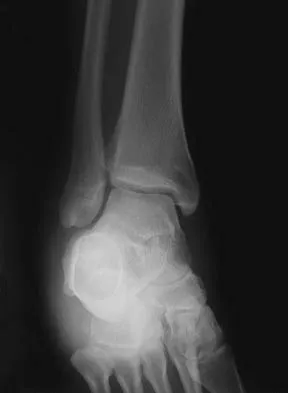
What is the primary mechanism of injury for the fracture shown in Figures 33a and 33b?
<img class="q-img mcq-img" src="/media/upload/general-orthopedics-2026-set-2-mcqs-4057-figure-21.webp"/>
<button class="opt-btn" data-qid="102" onclick="handleSelect(this, '102', 0)">
<span class="opt-char">A</span>
<span>Hyperdorsiflexion</span>
</button>
<button class="opt-btn" data-qid="102" onclick="handleSelect(this, '102', 1)">
<span class="opt-char">B</span>
<span>External rotation of the foot</span>
</button>
<button class="opt-btn" data-qid="102" onclick="handleSelect(this, '102', 2)">
<span class="opt-char">C</span>
<span>Internal rotation of the foot</span>
</button>
<button class="opt-btn" data-qid="102" onclick="handleSelect(this, '102', 3)">
<span class="opt-char">D</span>
<span>Adduction of the foot and ankle</span>
</button>
<button class="opt-btn" data-qid="102" onclick="handleSelect(this, '102', 4)">
<span class="opt-char">E</span>
<span>Excessive eversion of the foot and ankle</span>
</button>
<button onclick="toggleExp('102')" style="background:none; border:none; color:#7f8c8d; text-decoration:underline; cursor:pointer;">Show Explanation</button>
<span class="exp-title">Detailed Explanation</span><div markdown="1">The radiographs show a triplane fracture of the ankle. In adolescence, closure of the distal tibial physis starts peripherally at the anteromedial aspect of the medial malleolus and extends posteriorly and laterally. The anterolateral quadrant of the physis is the last to close, making this region the most susceptible to separation. When the foot is twisted into external rotation, the anterolateral portion of the epiphysis is avulsed by the pull of the anterior tibiofibular ligament. When this fragment alone is avulsed, the result is a juvenile Tillaux fracture. When the fracture extends to involve the remainder of the physis and posterior metaphysis, as in this patient, the result is a triplane fracture. Richards BS (ed): Orthopaedic Knowledge Update: Pediatrics. Rosemont, Ill, American Academy of Orthopaedic Surgeons, 1996, pp 267-272. Dias LS, Giegerich CR: Fractures of the distal tibial epiphysis in adolescence. J Bone Joint Surg Am 1983;65:438-444.
<strong>References:</strong><ul><li>Kling TF Jr: Operative treatment of ankle fractures in children. Orthop Clin North Am 1990;21:381-392.</li></ul>
<span>Question 103</span> <span>High Yield</span>
An 11-year-old basketball player reports that he felt a painful pop in the left knee when he stumbled while running. He is unable to bear weight on the extremity and cannot actively extend the knee against gravity. Examination reveals a large knee effusion. A lateral radiograph is shown in Figure 7. Management should consist of
<img alt="General Orthopedics Board Review 2026: High-Yield MCQs (Set 2) - Figure 3" class="q-img mcq-img" height="393" loading="lazy" onclick="window.open(this.src)" src="/media/mcq-images/25/general-orthopedics-2026-set-2-mcqs-4057-fig-3.webp" title="Click to enlarge" width="268"/>
<button class="opt-btn" data-qid="103" onclick="handleSelect(this, '103', 0)">
<span class="opt-char">A</span>
<span>physical therapy for quadriceps strengthening exercises.</span>
</button>
<button class="opt-btn" data-qid="103" onclick="handleSelect(this, '103', 1)">
<span class="opt-char">B</span>
<span>a long leg cast with the knee fully extended.</span>
</button>
<button class="opt-btn" data-qid="103" onclick="handleSelect(this, '103', 2)">
<span class="opt-char">C</span>
<span>excision of the fragment.</span>
</button>
<button class="opt-btn" data-qid="103" onclick="handleSelect(this, '103', 3)">
<span class="opt-char">D</span>
<span>suture reattachment of the patellar tendon to the tibial tuberosity.</span>
</button>
<button class="opt-btn" data-qid="103" onclick="handleSelect(this, '103', 4)">
<span class="opt-char">E</span>
<span>open reduction and tension band fixation.</span>
</button>
<button onclick="toggleExp('103')" style="background:none; border:none; color:#7f8c8d; text-decoration:underline; cursor:pointer;">Show Explanation</button>
<span class="exp-title">Detailed Explanation</span><div markdown="1">The radiograph shows an avulsion fracture, or "sleeve fracture," of the distal pole of the patella. The distal fragment is much larger than it appears on the radiograph because it largely consists of cartilage; therefore, excision of the fragment is contraindicated. The treatment of choice is open reduction and tension band fixation to correct patella alta and restore the extensor mechanism. Maguire JK, Canale ST: Fractures of the patella in children and adolescents. J Pediatr Orthop 1993;13:567-571.
<strong>References:</strong><ul><li>Grogan DP, Carey TP, Leffers D, et al: Avulsion fractures of the patella. J Pediatr Orthop 1990;10:721-730.</li></ul>
