AAOS Orthopedic MCQs (Set 4): Hip & Knee Reconstruction | Board Review Questions

Key Takeaway
This high-yield question set for AAOS, ABOS, and OITE exams focuses on advanced topics in hip and knee reconstruction. It covers primary and revision arthroplasty, joint preservation techniques, perioperative management, and complex reconstructive challenges, preparing residents and fellows for board certification and clinical excellence.
AAOS Orthopedic MCQs (Set 4): Hip & Knee Reconstruction | Board Review Questions
Comprehensive 100-Question Exam
00:00
Start Quiz
Question 1
A 37-year-old man who works in a factory has isolated, lateral unicompartmental pain about his knee with activities. Nonsurgical management has failed to provide relief. The radiograph shown in Figure 45 reveals a tibiofemoral angle of approximately 15 degrees which is clinically correctable to neutral. What is the best surgical option in this patient?
Explanation
Question 2
Figure 46 shows the AP radiograph of an active 80-year-old patient with an acetabular fracture. The fracture was initially managed nonsurgically; however, the patient is now scheduled to undergo total hip arthroplasty. What is the treatment of choice for the contained acetabular bone defect?
Explanation
Question 3
A 28-year-old woman who is an avid runner reports pain about the left hip with activities. Nonsurgical management has failed to provide relief. An MRI arthrogram is shown in Figure 47. What is the most likely diagnosis?
Explanation
Question 4
Figure 48a shows the full-leg standing radiograph of a patient with a prior femoral fracture. Figure 48b shows the lateral view of the same joint. The patient is scheduled to undergo total knee arthroplasty. Because the mechanical axis of the lower extremity in patients with a prior femoral fracture may be disrupted, which of the following should be used during surgery to restore the mechanical axis of the lower extremity in this patient?
Explanation
Question 5
Figure 49 shows a histologic section of the lung in a patient who died during total hip arthroplasty. What unexpected finding is seen in the pulmonary capillaries?
Explanation
Question 6
After trial placement of components in a primary total knee arthroplasty, the knee is unable to come to full extension, but the flexion gap is appropriately balanced. After adequate soft-tissue releases have been performed, what is the next most appropriate action to balance the reconstruction?
Explanation
Question 7
Figure 50 shows the cross table lateral radiograph of a 31-year-old paratrooper who has recalcitrant groin pain. The pain is worse after activities such as standing or sitting (driving). Examination reveals that pain can be reproduced by internal rotation of the leg with the hip and knee in 90 degrees of flexion. Extensive nonsurgical managment has failed to provide relief. What is the treatment of choice?
Explanation
Question 8
During total knee arthroplasty, the patella is noted to subluxate laterally despite a lateral retinacular release. Which of the following methods is most likely to improve patellar stability?
Explanation
Question 9
A 73-year-old man has stiffness after undergoing primary posterior cruciate ligament-retaining total knee arthroplasty 18 months ago. Extensive physiotherapy, dynamic splinting, and manipulations under anesthesia have failed to result in improvement. Examination reveals range of motion from 30 degrees to 60 degrees of flexion. The components are well fixed, and the evaluation for infection is negative. In discussing the possibility of revision arthroplasty, the patient should be advised that
Explanation
Question 10
A 62-year-old patient is seen for routine follow-up after undergoing cementless total hip arthroplasty 2 years ago. The patient reports limited range of motion that severely affects daily activities. A radiograph is shown in Figure 51. Management should now consist of
Explanation
Question 11
What bilateral surgical intervention is considered inappropriate based on the findings shown in the radiograph in Figure 52?
Explanation
Question 12
Figure 53a shows the AP radiograph of a 70-year-old patient who is scheduled to undergo unicompartmental knee arthroplasty. Figure 53b shows the immediate postoperative radiograph, and the radiograph shown in Figure 53c, obtained 6 months after surgery, shows a medial tibial plateau fracture. The etiology of the fracture is best related to
Explanation
Question 13
During impaction of a cementless acetabular component, the posterior column was fractured and found to be displaced. Which of the following is considered the most appropriate surgical option?
Explanation
Question 14
Which of the following factors increases the risk of sciatic nerve injury in primary total hip arthroplasty (THA)?
Explanation
Question 15
A 68-year-old woman who underwent a right total hip arthroplasty 1 year ago has dislocated her hip five times since surgery. Radiographs show a retroverted acetabular component. What is the best treatment for this patient?
Explanation
Question 16
Figure 54 shows the preoperative radiograph of a 45-year-old woman who is considering total hip arthroplasty with her orthopaedic surgeon. What femoral characteristic is a typical concern in this patient?
Explanation
Question 17
A 68-year-old man with no significant medical history underwent a total knee arthroplasty 4 years ago. A radiograph is shown in Figure 55. He reports that he had no problems with the knee until 6 weeks ago when he noted the gradual onset of pain following a colonoscopy. Examination reveals a painful, swollen knee. Knee aspiration reveals a WBC count of 40,000/mm3. Management should consist of
Explanation
Question 18
Which of the following substances makes up the majority by weight of the extracellular matrix for articular cartilage?
Explanation
Question 19
A 58-year-old woman is seen in the emergency department after falling at home. History reveals that she underwent right total knee arthroplasty 2 years ago. Radiographs are shown in Figures 56a and 56b. What is the most appropriate treatment?
Explanation
Question 20
A patient with a valgus knee and lateral compartment bone loss undergoes a total knee arthroplasty using posterior condylar referencing instrumentation. Six months after surgery, the patient reports significant anterior knee pain, and radiographs reveal severe lateral patellar tilt. Management should consist of
Explanation
Question 21
Figures 57a through 57c show the radiographs of a patient who has pain, discomfort, and a popping sensation localized to the posterior aspect of the knee after undergoing primary left total knee arthroplasty 6 months ago. Examination reveals that the patient is able to ambulate without a limp. There is no significant swelling, erythema, or effusion. Range of motion is 0 degrees to 115 degrees, and a palpable crepitation or snapping is detected at the posterior lateral joint line. What is the most likely diagnosis?
Explanation
Question 22
Which of the following is the primary mechanism of polyethylene wear in the hip?
Explanation
Question 23
Which of the following complications may occur subsequent to resurfacing hip arthroplasty for osteonecrosis of the hip but not after total hip arthroplasty?
Explanation
Question 24
Which of the following statements best describes results that have been reported with roentgen stereophotogrammetric analysis (RSA)?
Explanation
Question 25
Osteonecrosis of the large joints may develop in patients with which of the following conditions?
Explanation
Question 26
A 65-year-old man undergoes a posterior-stabilized total knee arthroplasty. Intraoperative trialing reveals the knee is perfectly balanced in full extension but is overly tight in 90 degrees of flexion. What is the most appropriate surgical step to balance the knee?
Explanation
Question 27
A 52-year-old man reports an audible squeaking noise from his right hip 3 years after a ceramic-on-ceramic total hip arthroplasty. He denies any pain or instability. What is the most common cause of this phenomenon?
Explanation
Question 28
During a total knee arthroplasty, the femoral component is inadvertently placed in 5 degrees of internal rotation relative to the surgical transepicondylar axis. This error is most likely to result in which of the following complications?
Explanation
Question 29
When performing a primary total hip arthroplasty via the direct anterior (Smith-Petersen) approach, the deep surgical interval is developed between which two muscles?
Explanation
Question 30
An 82-year-old woman sustains a fall 10 years after a primary total hip arthroplasty. Radiographs reveal a periprosthetic femur fracture extending around the tip of the stem. The stem is frankly loose, but there is excellent surrounding diaphyseal bone stock. According to the Vancouver classification, what is the best treatment?
Explanation
Question 31
A 66-year-old man presents with a chronically painful TKA. Joint aspiration is performed to rule out periprosthetic joint infection (PJI). The synovial fluid alpha-defensin test returns positive. What is the primary function of alpha-defensin in this context?
Explanation
Question 32
A 45-year-old woman presents with persistent anterior groin pain 1 year after an uncemented total hip arthroplasty. The pain is exacerbated by active straight leg raising. A cross-table lateral radiograph shows the acetabular component overhangs the anterior bone edge by 6 mm. What is the most appropriate initial management?
Explanation
Question 33
A 60-year-old woman complains of a painful 'catching' sensation at the anterior aspect of her knee when extending from a flexed position, 14 months after a posterior-stabilized total knee arthroplasty. What is the most likely etiology of this condition?
Explanation
Question 34
The primary advantage of highly cross-linked polyethylene compared to conventional ultra-high-molecular-weight polyethylene (UHMWPE) in total hip arthroplasty is:
Explanation
Question 35
A 72-year-old woman undergoes revision total knee arthroplasty. Intraoperatively, she is noted to have a deficient medial collateral ligament (MCL) but an intact patellar tendon and adequate bone stock. Which type of implant constraint is most appropriate?
Explanation
Question 36
A direct lateral (Hardinge) approach is used for a primary total hip arthroplasty. To minimize the risk of denervation to the anterior portion of the abductor musculature, proximal splitting of the gluteus medius should be limited to what distance superior to the tip of the greater trochanter?
Explanation
Question 37
A 60-year-old man presents with a painful, swollen hip 6 years after a metal-on-polyethylene total hip arthroplasty. Aspirate yields fluid with a high lymphocyte count, but cultures are negative. Serum cobalt levels are highly elevated, while chromium is normal. What is the most likely diagnosis?
Explanation
Question 38
During total knee arthroplasty, the surgeon evaluates the gaps with trial components. The knee is tight in full extension but perfectly balanced at 90 degrees of flexion. Which of the following is the most appropriate corrective action?
Explanation
Question 39
A 55-year-old active male is undergoing total hip arthroplasty. He asks about bearing surface options. Which of the following bearing couples has the lowest volumetric wear rate while avoiding the risk of squeaking or stripe wear?
Explanation
Question 40
During a primary posterior-stabilized total knee arthroplasty, the knee is found to be well-balanced in extension but tight in flexion. Which of the following is the most appropriate adjustment to achieve a balanced gap?
Explanation
Question 41
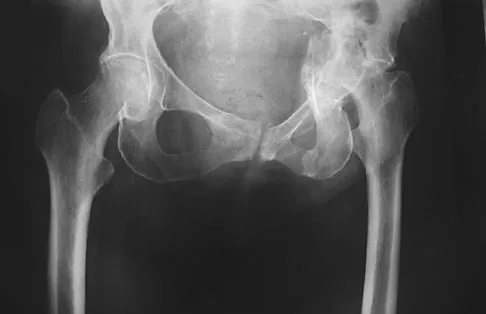
A 72-year-old woman presents with thigh pain after a fall. A radiograph reveals a fracture around her cemented femoral stem.
The stem is visibly loose with subsidence, but the proximal femoral bone stock is adequate. According to the Vancouver classification, what is the most appropriate surgical treatment?
Explanation
Question 42
A 68-year-old man presents with acute onset of knee pain, swelling, and fever 3 weeks following a primary total knee arthroplasty. Aspiration yields a synovial white blood cell count of 65,000 cells/µL with 95% neutrophils. Which of the following is the most appropriate initial management?
Explanation
Question 43
A surgeon is performing a primary total hip arthroplasty utilizing the direct anterior approach. Which of the following describes the internervous plane utilized in the superficial dissection?
Explanation
Question 44
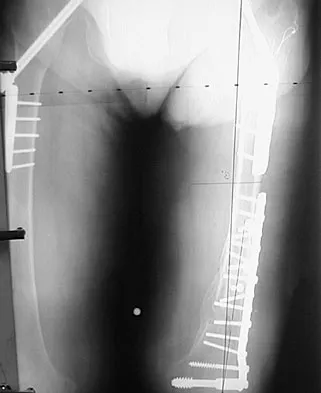
A 54-year-old woman complains of groin pain 6 years after receiving a metal-on-metal total hip arthroplasty. Her radiograph shows a steep cup abduction angle. MRI demonstrates a large fluid collection around the joint.
Serum cobalt and chromium are significantly elevated. Which histological finding is most expected in the periprosthetic tissue?
Explanation
Question 45
A 65-year-old woman undergoes a posterior-stabilized total knee arthroplasty. Intraoperatively, with the trial components in place, the knee is stable in extension but exhibits significant laxity in flexion. Which of the following component changes is the most appropriate next step?
Explanation
Question 46
A 48-year-old active man complains of a loud, high-pitched squeaking noise coming from his right hip, particularly when bending to tie his shoes. He underwent an uncomplicated ceramic-on-ceramic total hip arthroplasty 2 years ago. Radiographs demonstrate a well-fixed stem and a cup with 65 degrees of inclination. What is the most likely cause of this phenomenon?
Explanation
Question 47
A 65-year-old woman undergoes a posterior-stabilized (PS) total knee arthroplasty. Postoperatively, she experiences a sense of instability when rising from a low chair. Evaluation reveals a cam-post dislocation. What is the primary mechanical feature that prevents this specific complication in a properly balanced PS TKA?
Explanation
Question 48
A 45-year-old active man presents with a high-pitched squeaking noise from his hip 3 years after a cementless primary THA with a ceramic-on-ceramic bearing. The noise occurs primarily during deep flexion activities. Which of the following component positional factors most strongly correlates with this phenomenon?
Explanation
Question 49
A 72-year-old man presents with a painful TKA 4 years postoperatively. Both ESR and CRP are elevated. Joint aspiration yields synovial fluid with a WBC count of 4,500 cells/uL and 85% neutrophils. Which additional synovial fluid test has the highest specificity for confirming a periprosthetic joint infection?
Explanation
Question 50
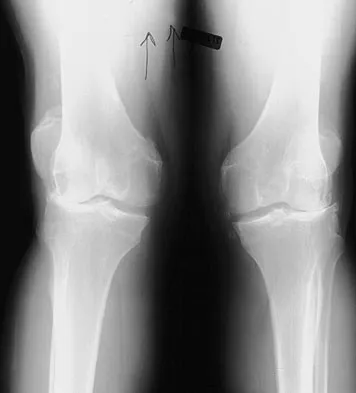
An 82-year-old woman with a history of recurrent posterior dislocations following a primary THA presents for revision. She has severe neuromuscular weakness and poor compliance with hip precautions. Her abductor mechanism is deficient but structurally intact. What is the most appropriate acetabular reconstruction option to minimize future dislocation risk?
Explanation
Question 51
A 68-year-old man presents 1 year after a posterior-stabilized TKA complaining of a painful catch and audible "pop" in his knee when extending from a flexed position. The examination is otherwise normal, and radiographs are unremarkable. What is the most likely etiology of his symptoms?
Explanation
Question 52
A 55-year-old woman is being evaluated for a medial unicompartmental knee arthroplasty (UKA). According to classical and modern guidelines, which of the following preoperative findings is an absolute contraindication for this procedure?
Explanation
Question 53
In total hip arthroplasty, the use of highly cross-linked polyethylene (HXLPE) has significantly reduced wear rates compared to conventional polyethylene. Which of the following manufacturing processes specifically decreases the fatigue strength and fracture toughness of HXLPE?
Explanation
Question 54
A 58-year-old woman complains of persistent groin pain 6 years after receiving a metal-on-metal total hip arthroplasty. Aspiration of the hip yields sterile, blood-tinged fluid. MRI demonstrates a large, solid and cystic periarticular mass. Histologic examination of the periarticular tissue would most likely demonstrate which of the following?
Explanation
Question 55
During a primary TKA in a patient with a varus deformity, the surgeon assesses the gaps using spacer blocks after making the initial bone cuts. The knee is tight medially in both extension and flexion. What is the most appropriate initial soft tissue release to balance the knee?
Explanation
Question 56
A surgeon performs a primary total hip arthroplasty using the direct anterior (Smith-Petersen) approach. Which of the following represents the correct superficial internervous plane utilized in this surgical approach?
Explanation
Question 57
An 81-year-old man falls and sustains a periprosthetic femur fracture around his cemented THA.
Radiographs reveal a fracture occurring around a loose femoral stem, but with adequate surrounding proximal bone stock. What is the most appropriate surgical treatment?
Explanation
Question 58
A 66-year-old man undergoes explantation of an infected TKA and placement of an articulating antibiotic-loaded cement spacer. Six weeks later, his wound is well-healed, and serum ESR and CRP have normalized. Before proceeding with the second-stage reimplantation, what is the most appropriate next step to confirm eradication of the infection?
Explanation
Question 59
During trialing in a primary THA via a posterior approach, the surgeon notes the leg lengths are perfectly equal to the contralateral side, but the hip easily dislocates in adduction and internal rotation. To increase stability via soft tissue tensioning without altering the leg length, which of the following component changes should be made?
Explanation
Question 60
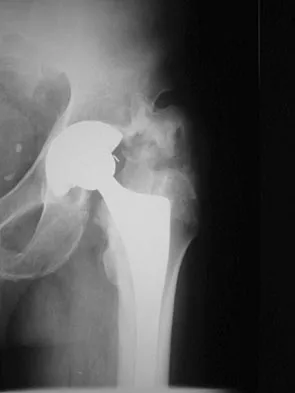
A 70-year-old woman presents with progressive knee pain 12 years after a primary TKA.
Radiographs demonstrate extensive osteolysis behind the tibial tray. Which of the following factors is most strongly associated with accelerated polyethylene wear and subsequent osteolysis in TKA?
Explanation
Question 61
A 65-year-old woman suffers an acute patellar tendon rupture 3 months following a primary TKA. Primary repair is attempted but fails at 6 weeks postoperatively. She now has an active extensor lag of 40 degrees and profound difficulty mobilizing. What is the most reliable surgical option for restoring extensor mechanism function?
Explanation
Question 62
During a primary total knee arthroplasty (TKA), the surgeon decides to use a posterior-stabilized (PS) implant. Which of the following best describes the primary mechanical function of the cam-and-post mechanism in this design?
Explanation
Question 63
A 65-year-old man presents with an audible and palpable squeaking sound from his right hip 2 years after a primary total hip arthroplasty (THA). Radiographs show well-fixed components. What is the most likely bearing surface combination he received?
Explanation
Question 64
A 68-year-old woman presents with a painful total knee arthroplasty 4 years post-surgery. Her serum ESR and CRP are elevated. Aspiration yields synovial fluid. According to the Musculoskeletal Infection Society (MSIS) criteria, what minimum synovial fluid white blood cell (WBC) count strongly indicates a chronic periprosthetic joint infection?
Explanation
Question 65
A 70-year-old man undergoes revision THA for recurrent posterior dislocations. During the procedure, the surgeon notes that the existing acetabular component is in neutral version. To minimize future posterior instability, the surgeon should reposition the cup to achieve which target orientation?
Explanation
Question 66
A 62-year-old woman complains of a painful catch and an audible pop when actively extending her knee from a flexed position, one year after a primary TKA.
What implant design or technical factor most increases the risk of this specific complication?
Explanation
Question 67
A 55-year-old woman presents with persistent groin pain and a palpable mass 4 years after a metal-on-metal THA. Imaging reveals a solid and cystic mass adjacent to the joint. Which histological finding is most characteristic of this condition?
Explanation
Question 68
During a primary TKA using a measured resection technique, the extension gap is symmetric and perfectly balanced, but the flexion gap is unacceptably tight. What is the most appropriate surgical step to correct this mismatch?
Explanation
Question 69
An 82-year-old woman falls and sustains a periprosthetic femur fracture around her cementless THA stem.
Radiographs demonstrate a fracture at the tip of the stem. The stem is loose, but there is adequate proximal bone stock. According to the Vancouver classification, what is the standard treatment?
Explanation
Question 70
In a TKA, which of the following soft-tissue releases is most appropriate to correct a severe fixed valgus deformity?
Explanation
Question 71
A surgeon performs a THA using the direct anterior approach (DAA). This approach exploits a true internervous plane between which two muscles?
Explanation
Question 72
A 75-year-old woman sustains a supracondylar femur fracture just above a well-fixed, closed-box posterior-stabilized (PS) TKA femoral component.
What is the preferred method of fixation for this Lewis-Rorabeck Type II fracture?
Explanation
Question 73
A 30-year-old man with a history of high-dose corticosteroid use presents with groin pain. Hip radiographs are normal, but an MRI shows a focal lesion in the anterosuperior femoral head with a double-line sign. There is no subchondral collapse. What is the most appropriate initial surgical intervention?
Explanation
Question 74
A 55-year-old man presents with an audible squeaking noise from his hip 2 years after a total hip arthroplasty with a ceramic-on-ceramic bearing.
Which of the following factors is most strongly associated with this phenomenon?
Explanation
None
