Orthopedic Hip & Knee 2026 MCQs: Board Review Questions & Answers (Part 4)

Key Takeaway
Your ultimate guide to Orthopedic Hip & Knee 2026 MCQs: Board Review Questions & Answers (Part 4) starts here. Top-rated Orthopedic Hip & Knee 2026 MCQs bank. Practice with clinical case questions, orthopedic surgery board review, and evidence-based answers updated for 2026.
Orthopedic Hip & Knee 2026 MCQs: Board Review Questions & Answers (Part 4)
Comprehensive 100-Question Exam
00:00
Start Quiz
Question 1
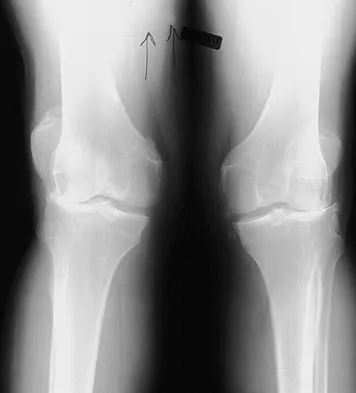
A 37-year-old man who works in a factory has isolated, lateral unicompartmental pain about his knee with activities. Nonsurgical management has failed to provide relief. The radiograph shown in Figure 45 reveals a tibiofemoral angle of approximately 15 degrees which is clinically correctable to neutral. What is the best surgical option in this patient?
Explanation
Question 2
Figure 46 shows the AP radiograph of an active 80-year-old patient with an acetabular fracture. The fracture was initially managed nonsurgically; however, the patient is now scheduled to undergo total hip arthroplasty. What is the treatment of choice for the contained acetabular bone defect?
Explanation
Question 3
A 28-year-old woman who is an avid runner reports pain about the left hip with activities. Nonsurgical management has failed to provide relief. An MRI arthrogram is shown in Figure 47. What is the most likely diagnosis?
Explanation
Question 4
Figure 48a shows the full-leg standing radiograph of a patient with a prior femoral fracture. Figure 48b shows the lateral view of the same joint. The patient is scheduled to undergo total knee arthroplasty. Because the mechanical axis of the lower extremity in patients with a prior femoral fracture may be disrupted, which of the following should be used during surgery to restore the mechanical axis of the lower extremity in this patient?
Explanation
Question 5
Figure 49 shows a histologic section of the lung in a patient who died during total hip arthroplasty. What unexpected finding is seen in the pulmonary capillaries?
Explanation
Question 6
After trial placement of components in a primary total knee arthroplasty, the knee is unable to come to full extension, but the flexion gap is appropriately balanced. After adequate soft-tissue releases have been performed, what is the next most appropriate action to balance the reconstruction?
Explanation
Question 7
Figure 50 shows the cross table lateral radiograph of a 31-year-old paratrooper who has recalcitrant groin pain. The pain is worse after activities such as standing or sitting (driving). Examination reveals that pain can be reproduced by internal rotation of the leg with the hip and knee in 90 degrees of flexion. Extensive nonsurgical managment has failed to provide relief. What is the treatment of choice?
Explanation
Question 8
During total knee arthroplasty, the patella is noted to subluxate laterally despite a lateral retinacular release. Which of the following methods is most likely to improve patellar stability?
Explanation
Question 9
A 73-year-old man has stiffness after undergoing primary posterior cruciate ligament-retaining total knee arthroplasty 18 months ago. Extensive physiotherapy, dynamic splinting, and manipulations under anesthesia have failed to result in improvement. Examination reveals range of motion from 30 degrees to 60 degrees of flexion. The components are well fixed, and the evaluation for infection is negative. In discussing the possibility of revision arthroplasty, the patient should be advised that
Explanation
Question 10
A 62-year-old patient is seen for routine follow-up after undergoing cementless total hip arthroplasty 2 years ago. The patient reports limited range of motion that severely affects daily activities. A radiograph is shown in Figure 51. Management should now consist of
Explanation
Question 11
What bilateral surgical intervention is considered inappropriate based on the findings shown in the radiograph in Figure 52?
Explanation
Question 12
Figure 53a shows the AP radiograph of a 70-year-old patient who is scheduled to undergo unicompartmental knee arthroplasty. Figure 53b shows the immediate postoperative radiograph, and the radiograph shown in Figure 53c, obtained 6 months after surgery, shows a medial tibial plateau fracture. The etiology of the fracture is best related to
Explanation
Question 13
During impaction of a cementless acetabular component, the posterior column was fractured and found to be displaced. Which of the following is considered the most appropriate surgical option?
Explanation
Question 14
Which of the following factors increases the risk of sciatic nerve injury in primary total hip arthroplasty (THA)?
Explanation
Question 15
A 68-year-old woman who underwent a right total hip arthroplasty 1 year ago has dislocated her hip five times since surgery. Radiographs show a retroverted acetabular component. What is the best treatment for this patient?
Explanation
Question 16
Figure 54 shows the preoperative radiograph of a 45-year-old woman who is considering total hip arthroplasty with her orthopaedic surgeon. What femoral characteristic is a typical concern in this patient?
Explanation
Question 17
A 68-year-old man with no significant medical history underwent a total knee arthroplasty 4 years ago. A radiograph is shown in Figure 55. He reports that he had no problems with the knee until 6 weeks ago when he noted the gradual onset of pain following a colonoscopy. Examination reveals a painful, swollen knee. Knee aspiration reveals a WBC count of 40,000/mm3. Management should consist of
Explanation
Question 18
Which of the following substances makes up the majority by weight of the extracellular matrix for articular cartilage?
Explanation
Question 19
A 58-year-old woman is seen in the emergency department after falling at home. History reveals that she underwent right total knee arthroplasty 2 years ago. Radiographs are shown in Figures 56a and 56b. What is the most appropriate treatment?
Explanation
Question 20
A patient with a valgus knee and lateral compartment bone loss undergoes a total knee arthroplasty using posterior condylar referencing instrumentation. Six months after surgery, the patient reports significant anterior knee pain, and radiographs reveal severe lateral patellar tilt. Management should consist of
Explanation
Question 21
Figures 57a through 57c show the radiographs of a patient who has pain, discomfort, and a popping sensation localized to the posterior aspect of the knee after undergoing primary left total knee arthroplasty 6 months ago. Examination reveals that the patient is able to ambulate without a limp. There is no significant swelling, erythema, or effusion. Range of motion is 0 degrees to 115 degrees, and a palpable crepitation or snapping is detected at the posterior lateral joint line. What is the most likely diagnosis?
Explanation
Question 22
Which of the following is the primary mechanism of polyethylene wear in the hip?
Explanation
Question 23
Which of the following complications may occur subsequent to resurfacing hip arthroplasty for osteonecrosis of the hip but not after total hip arthroplasty?
Explanation
Question 24
Which of the following statements best describes results that have been reported with roentgen stereophotogrammetric analysis (RSA)?
Explanation
Question 25
Osteonecrosis of the large joints may develop in patients with which of the following conditions?
Explanation
Question 26
During a posterior-stabilized total knee arthroplasty, trial reduction is performed. The knee is noted to be symmetric and balanced in flexion, but tight in extension. What is the most appropriate next step to balance the knee?
Explanation
Question 27
A 65-year-old woman undergoes total knee arthroplasty. Intraoperatively, the surgeon notes that the patella tracks laterally and has a tendency to subluxate during flexion. Which of the following component adjustments would most effectively improve patellar tracking?
Explanation
Question 28
A 55-year-old man receives a THA using a highly cross-linked polyethylene liner. What is the primary biochemical purpose of subjecting the polyethylene to a heating process (melting or annealing) immediately following gamma irradiation?
Explanation
Question 29
A 24-year-old hockey player presents with persistent anterior groin pain exacerbated by hip flexion.
An AP pelvis radiograph reveals a prominent 'crossover sign'. What is the primary pathomorphology associated with this radiographic finding?
Explanation
Question 30
During a posterior-stabilized total knee arthroplasty using an anterior referencing system, the surgeon evaluates the gaps and notes that the joint is tight in flexion but symmetric and balanced in extension. Which of the following is the most appropriate next step?
Explanation
Question 31
A patient undergoes a primary THA via a direct anterior approach. Postoperatively, they report a burning sensation and numbness over the anterolateral aspect of the operative thigh. Which nerve is most likely affected, and where is it most vulnerable during this surgical exposure?
Explanation
Question 32
A 72-year-old man presents with knee pain 2 years following a TKA. Synovial fluid analysis reveals a WBC count of 4,500 cells/µL with 85% PMNs. Which of the following additional findings would definitively confirm a periprosthetic joint infection (PJI) according to the major criteria of the 2018 International Consensus Meeting?
Explanation
Question 33
A 55-year-old man presents with medial-sided knee pain. Radiographs reveal medial compartment osteoarthritis. He is being considered for a medial unicompartmental knee arthroplasty (UKA). Which of the following is considered an absolute contraindication to UKA?
Explanation
Question 34
A 68-year-old woman undergoes a primary total hip arthroplasty via a posterior approach. Six weeks postoperatively, she experiences recurrent posterior dislocations. Radiographic evaluation shows the cup position.
The acetabular component is measured in 25 degrees of abduction and 5 degrees of retroversion. What is the most appropriate management?

Explanation
Question 35
A 62-year-old woman complains of anterior knee pain and a clunking sensation 1 year after a posterior-stabilized total knee arthroplasty. Examination reveals patellar maltracking with a lateral tilt. Radiographs and a CT scan demonstrate internal rotation of both the tibial and femoral components. Which of the following is the most likely consequence of this combined malrotation?
Explanation
Question 36
A 65-year-old man with ankylosing spondylitis and a completely fused lumbosacral spine is scheduled for a primary total hip arthroplasty (THA). How does this patient's spinopelvic stiffness alter the targeted functional safe zone for acetabular cup positioning compared to a patient with normal spinal mobility?
Explanation
Question 37
Intraoperative assessment during a primary posterior-stabilized total knee arthroplasty (TKA) reveals a flexion gap that is excessively tight, while the extension gap is perfectly balanced. Which of the following modifications is the most appropriate step to achieve a balanced knee?
Explanation
Question 38
Which of the following is considered an absolute contraindication to a medial unicompartmental knee arthroplasty (UKA)?
Explanation
Question 39
A 70-year-old man presents with a painful, swollen right knee 4 years after a primary TKA. Joint aspiration yields synovial fluid with a white blood cell count of 45,000 cells/mcL and 92% polymorphonuclear neutrophils. Which of the following is the most appropriate next step in management?
Explanation
Question 40
A 65-year-old man is scheduled to undergo a total hip arthroplasty (THA). Preoperative radiographs reveal spontaneous fusion of the lumbar spine from L2 to S1 secondary to diffuse idiopathic skeletal hyperostosis. How does this spinal stiffness affect acetabular dynamics and dislocation risk during the transition from standing to sitting?
Explanation
Question 41
A 55-year-old man presents with worsening groin pain 7 years after receiving a metal-on-polyethylene total hip arthroplasty with a large-diameter cobalt-chromium femoral head. Radiographs show well-fixed components without osteolysis. A MARS MRI demonstrates a thick-walled cystic mass communicating with the joint. Joint aspiration yields sterile fluid with markedly elevated cobalt levels. What is the most likely diagnosis?
Explanation
Question 42
A 68-year-old woman complains of recurrent knee swelling and a sense of instability when descending stairs 2 years after a primary posterior-stabilized total knee arthroplasty (TKA). Physical examination reveals a stable knee in full extension to varus and valgus stress, but marked anteroposterior translation at 90 degrees of flexion. Which of the following intraoperative technical errors is the most likely cause of this presentation?
Explanation
Question 43
When evaluating histologic tissue samples from a patient undergoing revision total hip arthroplasty for an adverse local tissue reaction (ALTR) associated with a metal-on-metal articulation, which of the following findings is most characteristic of ALVAL (aseptic lymphocyte-dominated vasculitis-associated lesion)?
Explanation
Question 44
A 78-year-old woman sustains a fall 5 years after a primary cementless THA.
Radiographs demonstrate a fracture around the femoral stem. Intraoperative assessment confirms that the femoral stem is grossly loose, but there is adequate cortical bone distal to the fracture in the diaphysis. What is the most appropriate management for this Vancouver B2 periprosthetic fracture?
Explanation
Question 45
A 72-year-old female with a history of recurrent THA dislocations was revised to a dual mobility articulation 3 years ago. She now presents with a new-onset, painless "clunk" with hip motion. Radiographs demonstrate an asymmetric, eccentric position of the metallic femoral head within the acetabular shell. What is the most likely diagnosis?
Explanation
Question 46
According to the 2018 International Consensus Meeting (ICM) criteria for diagnosing periprosthetic joint infection (PJI), which of the following synovial fluid biomarkers is considered a highly specific major criterion for confirming the diagnosis?
Explanation
Question 47
A 64-year-old woman is 1 year status post a posterior-stabilized TKA. She reports a painful catching sensation and an audible "clunk" at approximately 30 to 45 degrees of extension from a flexed position.
What is the most appropriate definitive management for this condition if conservative measures fail?
Explanation
Question 48
A 45-year-old female presents with persistent anterior groin pain 14 months after a primary THA. The pain is exacerbated when actively lifting her leg into a vehicle. Radiographs show the acetabular component in 15 degrees of anteversion with no signs of loosening, but a cross-table lateral view demonstrates the anterior edge of the cup is completely flush with the anterior acetabular rim. After 6 months of failed physical therapy and corticosteroid injections, what is the best surgical intervention?
Explanation
Question 49
A 55-year-old male with severe tri-compartmental knee osteoarthritis is scheduled for TKA. He has a history of a healed midshaft femoral fracture with a residual 22-degree extra-articular coronal varus deformity. Attempting an intra-articular resection to correct this deformity would compromise the collateral ligament attachments. What is the most appropriate surgical management?
Explanation
Question 50
The direct anterior approach (DAA) to the hip is increasingly popular due to its internervous plane. This surgical approach exploits the interval between muscles supplied by which of the following nerve pairs?
Explanation
Question 51
In the concept of true kinematic alignment for total knee arthroplasty, the primary goal is to co-align the axes of the prosthetic components with the three kinematic axes of the native knee. Which axis serves as the primary reference for positioning the femoral component?
Explanation
Question 52
A 22-year-old elite hockey player presents with chronic, activity-limiting groin pain. An AP pelvis radiograph demonstrates a "crossover sign" and projection of the ischial spine into the pelvic basin. These radiographic findings are most indicative of which pathology?
Explanation
Question 53
A 65-year-old woman presents with a catching sensation and pain in her anterior knee 1 year after a primary posterior-stabilized total knee arthroplasty. Range of motion is 0 to 120 degrees, and the catch occurs as the knee extends from 90 degrees of flexion. What is the primary etiology of this complication?
Explanation
Question 54
A 72-year-old man has a painful total hip arthroplasty (THA) 4 years postoperatively. Serum ESR is 45 mm/hr and CRP is 22 mg/L. Joint aspiration yields 2,500 WBC/uL with 75% PMNs. According to the 2018 ICM criteria, what is the next best step to confirm a periprosthetic joint infection?
Explanation
Question 55
A 55-year-old active male underwent a THA with a ceramic-on-ceramic bearing surface. Two years later, he reports an audible squeaking sound during hip flexion, but denies pain. What is the most significant risk factor for this phenomenon?
Explanation
Question 56
A 78-year-old woman sustains a fall 8 years after a primary cementless THA. She is unable to bear weight. Radiographs show a displaced fracture around the distal third of the femoral stem, with evidence of prior stem subsidence and severe proximal osteolysis.
What is the most appropriate management?
Explanation
Question 57
A 45-year-old man has medial compartment knee osteoarthritis and a 10-degree varus deformity. He is being evaluated for a medial opening wedge high tibial osteotomy (HTO). Which of the following is an absolute contraindication to this procedure?
Explanation
Question 58
A 62-year-old woman with a metal-on-metal THA presents with new-onset groin pain and a palpable anterior mass. Serum cobalt and chromium levels are significantly elevated. MRI reveals a large cystic fluid collection with thick walls. What is the most appropriate management?
Explanation
Question 59
A 68-year-old man requires a TKA for severe osteoarthritis. He has a history of a femoral shaft fracture resulting in a 15-degree coronal plane extra-articular varus deformity.
How should this deformity ideally be managed during the TKA to ensure a balanced knee?

Explanation
Question 60
A 70-year-old man is scheduled for a THA. He has a history of a rigid multilevel lumbar spinal fusion from L2 to the sacrum. How should acetabular cup placement be adjusted to minimize the risk of posterior dislocation during sitting?
Explanation
Question 61
Which of the following patients is the most appropriate candidate for a metal-on-metal hip resurfacing arthroplasty (HRA)?
Explanation
Question 62
A 70-year-old man presents with knee pain 15 years after a primary cruciate-retaining TKA. Radiographs show eccentric polyethylene wear and a large uncontained osteolytic lesion in the medial tibial metaphysis. The components are radiographically stable. What is the most appropriate treatment?
Explanation
Question 63
A 68-year-old woman sustains a complete patellar tendon rupture 2 years after a primary TKA. Primary repair is attempted but fails. She undergoes extensor mechanism reconstruction with a synthetic mesh. What is the optimal postoperative rehabilitation protocol?
Explanation
Question 64
A 55-year-old man undergoes a medial unicompartmental knee arthroplasty (UKA). Postoperatively, radiographs reveal an overcorrection of the mechanical axis into 3 degrees of valgus. Which of the following is the most likely late complication of this specific alignment error?
Explanation
Question 65
A 65-year-old man reports progressive, insidious left groin pain 6 years after a primary metal-on-polyethylene total hip arthroplasty.
His serum inflammatory markers are normal. Joint aspiration yields sterile, dark, cloudy fluid with a white blood cell count of 1,200 cells/uL and 60% neutrophils. An MRI with metal artifact reduction sequence (MARS) reveals a thick-walled cystic mass communicating with the joint space. What is the most likely cause of this presentation?
Explanation
Question 66
A 22-year-old woman presents with recurrent lateral patellar dislocations after failing 6 months of targeted physical therapy.
Advanced imaging demonstrates a tibial tubercle-trochlear groove (TT-TG) distance of 23 mm and a Caton-Deschamps index of 1.35. Which of the following is the most appropriate surgical treatment?
Explanation
None
