Orthopedic Shoulder 2026 MCQs: Board Review Questions & Answers (Part 4)

Key Takeaway
This topic focuses on Orthopedic Shoulder 2026 MCQs: Board Review Questions & Answers (Part 4), Top-rated Orthopedic Shoulder 2026 MCQs bank. Practice with clinical case questions, orthopedic surgery board review, and evidence-based answers updated for 2026.
Orthopedic Shoulder 2026 MCQs: Board Review Questions & Answers (Part 4)
Comprehensive 100-Question Exam
00:00
Start Quiz
Question 1
A 50-year-old electrician who is right-hand dominant has had right shoulder pain and stiffness after sustaining an electric shock 2 months ago. An AP radiograph obtained at the time of injury was considered negative, and the patient was diagnosed with a shoulder sprain. The patient now reports continued shoulder pain and restricted motion. AP and axillary radiographs and a CT scan are shown in Figures 41a through 41c. Management should consist of
Explanation
Question 2
Figure 42 shows the radiograph of a 70-year-old woman who has had a painful near ankylosis of her dominant elbow for 1 year. Treatment should consist of
Explanation
Question 3
A 72-year-old woman who was doing well after undergoing total shoulder arthroplasty for arthritis 4 months ago is suddenly unable to elevate her arm. Examination reveals 70 degrees of external rotation compared with 45 degrees on the uninvolved side, and she is unable to lift her hand off her lower back. Radiographs are shown in Figures 43a through 43c. Treatment should consist of
Explanation
Question 4
A 25-year-old man underwent a Putti-Platt repair for recurrent anterior dislocation of his right shoulder 9 months ago. He reports no further episodes of instability but continues to have severely restricted motion, with external rotation limited to less than 0 degrees with the arm at the side. He has pain at the ends of range of motion and restricted activities of daily living despite undergoing nearly 9 months of physical therapy. Radiographs of the shoulder show no arthritic changes. Management should now consist of
Explanation
Question 5
A 43-year-old bus driver sustains a hyperextension injury to her arm and shoulder 4 months after undergoing an open Bankart repair. Examination reveals increased external rotation, anterior shoulder pain, and internal rotation weakness. Her examination also reveals the findings shown in Figure 44. What is the most likely diagnosis?
Explanation
Question 6
Radial nerve palsy is most commonly associated with which of the following types of humeral fractures?
Explanation
Question 7
A 30-year-old firefighter sustained a longitudinal pulling injury to the arm while attempting to move a heavy object during a fire. Figure 45 shows an MRI scan of the elbow. Initial management should consist of
Explanation
Question 8
Which of the following is considered a reasonable goal for arthroplasty surgery in rotator cuff arthropathy?
Explanation
Question 9
What is the best surgical approach for the scapular fracture shown in Figure 46?
Explanation
Question 10
Management of a grade IV osteochondritis dissecans lesion of the capitellum should consist of
Explanation
Question 11
What preoperative factor correlates best with the outcome of rotator cuff repair?
Explanation
Question 12
A 55-year-old woman with polyarticular rheumatoid arthritis has had progressively increasing left shoulder pain for the past 2 years despite nonsurgical management. No focal weakness is noted during examination of the shoulder. AP and axillary radiographs are shown in Figures 47a and 47b. Treatment should consist of
Explanation
Question 13
When elevating the arm, the ratio of scapulothoracic to glenohumeral motion over the total range of motion is best described as
Explanation
Question 14
Figure 48 shows the initial AP chest radiograph of a 21-year-old motorcycle rider who sustained multiple injuries after striking a telephone pole at high speed. What is the most significant radiographic finding leading to a diagnosis?
Explanation
Question 15
A 21-year-old man who underwent repair of a distal biceps tendon rupture using a two-incision approach 4 months ago now reports difficulty gaining rotation of his forearm. Figures 49a and 49b show the AP and lateral radiographs. What is the most likely cause of his problem?
Explanation
Question 16
A 53-year-old man reports acute, severe left shoulder pain after undergoing abdominal surgery 10 days ago. Initial management, consisting of anti-inflammatory drugs, physical therapy, and a subacromial injection of corticosteroid, fails to provide relief. Reexamination of the shoulder 2 months after the onset of symptoms reveals atrophy of the infraspinous and supraspinous fossa and profound weakness of active abduction and external rotation. His neck is supple with a full range of motion. Plain radiographs and an MRI scan of the shoulder are normal. What diagnostic study should be performed next in the evaluation of this patient?
Explanation
Question 17
A 58-year-old reports pain and stiffness in his left shoulder following a seizure episode. Diagnosis at the time of the seizure is a frozen shoulder, and management consists of an aggressive physical therapy program of stretching exercises. Four months later he continues to have shoulder pain and has not gained any additional range of motion. A CT scan is shown in Figure 50. Management should now consist of
Explanation
Question 18
When conducted at near physiologic strain rates, tensile studies of the inferior glenohumeral ligament (IGHL) have shown that the
Explanation
Question 19
Manipulation under anesthesia for resistant frozen shoulder should be avoided in patients with
Explanation
Question 20
A patient who sustained a cerebrovascular accident (CVA) 18 months ago has a long-standing spastic adduction contracture of the shoulder with a rigid block to passive external rotation. Significant hygiene problems exist with maceration and continued skin breakdown. Management should consist of
Explanation
Question 21
A patient with degenerative osteoarthritis of the sternoclavicular (SC) joint reports constant pain, discomfort, and marked prominence and instability of the SC joint following medial clavicle resection. Which of the following procedures is most likely to produce these signs and symptoms?
Explanation
Question 22
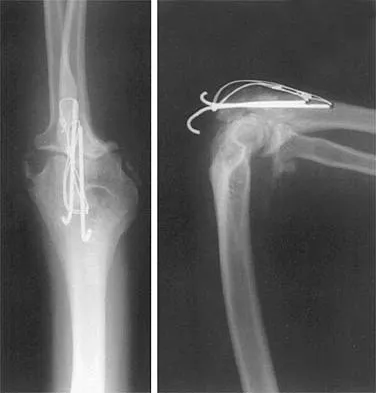
A 26-year-old man has had a 2-year history of pain and stiffness after sustaining a comminuted olecranon fracture. Treatment at the time of injury consisted of open reduction and internal fixation with tension band wiring. Examination reveals motion of 45 degrees to 110 degrees and pain throughout the arc of motion. Resisted flexion and extension are painful. Forearm rotation is normal. Radiographs are shown in Figure 51. Treatment should consist of
Explanation
Question 23
What is the most common cause of rotator cuff injury in high school athletes?
Explanation
Question 24
A 16-year-old boy with osteochondritis dissecans of the capitellum has intermittent symptoms of catching and locking. Examination is unremarkable. Radiographs reveal a loose body anteriorly with a diameter of 10 mm. To remove the loose body, elbow arthroscopy is being considered. Which of the following procedures would minimize the risk of neurovascular complication during the procedure?
Explanation
Question 25
Examination of the shoulder seen in Figure 52 shows atrophy and tenderness of the infraspinous fossa and profound weakness in external rotation. The supraspinous fossa shows normal muscle bulk. What is the most likely cause of this condition?
Explanation
Question 26
A 72-year-old woman undergoes reverse total shoulder arthroplasty. At her 2-year follow-up, radiographs show inferior scapular notching. Which of the following surgical techniques decreases the risk of this complication?
Explanation
Question 27
A 24-year-old rugby player has recurrent anterior shoulder instability. CT shows 25% anterior glenoid bone loss and an engaging Hill-Sachs lesion. What is the most appropriate surgical treatment?
Explanation
Question 28
A 55-year-old man presents with anterior shoulder pain and weakness following a fall. Physical examination reveals increased passive external rotation compared to the contralateral side, and a positive belly-press test. Which tendon is most likely injured?
Explanation
Question 29
A 28-year-old volleyball player complains of vague posterior shoulder pain and weakness. Exam reveals isolated atrophy of the infraspinatus with preserved supraspinatus muscle bulk. Where is the most likely site of nerve compression?
Explanation
Question 30
A 22-year-old baseball pitcher has posterior shoulder pain during the late cocking phase of throwing. He has a loss of internal rotation (GIRD) of 25 degrees. MRI shows articular-sided partial-thickness tearing of the posterior supraspinatus. What is the most likely diagnosis?
Explanation
Question 31
A 20-year-old male baseball pitcher sustains a Type II SLAP tear. Nonoperative management fails. What is the most appropriate next step in management to allow return to his previous level of play?
Explanation
Question 32
A 32-year-old male bodybuilder feels a pop in his anterior axilla while performing a heavy bench press. Examination reveals bruising and a loss of the anterior axillary fold contour. Weakness will be most pronounced in which of the following shoulder motions?
Explanation
Question 33
A 40-year-old woman develops lateral scapular winging after a cervical lymph node biopsy. Which nerve was most likely injured?
Explanation
Question 34
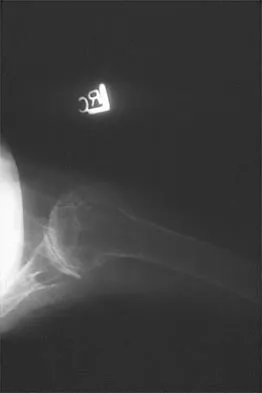
A 65-year-old man who underwent anatomic total shoulder arthroplasty 5 years ago presents with progressively worsening shoulder pain.
The "rocking horse" phenomenon in anatomic total shoulder arthroplasty, which leads to glenoid loosening, is most directly caused by:
Explanation
Question 35
A 50-year-old woman with type 1 diabetes presents with severe, progressive shoulder pain and stiffness over the last 4 months. She has an equal loss of active and passive range of motion, most notably in external rotation. What is the underlying pathophysiology of her condition?
Explanation
Question 36
A 78-year-old right-hand dominant woman sustains a displaced 3-part proximal humerus fracture involving the surgical neck and greater tuberosity. She has severe pre-existing glenohumeral osteoarthritis. What is the most appropriate surgical intervention?
Explanation
Question 37
A 28-year-old elite weightlifter complains of superior shoulder pain aggravated by dips and the bench press. Radiographs reveal widening of the acromioclavicular joint and subchondral cystic changes of the distal clavicle. If conservative management fails, what is the treatment of choice?
Explanation
Question 38
A 35-year-old man presents with vague posterior shoulder pain and numbness over the lateral deltoid. An MRI of the shoulder demonstrates isolated atrophy of the teres minor. Which of the following structures is most likely compressed?
Explanation
Question 39
A 42-year-old man suddenly developed excruciating, unprovoked right shoulder pain 2 weeks ago that lasted for several days. As the pain subsided, he noted profound weakness in shoulder abduction and external rotation. EMG shows active denervation of the supraspinatus and deltoid. What is the most likely diagnosis?
Explanation
Question 40
A 25-year-old cyclist falls onto his shoulder and sustains a midshaft clavicle fracture.
Which of the following is a widely accepted absolute indication for immediate open reduction and internal fixation?

Explanation
Question 41
A 30-year-old male falls directly on his shoulder adducted to his side. Radiographs show a 150% superior displacement of the distal clavicle relative to the acromion. What is the classification and recommended initial management for this injury?
Explanation
Question 42
A 35-year-old woman underwent a cervical lymph node biopsy in the posterior triangle of her neck 6 weeks ago. She now complains of a drooping right shoulder, dull aching pain, and an inability to actively elevate her arm above the horizontal plane. Physical examination reveals lateral winging of the scapula. Which of the following nerves was most likely injured?
Explanation
Question 43
A 40-year-old man presents with a locked posterior shoulder dislocation following a seizure. Advanced imaging demonstrates an anteromedial humeral head defect (reverse Hill-Sachs lesion) involving 40% of the articular surface. The glenoid is intact. What is the most appropriate surgical management?
Explanation
Question 44
A 22-year-old elite baseball pitcher presents with vague posterior shoulder pain. Physical examination of the throwing shoulder reveals 130 degrees of external rotation (ER) and 30 degrees of internal rotation (IR) at 90 degrees of abduction. The contralateral shoulder has 100 degrees of ER and 60 degrees of IR. The total arc of motion is 160 degrees bilaterally. What is the most appropriate initial management?
Explanation
Question 45
Which of the following radiographic findings in a proximal humerus fracture is considered the strongest predictor of subsequent humeral head ischemia and avascular necrosis?
Explanation
Question 46
A 30-year-old male volleyball player presents with painless weakness in external rotation of his dominant shoulder. Abduction strength is normal. An MRI confirms a paralabral cyst in the spinoglenoid notch. Which of the following associated pathologies is most likely the root cause of this cyst?
Explanation
Question 47
A 25-year-old male presents with pronounced medial winging of his right scapula after sustaining a direct blow to the lateral chest wall during a hockey game. He is unable to perform a wall push-up without the scapula lifting off the thorax. Which muscle and corresponding nerve are primarily affected?
Explanation
Question 48
During the evaluation of a patient with a suspected rotator cuff tear, which of the following isolated physical examination findings is most specific for a complete tear of the subscapularis tendon?
Explanation
Question 49
Scapular notching is a recognized complication following reverse total shoulder arthroplasty (RTSA). Which of the following glenosphere placements is most strongly associated with an increased incidence of this complication?
Explanation
Question 50
A 32-year-old bodybuilder feels a sudden, painful 'pop' in his anterior chest while performing a heavy bench press. Examination reveals an asymmetric anterior axillary fold and significant ecchymosis over the medial arm. Which of the following describes the most common anatomical site of this rupture?
Explanation
Question 51
A 24-year-old rugby player undergoes an open Latarjet procedure for recurrent anterior shoulder instability associated with 25% glenoid bone loss. Postoperatively, he exhibits profound weakness in elbow flexion and decreased sensation over the lateral aspect of the forearm. Which nerve was most likely injured during the coracoid transfer?
Explanation
Question 52
The rotator interval is a critical anatomic space in the shoulder that is often targeted in capsular release or plication. Which of the following structures are contained within this interval?
Explanation
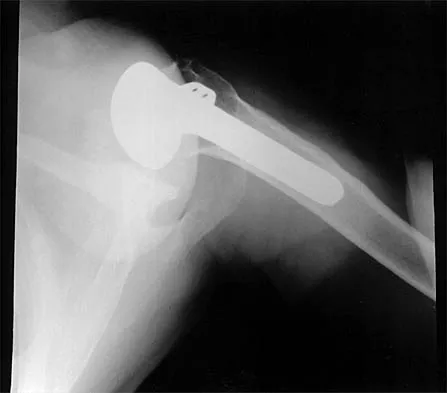
Question 53
A 68-year-old woman presents with persistent pseudoparalysis and severe shoulder pain after a massive irreparable rotator cuff tear. Clinical examination shows an intact deltoid and teres minor, but she has failed conservative treatment.
What is the most appropriate surgical treatment?
Explanation
Question 54
A 28-year-old male weightlifter presents with acute right shoulder pain after a heavy bench press. Examination reveals ecchymosis over the anterior axillary fold and a palpable defect. Loss of contour is most apparent when the patient presses his hands together.
Which of the following is true regarding this injury?
Explanation
Question 55
A 24-year-old baseball pitcher presents with posterior shoulder pain during the late cocking phase of throwing. He has a 20-degree loss of internal rotation compared to the contralateral side. MRI shows articular-sided partial tearing of the posterior supraspinatus and posterosuperior labral fraying.
What is the primary underlying pathophysiology?
Explanation
Question 56
A 35-year-old male presents with recurrent anterior shoulder instability. A CT scan with 3D reconstruction demonstrates 25% anterior glenoid bone loss.
Which of the following procedures is most appropriate?

Explanation
Question 57
A 42-year-old construction worker sustained an electrical shock and was diagnosed with a locked posterior shoulder dislocation. CT scan shows an anteromedial humeral head impaction fracture (reverse Hill-Sachs lesion) involving 30% of the articular surface.
The duration of dislocation is 2 weeks. What is the recommended treatment?

Explanation
Question 58
A 55-year-old male complains of poorly localized right shoulder pain and weakness, predominantly when externally rotating his arm. Examination reveals isolated atrophy of the infraspinatus with weakness in external rotation. Supraspinatus strength is normal.
MRI is most likely to show:
Explanation
Question 59
A 72-year-old man undergoes a reverse total shoulder arthroplasty. At 2-year follow-up, radiographs show grade 2 scapular notching. Which of the following surgical techniques minimizes this complication?
Explanation
Question 60
A 28-year-old volleyball player presents with insidious onset of posterior shoulder pain and weakness. Examination reveals isolated atrophy of the infraspinatus with normal supraspinatus strength. An MRI shows a paralabral cyst. Where is the cyst most likely located?
Explanation
Question 61
A 22-year-old rugby player has recurrent anterior shoulder instability. A CT scan with 3D reconstruction demonstrates 28% glenoid bone loss. What is the most appropriate definitive management?
Explanation
Question 62
A 78-year-old woman sustains a highly comminuted 4-part proximal humerus fracture. Her history is significant for severe rotator cuff arthropathy and pseudoparalysis of the shoulder prior to the injury. A representative radiograph is similar to
What is the most appropriate surgical treatment?
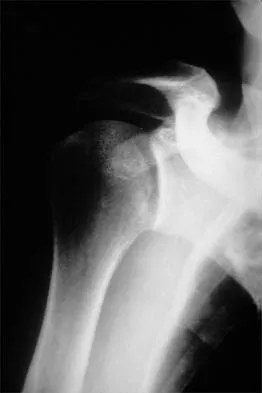
Explanation
Question 63
A 24-year-old professional baseball pitcher presents with posterior shoulder pain during the late cocking phase of throwing. Examination shows 15 degrees of internal rotation and 130 degrees of external rotation. What is the most likely pathophysiologic mechanism of his shoulder pain?
Explanation
Question 64
A 19-year-old football player sustains a direct blow to the anteromedial chest. He complains of severe pain at the sternoclavicular joint, dysphagia, and a choking sensation. What is the most critical next step in management?
Explanation
Question 65
A 55-year-old man presents with anterior shoulder pain and weakness after a fall onto an outstretched hand. On examination, he has increased passive external rotation. Which of the following physical examination tests would most likely be positive?
Explanation
Question 66
A 30-year-old competitive weightlifter feels a sudden pop in his anterior axillary fold while performing a heavy bench press. Examination reveals bruising and a loss of the anterior axillary contour. Surgical repair is planned. Where is the anatomical footprint of the torn structure?
Explanation
Question 67
A 45-year-old woman develops acute, severe right shoulder pain that wakes her from sleep. The pain lasts for two weeks and then subsides, but she subsequently develops profound weakness in shoulder elevation and external rotation. MRI of the shoulder is unremarkable. What is the most likely diagnosis?
Explanation
Question 68
A 20-year-old collegiate gymnast complains of deep shoulder pain and mechanical catching. MR arthrogram demonstrates a detachment of the superior labrum and biceps anchor from the glenoid. Which of the following is the most appropriate surgical intervention?
Explanation
Question 69
A 62-year-old man presents with insidious onset of mild shoulder pain and stiffness 14 months after an anatomic total shoulder arthroplasty. Inflammatory markers are normal, but joint aspiration yields a positive culture after 10 days. What is the most likely causative organism?
Explanation
Question 70
A 25-year-old man sustains an anterior shoulder dislocation during a seizure. Following closed reduction, he is noted to have numbness over the lateral aspect of the shoulder. Which muscle's function is most likely impaired?
Explanation
Question 71
A 35-year-old mountain biker falls directly onto the point of his shoulder. Radiographs show a 100% superior displacement of the clavicle relative to the acromion, with an increased coracoclavicular distance. What ligaments are ruptured?
Explanation
Question 72
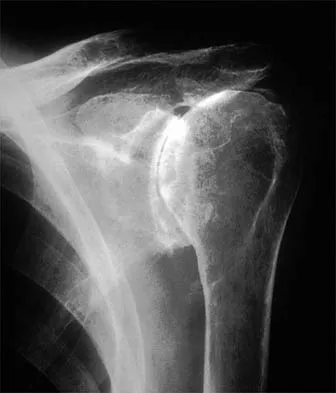
A 48-year-old woman presents with agonizing shoulder pain of sudden onset without trauma. Radiographs reveal a homogenous, well-defined radiopacity superior to the greater tuberosity as shown in
Which phase of the disease process is typically the most painful?

Explanation
Question 73
A 65-year-old manual laborer undergoes arthroscopy for a partial, fraying tear of the long head of the biceps tendon involving 60% of its substance. He expresses a strong desire to avoid cosmetic deformity and cramping. What is the most appropriate management?
Explanation
Question 74
A 72-year-old man undergoes a reverse total shoulder arthroplasty (RTSA) for cuff tear arthropathy. At his 2-year follow-up, radiographs demonstrate inferior scapular notching that extends beyond the inferior screw of the baseplate. According to the Sirveaux classification, what grade of notching is present?
Explanation
Question 75
A 35-year-old man presents with a locked posterior shoulder dislocation after a seizure. CT reveals an anteromedial humeral head defect (reverse Hill-Sachs lesion) involving 35% of the articular surface. The patient is active and desires to return to manual labor. What is the most appropriate surgical management?
Explanation
Question 76
A 28-year-old professional rugby player sustains an acute type V acromioclavicular (AC) joint separation. He is scheduled for an anatomic coracoclavicular (CC) ligament reconstruction. To accurately recreate the native anatomy, the surgeon must place the grafts based on the anatomic insertions. Which of the following statements regarding the CC ligaments is true?
Explanation
Question 77
A 45-year-old cyclist falls directly onto his right shoulder and sustains a midshaft clavicle fracture. Which of the following radiographic parameters is the strongest biomechanical and clinical indication for open reduction and internal fixation?
Explanation
Question 78
A 22-year-old collegiate baseball pitcher presents with vague, deep shoulder pain and decreased throwing velocity. MRI arthrogram reveals a Type II SLAP tear. During arthroscopy, what biomechanical mechanism is most commonly observed to exacerbate the pathology when the arm is placed in the late cocking phase of throwing?
Explanation
Question 79
A 74-year-old woman presents with long-standing shoulder pain and inability to elevate her arm past 40 degrees. She has a positive drop arm sign and hornblower's sign. Radiographs demonstrate severe superior migration of the humeral head with articulation against the acromion.
Which of the following is the most reliable surgical option to restore active forward elevation?
Explanation
Question 80
A 32-year-old competitive weightlifter feels a pop in his anterior axilla while performing a heavy bench press. Examination reveals loss of the anterior axillary fold and weakness in internal rotation. Operative exploration is planned. Where should the surgeon expect to find the native insertion of the ruptured tendon?
Explanation
Question 81
A 29-year-old elite volleyball player complains of vague posterior shoulder pain and progressive weakness. Physical examination reveals isolated weakness in external rotation with the arm at the side. Forward elevation and internal rotation strength are normal. MRI demonstrates a paralabral cyst. Where is the cyst most likely located?
Explanation
Question 82
A 55-year-old woman with type 1 diabetes presents with severe left shoulder pain that is worse at night and progressive stiffness over the past 3 months. Physical exam reveals passive external rotation limited to 10 degrees. Radiographs are normal. What is the initial treatment of choice?
Explanation
Question 83
A 21-year-old man undergoes a Latarjet procedure for recurrent anterior shoulder instability with 30% glenoid bone loss. The stabilizing "sling effect" provided by this procedure is primarily dependent on the dynamic tension of which structure?
Explanation
Question 84
Recent anatomic injection studies and quantitative MRI analyses have challenged traditional teaching regarding the vascular supply of the proximal humerus. According to current literature, which vessel provides the predominant blood supply to the articular segment of the humeral head?
Explanation
Question 85
A 68-year-old woman presents 3 months after an anatomic total shoulder arthroplasty (TSA) complaining of weakness and a new onset of pain.
Examination reveals passive external rotation of 80 degrees on the operative side compared to 40 degrees on the contralateral side. She has a positive belly-press test. What is the most likely diagnosis?
Explanation
Question 86
A 34-year-old recreational weightlifter complains of vague, poorly localized posterior shoulder pain and numbness over the lateral deltoid. MRI demonstrates isolated atrophy of the teres minor. The affected nerve is compressed in a space bordered by which of the following structures?
Explanation
Question 87
A 19-year-old football player sustains a high-energy blow to the medial clavicle. In the emergency department, he complains of shoulder pain, shortness of breath, and difficulty swallowing. Physical exam reveals a palpable depression at the medial end of the clavicle. What is the most appropriate next step in management?
Explanation
Question 88
A 26-year-old male presents with winging of his right scapula following a protracted illness.
On physical examination, the medial border of the scapula is prominent, especially when he pushes against a wall. Which nerve is most likely affected?
Explanation
Question 89
A 20-year-old elite collegiate tennis player presents with shoulder pain during the serve. Physical examination reveals glenohumeral internal rotation deficit (GIRD) of 25 degrees compared to the contralateral side, and 15 degrees of increased external rotation. The underlying pathophysiology of GIRD is most directly related to contracture of which structure?
Explanation
Question 90
A 70-year-old woman is 6 months status post a reverse total shoulder arthroplasty (RTSA) for massive rotator cuff tear. She was doing well until she experienced a sudden onset of superior shoulder pain without any distinct trauma.
Radiographs indicate an acromial stress fracture. Which biomechanical alteration inherent to RTSA most directly contributes to this complication?
Explanation
Question 91
A 13-year-old male baseball pitcher complains of right shoulder pain during the acceleration phase of throwing. He has tenderness over the proximal humerus. Radiographs show widening of the proximal humeral physis compared to the contralateral side. What is the most appropriate initial treatment?
Explanation
Question 92
A 42-year-old man presents with a 3-week history of severe, unrelenting shoulder pain that woke him from sleep. The pain has now begun to subside, but he has noticed profound weakness in overhead elevation and external rotation. MRI of the shoulder reveals no rotator cuff tear. EMG confirms acute denervation of the supraspinatus, infraspinatus, and deltoid. What is the most likely diagnosis?
Explanation
Question 93
During pre-operative planning for a recurrent anterior shoulder instability patient, a 3D CT scan is obtained. The surgeon uses the 'best-fit circle' method on the sagittal en face view to calculate glenoid bone loss. At what threshold of anterior glenoid bone loss is an arthroscopic Bankart repair generally considered to have an unacceptably high failure rate, making a bone block procedure (e.g., Latarjet) the standard recommendation?
Explanation
Question 94
A 72-year-old woman presents with lateral shoulder pain 2 years after undergoing a reverse total shoulder arthroplasty (RTSA). Radiographs reveal grade 3 scapular notching. Which of the following surgical technique modifications during the index procedure would have best minimized this complication?
Explanation
Question 95
A 24-year-old professional rugby player has a history of recurrent anterior shoulder instability. A 3D CT scan demonstrates 28% anterior glenoid bone loss. He is planned for a Latarjet procedure. Which of the following describes the primary stabilizing mechanism of this procedure when the arm is in the abduction-external rotation (ABER) position?
Explanation
Question 96
A 28-year-old professional volleyball player presents with insidious onset of vague posterior right shoulder pain and weakness. Physical examination demonstrates isolated weakness in external rotation with the arm at the side, but forward elevation and abduction strength are completely normal. An MRI is most likely to show a paralabral cyst in which of the following anatomic locations?
Explanation
Question 97
A 68-year-old woman sustains a displaced proximal humerus fracture after a ground-level fall.
According to Hertel's criteria, which of the following specific radiographic findings is the most reliable predictor of ensuing avascular necrosis of the humeral head?
Explanation
Question 98
A 32-year-old weightlifter felt a sudden tearing sensation in his anterior axilla while performing a heavy bench press. Examination reveals loss of the anterior axillary fold and weakness in internal rotation. Surgical exploration is planned for a complete tear of the sternal head of the pectoralis major. Where does the sternal head normally insert on the humerus relative to the clavicular head?
Explanation
Question 99
An 18-year-old male presents to the emergency department after a high-speed motor vehicle collision. He complains of left medial clavicle pain, dysphagia, and mild dyspnea. Examination reveals a palpable void at the left sternoclavicular joint. After plain radiographs, what is the most appropriate next step in management?
Explanation
Question 100
A 55-year-old woman with type 1 diabetes mellitus presents with progressive, severe shoulder stiffness and pain over the past 6 months. Examination demonstrates equal restriction of both active and passive range of motion.
What is the classic histologic finding in the joint capsule of patients with this condition?
Explanation
None
