Part of the Master Guide

HINTEGRA Total Ankle Arthroplasty: An Intraoperative Masterclass

Chronic Ankle Arthritis: A Detailed Clinical Case Study & Diagnostic Approach
17 Apr 2026 16 min read 120 Views
Illustration of plantar flexion hindfoot - Dr. Mohammed Hutaif

Key Takeaway

Severe chronic ankle arthritis diagnosis involves patient history noting chronic pain and painful plantarflexion. Clinical exam reveals restricted range of motion. Weight-bearing radiographs confirm significant tibiotalar joint space narrowing, subchondral sclerosis, and prominent osteophytes, particularly posterior, which correlate with symptoms and guide treatment.

Welcome to this Grand Rounds presentation. Today, we will conduct a comprehensive review and clinical case study focusing on the diagnostic approach, biomechanical considerations, and surgical management of end-stage post-traumatic ankle osteoarthritis. This case highlights the insidious progression of articular degeneration following remote ligamentous trauma and provides a framework for evidence-based surgical decision-making.

Patient Presentation and History

A 62-year-old male presented with a chief complaint of chronic, progressive left ankle pain spanning approximately eight years. The patient described the pain as deep-seated, aching, and significantly exacerbated by weight-bearing activities, prolonged standing, and notably, by forceful plantarflexion of the ankle. He reported a particular functional limitation in negotiating stairs, pushing off during the terminal stance phase of ambulation, and participating in recreational walking, activities that consistently provoked his symptoms. The pain was often rated 7/10 on a visual analogue scale during exacerbations, improving to 4/10 with rest. Nocturnal pain was also a significant complaint, indicating advanced articular degradation disrupting normal sleep architecture.

His medical history is significant for a remote, severe left ankle sprain sustained approximately 15 years prior, which was initially managed non-operatively with functional rehabilitation. There was no documented ankle fracture at that time, pointing toward an isolated lateral ligamentous complex disruption (anterior talofibular ligament and calcaneofibular ligament). He is otherwise healthy, with well-controlled essential hypertension and no history of inflammatory arthropathy, diabetes mellitus, or other systemic conditions that might predispose to widespread polyarthropathy. He is a non-smoker and consumes alcohol socially. Occupationally, he works in a supervisory role requiring moderate ambulation and prolonged static standing.

Conservative management over the preceding five years was exhaustive and ultimately failed to halt symptom progression. This non-operative regimen included:
* Serial administration of cyclooxygenase-2 selective non-steroidal anti-inflammatory drugs.
* Aggressive activity modification and load reduction.
* Custom rigid ankle-foot orthoses and articulated bracing designed to limit tibiotalar excursion.
* Multiple courses of physical therapy, focusing on peroneal strengthening, proprioceptive neuromuscular facilitation, and Achilles tendon stretching, which provided only transient, minimal relief.
* Two fluoroscopically guided intra-articular corticosteroid injections, providing symptomatic relief for approximately 3-4 weeks each, with diminishing returns upon subsequent administration.

The patient’s primary objective was to regain the ability to ambulate for extended periods without debilitating pain and to return to low-impact recreational activities. The specific emphasis on painful plantarflexion of the hindfoot in his presentation strongly suggested a significant degenerative process within the tibiotalar articulation, accompanied by concomitant posterior impingement secondary to hypertrophic osteophyte formation, and raised the suspicion for secondary subtalar joint involvement due to altered hindfoot kinematics.

Clinical Examination Findings

Inspection and Gait Kinematics

On inspection, the left ankle presented with mild effacement of the anterior gutters, indicative of a subtle but persistent tibiotalar joint effusion. There was no obvious erythema, localized warmth, or gross coronal plane deformity such as varus or valgus malalignment when assessed in a weight-bearing stance. Mild, non-pitting edema was noted diffusely around the joint capsule. The integumentary envelope was intact, with no signs of trophic changes, venous stasis dermatitis, or prior surgical incisions. Muscle atrophy of the gastrocnemius-soleus complex was not grossly pronounced, though subtle disuse atrophy could be appreciated circumferentially when compared to the contralateral limb.

Detailed gait analysis revealed a pronounced antalgic gait pattern. The patient demonstrated a shortened stance phase on the affected left lower extremity, a decreased stride length, and a noticeable avoidance of the push-off phase (terminal stance). This compensatory mechanism is a classic hallmark of rigid tibiotalar arthritis, as the patient attempts to minimize the required dorsiflexion moment and subsequent joint reactive forces across the degenerated articular surface.

Palpation and Provocative Joint Testing

Palpation elicited exquisite tenderness primarily along the anterior tibiotalar joint line, corresponding to the classic location of anterior tibial and talar neck osteophytes. Diffuse tenderness was also noted over the anterior joint capsule. Posterior palpation, specifically performed while the ankle was forcefully passively plantarflexed, reproduced the patient's characteristic sharp, posterior-based pain. This positive posterior impingement sign is highly suggestive of posterior gutter osteophytosis or an os trigonum syndrome exacerbated by the narrowed joint space.

Assessment of the collateral ligaments revealed no significant tenderness along the medial deltoid complex or the lateral ligamentous complex, suggesting primary ligamentous stability in the coronal plane, albeit in a stiffened joint. The subtalar joint was critically assessed for tenderness and mobility. Moderate discomfort was noted with deep palpation directly over the sinus tarsi and posteromedial to the talus. Provocative inversion and eversion of the subtalar joint elicited mild guarding, indicating possible secondary degenerative involvement or capsulitis secondary to altered load transmission from the rigid tibiotalar joint above.

Range of Motion and Biomechanical Assessment

Active and passive range of motion of the left tibiotalar joint was significantly restricted and universally painful, characteristic of end-stage arthropathy.
* Dorsiflexion was strictly limited to 0 degrees (neutral position), with a firm, mechanical endpoint and elicitation of significant anterior pain at the end range, indicative of anterior bony impingement. This was in stark contrast to the contralateral limb's physiological 15-20 degrees of dorsiflexion.
* Plantarflexion was limited to 20 degrees (compared to 45-50 degrees contralaterally), again presenting with a painful, firm mechanical block. The patient specifically reported an acute exacerbation of posterior ankle pain at maximum plantarflexion.

Neurological and Vascular Integrity

A comprehensive neurovascular examination of the distal lower extremity was unremarkable. Dorsalis pedis and posterior tibial pulses were palpable and symmetric bilaterally (2+). Capillary refill was brisk (under 2 seconds) in all digits. Sensation was intact to light touch and pinprick in the distributions of the saphenous, sural, superficial peroneal, deep peroneal, and medial/lateral plantar nerves. Motor function of the extensor hallucis longus, tibialis anterior, peroneals, and flexor hallucis longus was intact (5/5), limited only by pain secondary to joint loading during isometric testing.

Imaging and Diagnostics

Weight Bearing Radiographic Evaluation

Standard weight-bearing radiographic series of the left ankle, including anteroposterior, mortise, and lateral views, were obtained.

Image

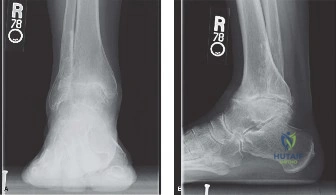
The radiographs demonstrated classic hallmarks of end-stage osteoarthritis. There was global, asymmetric joint space narrowing, most pronounced in the medial and central aspects of the tibiotalar articulation. Subchondral sclerosis was evident on both the tibial plafond and the talar dome. Hypertrophic marginal osteophytes were prominent, particularly at the anterior lip of the distal tibia and the corresponding talar neck, explaining the mechanical block to dorsiflexion. Large posterior osteophytes were also visualized, corresponding to the clinical findings of posterior impingement during plantarflexion. The mortise view confirmed the absence of significant talar tilt or coronal plane malalignment, maintaining a relatively congruent, albeit narrowed, mortise.

Advanced Cross Sectional Imaging

To further delineate the osseous morphology, assess bone stock, and evaluate the adjacent articulations, a non-contrast Computed Tomography scan of the left ankle and hindfoot was acquired.

Image

The CT scan provided critical multiplanar detail. Coronal and sagittal reconstructions confirmed the profound loss of articular cartilage and highlighted the presence of multiple subchondral cysts within the talar body and distal tibia, a finding not fully appreciated on plain radiographs. These cysts are critical to identify preoperatively as they dictate the requirement for bone grafting and influence the trajectory of hardware placement during arthrodesis. The CT scan also allowed for a detailed assessment of the subtalar joint. While some mild subchondral sclerosis was noted at the posterior facet, the joint space remained largely preserved, suggesting that the sinus tarsi pain noted on examination may be functional or inflammatory rather than structural end-stage subtalar osteoarthritis.

Diagnostic Intraarticular Injections

Given the clinical ambiguity regarding the source of the sinus tarsi pain and the mild CT findings in the subtalar joint, a diagnostic and therapeutic fluoroscopically guided injection of the subtalar joint was performed using 1% lidocaine and a corticosteroid preparation. The patient reported no significant relief of his primary weight-bearing pain following the subtalar injection, confirming that the primary pain generator was the tibiotalar joint. This diagnostic step is absolutely critical in surgical planning, as it differentiates the need for an isolated tibiotalar arthrodesis from a more extensive tibiotalocalcaneal arthrodesis.

Differential Diagnosis

The presentation of chronic ankle pain in a patient with a history of trauma requires a structured differential diagnosis to ensure appropriate surgical targeting.

Pathological Condition Clinical Presentation Radiographic Findings Differentiating Factors
Post Traumatic Ankle Osteoarthritis History of prior fracture or severe ligamentous injury. Asymmetric joint space narrowing, mechanical pain, restricted ROM. Unilateral joint space loss, subchondral sclerosis, marginal osteophytes, potential subluxation. Clear temporal relationship to prior trauma. Often unilateral. Primary diagnosis for this patient.
Primary Ankle Osteoarthritis Insidious onset, older demographic. Less common than post-traumatic OA in the ankle. Symmetric joint space narrowing, central osteophytes. Absence of significant traumatic history. Often bilateral or associated with generalized OA.
Inflammatory Arthropathy Morning stiffness, multiple joint involvement, systemic symptoms (fever, fatigue). Periarticular osteopenia, uniform joint space narrowing, marginal erosions. Elevated inflammatory markers (ESR, CRP), positive serology (Rheumatoid Factor, Anti-CCP).
Anterior Impingement Syndrome Anterior ankle pain, specifically with dorsiflexion. Often seen in athletes (e.g., soccer players). Anterior tibial and talar neck osteophytes (kissing lesions). Joint space may be preserved. Pain is highly localized anteriorly. Global joint space narrowing is absent in early stages.
Subtalar Osteoarthritis Pain localized to the sinus tarsi, exacerbated by walking on uneven ground or inversion/eversion. Narrowing of the posterior, middle, or anterior facets of the subtalar joint. Pain reproduced with subtalar motion. Diagnostic injection provides specific relief.

Surgical Decision Making and Classification

Pathoanatomic Classification Systems

The patient's radiographic findings align with a Modified Takakura Stage 3B or Canadian Orthopaedic Foot and Ankle Society end-stage classification. There is complete obliteration of the joint space with subchondral bone contact, extensive osteophyte formation, and subchondral cyst formation, but without severe coronal plane deformity (varus/valgus tilt less than 10 degrees). This classification helps standardize the description of the pathology and guides the complexity of the reconstructive effort.

Arthrodesis Versus Arthroplasty Considerations

The surgical management of end-stage ankle arthritis primarily involves a choice between Total Ankle Arthroplasty and Ankle Arthrodesis.

Total Ankle Arthroplasty has seen significant advancements in implant design and survivorship, offering the benefit of preserved sagittal plane motion, which theoretically protects adjacent joints (subtalar, talonavicular) from accelerated secondary osteoarthritis. It is generally indicated in older, lower-demand patients with good bone stock, minimal deformity, and a functional Achilles tendon.

Conversely, Ankle Arthrodesis remains the gold standard for high-demand patients, younger patients, those with severe deformity, poor bone stock, or a history of remote infection. Arthrodesis provides a durable, reliable, and definitive elimination of tibiotalar pain by fusing the joint.

In this specific case, the patient is a 62-year-old male who desires a return to recreational walking and has a physically demanding supervisory role. While his age makes him a potential candidate for arthroplasty, his desire for prolonged, unrestricted weight-bearing and the presence of significant subchondral cystic changes (which can compromise arthroplasty baseplate fixation) push the decision matrix toward arthrodesis. Furthermore, the diagnostic injection confirmed the subtalar joint was not the primary pain generator, making an isolated tibiotalar arthrodesis the most appropriate and predictable procedure to achieve a pain-free, stable, and plantigrade foot. The decision was made to proceed with an open anterior ankle arthrodesis utilizing rigid plate and screw fixation.

Surgical Technique and Intervention

Patient Positioning and Hemostasis

The patient was brought to the operating theater and placed in the supine position on a radiolucent operating table. A bump was placed under the ipsilateral hip to internally rotate the leg, bringing the ankle mortise into a true anteroposterior orientation relative to the ceiling. A well-padded pneumatic tourniquet was placed around the proximal thigh. Following the administration of prophylactic intravenous antibiotics and the induction of general anesthesia combined with a regional popliteal sciatic nerve block, the surgical site was prepped and draped in a standard sterile fashion. The limb was exsanguinated using an Esmarch bandage, and the tourniquet was inflated to 250 mmHg.

Anterior Surgical Approach and Neurovascular Protection

An anterior longitudinal approach to the ankle was utilized. A 10-centimeter incision was made centered over the tibiotalar joint, lateral to the crest of the tibia and extending distally toward the talonavicular joint. Careful subcutaneous dissection was performed to identify and protect the superficial peroneal nerve branches laterally. The extensor retinaculum was incised, and the interval between the extensor hallucis longus and the extensor digitorum longus was developed.

Deep dissection requires meticulous identification and mobilization of the anterior neurovascular bundle, comprising the deep peroneal nerve and the anterior tibial artery. These structures were carefully retracted laterally alongside the extensor digitorum longus, while the extensor hallucis longus and tibialis anterior were retracted medially. This exposure provides excellent, direct visualization of the anterior aspect of the distal tibia, the ankle mortise, and the talar dome.

Articular Preparation and Osteophyte Resection

The anterior capsule was excised, revealing the extensive hypertrophic anterior osteophytes on both the distal tibia and the talar neck. These osteophytes were aggressively resected using a combination of rongeurs and sharp osteotomes to restore the normal anatomic contour and allow for adequate visualization of the joint space.

Image

A lamina spreader was inserted into the joint to distract the articulation. The remaining degenerative articular cartilage and the sclerotic subchondral bone plate were systematically removed from the tibial plafond, the talar dome, and the medial and lateral gutters. This was achieved using a combination of sharp curettes, flexible osteotomes, and a high-speed coarse burr. It is imperative to remove all cartilage down to healthy, bleeding cancellous bone to optimize the biological environment for osseous union.

The subchondral cysts identified on the preoperative CT scan were encountered, thoroughly curetted to remove fibrous tissue, and packed with locally harvested autograft obtained from the resected anterior osteophytes and supplemental allograft cancellous chips. To further stimulate osteogenesis and local angiogenesis, the prepared bony surfaces of the tibia and talus were aggressively fenestrated (fish-scaled) using a 2.0mm drill bit and a small osteotome.

Multiplanar Reduction and Alignment

Achieving the correct multiplanar alignment is the most critical step in ankle arthrodesis to ensure optimal postoperative gait kinematics and prevent adjacent joint overload. The goal is to fuse the ankle in:
1. Neutral dorsiflexion (0 degrees).
2. 5 degrees of valgus hindfoot alignment.
3. 5 to 10 degrees of external rotation, matching the contralateral limb's tibial torsion.
4. Slight posterior translation of the talus beneath the tibia to shorten the anterior lever arm and facilitate the rollover phase of gait.

The joint was provisionally reduced and held with smooth Steinmann pins. Intraoperative fluoroscopy was utilized extensively to confirm the alignment in the anteroposterior, mortise, and lateral planes. The lateral view is particularly crucial to ensure the talus is not fused in equinus, which would result in a functionally longer limb, vaulting gait, and severe knee recurvatum forces.

Rigid Internal Fixation Construct

Once perfect alignment was confirmed fluoroscopically, definitive rigid internal fixation was applied. An anatomically pre-contoured anterior ankle arthrodesis plate was selected. The plate was positioned centrally over the distal tibia and the talar neck.

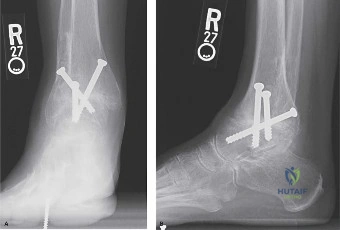
Initial fixation was achieved by placing a non-locking cortical screw through the dynamic compression slot of the plate into the tibia to allow for proximal-distal adjustment. A large fragment (6.5mm or 7.3mm) independent compression screw was then placed outside the plate, directed from the medial malleolus into the central body of the talus, effectively compressing the arthrodesis site. A second independent compression screw was placed from the anterolateral tibia, aiming posteromedially into the talar body.

Following the placement of the independent compression screws, the anterior plate was secured. Locking screws were placed into the distal tibia, and robust locking screws were directed into the talar body and neck. The combination of independent interfragmentary compression screws and an anterior neutralization plate provides a biomechanically superior construct. The anterior plate acts as a tension band against the powerful displacing forces of the Achilles tendon, neutralizing plantarflexion moments and providing absolute stability conducive to primary bone healing. Final fluoroscopic images confirmed hardware placement, excellent apposition of the arthrodesis surfaces, and maintenance of the desired anatomic alignment. The wound was irrigated copiously, and closure was performed in a layered fashion.

Post Operative Protocol and Rehabilitation

Acute Postoperative Immobilization

Immediately postoperatively, the patient was placed in a well-padded, bulky Jones dressing with a posterior plaster splint and a U-splint to maintain the ankle in a neutral position and control postoperative edema. The patient was admitted for 24 hours for intravenous antibiotics, pain management, and physical therapy instruction regarding strict non-weight-bearing mobilization using crutches or a knee scooter. Deep vein thrombosis prophylaxis was initiated using low-molecular-weight heparin, given the period of strict immobilization.

At two weeks postoperatively, the patient was seen in the clinic. The surgical incision was inspected, sutures were removed, and the limb was transitioned into a rigid, short-leg fiberglass cast. The patient was instructed to maintain strict non-weight-bearing status for an additional four weeks.

Progressive Weight Bearing and Osseous Integration

At six weeks postoperatively, clinical examination and radiographic evaluation were performed. Radiographs typically demonstrate early signs of osseous bridging and maintenance of hardware integrity. If clinical progression is satisfactory, the patient is transitioned from the cast to a removable controlled ankle motion (CAM) boot.

Weight-bearing is initiated progressively. The patient begins with 25% partial weight-bearing using crutches, increasing by 25% each week, guided by pain and tolerance. Physical therapy is formally initiated at this stage, focusing not on ankle range of motion (which is now fused), but on aggressive strengthening of the proximal musculature (quadriceps, hamstrings, gluteals), core stability, and maximizing the mobility and strength of the adjacent subtalar, talonavicular, and midfoot joints.

By 10 to 12 weeks postoperatively, assuming radiographic evidence of solid arthrodesis (trabecular bridging across at least three out of four cortices) and the absence of pain at the fusion site, the patient is transitioned to regular footwear. A rocker-bottom shoe modification or a rigid carbon fiber footplate is often prescribed to assist with the terminal stance phase of gait and reduce stress on the midfoot articulations. Maximum medical improvement and final osseous remodeling can take up to 12 to 18 months.

Clinical Pearls and Pitfalls

Pearls for Optimal Outcomes

  • Meticulous Joint Preparation: The success of an arthrodesis relies entirely on the biological environment. Inadequate debridement of the posterior joint capsule or failure to remove the dense subchondral sclerotic bone plate will predictably lead to nonunion. Aggressive fish-scaling or subchondral drilling is mandatory to expose vascular channels.
  • Sagittal Plane Alignment: Fusing the ankle in even slight equinus (plantarflexion) is a catastrophic error. It leads to a vaulting gait, severe knee recurvatum, and rapid degeneration of the midfoot. Always err on the side of neutral to 2 degrees of dorsiflexion.
  • Posterior Talar Translation: Translating the talus slightly posterior relative to the mechanical axis of the tibia shortens the anterior lever arm of the foot. This significantly decreases the effort required for the rollover phase of gait, reducing the demand on the adjacent joints.
  • Diagnostic Injections: Never underestimate the diagnostic power of a targeted intra-articular injection. Differentiating tibiotalar from subtalar pathology clinically can be nearly impossible in a stiff, guarding patient. The injection dictates the extent of the fusion required.

Pitfalls and Complication Avoidance

  • Neurovascular Injury: The anterior approach places the deep peroneal nerve and anterior tibial artery at significant risk. Meticulous dissection, identification, and gentle retraction are required. Over-retraction can lead to ischemic neurapraxia.
  • Inadequate Compression: Failure to achieve rigid interfragmentary compression leads to micromotion and subsequent nonunion. The use of independent, robust compression screws prior to the application of a neutralization plate is biomechanically critical.
  • Ignoring Coronal Malalignment: If preoperative varus or valgus deformity exists, it must be corrected at the level of the arthrodesis. Fusing an ankle in malalignment shifts the mechanical axis, leading to asymmetric loading of the knee and hindfoot, guaranteeing premature adjacent joint failure.
  • Wound Complications: The anterior ankle has a tenuous soft tissue envelope. Excessive soft tissue stripping, overly aggressive retraction, or closure under tension can lead to wound dehiscence and deep infection. Layered, tension-free closure over a drain (if necessary) is vital.

Dr. Mohammed Hutaif
Medically Verified Content by
Prof. Dr. Mohammed Hutaif
Consultant Orthopedic & Spine Surgeon
Chapter Index