
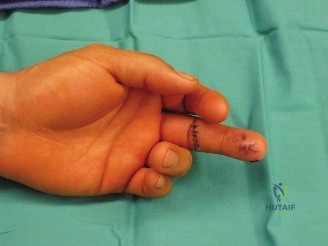
A 28-year-old carpenter presents to the ED with a sharp laceration to his middle finger from a utility knife. On examination, he is unable to actively flex the DIP joint of the affected finger. The PIP joint flexion is preserved. The wound is clean and located at the level of the middle phalanx. What is your diagnosis, and how would you classify this injury anatomically?
Candidate: This patient has an isolated Flexor Digitorum Profundus (FDP) injury. Anatomically, this corresponds to Verdan’s Zone I, as the injury is distal to the insertion of the Flexor Digitorum Superficialis (FDS).
Failing to verify FDS function before assuming an isolated injury. Candidates often forget to mention the specific zone or confuse Zone I with "no man's land" (Zone II). They also frequently omit the importance of ruling out associated neurovascular or bony injuries (like an avulsion fracture).
Confirm isolated FDP injury by testing PIP flexion (intact FDS) and isolated DIP flexion (absent FDP). Classify as Zone I. The response should include: "This is a Verdan Zone I flexor tendon injury. I would assess for neurovascular integrity and obtain radiographs to rule out an associated distal phalanx fracture or 'jersey finger' avulsion before proceeding to surgical planning."
You are now performing a primary repair for a patient with a lacerated FDP and FDS in Zone II. What specific biomechanical principles must you adhere to during the repair to ensure the best functional outcome?
Candidate: I would use a multi-strand core suture technique, such as a 4- or 6-strand repair, to achieve high tensile strength. I would also add an epitendinous suture to minimize bulk and smooth the gliding surface to prevent adhesions.
Forgetting to mention the fibro-osseous pulley system. Failing to emphasize the preservation of the A2 and A4 pulleys is a major error in Zone II, as their sacrifice leads to significant bowstringing and loss of mechanical advantage.
Structure the answer around: 1. Repair Strength: Use a multi-strand (4-6) core suture for sufficient tensile strength (>45N) for early mobilization. 2. Gliding surface: Epitendinous suture for smoothing and additional strength. 3. Pulley Preservation: Meticulous preservation of A2 and A4 pulleys. 4. Tendon tension: Ensuring accurate restoration of resting tension relative to adjacent digits.
Following a robust primary repair, what are the core principles of your post-operative rehabilitation, and how do you decide between a passive motion protocol and an early active motion protocol?
Candidate: I would use a dorsal blocking splint to keep the wrist and MCPs in flexion. The choice between passive and early active motion depends on the strength of the repair; with a strong multi-strand core suture, I prefer early active motion to reduce adhesions, provided the patient is compliant.
Ignoring the "human factor." Candidates often suggest aggressive protocols for non-compliant or cognitively impaired patients, which leads to inevitable rerupture. They also fail to mention the role of the hand therapist in the process.
State that rehabilitation is a multidisciplinary process requiring a "protected environment." The decision is risk-stratified: Early Active Motion (EAM) is reserved for stable, multi-strand repairs in highly compliant patients. Passive protocols are safer for tenuous repairs or unreliable patients. The goal is to balance adhesion prevention through controlled gliding with the high risk of rerupture if the patient exceeds structural limits.
Detailed Chapters & Topics
Dive deeper into specialized chapters regarding hand-case-34