Extensor Digitorum Communis Laceration (Zone V): Diagnosis and Clinical Presentation
Key Takeaway
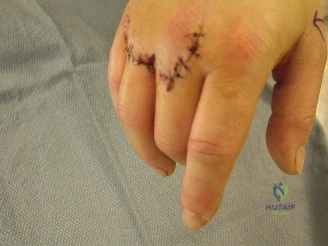
An Extensor Digitorum Communis (EDC) tendon laceration in Zone V, such as the ring finger, typically presents with an extensor lag at the MCP joint, an inability to actively extend the affected digit against gravity, and a visible dorsal hand laceration. Clinical examination reveals a palpable tendon gap and preserved passive range of motion.
A 34-year-old male presents with a laceration to the dorsum of his hand after a fall onto glass. He is unable to fully extend his ring finger at the MCP joint. Describe your systematic clinical examination and the significance of the findings in the context of this specific anatomical zone.
Candidate: I would examine the wound, check for active extension lag, and ensure neurovascular status is intact. The inability to extend at the MCP joint suggests an extensor tendon laceration. I would classify this as a Zone V injury because it is over the metacarpals. I would then book the patient for theater to repair the tendon.
Candidates often jump immediately to "taking it to theater." They fail to explicitly test the integrity of the juncturae tendinum (which can mask tendon lacerations), ignore the distinction between active and passive range of motion, and forget to document the status of the sagittal bands, which are critical stabilizers in Zone V.
I would begin with a thorough inspection of the wound, noting its size, depth, and contamination. I would confirm the diagnosis by testing active extension against resistance with the wrist in neutral. Importantly, I would distinguish this from a central slip injury (Zone III) by assessing PIP extension. I would check the juncturae tendinum by testing extension of the ring finger while the middle and little fingers are held in full flexion; if extension is maintained, it is likely due to the juncturae rather than an intact EDC. I would evaluate the sagittal bands for stability, document the distal sensory status—specifically the dorsal digital nerves—and confirm the absence of foreign bodies on radiographs.
During exploration, you find the proximal stump of the EDC has retracted significantly. What are the key technical principles for repairing this in Zone V, and how does the choice of suture technique influence your rehabilitation protocol?
Candidate: I would use a Kessler repair with a 3-0 Prolene for the core and a 5-0 PDS for the peripheral repair. I would then put the hand in a splint for 6 weeks and start physiotherapy afterwards.
This candidate proposes a dangerous post-operative plan. Static immobilization for 6 weeks in an extensor repair is antiquated and leads to inevitable stiffness and adhesion. They also fail to mention the importance of tensioning, which is the most common cause of residual extensor lag.
Technically, I would perform a modified Kessler core repair for strength and a running epitendinous peripheral suture to minimize gapping and reduce friction. The key is precise tensioning—the tendon must be repaired at a length that allows full passive flexion without creating a resting extensor lag. Because I have used a strong core-plus-peripheral repair, I would institute an early active motion protocol (e.g., dynamic or relative motion extension splinting) within the first few days post-op. This is essential to prevent peritendinous adhesions, which are notoriously aggressive in the dorsal hand, and to maximize functional recovery.
