Achondroplasia Orthopedic MCQs - Arab Board Exam Prep
Achondroplasia Orthopedic MCQs - Arab Board Exam Prep
Comprehensive 100-Question Exam
00:00
Start Quiz
Question 1
A couple with normal stature has a child diagnosed with achondroplasia. They are concerned about the genetics of this condition and ask about the likelihood of this occurring. Based on the epidemiology of achondroplasia, what is the most accurate genetic explanation?
Explanation
Correct Answer: De novo mutation of a gene on chromosome 4
Achondroplasia is inherited in an autosomal dominant manner. However, over 80% of individuals with achondroplasia have parents with normal stature. In these cases, the condition is the result of a 'de novo' (new) mutation of a gene localized to the distal short arm of chromosome 4.
Question 2
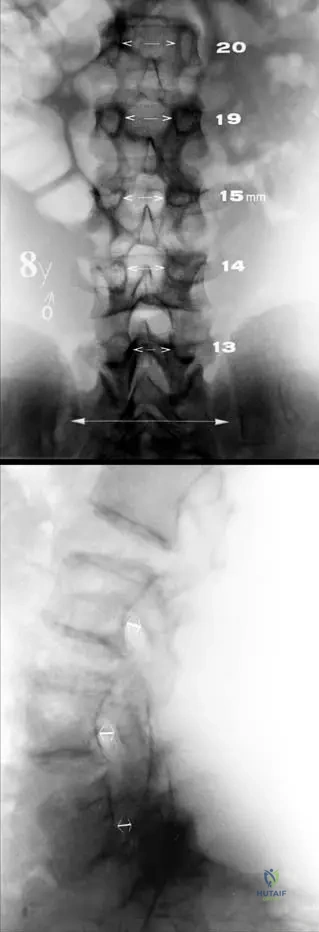
Review the AP and lateral radiographs of the lumbar spine in this patient with short-limb dwarfism. Which of the following is the characteristic radiographic finding shown?
Explanation
Correct Answer: Interpediculate distance decreases from the upper to lower lumbar spine
The provided radiograph demonstrates the classic spinal findings in achondroplasia. The interpediculate distance abnormally decreases from the upper to the lower lumbar spine (AP view), and characteristic short pedicles are seen on the lateral view, which predisposes these patients to spinal stenosis.
Question 3
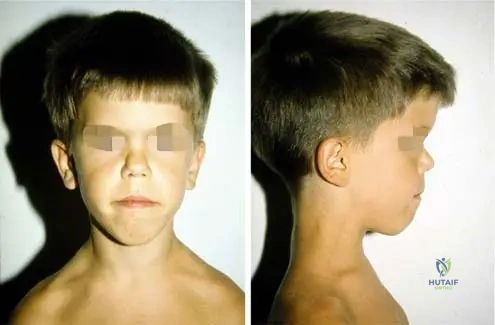
A 4-year-old boy presents with delayed motor milestones and the facial features shown below. What is the most likely diagnosis?
Explanation
Correct Answer: Achondroplasia
The clinical image shows a child with a head that is disproportionately large in relation to height, a prominent forehead (frontal bossing), and a broadened, depressed nasal bridge. These are the hallmark craniofacial features of achondroplasia, the most common human chondrodysplasia.
Question 4
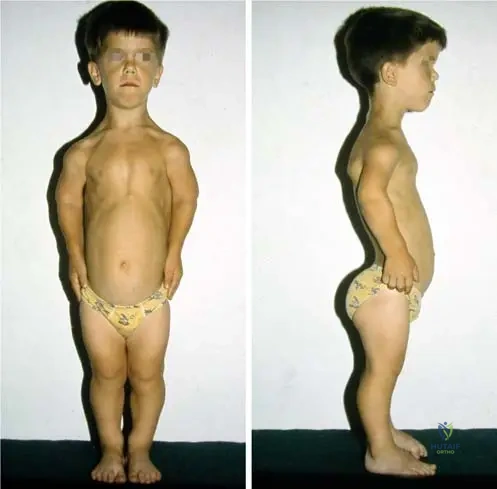
A patient with the most common human chondrodysplasia presents for orthopedic evaluation. Based on the clinical photograph provided, which combination of physical findings is most characteristic of this condition?
Explanation
Correct Answer: Exaggerated lumbar lordosis, limitation of elbow extension, and genu varum
As seen in the clinical image and described in the text, patients with achondroplasia typically present with exaggerated lumbar lordosis, limitation of elbow extension and rotation, and genu varum. Hyperextension of the knees and most other joints is also common.
Question 5
An infant is diagnosed with achondroplasia shortly after birth. The parents are counseled regarding potential life-threatening complications during infancy. Which of the following represents the greatest risk of mortality in this age group?
Explanation
Correct Answer: Spinal cord compression and upper airway obstruction
In infancy, patients with achondroplasia are at an increased risk of death primarily due to compression of the spinal cord (often at the foramen magnum) and upper airway obstruction.
Question 6
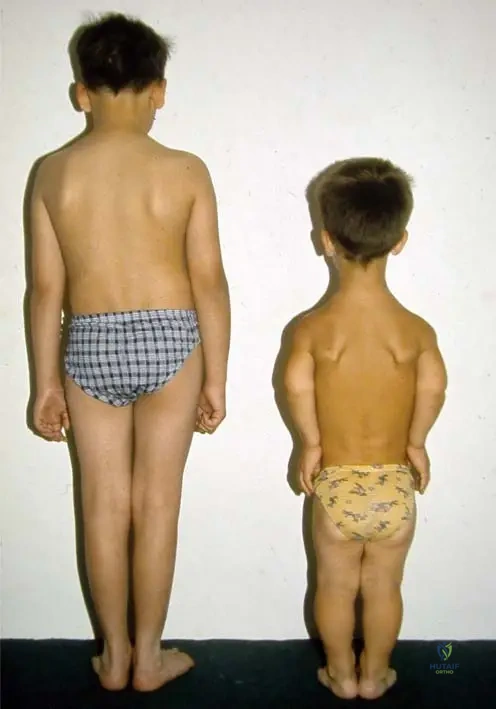
The image below compares a patient with a specific skeletal dysplasia to an age-matched individual of normal stature. Which of the following statements accurately describes the anthropometric differences seen in this condition?
Explanation
Correct Answer: There is no difference in trunk height, but the chest and shoulders are narrower
Achondroplasia is a disproportionate short-limb dwarfism. As demonstrated in the comparative clinical image, there is no significant difference in the height of the trunk between an achondroplastic patient and a normal individual; however, the chest and shoulders are notably narrower.
Question 7
A 12-month-old infant with achondroplasia is brought to the clinic. The parents are concerned because the child is not yet walking and seems 'floppy.' Which of the following is the most appropriate counseling regarding the child's development?
Explanation
Correct Answer: Hypotonia and delayed motor milestones are typical, but intelligence is usually normal
In infancy, hypotonia is typical in achondroplasia, and the acquisition of developmental motor milestones is often delayed. However, intelligence and life span are usually normal, and parents should be reassured regarding cognitive development.
Question 8
A 10-year-old girl with achondroplasia asks about her expected final adult height. According to established growth data for this condition, what is the mean adult height for females?
Explanation
Correct Answer: 124 cm
According to the clinical data for achondroplasia, the mean adult height in males is 131 ± 5.6 cm, and in females, it is 124 ± 5.9 cm.
Question 9
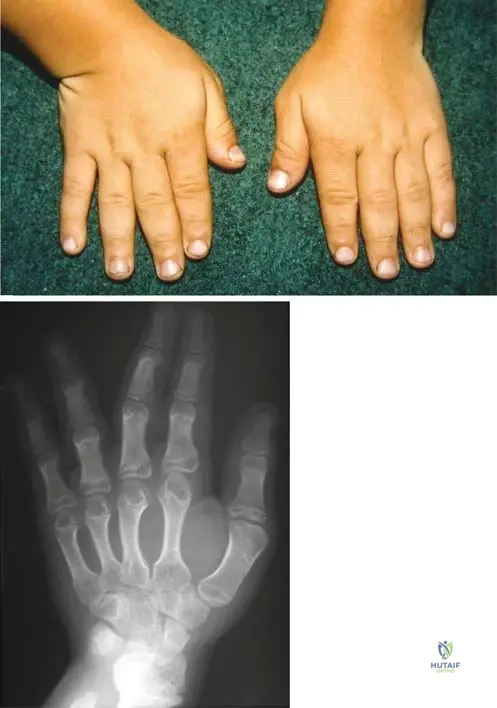
The clinical photograph below shows the hands of a patient with achondroplasia. Which of the following statements best describes the hand manifestations in this specific dysplasia compared to other short-limb dwarfisms?
Explanation
Correct Answer: The fingers are not as short as in many other short-limb dwarfisms
As shown in the clinical image and noted in the text, the fingers in achondroplasia are not as short as in many other forms of short-limb dwarfism. They often present with a 'trident' appearance, though their relative length is better preserved than in other severe dysplasias.
Question 10
Achondroplasia is caused by a mutation that affects endochondral ossification. The responsible gene is localized to which of the following chromosomal regions?
Explanation
Correct Answer: Distal short arm of chromosome 4
Achondroplasia is the result of a mutation of a gene (FGFR3) localized to the distal short arm of chromosome 4. This mutation leads to a gain of function that inhibits chondrocyte proliferation, resulting in disproportionate short-limb dwarfism.
Question 11
A 5-year-old boy with short stature presents for evaluation. An AP and lateral radiograph of the lumbar spine is shown below. What is the characteristic radiographic finding demonstrated in this condition?

Explanation
Correct Answer: Decrease in interpediculate distance from upper to lower lumbar spine
In achondroplasia, a hallmark radiographic finding is the narrowing of the interpediculate distance from the upper to the lower lumbar spine, which is the opposite of the normal widening seen in unaffected individuals. Short pedicles are also characteristically seen on the lateral view.
Question 12
A child presents with the facial features shown below. Which of the following genetic mutations is most likely responsible for this phenotype?
Explanation
Correct Answer: Mutation on the distal short arm of chromosome 4
The clinical image demonstrates a disproportionately large head, prominent forehead, and a broadened, depressed nasal bridge typical of achondroplasia. This condition is caused by a mutation localized to the distal short arm of chromosome 4 (specifically the FGFR3 gene).
Question 13
A patient with the condition shown below presents to the clinic. Which of the following joint findings is typically associated with this disorder?
Explanation
Correct Answer: Limitation of elbow extension and rotation
Patients with achondroplasia typically exhibit exaggerated lumbar lordosis, genu varum, hyperextension of the knees and most other joints, but characteristically have a limitation of elbow extension and rotation.
Question 14
A couple with normal stature has a child diagnosed with achondroplasia. They are concerned about the risk of having another child with the same condition. What percentage of achondroplasia cases are the result of a de novo mutation in parents with normal stature?
Explanation
Correct Answer: Over 80%
Over 80% of individuals with achondroplasia have parents with normal stature. In these cases, the condition is the result of a spontaneous 'de novo' mutation.
Question 15
An infant is diagnosed with achondroplasia. Which of the following is a typical finding during the first year of life in this patient population?
Explanation
Correct Answer: Hypotonia and delayed motor milestones
In infancy, patients with achondroplasia typically present with hypotonia, and the acquisition of developmental motor milestones is often delayed. Intelligence and overall life span are usually normal.
Question 16
While life span in achondroplasia is usually normal, there is an increased risk of death in infancy. Which of the following is a primary cause for this increased mortality risk?
Explanation
Correct Answer: Upper airway obstruction and spinal cord compression
Compression of the spinal cord (often at the foramen magnum) and upper airway obstruction are critical complications in infants with achondroplasia that significantly increase the risk of death during infancy.
Question 17
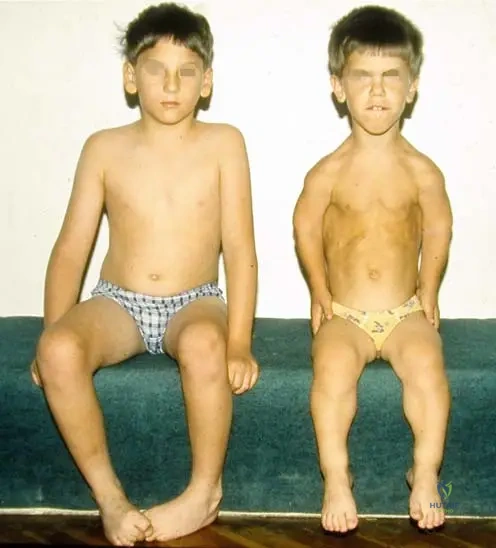
A 12-year-old boy with achondroplasia is compared to his unaffected peer. Based on the clinical appearance shown below, which of the following statements regarding his trunk and chest is accurate?
Explanation
Correct Answer: The chest and shoulders are narrower compared to an unaffected peer.
In achondroplasia, there is no significant difference in the height of the trunk compared to unaffected individuals; however, the chest and shoulders are characteristically narrower.
Question 18
A family asks about the expected adult height for their male child recently diagnosed with achondroplasia. According to standard growth data for this condition, what is the mean adult height for males?
Explanation
Correct Answer: 131 +/- 5.6 cm
The mean adult height in males with achondroplasia is 131 +/- 5.6 cm, whereas in females it is 124 +/- 5.9 cm.
Question 19
The hands of a patient with a skeletal dysplasia are shown below. In achondroplasia, how do the fingers typically present compared to many other short-limb dwarfisms?
Explanation
Correct Answer: They are not as short as in many other short-limb dwarfisms.
While achondroplasia is a short-limb dwarfism, the fingers are characteristically not as short as those seen in many other forms of short-limb dwarfism.
Question 20
A 25-year-old male with achondroplasia is planning to start a family with a female of normal stature. What is the inheritance pattern of his condition, and what is the risk of passing the mutation to his offspring?
Explanation
Correct Answer: Autosomal dominant; 50% risk
Achondroplasia is inherited in an autosomal dominant manner. An affected individual has a 50% chance of passing the mutated gene to each offspring, regardless of the child's sex.
Question 21
A 12-year-old boy with disproportionate short stature presents with back pain. The AP and lateral radiographs of the lumbar spine are shown below. Which of the following is the characteristic radiographic finding demonstrated in this condition?
Explanation
Correct Answer: Decreasing interpediculate distance from L1 to L5
In achondroplasia, the interpediculate distance characteristically decreases from the upper to the lower lumbar spine, which is the opposite of the normal spine where it widens. This, combined with short pedicles seen on the lateral view, contributes to the high risk of spinal stenosis in these patients.
Question 22
A couple with normal stature has a child diagnosed with achondroplasia. They are concerned about the risk of having another child with the same condition. What is the most likely genetic mechanism responsible for their child's condition?
Explanation
Correct Answer: De novo mutation on the distal short arm of chromosome 4
Achondroplasia is inherited in an autosomal dominant manner. However, over 80% of individuals with achondroplasia have parents with normal stature, meaning the condition is the result of a 'de novo' (new) mutation. This gene is localized to the distal short arm of chromosome 4 (FGFR3 gene).
Question 23
A 5-year-old child presents to the orthopedic clinic. Clinical photographs are shown below. Examination of the upper extremities in this patient is most likely to reveal which of the following findings?
Explanation
Correct Answer: Limitation of elbow extension and rotation
The clinical images demonstrate a patient with achondroplasia, characterized by exaggerated lumbar lordosis and genu varum. A classic upper extremity finding in these patients is the limitation of elbow extension and rotation, despite hyperextension being common in most other joints like the knees.
Question 24
An infant is diagnosed with the most common form of human chondrodysplasia. While life span is generally normal, there is an increased risk of death in infancy. Which of the following is the primary cause of this increased mortality risk?
Explanation
Correct Answer: Compression of the spinal cord and upper airway obstruction
In achondroplasia, intelligence and life span are usually normal. However, compression of the spinal cord (often at the foramen magnum) and upper airway obstruction significantly increase the risk of death during infancy.
Question 25
A 3-year-old boy is evaluated for delayed motor milestones. His clinical appearance is shown below. Which of the following best describes the craniofacial characteristics associated with this syndrome?
Explanation
Correct Answer: Disproportionately large head, prominent forehead, and depressed nasal bridge
The image shows the classic facial features of achondroplasia. The head is disproportionately large in relation to height (macrocephaly), the forehead is prominent (frontal bossing), and the nasal bridge is broadened and depressed.
Question 26
A pediatrician refers a 9-month-old infant with achondroplasia to the orthopedic clinic due to concerns about delayed motor milestones. The parents are highly anxious about the child's future cognitive development. What is the most appropriate counseling to provide regarding this child's developmental trajectory?
Explanation
Correct Answer: Motor delays are typical due to hypotonia, but intelligence is usually normal.
In infancy, hypotonia is typical in achondroplasia, and the acquisition of developmental motor milestones is often delayed as a result. However, intelligence and overall life span are usually normal.
Question 27
The hands of a patient with a disproportionate short-limb dwarfism are shown below. According to the specific characteristics of this condition, how do these digits typically compare to other forms of short-limb dwarfism?
Explanation
Correct Answer: They are not as short as in many other short-limb dwarfisms.
While achondroplasia is a short-limb dwarfism and features a characteristic 'trident hand' deformity, the fingers themselves are actually not as short as those seen in many other forms of short-limb dwarfism.
Question 28
A 10-year-old female with achondroplasia and her parents are inquiring about her expected final adult height. Based on epidemiological data for this condition, what is the mean adult height for females?
Explanation
Correct Answer: 124 cm
In achondroplasia, the mean adult height in males is 131 +/- 5.6 cm, and in females, it is 124 +/- 5.9 cm.
Question 29
A clinical comparison between a patient with achondroplasia and an age-matched individual of normal stature is shown below. Which of the following statements accurately describes the axial skeletal proportions in the affected individual?
Explanation
Correct Answer: There is no difference in trunk height, but the chest and shoulders are narrower.
Achondroplasia is a disproportionate short-limb dwarfism. As demonstrated in the clinical comparison, there is no significant difference in the height of the trunk between an achondroplastic patient and a normal individual; however, the chest and shoulders are notably narrower in achondroplasia.
Question 30
A 45-year-old male with achondroplasia presents with neurogenic claudication. Radiographic evaluation of his lumbar spine is performed. Which of the following anatomical abnormalities of the vertebrae is most responsible for his spinal stenosis?
Explanation
Correct Answer: Characteristic short pedicles
Spinal stenosis is a hallmark complication of achondroplasia in adulthood. It is primarily driven by the characteristic short pedicles (seen on lateral radiographs) and the decreasing interpediculate distance in the lumbar spine, which severely narrows the spinal canal.
Question 31
A 5-year-old boy with disproportionate short stature presents for evaluation. The AP and lateral radiographs of the lumbar spine are shown below. Which of the following best describes the classic radiographic finding seen in the AP view of this condition?
Explanation
Correct Answer: The interpedicular distance decreases from L1 to L5.
In achondroplasia, a hallmark radiographic finding on the AP view of the spine is the narrowing of the interpedicular distance from the upper to the lower lumbar spine (L1 to L5). In a normal spine, this distance widens caudally. Anterior beaking is more characteristic of mucopolysaccharidoses (like Morquio or Hurler syndrome), and severe platyspondyly is seen in conditions like thanatophoric dysplasia or spondyloepiphyseal dysplasia.
Question 32
A 3-year-old child presents with the facial features shown in the clinical photograph below. Which of the following genetic mechanisms is most likely responsible for this patient's condition?
Explanation
Correct Answer: De novo mutation of a gene on the distal short arm of chromosome 4.
The clinical image shows a child with a disproportionately large head, prominent forehead (frontal bossing), and a broadened, depressed nasal bridge, which are classic facial features of achondroplasia. Achondroplasia is caused by a mutation in the FGFR3 gene, localized to the distal short arm of chromosome 4. Over 80% of cases are the result of a de novo (new) mutation in individuals with parents of normal stature.
Question 33
In infants diagnosed with the most common human chondrodysplasia, which of the following complications poses the greatest risk of mortality during the first year of life?
Explanation
Correct Answer: Cervicomedullary compression and upper airway obstruction.
Achondroplasia is the most common chondrodysplasia. In infancy, compression of the spinal cord (specifically cervicomedullary compression at the narrowed foramen magnum) and upper airway obstruction significantly increase the risk of sudden death. Atlantoaxial instability is more characteristic of Down syndrome or Morquio syndrome, while a bell-shaped thorax causing severe restrictive lung disease is classic for asphyxiating thoracic dystrophy (Jeune syndrome) or thanatophoric dysplasia.
Question 34
A 7-year-old patient presents with the clinical posture and lower extremity alignment shown below. Upon physical examination of the upper extremities, which of the following findings is most commonly associated with this syndrome?
Explanation
Correct Answer: Limitation of elbow extension and rotation.
The image demonstrates exaggerated lumbar lordosis, genu varum, and hyperextension of the knees, typical of achondroplasia. While many joints in achondroplasia exhibit hyperextensibility (like the knees), the elbow is a notable exception. Limitation of elbow extension and rotation is a very common and classic clinical finding in patients with achondroplasia.
Question 35
A couple with normal stature brings their newborn child to the orthopedic clinic. The child has been diagnosed with achondroplasia. The parents are concerned about the risk of having another child with the same condition. What is the most accurate counseling regarding the etiology of their child's condition?
Explanation
Correct Answer: It is the result of a de novo mutation in over 80% of cases, making the recurrence risk for this couple very low.
Achondroplasia is inherited in an autosomal dominant manner. However, over 80% of individuals with achondroplasia have parents with normal stature. In these cases, the condition is the result of a spontaneous 'de novo' mutation. Therefore, the recurrence risk for parents of normal stature who have one affected child is extremely low (though slightly higher than the general population due to the rare possibility of germline mosaicism).
Question 36
The clinical photograph below demonstrates the hands of a patient with the most common disproportionate short-limb dwarfism. Which of the following statements regarding the hand anatomy in this condition is true?
Explanation
Correct Answer: The fingers are not as short as in many other short-limb dwarfisms.
In achondroplasia, the hands often exhibit a 'trident' appearance due to the inability to approximate the tips of the middle and ring fingers. However, as noted in the clinical description, the fingers in achondroplasia are actually not as short as they are in many other forms of short-limb dwarfism. Syndactyly is characteristic of Apert syndrome, and triphalangeal thumbs are seen in conditions like Holt-Oram syndrome.
Question 37
A 12-month-old infant with achondroplasia is brought to the clinic by his parents, who are concerned that he is not yet walking or pulling to stand. Which of the following is the most appropriate response regarding his development?
Explanation
Correct Answer: This is likely due to typical infantile hypotonia, and motor milestones are often delayed, though intelligence is usually normal.
In infancy, patients with achondroplasia typically present with hypotonia. As a result, the acquisition of developmental motor milestones (such as sitting, standing, and walking) is often delayed. However, their intelligence and life span are usually normal. While spinal cord compression is a risk, delayed motor milestones alone in a 12-month-old are expected due to hypotonia and altered biomechanics, not necessarily an acute cord compression.
Question 38
The clinical photograph compares a patient with achondroplasia (left) to an age-matched child with normal stature (right). Based on the typical anthropometric features of this condition, which of the following statements is correct regarding the patient's torso?
Explanation
Correct Answer: The trunk height is similar to the normal child, but the chest and shoulders are narrower.
Achondroplasia is a disproportionate short-limb dwarfism. The shortening primarily affects the appendicular skeleton (rhizomelic shortening). As demonstrated in the clinical image, there is no significant difference in the height of the trunk between an achondroplastic patient and a normal-statured peer; however, the chest and shoulders are characteristically narrower in achondroplasia.
Question 39
An 18-year-old male with achondroplasia presents for a final growth evaluation. According to standard growth curves for this specific skeletal dysplasia, what is the expected mean adult height for males?
Explanation
Correct Answer: 131 cm
In achondroplasia, the mean adult height for males is approximately 131 +/- 5.6 cm. For females, the mean adult height is slightly lower, at approximately 124 +/- 5.9 cm.
Question 40
Review the lateral lumbar spine radiograph of the patient shown below. The characteristic anatomical abnormality seen on this view directly predisposes the patient to which of the following clinical conditions in adulthood?
Explanation
Correct Answer: Lumbar spinal stenosis.
The lateral radiograph demonstrates characteristically short pedicles. Combined with the decreased interpedicular distance seen on the AP view, these short pedicles result in a congenitally narrow spinal canal. In adulthood, even mild degenerative changes (such as disc bulging or facet hypertrophy) can precipitate severe symptomatic lumbar spinal stenosis, which is a hallmark complication of achondroplasia.
Question 41
A 5-year-old boy with disproportionate short stature presents for evaluation. An anteroposterior and lateral radiograph of the lumbar spine is obtained, as shown below. Which of the following is the hallmark radiographic finding in the lumbar spine for this condition?
Explanation
Correct Answer: Interpediculate distance decreases from upper to lower lumbar spine
In achondroplasia, a classic radiographic feature is that the interpediculate distance decreases from the upper to the lower lumbar spine, which is the opposite of the normal spine. Additionally, characteristic short pedicles are seen on the lateral view, contributing to spinal stenosis.
Question 42
A couple with normal stature has a child diagnosed with achondroplasia. They are concerned about the risk in future pregnancies and ask how this occurred. What is the most accurate statement regarding the genetics of this condition in their child?
Explanation
Correct Answer: It represents a de novo mutation in over 80% of such cases
Achondroplasia is inherited in an autosomal dominant manner. However, over 80% of individuals with achondroplasia have parents with normal stature, meaning the condition is the result of a 'de novo' (new) mutation.
Question 43
A 3-year-old child presents to the orthopedic clinic. Based on the clinical photograph below, which of the following craniofacial features is characteristic of this patient's underlying skeletal dysplasia?
Explanation
Correct Answer: Disproportionately large head with a prominent forehead and depressed nasal bridge
As seen in the provided clinical image and described in the text, patients with achondroplasia typically have a head that is disproportionately large in relation to their height, a prominent forehead (frontal bossing), and a broadened, depressed nasal bridge.
Question 44
While evaluating an infant with achondroplasia, the orthopedic surgeon must be vigilant about potential life-threatening complications. Which of the following conditions significantly increases the risk of death during infancy in these patients?
Explanation
Correct Answer: Upper airway obstruction and spinal cord compression
According to the clinical text, compression of the spinal cord (often at the foramen magnum) and upper airway obstruction are the primary factors that increase the risk of death in infancy for patients with achondroplasia.
Question 45
A 12-year-old boy with achondroplasia presents for a routine follow-up. The clinical photograph below demonstrates his typical standing posture. Which combination of physical findings is most consistent with this condition?
Explanation
Correct Answer: Exaggerated lumbar lordosis, limitation of elbow extension, and genu varum
The clinical image and text highlight that exaggerated lumbar lordosis, limitation of elbow extension and rotation, genu varum, and hyperextension of the knees and most other joints are common findings in achondroplasia.
Question 46
Achondroplasia is the most common of the human chondrodysplasias. The genetic mutation responsible for this condition is localized to which of the following chromosomal regions?
Explanation
Correct Answer: Distal short arm of chromosome 4
Achondroplasia is caused by a mutation in the FGFR3 gene, which is localized to the distal short arm of chromosome 4.
Question 47
A pediatrician refers a 9-month-old infant with achondroplasia to the orthopedic clinic due to concerns about delayed walking and poor head control. What is the typical developmental and cognitive profile for a child with this condition?
Explanation
Correct Answer: Hypotonia and delayed motor milestones with normal intelligence
In infancy, hypotonia is typical in achondroplasia, and the acquisition of developmental motor milestones is often delayed. However, intelligence and life span are usually normal.
Question 48
A clinical photograph of the hands of a patient with a skeletal dysplasia is shown below. In the context of achondroplasia, how do the fingers typically present compared to many other short-limb dwarfisms?
Explanation
Correct Answer: They are not as short as in many other short-limb dwarfisms
As noted in the text accompanying the clinical image, the fingers in achondroplasia are not as short as in many other forms of short-limb dwarfism, often presenting with a characteristic 'trident' appearance (though the relative length is the key distinguishing feature mentioned).
Question 49
A 14-year-old male with achondroplasia asks about his expected final adult height. According to established growth data for this condition, what is the mean adult height for males?
Explanation
Correct Answer: 131 +/- 5.6 cm
The mean adult height in males with achondroplasia is 131 +/- 5.6 cm, whereas in females it is 124 +/- 5.9 cm.
Question 50
Two individuals are shown in the clinical photograph below. The patient on the right has achondroplasia. When comparing the trunk and shoulder dimensions of a patient with achondroplasia to an individual of normal stature, which of the following statements is most accurate?
Explanation
Correct Answer: There is no difference in trunk height, but the chest and shoulders are narrower
Achondroplasia is a disproportionate short-limb dwarfism. As demonstrated in the clinical comparison image, there is no difference between the patients in the height of the trunk; however, the chest and shoulders are narrower in achondroplasia.
Question 51
A 2-year-old child with achondroplasia is noted to have a persistent thoracolumbar kyphosis measuring 35 degrees. Which of the following is the most appropriate next step in management?
Explanation
Question 52
Achondroplasia is caused by a mutation in the FGFR3 gene. What is the specific effect of this mutation on the physeal growth plate?
Explanation
Question 53
A 35-year-old male with achondroplasia presents with neurogenic claudication. Radiographs show severe lumbar spinal stenosis. What anatomical feature primarily accounts for the spinal stenosis in this condition?
Explanation
Question 54
An 8-month-old infant with achondroplasia presents with hypotonia, central sleep apnea, and hyperreflexia. What is the most critical next step in evaluation?
Explanation
Question 55
A 7-year-old child with achondroplasia presents with symptomatic genu varum. Which of the following is the primary pathophysiological driver of this lower extremity deformity?
Explanation
Question 56
Two individuals with achondroplasia are expecting a child and request genetic counseling regarding the risk of homozygous achondroplasia. What is the probability that their child will inherit this fatal form of the condition?
Explanation
Question 57
Which of the following best describes the classic radiographic appearance of the pelvis in a patient with achondroplasia?
Explanation
Question 58
A 12-year-old boy with achondroplasia is evaluated for upper extremity joint mobility. Which of the following joint abnormalities is most commonly observed in this patient population?
Explanation
Question 59
A 4-year-old child presents with short-limbed dwarfism. Which of the following clinical findings best differentiates pseudoachondroplasia from achondroplasia?
Explanation
Question 60
A 45-year-old patient with achondroplasia undergoes a lumbar laminectomy for severe spinal stenosis. What crucial anatomical consideration must be addressed during decompression to ensure success while preventing iatrogenic instability?
Explanation
Question 61
Reviewing an anteroposterior (AP) radiograph of the lumbar spine in a patient with achondroplasia, what is the expected change in interpedicular distance from L1 to L5?
Explanation
Question 62
A 5-year-old child with achondroplasia develops signs of cor pulmonale. What is the most likely underlying etiology of this condition?
Explanation
Question 63
Parents of a 6-month-old infant with achondroplasia are concerned about a prominent bump on the child's back when sitting. Clinical exam reveals a flexible thoracolumbar kyphosis. What is the most appropriate advice for the parents?
Explanation
Question 64
A couple of normal stature has a child diagnosed with achondroplasia. Which of the following factors is most strongly associated with the de novo mutation seen in this patient?
Explanation
Question 65
Which of the following hand deformities is considered a hallmark clinical finding in patients with achondroplasia?
Explanation
Question 66
Achondroplasia is caused by a mutation in the fibroblast growth factor receptor 3 (FGFR3) gene. This mutation directly affects which zone of the growth plate?
Explanation
Question 67
Approximately 80% of achondroplasia cases arise from de novo mutations. Which of the following is the most significant risk factor for these sporadic occurrences?
Explanation
Question 68
A 9-month-old infant with achondroplasia presents with central sleep apnea, hypotonia, and brisk lower extremity reflexes. What is the most appropriate next step in management?
Explanation
Question 69
A 45-year-old male with achondroplasia presents with bilateral leg pain and weakness after walking 50 meters, which is relieved by sitting. Which anatomic abnormality is the primary driver of this patient's pathology?
Explanation
Question 70
The parents of an 8-month-old infant with achondroplasia are concerned about a prominent curve in the child's lower back when sitting unsupported. Radiographs confirm a flexible thoracolumbar kyphosis. What is the recommended initial management?
Explanation
Question 71
A 4-year-old child presents for evaluation of short stature. Pelvic radiographs display classic findings associated with achondroplasia. Which of the following accurately describes these expected radiographic features?
Explanation
Question 72
When reviewing the AP lumbar spine radiograph of a patient with achondroplasia, what classic finding differentiates their anatomy from an individual with normal stature?
Explanation
Question 73
Patients with achondroplasia frequently develop symptomatic genu varum. What is the primary anatomic cause of this deformity?
Explanation
Question 74
A 6-year-old boy presents with disproportionate short stature. The orthopedic surgeon suspects pseudoachondroplasia rather than achondroplasia. Which of the following physical examination findings most strongly supports pseudoachondroplasia?
Explanation
Question 75
Achondroplasia is characterized by a failure of normal endochondral ossification. Consequently, which of the following skeletal structures typically attains a normal size in these patients?
Explanation
Question 76
A major cause of sudden death in the first year of life for infants with achondroplasia is respiratory arrest. This is primarily attributed to which of the following?
Explanation
Question 77
A 6-year-old with achondroplasia is found to have a rigid, progressive thoracolumbar kyphosis measuring 50 degrees. Lateral spine radiographs are most likely to show which associated finding at the apical vertebra?
Explanation
Question 78
What is the underlying pathophysiological mechanism of the genetic mutation seen in achondroplasia?
Explanation
Question 79
A 6-month-old infant with achondroplasia presents with hypotonia, central sleep apnea, and poor head control. Which of the following is the most critical next step in management?
Explanation
Question 80
A 14-month-old child with achondroplasia has a prominent thoracolumbar kyphosis. Neurological examination is completely normal. What is the recommended initial management?
Explanation
Question 81
Which of the following is the hallmark radiographic finding in the lumbar spine of a patient with achondroplasia?
Explanation
Question 82
An 8-year-old child with achondroplasia presents with progressive, symptomatic genu varum. Radiographs show significant mechanical axis deviation. What is the primary underlying skeletal cause of this specific deformity?
Explanation
Question 83
The genetic defect in achondroplasia primarily affects which specific zone of the growth plate?
Explanation
Question 84
A 45-year-old male with achondroplasia presents with severe, progressive neurogenic claudication and lower extremity weakness. MRI confirms severe multi-level lumbar spinal stenosis. What is the most appropriate surgical approach?
Explanation
Question 85
When evaluating an AP pelvis radiograph of a child with achondroplasia, which constellation of findings is most characteristic?
Explanation
Question 86
A 38-year-old healthy male and a 35-year-old healthy female have a newborn diagnosed with achondroplasia. What is the approximate recurrence risk for their future pregnancies?
Explanation
Question 87
A patient with achondroplasia demonstrates a classic hand deformity. Which of the following describes the typical hand appearance in these patients?
Explanation
Question 88
A 3-year-old child presents with rhizomelic shortening, frontal bossing, and a trident hand. Genetic testing reveals a mutation in the FGFR3 gene. Which zone of the physis is primarily affected by this specific mutation?
Explanation
Question 89
A 6-month-old infant with achondroplasia presents with a history of central sleep apnea, hypotonia, and brisk deep tendon reflexes. What is the most appropriate next step in management?
Explanation
Question 90
A 14-month-old boy with achondroplasia has a flexible thoracolumbar kyphosis of 35 degrees. He has not yet begun walking independently. Neurological examination is normal. What is the recommended orthopedic management?
Explanation
Question 91
A 45-year-old male with achondroplasia presents with progressive neurogenic claudication and lower extremity weakness. MRI reveals severe lumbar spinal stenosis from L1 to L4. What is the most appropriate surgical intervention?
Explanation
Question 92
Which of the following radiographic features of the pelvis is classic for a patient with achondroplasia?
Explanation
Question 93
Review the AP radiograph of the lumbar spine in a patient with suspected skeletal dysplasia.
What is the characteristic finding of the lumbar pedicles in achondroplasia?
Explanation
Question 94
A 7-year-old girl with achondroplasia presents with progressive genu varum.
What is the primary underlying mechanical cause of genu varum in patients with this condition?
Explanation
Question 95
A 30-year-old pregnant woman with achondroplasia requires a Cesarean section. Which of the following is the most significant anesthetic consideration for her neuraxial anesthesia?
Explanation
Question 96
A patient with achondroplasia presents to the clinic for a routine evaluation. Which of the following upper extremity abnormalities is most commonly associated with this condition?
Explanation
Question 97
A male patient with achondroplasia marries a female of normal stature. What is the probability that their first child will inherit achondroplasia?
Explanation
Question 98
Two individuals with achondroplasia are expecting a child and undergo genetic counseling. What is the chance of the fetus inheriting homozygous achondroplasia, and what is its expected clinical course?
Explanation
Question 99
Parents of a 5-year-old boy with achondroplasia inquire about growth hormone (GH) therapy to improve his adult height. According to current literature, what is the expected outcome of GH therapy in achondroplasia?
Explanation
Question 100
A new targeted pharmacological therapy, Vosoritide, has been approved for pediatric patients with achondroplasia whose epiphyses are not yet closed. What is the mechanism of action of this medication?
Explanation
None
