العربية
Part of the Master Guide

100 High-Yield Orthopedic MCQs: Shoulder & Elbow | Mock Exam 251

AAOS Upper Extremity MCQs (Set 3): Shoulder & Elbow Injuries | 2008 Board Review
27 Apr 2026 56 min read 83 Views
Upper Extremity 2008 MCQs - Part 3

Key Takeaway

This high-yield question set (Set 3) for AAOS/ABOS exams focuses on crucial Upper Extremity topics. It covers the diagnosis and management of shoulder fractures, various elbow injuries, and common hand & wrist pathologies, providing comprehensive preparation for orthopedic board review and OITE.

AAOS Upper Extremity MCQs (Set 3): Shoulder & Elbow Injuries | 2008 Board Review

Comprehensive 100-Question Exam


00:00

Start Quiz

Question 1

A 22-year-old right hand-dominant man who fell off his motorcycle onto the tip of his right shoulder 2 weeks ago now reports pain and difficulty raising his right arm. Examination reveals tenderness and gross movement over the lateral scapular spine and severe weakness during resisted abduction. A radiograph and 3D-CT scan are shown in Figures 24a and 24b. What is the next most appropriate step in management?


Explanation

The patient has a displaced scapular spine fracture that has resulted in shoulder weakness from a poor deltoid lever arm. The downward tilt may lead to subacromial impingement and rotator cuff dysfunction. Open reduction and internal fixation would best allow normal deltoid and shoulder function. Bone stimulators and abduction bracing may lead to healing but in a malunited position. Arthroscopic acromioplasty and fragment excision should be avoided. Ogawa K, Naniwa T: Fractures of the acromion and the lateral scapular spine. J Shoulder Elbow Surg 1997;6:544-548.

Question 2

A 20-year-old minor league baseball pitcher is diagnosed with a symptomatic torn ulnar collateral ligament (UCL) in his pitching elbow. Nonsurgical management consisting of rest and physical therapy aimed at elbow strengthening has failed to provide relief. He has concomitant cubital tunnel symptoms that worsen while throwing. What is his best surgical option?


Explanation

High-level pitchers with symptomatic UCL tears require reconstruction, with autograft being the best studied graft selection. With concomitant ulnar nerve symptoms, a simultaneous ulnar nerve transposition provides good results. Ligament "repairs" and allograft reconstructions have not shown good long-term results. Azar FM, Andrews JR, Wilk KE, et al: Operative treatment of ulnar collateral ligament injuries of the elbow in athletes. Am J Sports Med 2000;28:16-23.


Question 3

A 30-year-old man has pain in the left arm after a motor vehicle accident. His neurovascular examination is intact, and radiographs are shown in Figures 25a and 25b. What is the best course of management?


Explanation

The floating elbow is best managed with early open reduction and internal fixation of the humeral and forearm fractures, followed by early range of motion. These fractures predispose the elbow to stiffness, and early range of motion is recommended. Solomon HB, Zadnik M, Eglseder WA: A review of outcomes in 18 patients with floating elbow. J Orthop Trauma 2003;17:563-570.


Question 4

A patient who underwent open reduction and internal fixation of an olecranon fracture 2 months ago now reports painless limitation of motion. Examination reveals a well-healed incision and a flexion-extension arc from 40 degrees to 80 degrees. The patient has been performing home exercises. Radiographs are shown in Figures 26a and 26b. What is the most appropriate treatment?


Explanation

The radiographs do not show an articular malunion. Treatment is directed at the soft-tissue contracture and should begin with formal physical therapy and static progressive splinting. Radiation therapy is effective in the perioperative period and is indicated when ectopic bone formation is a concern. Morrey BF: The posttraumatic stiff elbow. Clin Orthop Relat Res 2005;431:26-35.


Question 5

A 23-year-old professional baseball pitcher reports shoulder pain and decreased velocity while pitching. Physical examination reveals a side-to-side internal rotation deficit of 25 degrees. The O'Brien sign is negative; Neer and Hawkins signs are negative. Rotator cuff strength is full. Radiographs are unremarkable. What is the next step in management?


Explanation

Throwing athletes with symptomatic internal rotation deficits often benefit from an intensive posterior capsular stretching program. Patients that fail to respond to nonsurgical management may benefit from an arthroscopic posterior capsular release. Wilk KE, Meister K, Andrews JR: Current concepts in rehabilitation of the overhead throwing athlete. Am J Sports Med 2002;30:136-151.


Question 6

A 72-year-old woman who is right hand-dominant has severe pain in the right shoulder that has failed to respond to nonsurgical management. She reports night pain and significant disability. Examination reveals 30 degrees of active forward elevation. An AP radiograph is shown in Figure 27. Which of the following treatment options will provide the best functional improvement?


Explanation

The patient has end-stage rotator cuff tear arthropathy. The radiograph shows complete proximal humeral migration (acromiohumeral interval of 0 mm), severe glenohumeral arthritis, and acetabularization of the acromion. In addition, she has "pseudoparalysis" with active elevation of only 30 degrees. Reverse shoulder arthroplasty affords her the best opportunity for pain relief and functional improvement. The other procedures have mixed results but typically are better for pain relief than they are for functional gains. Frankle M, Siegal S, Pupello D, et al: The reverse shoulder prosthesis for glenohumeral arthritis associated with severe rotator cuff deficiency: A minimum two-year follow-up study of sixty patients. J Bone Joint Surg Am 2005;87:1697-1705.


Question 7

A healthy 64-year-old man just underwent an uncomplicated shoulder arthroplasty for severe glenohumeral osteoarthritis. Intraoperatively, 60 degrees of external rotation was obtained. Postoperatively, he starts on a range-of-motion program. What limitations are recommended?


Explanation

The patient needs restrictions on his external rotation to allow healing of the subscapularis tendon repair. Limitation to 60 degrees is common if the tendon repair is robust and shows no evidence of tension on range-of-motion testing during the surgery. Restriction from external rotation stretching for even 3 weeks would compromise his ultimate functional recovery. Boardman ND III, Cofield RH, Bengston KA, et al: Rehabilitation after total shoulder arthroplasty. J Arthroplasty 2001;16:483-486.


Question 8

A 64-year-old man who was involved in a high-speed motor vehicle accident 6 weeks ago has been in the ICU with a closed head injury. Examination reveals that his range of motion for external rotation to the side is -30 degrees. Radiographs are shown in Figures 28a and 28b. What is the most likely diagnosis?


Explanation

The patient has a posterior shoulder dislocation. The AP radiograph shows overlapping of the humeral head on the glenoid. The scapular Y view shows his humeral articular surface posterior to the glenoid. The posterior shoulder dislocation is frequently missed because the patient is comfortable in the "sling" position with the arm adducted and internally rotated across the abdomen. The marked restriction in external rotation on examination raises the suspicion of a posterior dislocation, adhesive capsulitis, or glenohumeral osteoarthritis. The posterior dislocation is diagnosed based on the radiographic findings. An axillary view or CT is recommended to better evaluate the dislocation. Robinson CM, Aderinto J: Posterior shoulder dislocations and fracture-dislocations. J Bone Joint Surg Am 2005;87:639-650.


Question 9

A 17-year-old high school football player reports wrist pain 5 months after the conclusion of the football season. A radiograph and MRI scan are shown in Figures 29a and 29b. What is the recommended intervention?


Explanation

The patient has a nonunion of the proximal pole of the scaphoid. Acutely, this can be repaired with a screw alone, but as a nonunion the proximal pole has very poor healing potential. Vacularized bone grafts have been successful for these challenging nonunions, particularly in adolescents. A cast can be used for nondisplaced acute waist fractures, and corticocancellous grafts can be used for nonunions of the waist. Waters PM, Stewart SL: Surgical treatment of nonunion and avascular necrosis of the proximal part of the scaphoid in adolescents. J Bone Joint Surg Am 2002;84:915-920.


Question 10

A 58-year-old woman with a history of severe asthma and long-term prednisone use reports a progression of chronic shoulder pain for the past 6 months. Radiographs and MRI scans are shown in Figures 30a through 30d. What is the most likely diagnosis?


Explanation

The patient has osteonecrosis of the humeral head. The radiographs show increased density in the superior subchondral region of the humeral head. The MRI scans reveal a central collapse of the humeral head. The patient's history of severe asthma and long-term prednisone use predisposes her to this condition. The MRI scans show no evidence of a full- or partial-thickness rotator cuff tear. Without a history of fevers, chills, or other systemic signs or symptoms, there is no indication of septic arthritis. The radiographs do not reveal periarticular erosions, commonly seen in rheumatoid arthritis. Matsen FA III, Rockwood CA Jr, Wirth MA, et al: Glenohumeral arthritis and its management, in Rockwood CA Jr, Matsen FA III (eds): Rockwood and Matsen The Shoulder, ed 2. Philadelphia, PA, WB Saunders, 1998, pp 871-874.


Question 11

A 28-year-old man sustained a shoulder dislocation 2 years ago. It remained dislocated for 3 weeks and required an open reduction. He now reports constant pain and has only 60 degrees of forward elevation and 10 degrees of external rotation. He desires to return to some sporting activities. An AP radiograph and intraoperative photograph (a view of the humeral head through a deltopectoral approach) are shown in Figures 31a and 31b. What is the best treatment option to decrease pain and improve function?


Explanation

The radiograph and intraoperative photograph show osteonecrosis with near complete head loss/collapse. A stemmed implant is more appropriate in this patient because there is very little bone to support a resurfacing implant. In a younger patient, a glenoid implant should be delayed as long as possible because of the eventual need for revision secondary to glenoid loosening and wear, especially in a young active male. The hemiarthroplasty may be converted to a total shoulder arthroplasty in the future. Levy O, Copeland SA: Cementless surface replacement arthroplasty of the shoulder: 5- to 10-year results with the Copeland mark-2 prosthesis. J Bone Joint Surg Br 2001;83:213-221.


Question 12

A 34-year-old man underwent open reduction and internal fixation of a closed both bones forearm fracture 11 months ago. The radiographs shown in Figures 32a and 32b reveal a 3-mm gap and loose screws. What is the best treatment option?


Explanation

In an atrophic nonunion with a good soft-tissue envelope, adequate plating with cancellous bone graft can be used to span defects of up to 6 cm. Cortical graft from the fibula or iliac crest is not necessary. BMP-7 is a bone graft substitute and should not be used alone in this patient because the hardware is loose.


Question 13

A football lineman who sustained a traumatic injury while blocking during a game now reports that his shoulder is slipping while pass blocking. Examination reveals no apprehension in abduction and external rotation; however, he reports pain with posterior translation of the shoulder. He has full strength in external rotation, internal rotation, and supraspinatus testing. What is the pathology most likely responsible for his symptoms?


Explanation

Traumatic posterior instability is a common finding in football players, especially in the blocking positions as well as in the defensive linemen and linebackers. A traumatic blow to the outstretched arm results in posterior glenohumeral forces. Labral detachment at the glenoid rim is common. Patients report slipping or pain with posteriorly directed pressure. Rarely do these patients have true dislocations that require reduction; however, recurrent episodes of subluxation or pain are not uncommon. Posterior repair has been shown to be successful in the treatment of traumatic instability. Bottoni CR, Franks BR, Moore JH, et al: Operative stabilization of posterior shoulder instability. Am J Sports Med 2005;33:996-1002. Williams RJ III, Strickland S, Cohen M, et al: Arthroscopic repair for traumatic posterior shoulder instability. Am J Sports Med 2003;31:203-209.

Question 14

A 17-year-old girl has multidirectional instability of the shoulder. What is the most appropriate initial management?


Explanation

Multidirectional instability of the shoulder is defined as symptomatic instability in two or more directions (anterior, posterior) but must include a component of inferior instability. Initial treatment should always include physical therapy and instruction in a home exercise program that emphasizes periscapular and rotator cuff strengthening to improve the dynamic stability of the glenohumeral joint. Immobilization has not been shown to be effective. Open capsular shift and arthroscopic capsular plication remain the surgical options when appropriate nonsurgical management fails (typically a minimum of 6 months of dedicated therapy and home program). Thermal capsulorrhaphy remains controversial but is not recommended by many clinicians because of reported complications including recurrent instability, axillary nerve injury, chondrolysis, and capsular injury. Neer CS II, Foster CR: Inferior capsular shift for involuntary inferior and multidirectional instability of the shoulder: A preliminary report. J Bone Joint Surg Am 1980;62:897-908. D'Alessandro DF, Bradley JP, Fleischli JE, et al: Prospective evaluation of thermal capsulorrhaphy for shoulder instability: Indications and results, two- to five-year follow-up. Am J Sports Med 2004;32:21-33. Levine WN, Clark AM Jr, D'Alessandro DF, et al: Chondrolysis following arthroscopic thermal capsulorrhaphy to treat shoulder instability: A report of two cases. J Bone Joint Surg Am 2005;87:616-621.

Question 15

In surgically treating hand and finger infections in patients with diabetes mellitus, what factor is associated with higher amputation rates?


Explanation

Patients with diabetes mellitus are prone to infection, and surgical treatment of their infections frequently requires multiple procedures. The triad of poor wound healing, chronic neuropathy, and vascular disease contributes to the increased infection rate. Studies have demonstrated increased amputation rates in patients with diabetes mellitus who have renal failure or deep polymicrobial or gram-negative infections. Gonzalez MH, Bochar S, Novotny J, et al: Upper extremity infections in patients with diabetes mellitus. J Hand Surg Am 1999;24:682-686. Trumble TE (ed): Hand Surgery Update 3: Hand, Elbow, & Shoulder. Rosemont, IL, American Society for Surgery of the Hand, 2003, pp 433-457.

Question 16

A 40-year-old unrestrained passenger reports chest wall pain after a motor vehicle accident. Which of the following structures is most important in preventing the injury shown in Figure 33?


Explanation

Through cadaveric study, Spencer and associates measured anterior and posterior translation of the sternoclavicular joint. The study demonstrated that the posterior sternoclavicular joint capsule is the most important structure for preventing both anterior and posterior translation of the sternoclavicular joint. Gilot GJ, Wirth MA, Rockwood CA: Injuries to the sternoclavicular joint, in Bucholz RW, Heckman JD, Court-Brown C (eds): Fractures in Adults. Philadelphia, PA, Lippincott, Williams and Wilkins, 2006, vol 2, pp 1373-1374.


Question 17

Figures 34a and 34b show the axial and sagittal MRI scans of a 36-year-old man who reports the insidious onset of pain in the right shoulder. What is the most appropriate description of the acromial morphology?


Explanation

The MRI scans reveal a meso os acromiale with edema at the site in a skeletally mature patient. Sher JS: Anatomy, biomechanics, and pathophysiology of rotator cuff disease, in Iannotti JP, Williams GR (eds): Disorders of the Shoulder: Diagnosis and Management. Philadelphia, PA, Lippincott Williams & Wilkins, 1999, p 23.


Question 18

What is the primary indication for performing a total wrist arthroplasty in a patient with painful rheumatoid arthritis?


Explanation

The most conservative indications for a total wrist arthroplasty are to spare motion on one side and to improve activities of daily living. Component loosening, dislocation, and wound problems are frequent. Suitable patients can be of various ages, wrist motion, and radiographic stages of arthritis. Ipsilateral total elbow arthroplasty, type III degenerative changes of the wrist, age older than 55, and limited range of motion are neither primary indications nor contraindications to a total wrist arthroplasty. Divelbiss BJ, Sollerman C, Adams BD: Early results of the universal total wrist arthroplasty in rheumatoid arthritis. J Hand Surg Am 2002;27:195-204. Vicar AJ, Burton RI: Surgical management of rheumatoid wrist-fusion or arthroplasty. J Hand Surg Am 1986;11:790-797.

Question 19

What is the most likely cause of the lesion shown in Figures 35a and 35b?


Explanation

The most common cause of myositis ossificans is contusion. Certain regions, including the quadriceps and brachialis, are more commonly affected. The mechanisms of development have not been clearly established. Beiner JM, Jokl P: Muscle contusion injuries: Current treatment options. J Am Acad Orthop Surg 2001;9:227-237.


Question 20

During treatment of rupture of the subscapularis tendon with associated biceps instability, treatment of the biceps tendon should include which of the following?


Explanation

With subscapularis tendon ruptures that have biceps tendon pathology, treatment with tenodesis or tenotomy has improved clinical results. Subluxation or dislocation of the biceps tendon is common with subscapularis rupture. Dislocation of the biceps can occur either beneath the tendon, within the tendon, or extra-articularly. In all cases, the restraints to medial translations of the biceps have been disrupted. Attempts at recentering the biceps have not been successful, and clinical results appear to be improved when tenodesis or tenotomy is employed in the treatment of the unstable biceps associated with subscapularis tears. Edwards TB, Walch G, Sirvenaux F, et al: Repair of tears of the subscapularis: Surgical technique. J Bone Joint Surg Am 2006;88:1-10. Deutsch A, Altchek DW, Veltri DM, et al: Traumatic tears of the subscapularis tendon: Clinical diagnosis, magnetic resonance imaging findings, and operative treatment. Am J Sports Med 1997;25:13-22.

Question 21

What is the most common bacteria cultured from dog and cat bites to the upper extremity?


Explanation

To define bacteria responsible for dog and cat bite infections, a prospective study yielded a median of five bacterial isolates per culture. Pasteurella is most common from both dog bites (50%) and cat bites (75%). Pasteurella canis was the most frequent pathogen of dog bites, and Pasteurella multocida was the most common isolate of cat bites. Other common aerobes included streptococci, staphylococci, moraxella, and neisseria.

Question 22

A previously healthy 65-year-old woman has a closed fracture of the right clavicle after falling down the basement stairs. Examination reveals good capillary refill in the digits of her right hand. Radial and ulnar pulses are 1+ at the right wrist compared with 2+ on the opposite side. In the arteriogram shown in Figure 36, the arrow is pointing at which of the following arteries?


Explanation

The axillary artery commences at the first rib as a direct continuation of the subclavian artery and becomes the brachial artery at the lower border of the teres major. The arteriogram reveals a nonfilling defect in the third portion of the artery just distal to the subscapular artery. The complex arterial collateral circulation in this region often permits distal perfusion of the extremity despite injury.


Question 23

Which of the following structures may help maintain radial length after a radial head fracture?


Explanation

Essex-Lopresti injuries affect axial stability of the forearm. Injury to the interosseous membrane or the triangular fibrocartilage complex can result in proximal migration of the radius. Morrey BF, Chao EY, Hui FC: Biomechanical study of the elbow following excision of the radial head. J Bone Joint Surg Am 1979;61:63-68.

Question 24

An adult patient has a closed humeral fracture that was treated nonsurgically and a concomitant radial nerve injury. Six weeks after injury, electromyography shows no evidence of recovery. Management should now consist of


Explanation

In patients with radial nerve injuries with closed humeral fractures, it has been reported that 85% to 95% spontaneously recover. Based on this premise, most surgeons favor expectant management of these injuries. Even if there is no evidence of recovery at 6 weeks, repeat electromyography at 12 weeks is advocated. If there is no clinical or electromyographic signs of recovery at 6 months, exploration is recommended. If the nerve is in continuity at the time of exploration, nerve action potentials are useful in helping determine the need for neurolysis, excision, and grafting, or if excision and repair is the best option. Pollock FH, Drake D, Bovill EG, et al: Treatment of radial neuropathy associated with fractures of the humerus. J Bone Joint Surg Am 1981;63:239-243.

Question 25

A 55-year-old man who works as a carpenter reports chronic right anterior shoulder pain and weakness. Examination reveals 90 degrees of external rotation (with the arm at the side) compared to 45 degrees on the left side. His lift-off examination is positive, along with a positive belly press finding. An MRI scan reveals a chronic, retracted atrophied subscapularis tendon. What is the most appropriate management of his shoulder pain and weakness?


Explanation

Chronic subscapularis tendon ruptures preclude primary repair. In such instances, subcoracoid pectoralis major tendon transfers may improve function and diminish pain. The subcoracoid position of the transfer allows redirection of the pectoralis major in a direction recreating the vector of the subscapularis tendon. Shoulder fusion is a salvage procedure, and corticosteroid injection may reduce pain but will not improve function. Jost B, Puskas GJ, Lustenberger A, et al: Outcome of pectoralis major transfer for the treatment of irreparable subscapularis tears. J Bone Joint Surg Am 2003;85:1944-1951.

Question 26

A 45-year-old male construction worker presents with persistent anterior shoulder pain. He had a prior SLAP repair 20 years ago. An MRI demonstrates a failed Type II SLAP repair and advanced biceps tendinopathy. What is the most appropriate surgical treatment?


Explanation

In patients older than 40 years, biceps tenodesis has been shown to have significantly lower failure rates and higher patient satisfaction compared to primary or revision SLAP repair. Revision SLAP repair in this age group has a high rate of continued pain and stiffness.

Question 27

According to the Hertel criteria for proximal humerus fractures, which of the following radiographic findings is most strongly associated with subsequent humeral head ischemia?


Explanation

The Hertel criteria identify predictors for high risk of avascular necrosis, which include a metaphyseal head extension (calcar length) of less than 8 mm and disruption of the medial hinge greater than 2 mm. An intact medial hinge suggests preserved vascularity.

Question 28

A 35-year-old male sustains a terrible triad injury to the elbow after a fall from a ladder. During the standard surgical reconstruction, what is the generally recommended sequence of repair?


Explanation

The standard surgical sequence for a terrible triad injury is to work deep to superficial: fixation of the coronoid first, followed by radial head repair or replacement, and finally repair of the lateral collateral ligament complex.

Question 29

A 40-year-old recreational weightlifter feels a sudden pop in his anterior elbow during a deadlift. Clinical examination reveals a reverse Popeye deformity and weakness in resisted supination. If a single anterior incision approach is utilized for repair, which nerve is at greatest risk of iatrogenic injury?


Explanation

The lateral antebrachial cutaneous nerve is the most commonly injured structure during a single anterior incision approach for distal biceps repair. The posterior interosseous nerve is at higher risk during a two-incision approach if retractors are placed poorly.

Question 30

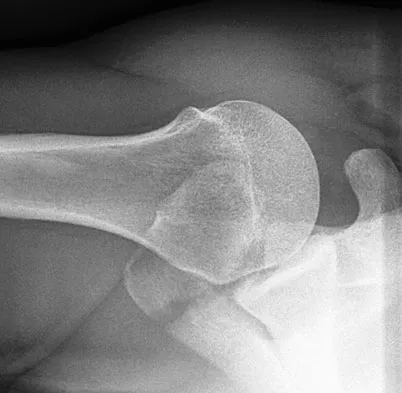
A 75-year-old female sustains a highly comminuted, osteoporotic intra-articular distal humerus fracture.

What is the primary advantage of total elbow arthroplasty (TEA) over open reduction and internal fixation (ORIF) in this specific patient population?


Explanation

In elderly patients with poor bone quality, TEA allows for immediate postoperative motion and reliable pain relief, avoiding the high risks of nonunion, malunion, and hardware failure seen with ORIF. However, TEA imposes permanent weight-bearing restrictions.

Question 31

A 28-year-old male falls onto his shoulder while snowboarding. Radiographs reveal a completely displaced midshaft clavicle fracture with 2.5 cm of shortening.

Compared to nonoperative management, surgical fixation of this injury is associated with:


Explanation

Surgical fixation of completely displaced, significantly shortened (>2 cm) midshaft clavicle fractures in active adults reduces the rate of nonunion and symptomatic malunion compared to nonoperative management. It also typically results in earlier functional return.

Question 32

A 30-year-old female presents with acute wrist and elbow pain after a high-energy fall. She is diagnosed with an Essex-Lopresti injury. What is the appropriate surgical management of the radial head in this scenario?


Explanation

Excision of the radial head is strictly contraindicated in Essex-Lopresti injuries due to the concomitant interosseous membrane disruption, which would lead to severe proximal radial migration. The radial head must be stabilized via ORIF or replacement.

Question 33

A 22-year-old rugby player with recurrent anterior shoulder instability and 25% glenoid bone loss undergoes a Latarjet procedure. During the coracoid transfer, the musculocutaneous nerve must be identified and protected. What is its approximate distance from the tip of the coracoid process?


Explanation

The musculocutaneous nerve typically enters the coracobrachialis muscle 3 to 8 cm (average ~5 cm) distal to the tip of the coracoid process. This places it at significant risk during coracoid osteotomy and transfer if dissection is carried too far distally.

Question 34

A 45-year-old woman falls on an outstretched hand and sustains an elbow dislocation, radial head fracture, and coronoid process fracture. She is taken to the operating room for surgical stabilization. What is the most widely accepted sequence for reconstructing the elbow in this 'terrible triad' injury?


Explanation

The standard surgical protocol for terrible triad injuries follows a deep-to-superficial approach. Fixation begins with the coronoid and anterior capsule, followed by radial head repair or replacement, and finally repair of the lateral collateral ligament (LCL).

Question 35

A 42-year-old woman falls on an outstretched hand and sustains a terrible triad injury of the elbow. Which of the following describes the most appropriate sequence of surgical reconstruction?


Explanation

The standard sequence for treating a terrible triad injury of the elbow is fixation of the coronoid first, followed by repair or replacement of the radial head, and finally repair of the lateral collateral ligament (LCL) complex. This deep-to-superficial approach systematically restores elbow stability.

Question 36

A 28-year-old man sustains a closed midshaft humeral fracture

. On initial emergency department presentation, he is unable to extend his wrist or fingers. What is the most appropriate initial management of this patient's neurologic deficit?


Explanation

Primary radial nerve palsies associated with closed humeral shaft fractures should be managed observationally with a functional brace or coaptation splint. Most palsies are neurapraxias or axonotmeses that spontaneously recover; surgical exploration is only indicated for open fractures, severe vascular injuries, or secondary palsies appearing after closed reduction.

Question 37

A 35-year-old male bodybuilder reports a sudden, painful "pop" in his right antecubital fossa while performing biceps curls. Physical examination reveals a "Popeye" deformity and weakness in forearm supination. If a single-incision anterior surgical approach is chosen for repair, the patient is at highest risk for injury to which of the following structures?


Explanation

The lateral antebrachial cutaneous nerve (LABCN) is the most commonly injured structure during a single-incision distal biceps tendon repair due to its superficial location in the anterior approach. In contrast, the posterior interosseous nerve (PIN) is more commonly at risk during a two-incision approach.

Question 38

A 78-year-old woman with severe osteoporosis presents with a 4-part proximal humerus fracture after a fall. She has a history of severe rotator cuff arthropathy with pseudo-paralysis of the shoulder prior to the injury. What is the most appropriate surgical intervention?


Explanation

Reverse total shoulder arthroplasty (RTSA) is the treatment of choice for elderly patients with a 4-part proximal humerus fracture and a preexisting massive rotator cuff tear or cuff tear arthropathy. RTSA relies on the deltoid for shoulder elevation and does not depend on tuberosity healing, which is often compromised in osteoporotic bone.

Question 39

An 18-year-old male football player sustains a direct blow to his medial clavicle. He presents with severe chest pain, shortness of breath, and dysphagia. Examination shows a depression of the medial clavicle. What is the most appropriate next step in management?


Explanation

Posterior sternoclavicular dislocations can compress the trachea, esophagus, and great vessels, presenting a life-threatening emergency. A CT scan is the diagnostic imaging modality of choice, and reduction should be performed in the operating room with cardiothoracic surgery backup due to the risk of catastrophic vascular injury.

Question 40

A 45-year-old man falls onto an outstretched hand and sustains a 'terrible triad' injury of the elbow.

During surgical reconstruction to restore stability, which of the following represents the most widely accepted standard sequence of repair?


Explanation

The standard surgical algorithm for a terrible triad injury proceeds from deep to superficial: coronoid fixation, followed by radial head fixation or replacement, and finally LUCL repair. The MCL is typically only repaired if the elbow remains unstable after the lateral side is secured.

Question 41

A 35-year-old male weightlifter experiences a sudden 'pop' and sharp pain in his dominant anterior elbow while attempting to lift a heavy box. Examination reveals a positive Hook test. If a single-incision anterior surgical approach is chosen for repair, which of the following nerves is at greatest risk of injury?


Explanation

The lateral antebrachial cutaneous nerve (LABCN) is the most commonly injured nerve during a single-incision anterior approach for distal biceps repair. In contrast, the posterior interosseous nerve (PIN) is at higher risk during a two-incision approach.

Question 42

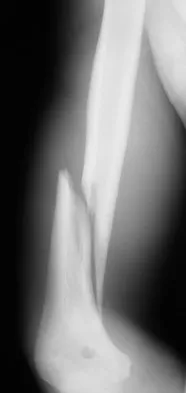
A lateral elbow radiograph of a 28-year-old woman who fell on an outstretched arm demonstrates a 'double arc' sign.

What does this radiographic finding indicate?


Explanation

The 'double arc' sign on a lateral elbow radiograph pathognomonically represents a type IV coronal shear fracture (McKee modification). The two arcs correspond to the subchondral bone of the capitellum and the lateral ridge of the trochlea, indicating trochlear extension.

Question 43

A 68-year-old woman sustains a displaced 4-part proximal humerus fracture. According to Hertel's radiographic criteria, which of the following findings is the strongest predictor for the subsequent development of humeral head avascular necrosis (AVN)?


Explanation

Hertel identified specific risk factors for ischemia of the humeral head following proximal humerus fractures. A posteromedial metaphyseal head extension (calcar length) of less than 8 mm and disruption of the medial hinge are the strongest predictors of subsequent AVN.

Question 44

A 19-year-old rugby player presents to the emergency department after a direct blow to the medial clavicle. He complains of severe pain, mild shortness of breath, and dysphagia. Examination reveals a palpable void at the sternoclavicular joint. What is the most appropriate initial management?


Explanation

This patient has a posterior sternoclavicular dislocation, which poses a life-threatening risk to mediastinal structures. Due to the risk of lacerating the underlying great vessels during manipulation, reduction must be performed in the operating room with cardiothoracic surgery standby.

Question 45

A 24-year-old competitive weightlifter feels a tearing sensation in his anterior axilla during the eccentric phase of a heavy bench press. He has weakness in internal rotation and adduction. Which anatomic portion of the affected muscle is most likely ruptured?


Explanation

Pectoralis major ruptures almost exclusively occur during the eccentric (lengthening) phase of a bench press. The sternal head, which forms the posterior layer of the tendon and inserts most proximally on the humerus, is placed under the greatest tension and typically tears first.

Question 46

A 32-year-old motorcyclist is involved in a high-speed collision.

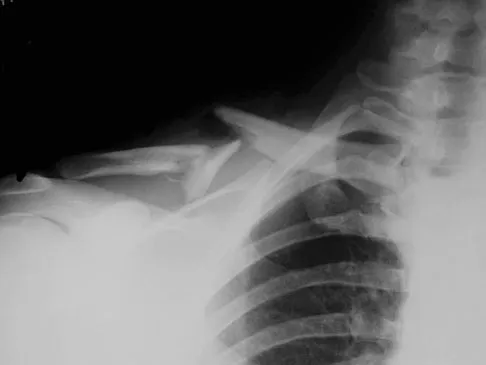
Chest radiographs demonstrate marked lateral displacement of the left scapula. The patient's left upper extremity is flaccid. What is the most critical next step in management?


Explanation

Scapulothoracic dissociation is a high-energy injury characterized by lateral scapular displacement and is highly associated with catastrophic neurovascular injuries. CT angiography is the most critical initial step to evaluate for a limb- or life-threatening subclavian or axillary artery disruption.

Question 47

A 40-year-old woman presents with severe wrist pain and elbow stiffness 3 months after undergoing an isolated radial head excision for a comminuted radial head fracture. She did not receive a radial head arthroplasty. Radiographs of the wrist now show positive ulnar variance. Which of the following undetected injuries was most likely present at the time of her initial trauma?


Explanation

The patient's presentation of proximal radial migration and ulnocarpal impingement following radial head excision is diagnostic of an Essex-Lopresti injury. This injury involves a longitudinal radioulnar dissociation caused by a radial head fracture combined with an interosseous membrane tear and DRUJ disruption.

Question 48

A 26-year-old elite volleyball attacker complains of chronic posterior shoulder pain and isolated weakness in external rotation. Forward elevation and internal rotation are full and 5/5 in strength. MRI reveals a paralabral cyst. At which anatomic location is the nerve compression most likely occurring?


Explanation

Isolated weakness of external rotation (infraspinatus) with preserved abduction (supraspinatus) points to compression of the suprascapular nerve at the spinoglenoid notch. Compression at the more proximal suprascapular notch would affect both the supraspinatus and infraspinatus.

Question 49

A 50-year-old man requires an open capsular release for severe post-traumatic elbow stiffness. During a lateral column procedure, the anterior capsule is sharply elevated off the anterior humerus. Which neurovascular structure is at highest risk during this specific step?


Explanation

During a lateral column approach for anterior capsulectomy, the radial nerve is at the greatest risk of injury. The nerve courses directly over the anterior aspect of the joint capsule near the radiocapitellar articulation and can be injured if the capsule is inadvertently penetrated or poorly elevated.

Question 50

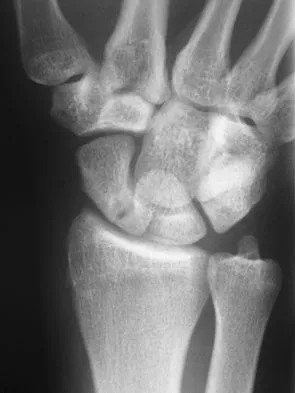
A 34-year-old man sustains an oblique fracture of the distal third of the humeral shaft (Holstein-Lewis fracture).

He demonstrates an inability to extend his wrist and fingers. The injured nerve is most susceptible to tethering and injury at which specific anatomical site?


Explanation

In a Holstein-Lewis distal third humeral shaft fracture, the radial nerve is particularly vulnerable to entrapment or laceration. This occurs precisely where the nerve is tethered as it pierces the lateral intermuscular septum, passing from the posterior to the anterior compartment of the arm.

Question 51

A 7-year-old boy sustains a Bado Type I Monteggia fracture-dislocation.

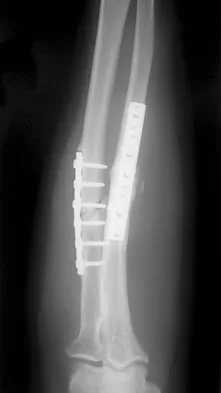
Intraoperatively, after open reduction and internal fixation of the ulnar shaft fracture, the surgeon notes that the radial head remains anteriorly dislocated. What is the most appropriate next step in management?


Explanation

In acute Monteggia fracture-dislocations, persistent dislocation of the radial head following ulnar fixation is almost exclusively due to malreduction (especially shortening or angular deformity) of the ulna. The immediate next step must be to critically assess and revise the ulnar reduction.

Question 52

A 13-year-old male baseball pitcher presents with 3 months of lateral shoulder pain during the acceleration phase of throwing. Radiographs demonstrate widening and irregularity of the proximal humeral physis. What is the primary pathophysiology of this condition?


Explanation

This presentation describes 'Little Leaguer's shoulder,' which is characterized radiographically by a widened proximal humeral physis. Pathophysiologically, it represents a Salter-Harris type I stress fracture caused by repetitive torsional loads during the throwing motion.

Question 53

A 22-year-old cyclist falls directly onto his shoulder, sustaining a completely displaced, midshaft clavicle fracture with 2.5 cm of shortening. Compared to nonoperative management with a sling, operative plate fixation of this specific injury pattern is proven to significantly decrease the risk of which complication?


Explanation

In completely displaced and shortened (>2 cm) midshaft clavicle fractures, operative fixation has been shown to significantly decrease the rate of nonunion and symptomatic malunion compared to nonoperative management. However, operative fixation increases the risks of infection and need for hardware removal.

Question 54

A 25-year-old gymnast reports clicking, pain, and a feeling of instability in her elbow when pushing herself out of a chair, months after a posterior elbow dislocation. The pivot-shift test of the elbow is positive. Which ligamentous structure is primarily deficient?


Explanation

The patient's history and symptoms describe posterolateral rotatory instability (PLRI) of the elbow. The essential lesion in PLRI is insufficiency or rupture of the lateral ulnar collateral ligament (LUCL), which normally acts as a primary stabilizer against external rotation and varus stress.

Question 55

A 45-year-old man falls on an outstretched hand and sustains a 'terrible triad' injury of the elbow. What is the most appropriate surgical sequence to effectively restore elbow stability?


Explanation

The standard surgical protocol for a terrible triad injury involves repairing structures from deep to superficial, or inside-out. The coronoid is fixed first, followed by the radial head (fixation or arthroplasty), and finally the lateral collateral ligament (LCL) complex.

Question 56

A 25-year-old cyclist falls, sustaining a midshaft clavicle fracture with 100% displacement and 2 cm of shortening. Compared to nonoperative management, open reduction and internal fixation (ORIF) of this fracture is associated with which of the following outcomes?


Explanation

ORIF of severely displaced and shortened midshaft clavicle fractures decreases the risk of nonunion and symptomatic malunion compared to nonoperative treatment. However, it carries surgical risks, including a higher likelihood of requiring subsequent hardware removal.

Question 57

A 38-year-old bodybuilder feels a sudden 'pop' in his anterior arm while deadlifting. Examination reveals a positive hook test and loss of the distal biceps contour. If this injury is managed nonoperatively, which of the following functional deficits is most expected?


Explanation

A complete distal biceps tendon rupture results primarily in a significant loss of forearm supination strength (averaging 40% to 50%). Loss of elbow flexion strength is less severe, typically around 30%.

Question 58

During a deltoid-splitting approach for proximal humerus fracture fixation, the surgeon must be careful to avoid the axillary nerve. At approximately what distance distal to the lateral edge of the acromion does the axillary nerve typically cross the deep surface of the deltoid?


Explanation

The axillary nerve courses roughly 5 cm (or about 2 inches) distal to the lateral border of the acromion. A deltoid split should safely remain superior to this landmark to avoid denervating the anterior deltoid.

Question 59

A 14-year-old elite baseball pitcher presents with right shoulder pain that occurs exclusively during the late cocking phase of throwing. Radiographs demonstrate widening of the proximal humeral physis. What is the most appropriate initial management?


Explanation

'Little League Shoulder' is a stress fracture of the proximal humeral physis caused by repetitive rotational torque. The cornerstone of treatment is absolute rest from throwing for typically 3 months to allow physeal healing.

Question 60

A 19-year-old male is tackled during a football game and presents with severe chest pain, dyspnea, dysphagia, and diminished pulses in his left arm. A posterior sternoclavicular dislocation is suspected. What is the most appropriate next step in management after securing the airway?


Explanation

Posterior sternoclavicular dislocations can be life-threatening due to compression of great vessels, the trachea, and esophagus. A contrast-enhanced CT scan is essential to evaluate the mediastinal structures before attempting a reduction.

Question 61

A 35-year-old man presents with a stiff elbow 6 months after a complex fracture-dislocation. His range of motion is 30 to 90 degrees, and radiographs show heterotopic ossification (HO). When considering surgical release and HO excision, what is the most important factor dictating the timing of surgery?


Explanation

The presence of a well-defined, mature trabecular pattern on plain radiographs indicates mature heterotopic ossification. Historical markers like normal alkaline phosphatase or a cold bone scan are no longer considered reliable prerequisites for excision.

Question 62

A 28-year-old motorcyclist is involved in a high-speed collision. He presents with massive shoulder swelling, a pulseless left upper extremity, and a completely flail limb. Radiographs show significant lateral displacement of the scapula. This condition (scapulothoracic dissociation) is most highly associated with which of the following injuries?


Explanation

Scapulothoracic dissociation is a severe closed traumatic forequarter amputation characterized by complete disruption of the scapulothoracic articulation. It carries a very high association with massive axillary or subclavian vascular injuries and complete brachial plexus avulsions.

Question 63

A 40-year-old woman reports recurrent clicking and a sense of 'giving way' in her lateral elbow, particularly when she pushes herself out of a chair. What ligament is primarily deficient, and what is the typical mechanism of the initial injury?


Explanation

Posterolateral rotatory instability (PLRI) is caused by deficiency of the lateral ulnar collateral ligament (LUCL). It typically occurs following a traumatic event involving an axial load, a valgus force, and external rotation (supination) of the forearm relative to the humerus.

Question 64

A 32-year-old man falls from a height onto his outstretched hands, sustaining a highly comminuted radial head fracture, diffuse forearm pain, and distal radioulnar joint (DRUJ) instability. To prevent longitudinal radioulnar dissociation, what is the most appropriate surgical management for the radial head?


Explanation

This patient has an Essex-Lopresti injury. Radial head excision is absolutely contraindicated as it will lead to proximal migration of the radius. A metallic radial head arthroplasty is required to restore the lateral column and longitudinal stability.

Question 65

A 72-year-old man with a chronic massive rotator cuff tear presents with pseudoparalysis. Radiographs show severe superior migration of the humeral head and acetabularization of the acromion. If a reverse total shoulder arthroplasty is performed, the center of rotation is altered in which direction compared to the native anatomy?


Explanation

The Grammont design principles for reverse total shoulder arthroplasty involve medializing and inferiorizing the center of rotation. This optimizes the deltoid's moment arm and resting tension, allowing it to substitute for the deficient rotator cuff.

Question 66


A 24-year-old woman falls on her outstretched hand. Radiographs demonstrate a coronal shear fracture of the capitellum extending medially to involve the lateral trochlear ridge (Type IV or McKee modification). What is the preferred surgical approach and fixation strategy?


Explanation

Coronal shear fractures of the capitellum, especially those involving the trochlea, are best managed via an extended lateral approach. Fixation is optimally achieved with anterior-to-posterior headless compression screws buried beneath the articular cartilage.

Question 67

A 21-year-old collegiate baseball pitcher presents with anterior shoulder pain. Physical examination of his throwing shoulder reveals 25 degrees less internal rotation compared to his non-throwing shoulder, but his total arc of motion is symmetric. What is the primary underlying anatomic pathology associated with this condition?


Explanation

Glenohumeral internal rotation deficit (GIRD) is characterized by a loss of internal rotation in the throwing shoulder. It is primarily driven by a contracture and thickening of the posteroinferior capsule.

Question 68

A 29-year-old weightlifter feels a tearing sensation in his chest while performing a heavy bench press. Examination reveals bruising and loss of the normal anterior axillary fold contour. What is the most common anatomic location for a pectoralis major rupture?


Explanation

Pectoralis major ruptures most frequently occur in weightlifters (especially during the bench press) at the tendinous insertion onto the lateral lip of the bicipital groove of the proximal humerus.

Question 69

A 30-year-old volleyball player presents with vague posterior shoulder pain and weakness in external rotation. MRI reveals a paralabral cyst compressing the nerve at the spinoglenoid notch. Which muscle(s) will most likely demonstrate denervation changes on electromyography (EMG)?


Explanation

Compression of the suprascapular nerve at the spinoglenoid notch occurs distal to the motor branches innervating the supraspinatus. Therefore, it results in isolated weakness and denervation of the infraspinatus muscle.

Question 70

A 60-year-old woman sustains a highly comminuted intra-articular distal humerus fracture (AO type 13-C). The surgeon plans an open reduction and internal fixation via a posterior approach with an olecranon osteotomy. Which osteotomy technique is associated with the highest intrinsic stability and lowest rate of hardware complications?


Explanation

A chevron (V-shaped) osteotomy directed toward the bare area of the greater sigmoid notch provides excellent intrinsic bony stability due to its interdigitating geometry, facilitating high union rates when repaired with a tension band or plate.

Question 71

A 45-year-old man presents with persistent numbness in the ring and small fingers and intrinsic weakness. EMG confirms severe ulnar neuropathy at the elbow. During an anterior submuscular transposition of the ulnar nerve, which structure must be meticulously released to prevent secondary compression of the nerve as it exits the elbow?


Explanation

During an anterior transposition of the ulnar nerve, it is critical to release the deep flexor-pronator aponeurosis. Failure to do so can create a sharp fascial band that causes secondary compression or kinking of the nerve distally.

Question 72

A 40-year-old man falls on an outstretched hand and sustains a posterior elbow dislocation, a radial head fracture, and a coronoid fracture. During surgical management, what is the standard recommended sequence of repair to restore elbow stability?


Explanation

The standard sequence for terrible triad injuries is to build from deep to superficial and medial to lateral: fix the coronoid, address the radial head (fixation or arthroplasty), and finally repair the lateral ulnar collateral ligament (LUCL). The medial collateral ligament is generally only addressed if the elbow remains unstable after the lateral side is stabilized.

Question 73

A 28-year-old male volleyball player presents with insidious onset of right shoulder weakness. Examination reveals isolated weakness in external rotation with the arm at the side, but normal forward elevation and internal rotation. MRI shows a paralabral cyst at the spinoglenoid notch. Which of the following labral pathologies is most commonly associated with this finding?


Explanation

A paralabral cyst at the spinoglenoid notch typically causes isolated compression of the suprascapular nerve as it innervates the infraspinatus, leading to isolated external rotation weakness. These cysts are most frequently associated with posterior or posterosuperior labral tears, where synovial fluid acts as a one-way valve to form the cyst.

Question 74

Which of the following radiographic findings is the most reliable predictor of future avascular necrosis (AVN) following a displaced proximal humerus fracture?


Explanation

Hertel criteria for predicting ischemia and AVN of the humeral head include a short medial calcar segment (<8 mm attached to the articular segment), disrupted medial hinge, and an anatomic neck fracture pattern. A short calcar segment is highly predictive of AVN because it implies disruption of the ascending branch of the anterior humeral circumflex artery and intraosseous vessels.

Question 75

A 45-year-old man undergoes a two-incision technique for repair of a distal biceps tendon rupture. Six months postoperatively, he complains of a severe progressive loss of forearm rotation, though his elbow flexion arc is fully preserved. What is the most likely complication he has developed?


Explanation

The two-incision technique for distal biceps repair carries a higher risk of heterotopic ossification and radioulnar synostosis compared to a single-incision anterior approach. This complication severely limits forearm pronation and supination due to bone bridging between the radius and ulna.

Question 76

A 78-year-old woman with severe osteoporosis falls and sustains a highly comminuted, displaced intra-articular fracture of the distal humerus. The articular fragments are too small for rigid fixation. What is the most appropriate surgical treatment that allows early mobilization?


Explanation

Total elbow arthroplasty (TEA) is the treatment of choice for highly comminuted, unsalvageable intra-articular distal humerus fractures in elderly, osteoporotic patients. It allows for immediate postoperative range of motion and has reliable outcomes for pain control and function in low-demand individuals.

Question 77

A 22-year-old collegiate baseball pitcher presents with right shoulder pain. Physical examination shows a 25-degree loss of internal rotation compared to the contralateral side, with an equivalent increase in external rotation. Which of the following anatomic structures is most likely contracted?


Explanation

Glenohumeral internal rotation deficit (GIRD) in overhead throwing athletes is primarily caused by contracture and thickening of the posteroinferior capsule, specifically the posterior band of the inferior glenohumeral ligament. Treatment centers on posterior capsular stretching programs.

Question 78

A 24-year-old male cyclist sustains a midshaft clavicle fracture. Which of the following is considered an absolute indication for open reduction and internal fixation?


Explanation

Absolute indications for operative treatment of clavicle fractures include open fractures, neurovascular compromise, and severe skin tenting that threatens skin integrity (impending open fracture). Displacement and shortening are relative indications, considered primarily to decrease nonunion rates in active individuals.

Question 79

A 35-year-old man presents to the emergency department after a first-time generalized seizure. Radiographs demonstrate a posterior shoulder dislocation with an anteromedial humeral head defect (reverse Hill-Sachs lesion) involving 25% of the articular surface. The shoulder is unstable in internal rotation after closed reduction. What is the most appropriate surgical management?


Explanation

For reverse Hill-Sachs lesions involving 20% to 40% of the articular surface, transferring the lesser tuberosity with the subscapularis tendon into the defect (modified McLaughlin procedure) is indicated. This prevents the defect from engaging the posterior glenoid rim during internal rotation.

Question 80

A 42-year-old carpenter presents with chronic lateral elbow pain exacerbated by lifting objects with the forearm pronated. Nonoperative management has failed after 12 months. He undergoes surgical debridement. Histologic examination of the excised pathological tissue is most likely to show which of the following?


Explanation

Lateral epicondylitis (tennis elbow) is a degenerative tendinosis rather than an acute inflammatory process. Histologically, it is characterized by angiofibroblastic hyperplasia, disorganized collagen, and a distinct absence of acute inflammatory cells.

Question 81

A 45-year-old woman falls on an outstretched hand, sustaining a terrible triad injury of the elbow. During surgical reconstruction, what is the most appropriate sequence of repair to restore elbow stability?


Explanation

The standard surgical sequence for a terrible triad injury is to build stability from deep to superficial, typically starting with coronoid fixation. This is followed by radial head fixation or arthroplasty, and finally, repair of the lateral collateral ligament (LCL) complex.

Question 82

A 35-year-old male undergoes a two-incision surgical repair of a distal biceps tendon rupture. Postoperatively, he presents with an inability to extend his thumb and fingers at the metacarpophalangeal joints, but his wrist extension is preserved with radial deviation. Which nerve was most likely injured?


Explanation

The posterior interosseous nerve (PIN) is particularly at risk during the posterolateral muscle-splitting approach of a two-incision distal biceps repair. Injury results in loss of finger and thumb extension, while wrist extension is preserved (with radial deviation) due to an intact extensor carpi radialis longus.

Question 83

A 40-year-old man presents with severe shoulder pain and limited external rotation after a seizure. Radiographs demonstrate a locked posterior shoulder dislocation with an anteromedial humeral head impression fracture (reverse Hill-Sachs lesion) involving 30% of the articular surface. What is the most appropriate surgical management?


Explanation

For posterior shoulder dislocations with an anteromedial articular defect between 20% and 40%, the modified McLaughlin procedure (transfer of the lesser tuberosity/subscapularis into the defect) provides stability. Defects greater than 40% typically require arthroplasty.

Question 84

A 24-year-old cyclist falls directly onto his left shoulder, sustaining a closed midshaft clavicle fracture. Which of the following radiographic or clinical findings is the strongest indication for open reduction and internal fixation (ORIF) to decrease the rate of symptomatic malunion?


Explanation

Significant shortening (greater than 2 cm) and 100% displacement of midshaft clavicle fractures are strong indications for ORIF in active adults. Surgical fixation in these cases significantly reduces the rates of nonunion and symptomatic malunion compared to nonoperative management.

Question 85

A 72-year-old woman presents with severe shoulder pain and an inability to raise her arm above 40 degrees of forward elevation. Radiographs show an acromiohumeral interval of 3 mm and severe glenohumeral osteoarthritis. If she undergoes the most appropriate arthroplasty procedure, what is its primary biomechanical advantage?


Explanation

This patient has rotator cuff tear arthropathy with pseudoparalysis, which is best treated with a reverse total shoulder arthroplasty (rTSA). The rTSA medializes and inferiorizes the center of rotation, lengthening the deltoid moment arm and allowing it to initiate forward elevation without a functioning rotator cuff.

Question 86

A 32-year-old female presents with lateral elbow pain after a fall. Imaging reveals a displaced coronal shear fracture of the capitellum with extension into the lateral trochlear ridge. What is the preferred surgical approach and fixation strategy?


Explanation

Displaced coronal shear fractures of the capitellum are best managed with an extended lateral approach (Kocher or Kaplan). Headless compression screws placed from anterior-to-posterior provide stable fixation while countersinking below the articular cartilage to prevent joint impingement.

None

Clinic OS
Medically Verified Content by
Prof. Clinic OS
Consultant Orthopedic & Spine Surgeon
Chapter Index
