
AAOS Pediatric Orthopedic MCQs (Set 2): DDH, SCFE & Spinal Deformities | Board Review
Comprehensive 100-Question Exam
00:00
Start Quiz
Question 1
The parents of a 15-month-old child report that he is not yet walking. Further evaluation, rather than reassurance and observation, should be conducted if the child is not performing what other activity?
Explanation
Question 2
Of the following clinical situations, which is most likely to lead to osteonecrosis associated with a slipped capital femoral epiphysis (SCFE)?
Explanation
Question 3
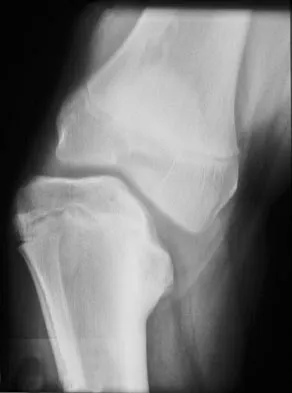
An 8-year-old boy has had pain and swelling around the right knee for the past 4 weeks. He recalls bumping it about 4 weeks ago. He has no pain in other joints, and denies any fevers, chills, or other symptoms. A radiograph is shown in Figure 13. Laboratory studies show a WBC count of 9,700/mm3, an erythrocyte sedimentation rate of 18 mm/h, and a C-reactive protein level of 3.7 mg/L. What is the next most appropriate step in management?
Explanation
Question 4
A 2-year-old child is being evaluated for limb-length and girth discrepancy. As a newborn, the patient was large for gestational age and had hypoglycemia. Current examination shows enlargement of the entire right side of the body, including the right lower extremity and foot. The skin shows no abnormal markings, and the neurologic examination is normal. The spine appears normal. Radiographs confirm a 2-cm discrepancy in the lengths of the lower extremities. Additional imaging studies should include
Explanation
Question 5
A 12 1/2-year-old boy reports intermittent knee pain and limping that interferes with his ability to participate in sports. He actively participates in football, basketball, and baseball. He denies any history of injury. Examination shows full range of motion without effusion. Radiographs reveal an osteochondritis dissecans (OCD) lesion on the lateral aspect of the medial femoral condyle. MRI scans are shown in Figures 14a and 14b. Initial treatment should consist of
Explanation
Question 6
A 14-year-old boy undergoes application of a circular frame with tibial and fibular osteotomy for gradual limb lengthening. He initiates lengthening 7 days after surgery. During the first week of lengthening, he reports that turning of the distraction devices is becoming increasingly difficult. On the 9th day of lengthening, he is seen in the emergency department after feeling a pop in his leg and noting the acute onset of severe pain. What complication has most likely occurred?
Explanation
Question 7
What is the most common primary malignant bone or cartilage tumor in children?
Explanation
Question 8
What is the peak period of onset in children with pauciarticular juvenile rheumatoid arthritis?
Explanation
Question 9
A 10-year-old girl who is Risser stage 0 has back deformity associated with neurofibromatosis type 1 (NF1). She has no back pain. Examination shows multiple cafe-au-lait nevi with normal lower extremity neurologic function and reflexes. Standing radiographs of the spine show a short 50-degree right thoracic scoliosis with a kyphotic deformity of 55 degrees (apex T8). A 10-degree progression in scoliosis has occurred during the past 1 year. There is no cervical deformity. MRI shows mild dural ectasia, primarily in the upper lumbar region. Management should consist of
Explanation
Question 10
In obstetrical brachial plexus palsy, which of the following signs is associated with the poorest prognosis for recovery in a 2-month-old infant?
Explanation
Question 11
A 6-year-old boy with acute hematogenous osteomyelitis of the distal femur is being treated with intravenous antibiotics. The most expeditious method to determine the early success or failure of treatment is by serial evaluations of which of the following studies?
Explanation
Question 12
A 6-year-old girl has a painless spinal deformity. Examination reveals 2+ and equal knee jerks and ankle jerks, negative clonus, and a negative Babinski. The straight leg raising test is negative. Abdominal reflexes are asymmetrical. PA and lateral radiographs are shown in Figures 15a and 15b. What is the next most appropriate step in management?
Explanation
Question 13
Figure 16 shows the radiograph of a 7-year-old boy who sustained a pathologic fracture of the left humerus 1 day ago. Initial management should consist of
Explanation
Question 14
Figure 17 shows the AP radiograph of a 5-year old child who has mild short stature and a painless bilateral gluteus medius lurch. Initial work-up should include
Explanation
Question 15
A 7-year-old girl with spinal muscular atrophy (SMA) type II has popping of the left hip. Examination reveals painless subluxation of the joint in adduction with palpable reduction in abduction. Radiographs show coxa valga, subluxation of the left hip, and pelvic obliquity with elevation of the left hemipelvis. Treatment should consist of
Explanation
Question 16
A newborn with myelomeningocele has no movement below the waist and has bilateral hips that dislocate with provocative flexion and adduction. What is the best treatment option for the hip instability?
Explanation
Question 17
A 14-year-old boy reports a 4-month history of increasing backache with difficulty walking long distances. His parents state that he walks with his knees slightly flexed and is unable to bend forward and get his hands to his knees. He denies numbness, tingling, and weakness in his legs and denies loss of bladder and bowel control. A lateral radiograph of the lumbosacral spine is shown in Figure 18. What is the best surgical management for this condition?
Explanation
Question 18
Duchenne's muscular dystrophy is a genetic disorder that is transmitted by which of the following modes of inheritance?
Explanation
Question 19
A 4-month-old infant is referred for evaluation of congenital scoliosis. The child has no congenital heart anomalies, and a renal ultrasound shows that he has one kidney. Examination reveals mild scoliosis and a large hairy patch on the child's back. Neurologic evaluation is normal for his age. A clinical photograph and radiograph are shown in Figures 19a and 19b. Initial management should consist of
Explanation
Question 20
A 12-year-old boy reports limping and chronic knee pain that is now inhibiting his ability to participate in sports. Clinical examination and radiographs of the knee are normal. Additional evaluation should include
Explanation
Question 21
In children with moderate to severe osteogenesis imperfecta (OI), intravenous pamidronate therapy has been shown to increase the thickness of cortical bone. This occurs primarily as a consequence of
Explanation
Question 22
Split posterior tibial tendon transfer is used in the treatment of children with cerebral palsy. Which of the following patients is considered the most appropriate candidate for this procedure?
Explanation
Question 23
Late surgical treatment of posttraumatic cubitus varus (gunstock deformity) is usually necessitated by the patient reporting problems related to
Explanation
Question 24
An 11-year-old boy sustained an ankle injury while playing football. Figure 20 shows an AP radiograph obtained the day of injury. Treatment should consist of
Explanation
Question 25
A 3-year-old child has bilateral genu varum and short stature. Radiographs show physeal widening and generalized osteopenia. The femora and tibiae show anterolateral bowing. Laboratory studies show low normal serum calcium values, significantly decreased serum phosphate levels, and normal parathyroid hormone (PTH), alkaline phosphatase, and vitamin-D levels. These findings are consistent with
Explanation
Question 26
A 6-week-old female born breech presents for evaluation of developmental dysplasia of the hip (DDH). Ultrasound of the hips reveals an alpha angle of 45 degrees and a beta angle of 78 degrees on the left side. The right hip is normal. What is the most appropriate next step in management?
Explanation
Question 27
A 2-year-old female who recently immigrated is brought to the clinic for a noticeable limp and leg length discrepancy. Radiographs reveal an untreated, high-riding developmental dislocation of the right hip. What is the most appropriate definitive management?
Explanation
Question 28
A 13-year-old obese male presents to the emergency department with severe right thigh pain after a minor slip on the ice. He is completely unable to bear weight on the right leg. Radiographs demonstrate a slipped capital femoral epiphysis (SCFE). Which of the following complications is he at the greatest risk of developing?
Explanation
Question 29
A 12-year-old premenarchal female presents for a routine evaluation. Radiographs reveal a right thoracic adolescent idiopathic scoliosis (AIS) curve measuring 35 degrees. Her Risser stage is 0. What is the most appropriate management?
Explanation
Question 30
A 12-year-old boy undergoes in-situ screw fixation for a unilateral SCFE. Which of the following patient profiles represents an absolute indication for prophylactic pinning of the asymptomatic contralateral hip?
Explanation
Question 31
A 4-month-old infant with DDH has been treated in a Pavlik harness for 3 weeks. At the current visit, the mother notes that the child is not kicking the left leg as much. On exam, the infant lacks active knee extension on the left. Injury to which nerve is the most likely cause?
Explanation
Question 32
A 3-year-old boy presents with a progressive spinal deformity. Radiographs reveal a fully segmented hemivertebra at T8 with a localized scoliotic curve of 38 degrees that has progressed 10 degrees over the last year. What is the recommended treatment?
Explanation
Question 33
In a typical patient with a slipped capital femoral epiphysis (SCFE), the relative displacement of the proximal femoral epiphysis in relation to the femoral neck is most accurately described as:
Explanation
Question 34
On an anteroposterior (AP) pelvis radiograph of a normal 6-month-old infant, the femoral head ossific nucleus should be located in the inferomedial quadrant formed by the intersection of which two radiographic lines?
Explanation
Question 35
A 14-year-old elite gymnast presents with persistent low back pain. Radiographs demonstrate a Grade II L5-S1 isthmic spondylolisthesis. She has failed 6 months of rest, bracing, and physical therapy. What is the most appropriate surgical treatment?
Explanation
Question 36
A 9-year-old child with a BMI in the 10th percentile presents with bilateral, insidious-onset hip pain. Radiographs confirm bilateral mild SCFE. Given the patient's atypical presentation, which of the following laboratory tests is most critical to obtain?
Explanation
Question 37
A newborn presents in the nursery with bilateral severe clubfeet, knee recurvatum, and rigid, irreducible dislocated hips. Evaluation reveals multiple joint contractures and decreased muscle mass. Which of the following is the most likely diagnosis?
Explanation
Question 38
A 15-year-old girl is diagnosed with adolescent idiopathic scoliosis (Lenke Type 1). Her main thoracic curve measures 58 degrees and is flexible on side-bending. Her pulmonary function tests are normal. What is the standard of care for this patient?
Explanation
Question 39
When evaluating an anteroposterior (AP) pelvis radiograph for a suspected SCFE, a line is drawn along the superior border of the femoral neck. In a normal hip, this line should intersect a portion of the lateral epiphysis. What is the name of this line?
Explanation
Question 40
A 6-week-old female with developmental dysplasia of the hip (DDH) has been treated with a Pavlik harness for 4 weeks. Repeat ultrasound reveals a persistent dislocation with an alpha angle of 35 degrees. What is the most appropriate next step in management?
Explanation
Question 41
Which of the following patients diagnosed with a unilateral slipped capital femoral epiphysis (SCFE) is most strongly indicated for prophylactic pinning of the contralateral hip?
Explanation
Question 42
A 12-year-old girl presents with adolescent idiopathic scoliosis (AIS). Her radiographs demonstrate a right thoracic curve of 35 degrees. She is premenarchal and Risser 0. Which of the following is the most appropriate management?
Explanation
Question 43
A 4-year-old girl presents with a persistently subluxated right hip following previous treatment for DDH. A pelvic osteotomy is planned to improve anterolateral acetabular coverage. Which of the following osteotomies hinges at the triradiate cartilage and decreases the volume of the acetabulum?
Explanation
Question 44
A 13-year-old boy presents to the emergency department unable to bear weight on his left leg after a minor fall. Radiographs confirm a severe slipped capital femoral epiphysis (SCFE). Which of the following complications is he at the highest risk for developing compared to a patient with a stable SCFE?
Explanation
Question 45
Which of the following vertebral anomalies carries the highest risk for rapid curve progression in congenital scoliosis, often necessitating early surgical intervention?
Explanation
Question 46
During the ultrasound evaluation of a 4-week-old infant suspected of having DDH, the alpha angle is measured. This angle is formed by the intersection of the iliac bone line and which of the following structures?
Explanation
Question 47
A 12-year-old boy with a BMI of 32 complains of left knee pain for 2 months. Knee examination is normal. When his left hip is passively flexed to 90 degrees, the thigh deviates into obligatory external rotation. What is the pathomechanics of the underlying disorder?
Explanation
Question 48
A 15-year-old boy presents with progressive mid-back pain and a rounded posture. Standing lateral radiographs reveal a thoracic kyphosis of 60 degrees. Which of the following radiographic findings confirms the diagnosis of classic Scheuermann's disease?
Explanation
Question 49
An infant treated with a Pavlik harness for DDH develops a femoral nerve palsy. Which of the following positioning errors is the most likely cause?
Explanation
Question 50
A 4-week-old female infant is diagnosed with developmental dysplasia of the hip (DDH) and placed in a Pavlik harness. During a follow-up visit, the parents report that the child is not actively kicking her left leg. On examination, the knee lacks active extension, but ankle motion is intact. What is the most likely cause of this finding?
Explanation
Question 51
Which of the following conditions is considered an absolute indication for prophylactic in situ pinning of the contralateral asymptomatic hip in a patient presenting with unilateral Slipped Capital Femoral Epiphysis (SCFE)?
Explanation
Question 52
A 2-year-old child presents with a congenital scoliosis secondary to a fully segmented hemivertebra at T8. Which of the following is the most critical screening test to perform in this patient?
Explanation
Question 53
A 3-year-old girl presents with a painless limp. Examination reveals a positive Trendelenburg sign. Radiographs show a dislocated left hip with a false acetabulum. What is the most appropriate surgical management?
Explanation
Question 54
A 12-year-old obese boy presents to the emergency department with severe groin pain after a minor fall and is completely unable to bear weight. Radiographs confirm a slipped capital femoral epiphysis. According to the Loder classification, what is the primary complication associated with his inability to bear weight?
Explanation
Question 55
A 13-year-old female presents with adolescent idiopathic scoliosis. She is pre-menarchal and Risser 0. Her right thoracic curve measures 32 degrees on standing PA radiographs. What is the most appropriate management?
Explanation
Question 56
On a coronal ultrasound of a 6-week-old infant's hip, the alpha angle measures 48 degrees and the beta angle measures 70 degrees. According to the Graf classification, what does this alpha angle indicate?
Explanation
Question 57
A 14-year-old boy underwent in situ pinning for a stable SCFE 6 months ago. He now presents with progressive hip stiffness. Examination shows severe restriction of all hip motions. Radiographs show a 2 mm joint space symmetrically but no evidence of AVN. What is the most likely diagnosis?
Explanation
Question 58
A 15-year-old gymnast presents with persistent low back pain and tight hamstrings. Radiographs reveal a Grade III isthmic spondylolisthesis at L5-S1. She has failed 6 months of nonoperative treatment. What is the most appropriate surgical intervention?
Explanation
Question 59
A 2-year-old boy is being followed after closed reduction and spica casting for DDH at age 8 months. Which radiographic finding is considered the earliest indicator of avascular necrosis of the femoral head in this patient?
Explanation
Question 60
Slipped capital femoral epiphysis (SCFE) represents a mechanical failure through which specific histologic layer of the physis?
Explanation
Question 61
In a 9-month-old male with a left thoracic curve measuring 25 degrees, the rib-vertebral angle difference (RVAD) of Mehta is measured at 28 degrees. What is the most likely natural history of this curve and the recommended treatment?
Explanation
Question 62
An infant is born with bilateral dislocated hips and rigid extension contractures of the knees. Genetic testing confirms arthrogryposis multiplex congenita. What is the expected success rate of Pavlik harness treatment in this patient?
Explanation
Question 63
A 25-year-old male presents with groin pain exacerbated by hip flexion and internal rotation. He has a history of mild SCFE treated with in situ pinning at age 13. Radiographs show a prominent alpha angle and a "pistol grip" deformity. What type of femoroacetabular impingement (FAI) is most likely occurring?
Explanation
Question 64
A 12-year-old non-ambulatory male with Duchenne muscular dystrophy presents with a progressive thoracolumbar scoliosis of 55 degrees. His forced vital capacity (FVC) is currently 45% of predicted. What is the most appropriate management?
Explanation
Question 65
When evaluating a 5-month-old with suspected DDH, an AP pelvis radiograph is obtained. Which of the following describes a normal spatial relationship on this imaging?
Explanation
Question 66
A 10-year-old girl with primary hypothyroidism presents with bilateral vague knee pain. Frog-leg lateral radiographs of the pelvis demonstrate widening of the bilateral proximal femoral physes without obvious slippage. What is the most appropriate next step in management?
Explanation
Question 67
A 15-year-old Risser 4 male with adolescent idiopathic scoliosis has a single right thoracic curve measuring 55 degrees. He is entirely asymptomatic. What is the primary indication for performing a posterior spinal fusion in this patient?
Explanation
Question 68
During an anterior open reduction for a developmental dislocation of the hip in a 14-month-old, the surgeon notes an hour-glass constriction of the joint capsule. Which structure is directly responsible for creating this specific capsular constriction?
Explanation
Question 69
A 16-year-old patient who had a severe, unstable SCFE treated with in situ pinning 4 years ago now presents with severe hip pain and limited abduction. Radiographs show a collapsed, sclerotic femoral head with crescent signs. What is the most definitive surgical option for this patient?
Explanation
Question 70
A 6-week-old infant with developmental dysplasia of the hip (DDH) is being treated with a Pavlik harness. During a follow-up visit, the parents report that the child has stopped kicking the left leg. On examination, there is an absence of active knee extension on the left side, but withdrawal to painful stimuli on the plantar foot is intact. What is the most appropriate next step in management?
Explanation
Question 71
A 13-year-old boy with a BMI in the 98th percentile presents to the emergency department unable to bear weight on his right leg after tripping over a rug. Radiographs confirm a slipped capital femoral epiphysis (SCFE). According to the Loder classification, which of the following is the most significant consequence of his inability to bear weight?
Explanation
Question 72
A newborn is evaluated in the nursery and noted to have a spinal asymmetry. Radiographs reveal a fully segmented hemivertebra at T8, confirming a diagnosis of congenital scoliosis. Which of the following screening evaluations is most critical in the initial workup of this patient?
Explanation
Question 73
A 4-week-old female infant born in breech presentation undergoes a screening hip ultrasound. The coronal view demonstrates a shallow acetabulum with an alpha angle of 45 degrees and a beta angle of 80 degrees. According to the Graf classification, what is the most appropriate management?
Explanation
Question 74
An 8-year-old boy presents with bilateral groin pain and an altered gait. Radiographs demonstrate bilateral stable slipped capital femoral epiphyses (SCFE). His height is in the 5th percentile, and his weight is in the 90th percentile. Which of the following laboratory evaluations is most critical in determining the etiology of his condition?
Explanation
Question 75
A 13-year-old girl with adolescent idiopathic scoliosis (AIS) presents for follow-up. She is pre-menarchal and Risser stage 0. Standing radiographs reveal a progressive right thoracic curve measuring 32 degrees. Based on the BrAIST trial, what is the most appropriate recommendation?
Explanation
Question 76
An 18-month-old girl undergoes an open reduction for a chronically dislocated developmental dysplasia of the hip (DDH). Intraoperatively, there is significant acetabular dysplasia with a steep, shallow acetabulum. Which pelvic osteotomy is most appropriate to provide anterolateral coverage by redirecting the acetabulum without reducing its volume?
Explanation
Question 77
In which of the following patients presenting with a unilateral slipped capital femoral epiphysis (SCFE) is prophylactic in situ pinning of the contralateral hip most strongly indicated?
Explanation
Question 78
A 15-year-old male gymnast complains of worsening lower back pain over the past 3 weeks, exacerbated by extension. Plain radiographs show no obvious cortical break or spondylolisthesis. Which imaging modality is most sensitive for detecting an early, active pars interarticularis stress reaction?
Explanation
Question 79
Following a closed reduction of developmental dysplasia of the hip (DDH) in a 6-month-old, the child is placed in a hip spica cast. To minimize the risk of developing iatrogenic avascular necrosis (AVN), which of the following joint positions must be strictly avoided during casting?
Explanation
Question 80
A 16-year-old boy presents with progressive mid-back pain and a rounded posture. Standing lateral radiographs reveal a thoracic kyphosis of 65 degrees. According to the classic Sorensen criteria, what radiographic finding is required to definitively diagnose Scheuermann's kyphosis?
Explanation
Question 81
A 13-year-old girl underwent an uncomplicated in situ pinning for a stable SCFE 6 months ago. She now returns with a stiff, painful hip and severe limitation in all planes of motion. Radiographs demonstrate profound global joint space narrowing (less than 3 mm). What is the most likely etiology of her current condition?
Explanation
Question 82
A 9-month-old boy is evaluated for a left thoracic scoliosis measuring 28 degrees. Radiographic measurement shows a rib-vertebral angle difference (RVAD) of Mehta of 25 degrees with Phase 2 rib head overlap. What is the most appropriate management strategy?
Explanation
Question 83
When evaluating an anteroposterior pelvis radiograph of a 12-month-old child suspected of having residual developmental dysplasia of the hip (DDH), the acetabular index is measured. What is generally considered the upper limit of normal for the acetabular index at this age?
Explanation
Question 84
A 14-year-old non-ambulatory boy with Duchenne muscular dystrophy (DMD) presents with a progressive 55-degree thoracolumbar scoliosis. His forced vital capacity (FVC) is currently 40% of predicted. What is the most appropriate intervention for his spinal deformity?
Explanation
Question 85
A 4-week-old female is treated with a Pavlik harness for developmental dysplasia of the hip (DDH). At the 2-week follow-up, she exhibits decreased spontaneous extension of the right knee and an absent patellar reflex. What is the most appropriate next step in management?
Explanation
Question 86
A 13-year-old boy presents with severe left hip pain and an inability to bear weight following a minor fall. Radiographs confirm a slipped capital femoral epiphysis (SCFE). Which of the following is the most likely severe complication directly associated with this specific presentation?
Explanation
Question 87
Which of the following congenital spinal anomalies carries the highest risk of rapid curve progression, typically necessitating the earliest surgical intervention?
Explanation
Question 88
An infant undergoes screening ultrasound for developmental dysplasia of the hip (DDH). The report notes an alpha angle of 45 degrees. Which of the following anatomic structures form the lines used to measure the alpha angle?
Explanation
Question 89
A 7-year-old boy, whose weight is in the 30th percentile, presents with a stable slipped capital femoral epiphysis (SCFE). Which of the following laboratory studies is most highly indicated for this patient?
Explanation
Question 90
A 12-year-old premenarchal female with adolescent idiopathic scoliosis (AIS) has a right thoracic curve of 32 degrees and a Risser stage of 1. According to the Bracing in Adolescent Idiopathic Scoliosis Trial (BRAIST), what is the most significant factor determining the success of brace treatment?
Explanation
Question 91
An 18-month-old girl undergoes a closed reduction trial for a dislocated right hip. Intraoperative arthrography reveals a medial dye pool measuring 7 mm. What is the most appropriate next step in management?
Explanation
Question 92
A 14-year-old boy undergoes in situ percutaneous pinning for a stable slipped capital femoral epiphysis (SCFE). Which of the following screw configurations provides the optimal balance of biomechanical stability and minimized complication risk?
Explanation
Question 93
An 8-month-old boy is diagnosed with infantile idiopathic scoliosis. Radiographs reveal a 25-degree left thoracic curve. Which of the following radiographic parameters best predicts whether this curve will progress rather than spontaneously resolve?
Explanation
Question 94
A 4-year-old girl with residual acetabular dysplasia requires a pelvic osteotomy. The surgeon plans an incomplete transiliac osteotomy that hinges on the triradiate cartilage to decrease the volume and change the shape of the acetabulum. Which procedure is being described?
Explanation
Question 95
Following pinning of a SCFE, a 13-year-old patient develops a stiff, painful hip with a 15-degree flexion contracture. Radiographs reveal global narrowing of the joint space to less than 3 mm. What is the most likely diagnosis?
Explanation
Question 96
A 14-year-old female presents with back pain and is diagnosed with an L5-S1 isthmic spondylolisthesis. Which of the following radiographic findings is considered the most significant risk factor for further slip progression?
Explanation
Question 97
A 2.5-year-old child presents with an untreated, completely dislocated left hip (DDH) and is scheduled for an open reduction. To minimize the risk of osteonecrosis during the reduction in a child of this age, which adjunctive procedure is most commonly required?
Explanation
Question 98
When evaluating an AP pelvis radiograph for a suspected slipped capital femoral epiphysis (SCFE), what defines an abnormal Klein's line?
Explanation
Question 99
A 15-year-old boy presents with a Lenke Type 1 (main thoracic) adolescent idiopathic scoliosis curve of 55 degrees. When planning posterior spinal fusion, what is the primary goal regarding the selection of the lowest instrumented vertebra (LIV)?
Explanation
Question 100
An infant is diagnosed with a teratologic hip dislocation associated with arthrogryposis multiplex congenita. What is the most appropriate initial management strategy for the hip?
Explanation
None
Detailed Chapters & Topics
Dive deeper into specialized chapters regarding pediatrics-2007-set-2-mcqs-4021