Orthopedic Prometric MCQs - Chapter 3 Part 43
Orthopedic Prometric MCQs - Chapter 3 Part 43
Comprehensive 100-Question Exam
00:00
Start Quiz
Question 1
What is the mechanism of injury that leads to the clinical diagnosis of "turf toe":
Explanation
Question 2
The gold standard for evaluation of chronic compartment syndrome in the athlete is:
Explanation
Question 3
Internal impingement of the shoulder between the posterosuperior glenoid rim and the rotator cuff occurs in which phase of throwing:
Explanation
Question 4
When comparing open distal clavicle resection with arthroscopic distal clavicle resection for osteolysis of the distal clavicle, arthroscopic techniques:
Explanation
Question 5
A magnetic resonance image (MRI) of the dominant elbow of a 19-year-old minor league baseball pitcher is presented (pic). He has been unable to pitch for the past 6 weeks secondary to pain. The recommended treatment includes:
Explanation
Question 6
Following acute lateral traumatic patellar dislocation, the surgical procedure that most closely reconstructs the injured structure is:
Explanation
Question 7
A 22-year-old male tennis player has dominant side shoulder pain when serving and hitting overheads. Despite a prolonged course of physiotherapy, he is unable to return to tennis because of shoulder pain. His treating physician recommend arthroscopy of his shoulder with debridement of associated lesions. What is the likelihood that he will be playing tennis at his preinjury level of competition at 1 year following surgery:
Explanation
Question 8
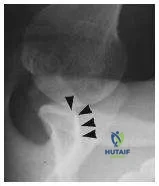
A glenoid profile radiograph (Slide) of a 21-year-old male rugby player with multiple traumatic anterior shoulder dislocations is presented. Which of the following is the preferred treatment:
Explanation
Question 9
Which of the following statements is true regarding humeral retroversion in a throwers dominant shoulder:
Explanation
Question 10
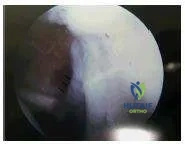
An arthroscopic photo (Slide) looking from the posterior portal is presented. The arrows point to which structure:
Explanation
Question 11
When performing a Latarjet coracoid transfer for anterior shoulder instability with bony anterior glenoid rim insufficiency, glenoid surface of the coracoid transfer must be positioned.
Explanation
Question 12
An arthroscopic photo (Slide) during shoulder arthroscopy looking from the posterior portal is presented. The arrows point to which structure:
Explanation
Question 13
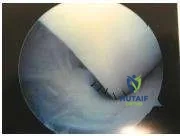
An arthroscopic photo (Slide) of the shoulder looking from the posterior portal is presented. The large white structure at the top of the figure is the biceps tendon. The arrows point to which structure:
Explanation
Question 14
An arthroscopic photo (Slide) looking from the posterior portal is presented. The arrows point to which structure:
Explanation
Question 15
An arthroscopic photo (Slide) looking from the posterior portal at the anterior inferior aspect of the glenoid is presented. What is the proper treatment in this case based on the finding:
Explanation
Question 16
An arthroscopic photo (Slide) looking from the posterior portal is presented. Identify the torn structure:
Explanation
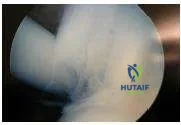 This photo demonstrates a torn ligamentous pulley that has possibly resulted in an unstable biceps tendon. Pathology of the ligamentous pulley is often associated with rotator cuff pathology.
Question 17
When comparing anterior cruciate ligament (AC L) reconstruction using autogenous hamstrings and AC L reconstruction using autogenous patellar tendon, the most consistent difference is:
Explanation
Question 18
Muscle contusions are clinically graded according to:
Explanation
Question 19
The treatment protocol found to hasten recovery after quadriceps contusion is:
Explanation
Question 20
The differential diagnosis for patients presenting with radiographs consistent with myositis ossificans includes all of the following except:
Explanation
Question 21
During reconstruction of the posterior cruciate ligament (PCL), understanding the bundle anatomy is critical for restoring normal knee kinematics. Which of the following statements regarding the anterolateral (AL) and posteromedial (PM) bundles is correct?
Explanation
Question 22
A 24-year-old football player sustains a direct blow to the anteromedial tibia with the knee in extension. Physical examination reveals a positive dial test with 15 degrees of asymmetric external rotation at 30 degrees of knee flexion, but symmetrical external rotation at 90 degrees compared to the contralateral knee. What is the most likely injured structure?
Explanation
Question 23
In a patient with recurrent lateral patellar dislocations undergoing medial patellofemoral ligament (MPFL) reconstruction, the femoral tunnel must be placed anatomically to prevent abnormal patellofemoral contact pressures. Where is the anatomical femoral attachment of the MPFL located?
Explanation
Question 24
A 21-year-old collegiate baseball pitcher presents with medial elbow pain and decreased pitching velocity. Magnetic resonance arthrography demonstrates a tear of the medial ulnar collateral ligament (MUCL). Which structure is the primary restraint to valgus stress between 30 and 120 degrees of elbow flexion?
Explanation
Question 25
A 13-year-old gymnast complains of lateral elbow pain and catching. Radiographs demonstrate a radiolucent defect in the capitellum with a sclerotic margin.
What fundamentally differentiates osteochondritis dissecans (OCD) of the capitellum from Panner's disease?
Explanation
Question 26
A 45-year-old patient experiences a sudden 'pop' in the posterior knee while squatting. MRI reveals a posterior medial meniscus root tear. Biomechanically, this injury is equivalent to which of the following?
Explanation
Question 27
A 30-year-old male felt a tearing sensation in his anterior axillary fold while performing a heavy bench press. Examination reveals loss of the anterior axillary fold contour and weakness in internal rotation. Which portion of the pectoralis major is most commonly ruptured during this activity?
Explanation
Question 28
A 22-year-old hockey player presents with anterior groin pain exacerbated by hip flexion and internal rotation. Radiographs reveal an increased alpha angle, consistent with femoroacetabular impingement (FAI). This morphological abnormality (Cam lesion) is typically located in which quadrant of the femoral head-neck junction?
Explanation
Question 29
During a football tackle, a player sustains an injury to the distal tibiofibular syndesmosis. What is the most common mechanism of injury for a 'high ankle sprain'?
Explanation
Question 30
A 25-year-old marathon runner presents with bilateral exercise-induced anterior leg pain. Chronic exertional compartment syndrome is suspected. Based on the modified Pedowitz criteria, which of the following intracompartmental pressure measurements is diagnostic?
Explanation
Question 31
A 19-year-old collegiate soccer player undergoes ACL reconstruction. Which of the following autografts is associated with the lowest risk of re-rupture in highly active young athletes but the highest incidence of anterior knee pain?
Explanation
Question 32
A 25-year-old rugby player sustains a direct blow to the anteromedial tibia with the knee flexed. Clinical exam reveals a positive Dial test at 30 degrees of flexion, but symmetric rotation at 90 degrees. What is the most likely injured structure?
Explanation
Question 33
Which of the following zones of the meniscus is most amenable to successful surgical repair due to its robust vascular supply?
Explanation
Question 34
A 14-year-old elite baseball pitcher presents with vague, progressive shoulder pain during the acceleration phase of throwing. Radiographs demonstrate widening of the proximal humeral physis. What is the most appropriate initial management?
Explanation
Question 35
The "peel-back" mechanism is a primary cause of Superior Labrum Anterior and Posterior (SLAP) tears in overhead throwing athletes. During which phase of throwing does this mechanism primarily occur?
Explanation
Question 36
A 22-year-old professional football player sustains recurrent anterior shoulder dislocations. Advanced imaging reveals a 25% bony Bankart lesion of the anterior glenoid rim. What is the most appropriate surgical intervention to prevent recurrence?
Explanation
Question 37
In a high-level baseball pitcher undergoing ulnar collateral ligament (UCL) reconstruction, which nerve is most intimately at risk of injury and often requires careful decompression or transposition?
Explanation
Question 38
What is the most common anatomic location for Osteochondritis Dissecans (OCD) lesions in the adolescent knee?
Explanation
Question 39
A 30-year-old recreational athlete suffers an acute Achilles tendon rupture. When comparing operative versus non-operative management, the patient should be counseled that surgical repair is generally associated with:
Explanation
Question 40
According to the modified Pedowitz criteria, a diagnosis of chronic exertional compartment syndrome (CECS) of the leg is objectively confirmed if the intracompartmental pressure is at least:
Explanation
Question 41
A 12-year-old boy presents with anterior knee pain heavily aggravated by jumping activities. Examination reveals point tenderness directly over the inferior pole of the patella. Radiographs show localized fragmentation at the patellar apex. What is the most likely diagnosis?
Explanation
Question 42
A 21-year-old collegiate sprinter sustains an acute Zone 2 fracture of the proximal fifth metatarsal. To facilitate the fastest and most reliable return to play, what is the standard recommended treatment?
Explanation
Question 43
An athlete sustains a syndesmotic injury (high ankle sprain) during a tackle. What is the most common biomechanical mechanism of injury associated with this condition?
Explanation
Question 44
A 16-year-old gymnast experiences an acute lateral patellar dislocation upon landing a vault. Which ligament is the primary restraint to lateral patellar translation at 0 to 30 degrees of knee flexion, and is nearly universally torn in this scenario?
Explanation
Question 45
A ballet dancer complains of a deep "snapping" sensation in her anterior groin when extending her hip from a flexed and abducted position. There is no pain over the greater trochanter. What is the anatomical structure causing this internal snapping hip syndrome?
Explanation
Question 46
An ice hockey player presents with chronic lower abdominal and groin pain exacerbated by resisted sit-ups and coughing. Examination reveals no obvious inguinal hernia bulge, but there is marked tenderness over the pubic tubercle and the external inguinal ring. What is the most likely diagnosis?
Explanation
Question 47
In Acromioclavicular (AC) joint injuries, the coracoclavicular (CC) ligaments provide the primary vertical stability to the joint. Which of the following accurately describes the anatomical arrangement of the CC ligaments?
Explanation
Question 48
A 22-year-old football player sustains a knee injury. MRI shows a complete tear of the anterior cruciate ligament (ACL) and a medial meniscus posterior horn tear. If a bone-patellar tendon-bone (BPTB) autograft is used for reconstruction, what is the most common post-operative complication?
Explanation
Question 49
A 25-year-old baseball pitcher presents with medial elbow pain during the late cocking and early acceleration phases of throwing. Valgus stress test is positive. Which band of the ulnar collateral ligament (UCL) is the primary restraint to valgus stress at 90 degrees of flexion?
Explanation
Question 50
In a patient with posterolateral rotatory instability (PLRI) of the elbow, what is the key deficient structure causing this pathology?
Explanation
Question 51
A 16-year-old gymnast complains of chronic anterior knee pain. On examination, the patella is highly mobile laterally. You suspect patellofemoral instability. Reconstruction of the medial patellofemoral ligament (MPFL) is planned. Where is the normal anatomic femoral origin of the MPFL?
Explanation
Question 52
A 24-year-old soccer player undergoes an isolated medial meniscal repair. Which of the following zones of the meniscus has the best healing potential?
Explanation
Question 53
A 28-year-old weightlifter feels a sudden "pop" in his anterior shoulder while doing a heavy bench press. He has loss of the anterior axillary fold contour. Which of the following is the most likely diagnosis?
Explanation
Question 54
A 30-year-old runner presents with lateral knee pain that is worse when running downhill. Tenderness is maximal 2-3 cm proximal to the lateral joint line. Examination reveals a positive Noble compression test. What is the most likely diagnosis?
Explanation
Question 55
A 21-year-old collegiate basketball player sustains an inversion ankle injury. He has tenderness over the anterior inferior tibiofibular ligament (AITFL) and a positive squeeze test. What is the most sensitive imaging modality or dynamic test for diagnosing a syndesmotic injury?
Explanation
Question 56
A 35-year-old recreational tennis player has chronic, recalcitrant Achilles tendinopathy. MRI shows a focal area of tendinosis 4 cm proximal to the calcaneal insertion. What is the blood supply to this watershed area of the Achilles tendon?
Explanation
Question 57
A 19-year-old female dancer complains of a deep groin pain and a "clicking" sensation in her hip. Radiographs show a lateral center-edge angle of 15 degrees. What is the most likely underlying structural pathology?
Explanation
Question 58
A 23-year-old hockey player presents with athletic pubalgia (sports hernia). He has pain with resisted sit-ups. Which structure is most commonly involved in the pathogenesis of this condition?
Explanation
Question 59
A 20-year-old baseball pitcher presents with a SLAP tear. During which phase of throwing does a type II SLAP tear most commonly become symptomatic due to the peel-back mechanism?
Explanation
Question 60
A 32-year-old male sustains a complete distal biceps tendon rupture. During surgical repair using a single-incision anterior approach, which nerve is at the highest risk of injury?
Explanation
Question 61
A 26-year-old rugby player has recurrent anterior shoulder instability. CT scan shows a 25% anterior glenoid bone loss. What is the most appropriate surgical management?
Explanation
Question 62
A 22-year-old pole vaulter presents with deep posterior ankle pain with extreme plantarflexion. Radiographs reveal an os trigonum. What structure is most at risk during an endoscopic excision of the os trigonum?
Explanation
Question 63
A 17-year-old male baseball pitcher complains of lateral elbow pain. Radiographs reveal an osteochondritis dissecans (OCD) lesion of the capitellum with an open physis. What is the most appropriate initial management for a stable lesion?
Explanation
Question 64
Which of the following physical examination findings is most specific for a complete posterior cruciate ligament (PCL) injury?
Explanation
Question 65
A 28-year-old rugby player grabs an opponent's jersey and feels a sudden "snap" in his ring finger. He is unable to actively flex the DIP joint. What is the most likely diagnosis?
Explanation
Question 66
A 19-year-old football lineman presents with a stinger (burner) after a direct impact to the neck and shoulder. Symptoms typically resolve within minutes. Which nerve roots are most commonly involved in this traction injury?
Explanation
Question 67
A 24-year-old marathon runner is diagnosed with a femoral neck stress fracture. Radiographs show a fracture line on the tension side (superior aspect) of the femoral neck. What is the recommended treatment?
Explanation
Question 68
A collegiate baseball pitcher presents with chronic medial elbow pain and a decline in pitching velocity. A moving valgus stress test is positive. Which specific ligamentous bundle is the primary restraint to valgus stress of the elbow between 30 and 120 degrees of flexion?
Explanation
Question 69
A 24-year-old professional quarterback undergoes shoulder arthroscopy for a symptomatic labral tear. The surgeon notes a type II SLAP lesion caused by a 'peel-back' mechanism. This biomechanical force is maximal during which phase of the throwing motion?
Explanation
Question 70
A 14-year-old gymnast presents with chronic anterior knee pain. Imaging reveals an osteochondritis dissecans (OCD) lesion. What is the most common anatomical location for this lesion in the knee?
Explanation
Question 71
During medial patellofemoral ligament (MPFL) reconstruction for recurrent patellar instability, accurate anatomic placement of the femoral tunnel is critical for graft isometry. The normal femoral footprint of the MPFL is located:
Explanation
Question 72
A 28-year-old marathon runner complains of bilateral lower leg pain that occurs predictably after 3 miles and resolves shortly after stopping. Which of the following compartment pressure measurements (Pedowitz criteria) confirms the diagnosis of chronic exertional compartment syndrome?
Explanation
Question 73
A 40-year-old male feels a sudden pop in his anterior elbow while lifting a heavy box. On examination, what is the most sensitive and specific clinical test for diagnosing a complete distal biceps tendon rupture?
Explanation
None
