Part of the Master Guide

Orthopedic Prometric MCQs - Chapter 3 Part 1

Orthopedic Prometric MCQs - Chapter 3 Part 28
25 Apr 2026 42 min read 24 Views
Orthopedic Prometric MCQs - Chapter 3 Part 28

Orthopedic Prometric MCQs - Chapter 3 Part 28

Comprehensive 100-Question Exam


00:00

Start Quiz

Question 1

A patient with a fracture dislocation of the spine has a sensory level at the xiphoid process. Which of the following nerve root levels indicates this finding:


Explanation

The skin over the xiphoid process area is innervated by the T7 nerve root. In addition to knowing the innervation of selected muscles and the deep tendon reflexes, the clinician should also know the sensory levels to localize pathologic processes. T4 Nipple line T7 Xiphoid process T10 Umbilicus T12 Groin

Question 2

A patient with a fracture dislocation of the spine has a sensory level at the umbilicus. Which of the following nerve root levels indicates this finding:


Explanation

The skin of the umbilicus is innervated by the T10 nerve root.br> In addition to knowing the innervation of selected muscles and the deep tendon reflexes, the clinician should also know the sensory levels to localize pathologic processes. T4 Nipple line T7 Xiphoid process T10 Umbilicus T12 Groin

Question 3

Which of the following statements regarding the presentation of thoracic disk herniations is false:


Explanation

Patients with thoracic disk herniations may present with mechanical axial back pain, radicular pain, or myelopathy, but pain is the principal symptom. Bowel and bladder symptoms occur in 10% to 20% of affected patients.

Question 4

Which of the following statements regarding the treatment of thoracic disk herniations is true:


Explanation

The majority (75%) of patients with thoracic disk herniations may be managed nonoperatively. Surgical procedures must adequately decompress the involved nerve root. Posterior approach by laminectomy is usually not adequate, and costotransversectomy is not effective for large central calcified herniations (an anterior approach is preferred). The anterior transthoracic approach is effective for T5-T12 lateral and anterior disk herniations.

Question 5

Which of the following is the only accepted pharmacological agent for the acute treatment of a spinal cord injury:


Explanation

Methylprednisolone is currently the only accepted pharmacologic agent for the treatment of spinal cord injury. The North American Spinal C ord Injury Studies (NASC IS) found significant motor and sensory improvement in patients who were treated within 8 hours of injury with a methylprednisolone bolus of 30 mg/kg, followed by an infusion of 5.4 mg per hour for 24 hours. Other agents have been studied in animal experiments but have not been promising in clinical trials.

Question 6

A 45-year-old man has neck pain following a motor vehicle accident. His neurologic examination is normal. His plain radiographs are shown (Slide). The most likely diagnosis is:


Explanation

The lateral radiograph shows translation and kyphosis at the level of injury. The facets of C4 do not superimpose on each to create a "double sail" sign. This patient has a unilateral facet dislocation. With unilateral facet dislocations, there is usually 3 mm to 4 mm of forward translation and 5° to 7° of angulation.

Question 7

A 35-year-old man has neck pain following a motor vehicle accident. His axial computed tomography scan is shown (Slide). The most likely diagnosis is:


Explanation

The axial computed tomography scan of C 4-C 5 shows a unilateral facet dislocation. Notice that the superior facet of C 5 lies posterior to the inferior facet of C 4. This relationship should be the exact opposite. Also, notice that C 4 is rotated on the body of C 5 and translated forward.

Question 8

A 40-year-old woman has severe neck pain following a motor vehicle accident. Her plain lateral radiograph of the spine is shown (Slide). A sagittal magnetic resonance scan is shown (Slide). The most likely diagnosis is:


Explanation

There is significant subluxation of C 5 on C 6 on the plain radiograph. The facets of C 5 and C 6 have lost their normal relationship. This patient has a bilateral facet dislocation. There is compression and significant changes within the spinal cord. This patient should be treated with reduction and fusion.

Question 9

A 40-year-old woman has severe neck pain following a motor vehicle accident. Her plain lateral radiograph of the spine is shown (Slide). A sagittal magnetic resonance is shown (Slide). The most appropriate treatment would be:


Explanation
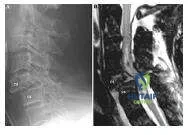
There is significant subluxation of C 5 on C 6 on the plain radiograph. The facets of C 5 and C 6 have lost their normal relationship. This patient has a bilateral facet dislocation. There is compression and significant changes within the spinal cord. This patient should be treated with reduction and fusion. This is a ligamentous injury so reduction and immobilization will not result in satisfactory healing. Orthopedic Prometric Exam Chapter 3 Image

Question 10

In which of the following nerve roots is compression neuropathy common in cervical spondylosis:


Explanation

The nerve roots that are most commonly affected in cervical spondylosis are C6 and C7, secondary to degenerative changes in the C 5-C 6 and C 6-C 7 nerve roots. Patients may have specific dermatomal pain or pain that is diffuse and poorly localized.

Question 11

Which of the following sensory areas is affected by compression of the C 6 nerve root:


Explanation

It is important to remember the sensory dermatome when examining patients who have neck and upper extremity pain: C3 Posterior neck, occiput C4 Base of neck, medial shoulder C5 Base of neck to shoulder and upper arm C6 Lateral forearm into the radial side of the hand C7 Posterolateral forearm into the middle finger of the hand C8 Ulnar side of the forearm and hand

Question 12

Which of the following sensory areas is affected by compression of the C 7 nerve root:


Explanation

It is important to remember the sensory dermatome when examining patients who have neck and upper extremity pain: C3 Posterior neck, occiput C4 Base of neck, medial shoulder C5 Base of neck to shoulder and upper arm C6 Lateral forearm into the radial side of the hand C7 Posterolateral forearm into the middle finger of the hand C8 Ulnar side of the forearm and hand

Question 13

A patient comes into your office with neck and arm pain. The patientâ s plain radiograph is shown (Slide). Which of the following signs is most likely to be found on physical examination:


Explanation
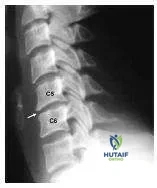
The lateral radiograph shows narrowing of the C 5-C 6 intervertebral disk space with osteophytes arising anteriorly and posteriorly. This degenerative process results in facet joint hypertrophy, osteophytes in the uncovertebral joints, and hypertrophy of the ligamentum flavum. The C 6 nerve root is compressed resulting in numbness on the lateral forearm into the radial side of the hand. Elbow and wrist extension may be affected, and the biceps tendon reflex may be diminished or absent. It is important to remember the sensory dermatome when examining patients who have neck and upper extremity pain: C3 Posterior neck, occiput C4 Base of neck, medial shoulder Orthopedic Prometric Exam Chapter 3 Image C5 Base of neck to shoulder and upper arm C6 Lateral forearm into the radial side of the hand C7 Posterolateral forearm into the middle finger of the hand C8 Ulnar side of the forearm and hand

Question 14

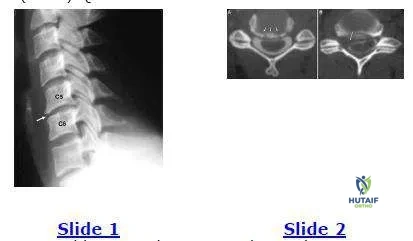
A 45-year-old woman has pain in her right upper extremity and neck. The plain film is is presented (Slide 1) as well as an axial post myelogram CT images (Slide 2, A & B). Her pain has not responded to nonsteroidal anti- inflammatory drugs or physical therapy. Which of the following is the most appropriate treatment:


Explanation

The axial post myelogram CT image shows a disk herniation, and the sagittal view shows prominent osteophytes. There is no evidence of an infection or a neoplasm. This patient is a candidate for anterior disckectomy and fusion.

Question 15

Plain radiographs of the lumbosacral spine are useful for:


Explanation

Plain radiographs are useful for assessing the alignment of the spine, bone destruction by tumors and infections, and instability patterns. The radiographs also will show degenerative intervertebral disks. Plain radiographs are not sensitive for detecting marrow changes, herniated disks, and neural compression secondary to degenerative changes.

Question 16

Computerized tomography scans are efficacious for detecting which of the following conditions:


Explanation

Computerized tomography scans are excellent for assessing bone structure, especially in patients with metastatic bone disease and primary bone tumors of the spine. C omputerized tomography is useful for distinguishing between bone and soft tissue compression in neural compressive disorders.

Question 17

A 35-year-old construction worker has left leg pain and difficulty walking. His examination is normal except for decreased sensation to the lateral border of the left foot, the inability to walk on the toes of the left foot, and a positive stretch test producing left heel and lateral foot pain. A magnetic resonance image shows a large posterolateral herniated nucleus pulposus on the left side at L5-S1. The gait abnormality is most likely due to:


Explanation

In the lumbar spine, direct posterior and posterolateral disk herniations typically compress the traversing nerve root. In this patient, the herniated disk at the L5-S1 level compresses the shoulder of the S1 nerve root as it comes off the dural sac. The S1 nerve root supplies sensation to the posterior calf and lateral border of the foot, and motor chiefly to the gastrocsoleus muscle complex.

Question 18

Which of the following types of neural dysfunction is present with a cervical fracture-dislocation, resulting in a Brown-Sequard neurological injury:


Explanation

A Brown-Sequard injury causes damage to half of the spinal cord. Brown- Sequard injuries produce ipsilateral proprioceptive and motor loss and contralateral loss of sensitivity to pain and temperature. Proprioceptive sensory fibers enter the spinal cord, travel in the dorsal columns and lateral and ventral spinothalmic tracts, and decussate high in the thalamus. Motor efferent nerves cross in the medulla and travel down in the lateral corticospinal tracts.Spinthalamic fibers enter and decussate in the spinal cord. Hence, cord hemi-section produces contralateral pain and temperature (spinothalamic) loss, and ipsilateral motor (corticospinal) and, proprioceptive (dorsal columns) deficit. Often due to penetrating injuries, Brown-Sequard injuries have the best prognosis of the cord injury complexes.

Question 19

The axial computed tomography scan depicts a patient with spinal stenosis (Slide). The primary source of neural compression is impingement on the traversing nerve root by the:


Explanation
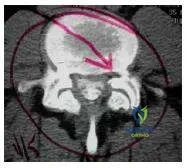
Spinal stenosis involves narrowing of the spinal canal by a combination of factors. Degeneration of the disk with dehydration allows loss of disk height and bulging posteriorly into the canal. The ligamentum flavum becomes redundant at the segment due to loss of the disk height and buckling of the ligament. C hief among the sources of compression, however, is the overgrowth of the facet joint, which acts to autostabilize the motion segment. The facets are oriented in an oblique plane, depending on the level involved. The superior facet of the subjacent vertebral body lies anterior and lateral to its counterpart from the level above, forming a shingle configuration. The superior articular process, therefore, lies adjacent to the shoulder of the traversing nerve root and is a significant source of lateral recess stenosis. Orthopedic Prometric Exam Chapter 3 Image

Question 20

The type of disk herniation shown (Slide) at the L5-S1 level is most likely to cause:


Explanation

This slide shows a posterolateral disk herniation on the right. Posterolateral disk herniations cause compression of the traversing S1 nerve root at this level. Sensation affected is the posterior calf and lateral border of the foot, while motor innervation is to the gastroc soleus complex. With far lateral disk herniations, the exiting nerve root is compressed and symptoms may be seen referred to the level above. Orthopedic Prometric Exam Chapter 3 Image

Question 21

A 32-year-old male sustains a stab wound to the back.

Neurological examination reveals right-sided paralysis and loss of vibration sense, along with left-sided loss of pain and temperature sensation below the T8 level. Which of the following best describes this syndrome?


Explanation

Brown-Sequard syndrome is caused by a hemisection of the spinal cord. It presents with ipsilateral motor and proprioceptive loss and contralateral pain and temperature loss.

Question 22

A patient with a suspected spinal fracture is found to have sensory loss up to the level of the nipples. Which dermatomal nerve root level corresponds to this finding?


Explanation

The T4 dermatome corresponds to the nipple line. Other critical landmarks include the umbilicus at T10 and the xiphoid process at T7.

Question 23

During the evaluation of a patient with a spinal cord injury, the examiner notes that the patient has intact proprioception and vibration sense, but complete loss of motor function, pain, and temperature sensation below the level of the lesion. What is the most likely diagnosis?


Explanation

Anterior cord syndrome typically results from flexion injuries or anterior spinal artery compromise. It spares the dorsal columns, maintaining proprioception and vibration sense while affecting the corticospinal and spinothalamic tracts.

Question 24

Which of the following surgical approaches is strictly contraindicated for the excision of a central calcified thoracic disc herniation?


Explanation

Standard posterior laminectomy is contraindicated for central thoracic disc herniations due to the high risk of catastrophic spinal cord injury. Anterior or lateral approaches must be utilized to safely access the pathology without retracting the cord.

Question 25

A 25-year-old male is brought to the emergency department after a high-speed motor vehicle accident. He has a T2 fracture-dislocation. His blood pressure is 80/50 mmHg and heart rate is 50 bpm. His extremities are warm and pink. What is the primary cause of his hemodynamic instability?


Explanation

Neurogenic shock is characterized by hypotension, bradycardia, and warm extremities due to the loss of sympathetic tone following high thoracic or cervical spinal cord injuries. Spinal shock refers to the temporary loss of spinal reflexes, not hemodynamic parameters.

Question 26

A 45-year-old female presents with a seatbelt-type flexion-distraction injury (Chance fracture) of the L1 vertebra.

Which of the following associated injuries must be meticulously ruled out?


Explanation

Chance fractures are highly associated with intra-abdominal injuries, particularly to hollow viscera like the small bowel (up to 50% incidence). Prompt general surgery consultation and abdominal imaging are mandatory.

Question 27

According to the Thoracolumbar Injury Classification and Severity (TLICS) score, which of the following patients has an absolute indication for surgical intervention?


Explanation

A TLICS score of >4 is an indication for surgery. The translation/rotation injury (3) with PLC disruption (3) and incomplete cord injury (3) scores a 9, strongly indicating surgical stabilization.

Question 28

A patient with a T4 level complete spinal cord injury suddenly develops a severe pounding headache, diaphoresis above the level of injury, and a blood pressure of 210/110 mmHg. What is the most appropriate initial management?


Explanation

The patient is experiencing autonomic dysreflexia, common in injuries above T6, often triggered by a noxious stimulus below the lesion (e.g., distended bladder or bowel). The first step is to remove the inciting stimulus and sit the patient upright.

Question 29

A spinal cord injury patient presents with perianal sensation, voluntary anal sphincter contraction, and intact great toe flexion, despite otherwise complete motor and sensory loss below T10. This clinical scenario indicates:


Explanation

Sacral sparing signifies an incomplete spinal cord injury and is defined by the presence of perianal sensation, voluntary rectal sphincter tone, or great toe flexion. It suggests the potential for further neurological recovery.

Question 30

The bulbocavernosus reflex is mediated by which of the following nerve roots?


Explanation

The bulbocavernosus reflex is mediated by the S2-S4 nerve roots. Its return clinically signifies the end of the spinal shock phase.

Question 31

Thoracic disc herniations most commonly occur at which of the following vertebral levels?


Explanation

Approximately 75% of thoracic disc herniations occur between T8 and T11. They are much less common than cervical or lumbar herniations due to the stabilizing effect of the rib cage.

Question 32

A 65-year-old male with long-standing cervical spondylosis sustains a hyperextension injury to his neck. Examination shows marked bilateral weakness in his upper extremities, particularly the hands, with relative sparing of motor function in his lower extremities. What is the most likely diagnosis?


Explanation

Central cord syndrome typically occurs in elderly patients with pre-existing cervical stenosis following a hyperextension injury. It disproportionately affects the upper extremities more than the lower extremities.

Question 33

A patient with a suspected spinal injury demonstrates a sensory level exactly at the umbilicus.

Which dermatome correlates to this landmark?


Explanation

The T10 dermatome reliably corresponds to the level of the umbilicus. This is a critical landmark for rapidly assessing the neurological level of injury in spine trauma.

Question 34

A patient is brought to the emergency department after a motor vehicle collision. Neurological examination reveals loss of motor function, pain, and temperature sensation below the T6 level, but proprioception and vibratory sense are intact. Which of the following spinal cord syndromes is the most likely diagnosis?


Explanation

Anterior cord syndrome is characterized by loss of motor function, pain, and temperature sensation below the injury level due to damage to the anterior two-thirds of the spinal cord. Proprioception and vibration remain intact as the dorsal columns are spared.

Question 35

A 28-year-old male sustains a thoracic spine injury.

Radiographs reveal a bony Chance fracture. Which of the following mechanisms of injury is most classically associated with this fracture pattern?


Explanation

A Chance fracture is a flexion-distraction injury often seen in seatbelt restrained passengers during motor vehicle collisions. It typically involves tension failure of the posterior and middle columns, with the axis of rotation acting anterior to the vertebral body.

Question 36

In a patient presenting with a traumatic spinal cord injury, the physical examination demonstrates a sensory level isolated to the nipple line. Which of the following dermatomal nerve root levels corresponds directly to this finding?


Explanation

The sensory level for the nipple line corresponds to the T4 dermatome. Other key landmarks include the xiphoid process (T6) and the umbilicus (T10).

Question 37

A 65-year-old male with a history of severe cervical spondylosis falls forward, striking his chin. He presents with severe weakness in his upper extremities but is able to move his lower extremities against gravity. What is the pathophysiological mechanism responsible for this specific neurological pattern?


Explanation

This describes central cord syndrome, classically caused by hyperextension injuries in patients with pre-existing cervical spondylosis. The centrally located cervical tracts supplying the upper extremities are damaged more severely than the peripherally located sacral/lumbar tracts.

Question 38

A 40-year-old female presents with severe myelopathy and imaging confirms a large, central, calcified disc herniation at the T8-T9 level. Which of the following surgical approaches is explicitly contraindicated due to a high risk of iatrogenic neurological deterioration?


Explanation

Standard posterior laminectomy is contraindicated for central calcified thoracic disc herniations. It requires excessive retraction of the spinal cord to access the anteriorly located disc, resulting in a high risk of paraplegia.

Question 39

A 22-year-old male sustains a severe spinal cord injury. On examination, he has flaccid paralysis, absent reflexes below the level of injury, and absent perianal sensation. The bulbocavernosus reflex is absent. This clinical picture most accurately represents:


Explanation

Spinal shock is characterized by temporary loss of all spinal reflexes and muscle tone below the level of injury. The return of the bulbocavernosus reflex clinically marks the end of the spinal shock phase.

Question 40

Which of the following vital sign patterns correctly distinguishes neurogenic shock from hypovolemic shock in a polytrauma patient?


Explanation

Neurogenic shock results from disruption of descending sympathetic pathways, leading to loss of vasomotor tone and unopposed vagal tone. This manifests clinically as profound hypotension combined with bradycardia, unlike the tachycardia seen in hypovolemic shock.

Question 41

A trauma patient presents with a cervical spine injury.

Imaging reveals bilateral fractures through the pars interarticularis of C2. Which of the following is the primary mechanism resulting in this specific injury?


Explanation

A Hangman's fracture (traumatic spondylolisthesis of the axis) involves bilateral fractures of the C2 pars interarticularis. The classic mechanism is hyperextension combined with axial loading, as seen in motor vehicle accidents or judicial hangings.

Question 42

Which of the following associated injuries has the highest incidence in patients diagnosed with a bony Chance fracture of the thoracolumbar junction?


Explanation

Chance fractures (flexion-distraction injuries) are highly associated with intra-abdominal injuries, particularly hollow viscus injuries (e.g., bowel ruptures). A high index of suspicion and prompt general surgery evaluation are essential.

Question 43

A patient presents with a traumatic cervical spine injury.

A Type II odontoid fracture is identified. Which of the following factors contributes most significantly to the high nonunion rate of this specific fracture type?


Explanation

Type II odontoid fractures occur at the base of the dens, which is a vascular watershed area. The limited blood supply to this region is the primary reason for the high nonunion rate associated with these fractures.

Question 44

A 35-year-old paraplegic male with a known complete spinal cord injury at T4 suddenly develops severe headache, profuse sweating above the nipple line, and profound hypertension (BP 210/110 mmHg). What is the most appropriate immediate intervention?


Explanation

The patient is experiencing autonomic dysreflexia, a potentially life-threatening condition occurring in cord lesions at or above T6. It is triggered by noxious stimuli below the lesion, most commonly a distended bladder or bowel, requiring immediate decompression.

Question 45

A cervical radiograph of a trauma patient demonstrates anterior translation of C5 over C6 by approximately 25% of the vertebral body width.

What is the most likely diagnosis?


Explanation

A unilateral facet dislocation typically results in anterior translation of the involved vertebral body by approximately 25% (up to 50%) of its anteroposterior width. Bilateral facet dislocations usually demonstrate 50% or greater translation.

Question 46

According to the ASIA (American Spinal Injury Association) Impairment Scale, a patient who has preserved motor function below the neurological level, with more than half of the key muscles demonstrating a muscle grade less than 3, is classified as:


Explanation

ASIA C denotes an incomplete motor injury where motor function is preserved below the neurological level, but more than half of the key muscles below that level have a muscle grade of less than 3. ASIA D requires at least half the key muscles to have a grade of 3 or greater.

Question 47

A 45-year-old male sustains a burst fracture of L1.

According to the Denis three-column theory, which structural failure differentiates a burst fracture from a simple compression fracture?


Explanation

In the Denis three-column classification, a simple compression fracture involves only the anterior column. A burst fracture involves failure of both the anterior and middle columns under axial compression, often with retropulsion of bone into the spinal canal.

Question 48

Which of the following clinical findings best differentiates a Conus Medullaris syndrome from a Cauda Equina syndrome?


Explanation

Conus medullaris syndrome typically presents with mixed upper and lower motor neuron signs and early bowel/bladder dysfunction due to involvement of the sacral cord segments. Cauda equina syndrome involves peripheral nerve roots, causing strict lower motor neuron signs and asymmetric radicular pain.

Question 49

During a left-sided transthoracic approach for a T10-T11 disc herniation, the surgeon is cautious of a major radiculomedullary artery that supplies the anterior lower two-thirds of the spinal cord. This artery typically arises from the left side between which spinal levels?


Explanation

The artery of Adamkiewicz is the largest anterior radiculomedullary artery. It most commonly arises on the left side from an intercostal or lumbar artery between the T9 and L2 levels, providing critical blood supply to the lower spinal cord.

Question 50

A patient with long-standing Ankylosing Spondylitis sustains a minor ground-level fall and complains of back pain. Which of the following statements regarding spinal fractures in this patient population is most accurate?


Explanation

The ankylosed spine is osteopenic and rigid, making it highly susceptible to fracture even from minor trauma. These fractures behave mechanically like long-bone fractures, often traversing all three columns, are highly unstable, and carry a high risk of epidural hematoma and neurological deficit.

Question 51

A 55-year-old male presents with clumsiness in his hands and frequent dropping of objects. On examination, he is unable to keep his small finger fully adducted (Wartenberg's sign positive) but his grip strength is intact. He exhibits hyperreflexia in the lower extremities. Which of the following is the most likely diagnosis?


Explanation

Cervical spondylotic myelopathy often presents with upper extremity clumsiness, myelopathy hand findings (like finger escape sign or Wartenberg's sign due to intrinsic weakness), and upper motor neuron signs (hyperreflexia) in the lower extremities.

Question 52

A penetrating stab wound to the right side of the T8 spinal cord produces a Brown-Sequard syndrome. Which of the following clinical deficits will be observed?


Explanation

Brown-Sequard syndrome causes ipsilateral loss of motor function (corticospinal tract) and proprioception/vibration (dorsal columns), and contralateral loss of pain and temperature sensation (spinothalamic tract) which crosses 1-2 levels above the entry site.

Question 53

A Jefferson fracture is defined as a burst fracture of the C1 ring. If the sum of the lateral mass displacement over the C2 articular facets on an open-mouth odontoid radiograph exceeds 7 mm, which critical structure is presumed completely disrupted?


Explanation

The Rule of Spence states that if the combined overhang of the C1 lateral masses on C2 is greater than 6.9 mm (often rounded to 7 mm), it implies a complete rupture of the transverse atlantal ligament, rendering the injury highly unstable.

Question 54

A patient presents with a spinal cord injury following a severe trauma. Sensation is preserved below the level of injury including the S4-S5 dermatomes, but there is no voluntary motor function in the lower extremities. Anal sphincter tone is absent, but deep anal sensation is present. Which ASIA Impairment Scale (AIS) grade does this represent?


Explanation

ASIA B represents a sensory incomplete injury where sensation is preserved below the neurologic level (including S4-S5), but motor function is completely lost. The presence of deep anal sensation confirms the incomplete sensory status.

Question 55

A 35-year-old male sustains a severe flexion-distraction injury to the T12 vertebra in a motor vehicle collision. Which of the following concurrent injuries is most likely to be present and requires urgent evaluation?


Explanation

Flexion-distraction (Chance) injuries of the thoracolumbar spine, particularly from lap seatbelts, have a high association (up to 40-50%) with intra-abdominal injuries, most commonly hollow viscus ruptures.

Question 56

A patient with a traumatic spinal fracture is noted to have a sensory level localizing to the inguinal ligament. What is the corresponding nerve root level for this dermatome?


Explanation

The sensory dermatome for the inguinal ligament corresponds to the L1 nerve root. By comparison, T10 corresponds to the umbilicus and T12 represents the suprapubic region.

Question 57

Which of the following is considered an absolute contraindication for a standard posterior laminectomy in the surgical management of a central, calcified thoracic disc herniation?


Explanation

Standard posterior laminectomy is contraindicated for central thoracic disc herniations because retracting the thoracic spinal cord to access an anterior central lesion carries an unacceptably high risk of irreversible cord injury. Anterior or posterolateral approaches are required.

Question 58

A 45-year-old male involved in a high-speed collision presents with paraplegia, loss of pain and temperature sensation in his lower extremities, but preserved vibration and proprioception. Which spinal cord syndrome does this describe?


Explanation

Anterior cord syndrome typically results from flexion injuries or anterior spinal artery compromise. It causes motor, pain, and temperature loss below the lesion, with preserved dorsal column function (proprioception and vibration).

Question 59

Regarding the Thoracolumbar Injury Classification and Severity Score (TLICS), a patient presents with a T11-T12 burst fracture, indeterminate posterior ligamentous complex (PLC) status on MRI, and intact neurologic function. What is the total TLICS score and the recommended management?


Explanation

TLICS calculates morphology (burst = 2), PLC status (indeterminate = 2), and neurologic status (intact = 0) for a total of 4. A score of 4 means the treatment can be either operative or non-operative based on the surgeon's clinical judgment.

Question 60

A 28-year-old patient with a complete T4 spinal cord injury sustained 6 weeks ago suddenly develops a pounding headache, facial flushing, profuse sweating above the level of injury, and a blood pressure of 190/110 mmHg. Which of the following is the most appropriate initial management step?


Explanation

The patient is experiencing autonomic dysreflexia, which is common in injuries above T6. The first and most critical step is to remove the offending stimulus, most commonly a distended bladder (e.g., blocked catheter) or bowel impaction.

Question 61


A patient is diagnosed with spinal shock following severe trauma. Which of the following clinical signs marks the end of the spinal shock phase?


Explanation

Spinal shock is a transient state of physiologic reflex depression of cord function below the level of injury. The return of the bulbocavernosus reflex typically heralds the end of spinal shock, allowing for accurate determination of the SCI extent.

Question 62

In a patient presenting with an acute traumatic spinal cord injury, which of the following MRI findings of the spinal cord is associated with the poorest prognosis for neurologic recovery?


Explanation

The presence of hemorrhage within the spinal cord parenchyma (hematomyelia) on MRI is a strong predictor of poor neurologic recovery compared to edema alone.

Question 63

What is the most common anatomical location for a symptomatic thoracic disc herniation?


Explanation

The vast majority of symptomatic thoracic disc herniations occur in the lower third of the thoracic spine, with the T11-T12 level being the most common, likely due to increased mobility transitioning to the lumbar spine.

Question 64

A patient with a gunshot wound to the abdomen develops paraplegia. Imaging shows a bullet lodged in the T10 vertebral body with an associated incomplete neurologic deficit. CT scan shows bone fragments in the spinal canal. Which of the following is an absolute indication for surgical decompression and removal of the bullet in this scenario?


Explanation

Routine removal of bullets from the spine is not indicated. However, progressive neurologic deterioration in the presence of compressive elements (bullet or bone fragments) is a definitive indication for urgent surgical decompression.

Question 65

A patient sustains a complete spinal cord injury after a fall. Neurological examination reveals a sensory level at the nipple line. Which of the following nerve root levels indicates this finding?


Explanation

The sensory dermatome for the nipple line is T4. The umbilicus is T10, and the xiphoid process is T7.

Question 66

A trauma patient presents with a complete spinal cord injury. Pinprick and light touch sensation are absent below the inguinal ligament. Which nerve root level does this specific landmark represent?


Explanation

The sensory dermatome for the inguinal ligament corresponds to the L1 nerve root level.

Question 67

A patient with a T4 complete spinal cord injury suddenly develops a severe, pounding headache, profound diaphoresis above the level of injury, and severe hypertension. What is the most common precipitating cause of this condition?


Explanation

This presentation describes autonomic dysreflexia, which occurs in patients with spinal cord injuries above T6. The most common trigger is a noxious stimulus below the level of injury, typically a distended bladder or bowel impaction.

Question 68

An elderly patient with pre-existing cervical spondylosis presents after a hyperextension injury to the neck. Examination shows bilateral motor weakness that is much more pronounced in the upper extremities than the lower extremities. What is the most likely diagnosis?


Explanation

Central cord syndrome is classically caused by hyperextension injuries in patients with pre-existing cervical spondylosis. It causes motor weakness that affects the upper extremities more severely than the lower extremities due to the central location of the cervical motor tracts.

Question 69

A 25-year-old man sustains a stab wound to the right side of his thoracic spine. He presents with loss of motor function and proprioception in his right leg, and loss of pain and temperature sensation in his left leg. This clinical picture is most consistent with:


Explanation

Brown-Séquard syndrome results from hemisection of the spinal cord. It presents with ipsilateral loss of motor function (corticospinal tract) and proprioception (dorsal columns), and contralateral loss of pain and temperature sensation (spinothalamic tract).

Question 70

In the ASIA Impairment Scale, how is a patient classified if they have preserved motor function below the neurological level of injury, and more than half of the key muscle functions below that level have a muscle grade less than 3?


Explanation

ASIA C denotes an incomplete spinal cord injury where motor function is preserved below the neurological level, but more than half of the key muscles have a grade less than 3 (non-antigravity). ASIA D requires at least half to be grade 3 or greater.

Question 71

A patient presents with progressive myelopathy due to a large, calcified central thoracic disc herniation at T8-T9. Which of the following surgical approaches is generally CONTRAINDICATED due to the high risk of iatrogenic spinal cord injury?


Explanation

A standard posterior laminectomy is contraindicated for central thoracic disc herniations. Retracting the thoracic spinal cord to access the anteriorly situated disc carries a very high risk of permanent spinal cord injury.

Question 72

According to the Denis three-column theory of spinal stability, a typical burst fracture of the thoracolumbar spine is characterized by failure of which columns?


Explanation

A burst fracture involves failure of both the anterior and middle columns under axial compression. This distinguishes it from a simple compression fracture, which only involves the anterior column.

Question 73

Which of the following physical examination findings is the most reliable clinical indicator that a patient has emerged from the phase of spinal shock?


Explanation

The return of the bulbocavernosus reflex marks the end of spinal shock. Once this reflex returns, the true extent of the permanent neurological deficit can be accurately assessed.

Question 74

Which of the following incomplete spinal cord injury syndromes carries the worst prognosis for functional motor recovery?


Explanation

Anterior cord syndrome typically involves occlusion of the anterior spinal artery and carries the worst prognosis for motor recovery, with only about 10-20% of patients regaining functional motor control.

Question 75

A patient sustains a high-energy pelvic ring injury with a sacral fracture extending through the sacral foramina. According to the Denis classification of sacral fractures, which zone is involved and what is its associated feature?


Explanation

Denis Zone 2 sacral fractures pass vertically through the sacral foramina. They carry an intermediate risk of neurological injury (often unilateral radiculopathy/sciatica) compared to Zone 1 (alar) and Zone 3 (central canal, highest risk of sphincter dysfunction).

Question 76

A 12-year-old restrained passenger in a motor vehicle collision presents with a lap-belt injury. Radiographs show a fracture extending horizontally through the spinous process, pedicles, and vertebral body of L2. What associated injury must be specifically ruled out?


Explanation

This describes a Chance fracture (flexion-distraction injury), highly associated with lap-belt use. Up to 50% of these patients have concurrent intra-abdominal injuries, most commonly involving hollow viscus organs (bowel perforation).

Question 77

A 35-year-old sustains a Type II odontoid fracture with a reverse obliquity fracture line (sloping from anterior-inferior to posterior-superior). Which fixation method is contraindicated?


Explanation

Anterior odontoid screw fixation is contraindicated in reverse obliquity Type II fractures because the lag screw trajectory will cause the fracture to shear and displace rather than compress.

Question 78

Which of the following is an established indication for emergent surgical decompression following a gunshot wound to the spine?


Explanation

Most gunshot wounds to the spine are managed non-operatively. Surgery is indicated for progressive neurological deficit with an incomplete injury, or severe cauda equina compression with ongoing deficit.

Question 79

A 30-year-old presents with a unilateral jumped facet at C5-C6 following a hyperflexion-rotation injury. He is neurologically intact. Pre-reduction MRI demonstrates a large, uncontained C5-C6 disc herniation compressing the cord. What is the most appropriate management?


Explanation

If an MRI reveals a large extruded disc herniation in the setting of a facet dislocation, an anterior discectomy should be performed prior to reduction. Closed or posterior reduction first could force the disc further into the canal, causing a catastrophic spinal cord injury.

Question 80

A 75-year-old woman presents with severe mid-back pain after a minor fall.

Radiographs show an anterior wedge compression fracture of T11 with 20% loss of height. Neurological examination is normal. What is the most appropriate initial management?


Explanation

The initial management for uncomplicated, neurologically intact osteoporotic vertebral compression fractures is non-operative. It includes pain control, orthosis use if symptomatic, and early mobilization to prevent deconditioning.

Question 81

A 55-year-old diabetic male presents with worsening back pain, fever, and new-onset lower extremity weakness. Laboratory tests show elevated CRP and ESR. MRI with contrast reveals a rim-enhancing fluid collection in the dorsal epidural space. What is the most likely causative organism?


Explanation

The clinical picture describes a spinal epidural abscess. Staphylococcus aureus is by far the most common causative organism, responsible for over 60% of cases.

Question 82

A patient arrives at the trauma bay after a high-speed motorcycle crash. He has flaccid paralysis below T2. His blood pressure is 80/50 mmHg, and his heart rate is 55 bpm. His extremities are warm and well-perfused. What is the primary pathophysiological mechanism for his hemodynamic state?


Explanation

Neurogenic shock occurs with cervical or high thoracic spinal cord injuries. It is caused by the loss of sympathetic outflow, resulting in unopposed parasympathetic tone, profound vasodilation (warm extremities), hypotension, and bradycardia.

Question 83

A lateral lumbar radiograph of a 14-year-old gymnast

shows forward slippage of L5 on S1 by 60%. According to the Meyerding classification, what grade of spondylolisthesis does this represent?


Explanation

The Meyerding classification grades spondylolisthesis based on the percentage of slip: Grade I (0-25%), Grade II (26-50%), Grade III (51-75%), Grade IV (76-100%), and Grade V (>100%, spondyloptosis). A 60% slip is Grade III.

Question 84

A 40-year-old man sustains an axial load injury to his head resulting in a Jefferson fracture. Open-mouth odontoid radiographs reveal lateral displacement of the lateral masses of C1 relative to C2. According to the Rule of Spence, what total combined overhang of the lateral masses strongly suggests incompetence of the transverse atlantal ligament?


Explanation

The Rule of Spence dictates that a combined overhang of the C1 lateral masses on C2 of greater than 6.9 mm on an open-mouth radiograph indicates a rupture of the transverse atlantal ligament, rendering the injury highly unstable.

None

Dr. Mohammed Hutaif
Medically Verified Content by
Prof. Dr. Mohammed Hutaif
Consultant Orthopedic & Spine Surgeon
Chapter Index
