AAOS Orthopedic Trauma MCQs (Set 1): Acute Fracture & Emergency Care | ABOS & OITE Review
Key Takeaway
This high-yield question set for the AAOS and ABOS board exams provides practice on critical orthopedic trauma topics. It covers acute fracture management, principles of emergency orthopedic care, and specific traumatic injuries of the extremities, essential for residents and practicing orthopedists.
AAOS Orthopedic Trauma MCQs (Set 1): Acute Fracture & Emergency Care | ABOS & OITE Review
Comprehensive 100-Question Exam
00:00
Start Quiz
Question 1
A 26-year-old woman sustained a nondisplaced femoral neck fracture and treatment consisted of use of percutaneous cannulated screws. At her 3-month follow-up visit, she reports hip pain and is unable to ambulate. A radiograph is shown in Figure 1. What is the next most appropriate treatment?
Explanation
Question 2
Which of the following choices best describes the fracture pattern shown in Figures 2a through 2c?
Explanation
Question 3
The correct starting point for an external fixation half pin placed into the anterior inferior iliac spine (AIIS) is labeled by what letter in Figure 3?
Explanation
Question 4
Figures 4a and 4b show the radiographs of a 53-year-old woman who was injured in a fall. After initial closed reduction, what is the preferred treatment for this fracture?
Explanation
Question 5
A 25-year-old semiprofessional football player sustains a hyperextension injury to the left foot. He is unable to bear weight. Examination reveals tenderness along the midfoot with swelling and plantar ecchymosis. Radiographs are negative. What is the next step in evaluation of this patient?
Explanation
Question 6
A 52-year-old woman slips in her bathroom and strikes her right hand on a cabinet. She notes swelling, ecchymosis, and pain with attempted motion. There are no open wounds. Radiographs are shown in Figures 5a through 5c. What is the most appropriate treatment?
Explanation
Question 7
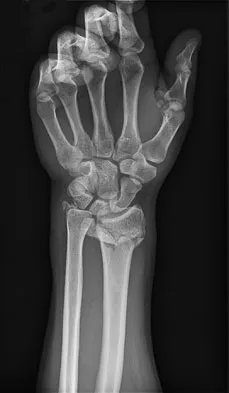
A 19-year-old college student reports a 1-week history of wrist pain following an intramural rugby match. A PA radiograph is shown in Figure 6. He denies any prior wrist injury. What is the best course of action?
Explanation
Question 8
A 29-year-old woman was injured in a high-speed motor vehicle accident 3 hours ago. Radiographs are shown in Figures 7a through 7e. Her right foot injury is open and contaminated. Her associated injuries include a closed head injury and a ruptured spleen requiring resection. She has had 6 units of packed red blood cells and the trauma surgeon has turned her care over to you. Her current base deficit is 10 and her urinary output has averaged 0.4 mL/kg for the last 2 hours. What is the best treatment at this time?
Explanation
Question 9
A 45-year-old man who is a smoker has a significant hemothorax and bilateral closed femoral fractures. On insertion of a chest tube, 1,100 mL of blood was returned. He has had 75 mL of chest tube output over the last 2 hours while being resuscitated in the ICU. His base deficit is now 2 and his urine output has been 3 mL/kg over the last hour. What is the next most appropriate step in management?
Explanation
Question 10
A 47-year-old woman falls and sustains a direct blow to her middle finger. She notes pain and swelling and is unable to move the proximal interphalangeal (PIP) or distal interphalangeal (DIP) joints. Radiographs are shown in Figures 8a through 8c. Proper management should consist of
Explanation
Question 11
Figures 9a and 9b show the radiographs of a 4-year-old child who sustained an elbow injury. What is the most likely complication resulting from this fracture if treated in a cast?
Explanation
Question 12
Which of the following is most commonly associated with an open clavicular fracture?
Explanation
Question 13
A 22-year-old woman injures her neck in a motor vehicle accident. Examination reveals no sensory or motor function below T8. Radiographs and an MRI scan show a burst fracture at T7. Forty-eight hours later, the bulbocavernosus reflex is present but there is no evidence of motor or sensory recovery in the lower extremities. What is the most likely diagnosis?
Explanation
Question 14
A 26-year-old man falls off a motorcycle and injures his left wrist. There are no open wounds and the neurovascular examination is normal. Radiographs are shown in Figures 10a and 10b. Definitive management should consist of
Explanation
Question 15
Which of the following studies best increases the ability to diagnose femoral neck fractures in patients with femoral shaft fractures?
Explanation
Question 16
The axis of forearm rotation occurs between what two anatomic points?
Explanation
Question 17
Figure 11 shows the radiograph of a 26-year-old man with type I diabetes mellitus who was struck by a motor vehicle. What is the most common complication associated with this pelvic fracture?
Explanation
Question 18
Which of the following factors is a significant predictor of reoperation following open reduction and internal fixation of intertrochanteric fractures with a sliding-compression hip-screw device?
Explanation
Question 19
Following fixation of a displaced intra-articular fracture of the distal humerus through a posterior approach, what is the expected outcome?
Explanation
Question 20
A 15-year-old boy falls from his bicycle and sustains an injury to his elbow. Prereduction radiographs are shown in Figure 12a. Closed reduction is performed without difficulty and postreduction radiographs are shown in Figure 12b. What is the next most appropriate step in treatment?
Explanation
Question 21
A 7-year-old boy is seen in the emergency department with an isolated and displaced supracondylar humerus fracture and absent radial and ulnar pulses. Despite a moderately painful attempt at realignment, examination reveals that his hand remains pulseless. What is the next most appropriate step in management?
Explanation
Question 22
A 28-year-old cowgirl was injured while herding cattle 1 week ago. A radiograph and CT scans are shown in Figures 13a through 13c. What is the most appropriate management for this injury?
Explanation
Question 23
As reflected by the SF-36 scores, patients with which of the following conditions demonstrate the most disability in physical function?
Explanation
Question 24
A 25-year-old man is involved in a motor vehicle accident and brought to the emergency department at 4 am on Sunday morning. He has a closed distal third femoral shaft fracture. His leg is initially pulseless but after applying inline traction, a distal pulse can be palpated and the limb appears to be viable. The pulse in the injured limb "feels" different than the pulse in the uninjured limb. What is the next step in assessing the vascular status of this limb?
Explanation
Question 25
What is the most appropriate treatment for a 50-year-old woman who sustains the injury shown in Figures 14a and 14b?
Explanation
Question 26
A 35-year-old male is brought to the ED after a motorcycle crash. His blood pressure is 80/40 mmHg and heart rate is 120 bpm. Primary survey reveals an unstable pelvis. A pelvic binder is applied. Which of the following is the most appropriate anatomical landmark for the correct placement of a pelvic binder to optimize reduction and control hemorrhage?
Explanation
Question 27
A 35-year-old hypotensive male is brought to the emergency department after a motorcycle collision. Radiographs demonstrate an 'open-book' pelvic ring injury. In the trauma bay, a circumferential pelvic binder is applied. To most effectively reduce the pelvic volume and stabilize the fracture, the binder should be centered over which of the following anatomic landmarks?
Explanation
Question 28
A 40-year-old farmer sustains a Gustilo-Anderson Grade IIIB open tibial shaft fracture with severe soil and fecal contamination following a tractor rollover. According to current orthopedic trauma guidelines, what is the most appropriate initial prophylactic antibiotic regimen?
Explanation
Question 29
A 25-year-old male is admitted with a highly comminuted tibial shaft fracture. Twelve hours later, he complains of severe leg pain out of proportion to the injury, unrelieved by opioids. Passive stretch of the toes exacerbates the pain. Which of the following pressure measurements is the most reliable threshold for diagnosing acute compartment syndrome?
Explanation
Question 30
A 28-year-old woman sustains a displaced femoral neck fracture. Which of the following factors has been shown in the literature to be the most significant predictor for the development of avascular necrosis (AVN) of the femoral head in young adults?
Explanation
Question 31
A polytrauma patient presents with bilateral closed femur fractures, a severe closed head injury, and bilateral pulmonary contusions. On admission, arterial blood gas reveals a base deficit of 9 mEq/L and a lactate of 4.5 mmol/L. What is the most appropriate initial management of the femur fractures?
Explanation
Question 32
According to the Lower Extremity Assessment Project (LEAP) study, which of the following scoring systems most accurately predicts the functional outcome and need for amputation in a patient with a mangled lower extremity?
Explanation
Question 33
A 45-year-old man sustains a severe pelvic crush injury. Clinical examination reveals a large, fluctuant, soft-tissue mass overlying the greater trochanter. What is the pathophysiology of this specific soft-tissue injury?
Explanation
Question 34
A 50-year-old male undergoes a dual-incision four-compartment fasciotomy for acute compartment syndrome associated with a Schatzker VI tibial plateau fracture. Despite the procedure, he continues to have progressive ischemic pain and toe flexion contractures. Incomplete release of which compartment is the most likely cause of his ongoing symptoms?
Explanation
Question 35
A 60-year-old woman presents to the emergency department after a fall onto an outstretched hand, sustaining a severely displaced, apex volar distal radius fracture. She complains of dense numbness in her thumb, index, and long fingers, and severe pain. What is the most appropriate next step in management?
Explanation
Question 36
A 32-year-old man is brought to the emergency department after a high-speed motor vehicle collision. Imaging reveals a traumatic spondylolisthesis of the axis (Hangman's fracture) with bilateral pars interarticularis fractures. Which of the following is the classic mechanism of injury for this fracture pattern?
Explanation
Question 37
A 6-year-old boy presents with a Gartland type III extension-type supracondylar humerus fracture. On examination, the radial pulse is absent, but the hand is warm and pink with brisk capillary refill. What is the most appropriate next step in management?
Explanation
Question 38
A 65-year-old woman on long-term alendronate therapy presents with prodromal thigh pain followed by a low-energy transverse fracture of the femoral shaft. Radiographs show lateral cortical thickening at the fracture site. What is the primary pathophysiologic mechanism leading to this atypical fracture?
Explanation
Question 39
A 40-year-old male sustains an APC-III (Anteroposterior Compression type III) pelvic ring injury and is profoundly hypotensive. In the setting of severe pelvic trauma, which of the following is statistically the most common source of major pelvic hemorrhage?
Explanation
Question 40
According to the Lauge-Hansen classification, what is the sequential order of anatomic structures injured in a Supination-External Rotation (SER) ankle fracture?
Explanation
Question 41
A 22-year-old unrestrained passenger presents after a head-on motor vehicle collision with severe hip pain. Radiographs demonstrate a posterior dislocation of the hip without an associated fracture. In what position is the injured lower extremity classically held upon clinical presentation?
Explanation
Question 42
A 35-year-old male falls from a ladder and sustains a 'terrible triad' injury of the elbow. Operative management is planned. According to standard principles of surgical reconstruction for this specific injury, what is the recommended sequence of repair?
Explanation
Question 43
A 25-year-old competitive cyclist falls directly onto his shoulder and sustains a closed, isolated midshaft clavicle fracture. Which of the following radiographic findings represents the strongest indication for operative fixation (ORIF) over nonoperative management?
Explanation
Question 44
A 30-year-old man sustains a low-velocity civilian gunshot wound to the thigh, resulting in a comminuted midshaft femur fracture. The bullet passed cleanly through the soft tissues without massive tissue destruction. His distal pulses are intact. What is the standard of care for the management of this fracture?
Explanation
Question 45
A 40-year-old man sustained a Hawkins Type II talar neck fracture and underwent open reduction and internal fixation. At his 8-week follow-up, an AP radiograph of the ankle reveals 'Hawkins sign'. What does this radiographic finding indicate?
Explanation
Question 46
A hemodynamically unstable trauma patient presents with an anterior-posterior compression (APC) type III pelvic ring injury. The trauma team decides to apply a noninvasive pelvic binder. What is the correct anatomical landmark for placing the center of the binder to optimally reduce pelvic volume?
Explanation
Question 47
A 28-year-old female sustains a Gustilo-Anderson type IIIB open tibia fracture. She has a documented history of anaphylaxis to penicillin. Which of the following intravenous antibiotic regimens is most appropriate in the emergency department?
Explanation
Question 48
A 30-year-old man sustains a closed tibial shaft fracture. His blood pressure in the emergency department is 120/80 mm Hg. Compartment pressures are measured as follows: Anterior 45 mm Hg, Lateral 35 mm Hg, Superficial Posterior 40 mm Hg, Deep Posterior 50 mm Hg. What is the Delta P and the most appropriate next step?
Explanation
Question 49
A 25-year-old male sustains bilateral femoral shaft fractures in a motor vehicle collision. On post-injury day two, he develops acute respiratory distress. Which of the following represents the classic clinical triad of fat embolism syndrome?
Explanation
Question 50
In the context of Damage Control Orthopedics (DCO) for a polytraumatized patient, which of the following metabolic parameters best indicates adequate systemic resuscitation, allowing safe conversion from external fixation to definitive intramedullary nailing?
Explanation
Question 51
A 40-year-old man presents with a high-energy posterior knee dislocation. After closed reduction, pedal pulses are palpable but appear asymmetric compared to the uninjured limb. What is the most appropriate next step in evaluation?
Explanation
Question 52
A 28-year-old trauma patient has an estimated blood loss of 35%. His vitals show a blood pressure of 90/60 mm Hg, heart rate of 130 bpm, and respiratory rate of 30 breaths/min. He is confused and his urine output is 10 mL/hr. According to the ATLS classification, what class of hemorrhagic shock does this represent?
Explanation
Question 53
A 35-year-old male sustains a Gustilo-Anderson type II open tibial shaft fracture. Intravenous antibiotics are administered within 30 minutes of arrival. Due to operating room unavailability, surgical debridement is delayed for 10 hours. How does this delay affect his infection risk compared to debridement within 6 hours?
Explanation
Question 54
A 22-year-old man presents with a low-velocity civilian gunshot wound to the thigh resulting in a midshaft femur fracture. Vascular examination is normal, with symmetric pulses and an Ankle-Brachial Index (ABI) of 1.1. What is the most appropriate initial management?
Explanation
Question 55
A 34-year-old polytrauma patient presents with a severe closed head injury (GCS 7) and bilateral femoral shaft fractures. Intracranial pressure (ICP) monitoring reveals an ICP of 25 mm Hg. What is the safest initial orthopedic management for the femur fractures?
Explanation
Question 56
The CRASH-2 trial demonstrated a significant mortality benefit for the use of tranexamic acid (TXA) in bleeding trauma patients. What is the mechanism of action and the optimal timing of administration for TXA?
Explanation
Question 57
In the evaluation of a mangled lower extremity, which of the following is considered an absolute indication for primary amputation?
Explanation
Question 58
Acute compartment syndrome of the thigh is a rare but devastating complication typically associated with severe blunt trauma or femur fractures. Which compartment of the thigh is most frequently involved?
Explanation
Question 59
A hemodynamically unstable patient with an anterior-posterior compression (APC) type III pelvic ring injury transiently responds to fluid resuscitation. A pelvic binder has been appropriately placed, but the patient's blood pressure begins to drop again. FAST exam is negative. What is the most appropriate next step in management?
Explanation
Question 60
A 25-year-old male sustains a displaced intracapsular femoral neck fracture from a fall off a ladder. What is the most appropriate timing and goal of surgical intervention?
Explanation
Question 61
A 35-year-old male is admitted with a closed tibial shaft fracture following a motor vehicle collision. He is intubated for an associated head injury. Intracompartmental pressure monitoring is initiated. Which of the following thresholds is the most widely accepted absolute indication for a four-compartment fasciotomy?
Explanation
Question 62
A 45-year-old male presents in hemorrhagic shock following a motorcycle collision. An anteroposterior pelvic radiograph demonstrates a symphyseal diastasis of 4 cm. What is the most appropriate anatomic landmark for the placement of a circumferential pelvic sheet or commercial binder to ensure optimal mechanical reduction?
Explanation
Question 63
A 28-year-old female sustains a Grade IIIb open tibial shaft fracture with heavy farm soil contamination. According to current evidence-based guidelines, what is the most appropriate initial intravenous antibiotic regimen to administer in the emergency department?
Explanation
Question 64
A 22-year-old male sustains a closed femoral shaft fracture and severe bilateral pulmonary contusions. Which of the following physiologic parameters strongly suggests that Damage Control Orthopedics (DCO) via external fixation is favored over Early Total Care (ETC) with intramedullary nailing?
Explanation
Question 65
A 30-year-old male sustains a completely displaced transcervical femoral neck fracture following a fall from height. To minimize the risk of avascular necrosis (AVN), what is the optimal surgical timing and management of this injury?
Explanation
Question 66
A 55-year-old female undergoes volar locking plate fixation for a displaced distal radius fracture. Six months postoperatively, she presents with an inability to actively flex the interphalangeal joint of her thumb. Which of the following technical errors most likely contributed to this complication?
Explanation
Question 67
A 40-year-old male sustains a Grade IIIa open tibia fracture. He receives appropriate intravenous antibiotics and tetanus prophylaxis in the emergency department. Based on current literature, what is the single most critical factor in decreasing his risk of deep infection?
Explanation
Question 68
A 25-year-old male presents with a gunshot wound to the right distal thigh, an expanding hematoma, and an absent dorsalis pedis pulse. Radiographs reveal a comminuted distal femur fracture. What is the most appropriate sequence of operative management?
Explanation
Question 69
A 29-year-old male sustains a posterior hip dislocation. Closed reduction is performed within 4 hours. A post-reduction CT scan demonstrates a 5 mm intra-articular bone fragment and an incongruent hip joint. What is the next most appropriate step in management?
Explanation
Question 70
A 35-year-old man sustains a closed tibial shaft fracture in a motor vehicle collision. Six hours after admission, he complains of severe, unrelenting leg pain that is poorly controlled with intravenous narcotics. His leg is tense and markedly swollen. Blood pressure is 110/70 mm Hg. A compartment pressure monitor reveals an absolute anterior compartment pressure of 45 mm Hg. What is the most appropriate next step in management?
Explanation
Question 71
A 40-year-old man is brought to the trauma bay after a high-speed motorcycle crash. He has an anteroposterior compression (APC) type III pelvic ring injury. His initial blood pressure is 80/40 mm Hg. A pelvic binder is applied correctly, but he remains hypotensive despite initial blood transfusion. Focused assessment with sonography for trauma (FAST) is negative. What is the next most appropriate step?
Explanation
Question 72
A 28-year-old man sustains a closed distal third spiral fracture of the humerus (Holstein-Lewis fracture). On initial examination in the emergency department, his radial nerve function is intact. Following a closed reduction and application of a coaptation splint, he is unable to extend his wrist or fingers, and lacks sensation in the first dorsal web space. What is the most appropriate management?
Explanation
Question 73
A 25-year-old woman is brought to the emergency department after a severe traumatic knee dislocation. The knee is successfully reduced. Dorsalis pedis and posterior tibial pulses are palpable but slightly weaker than the contralateral limb. An Ankle-Brachial Index (ABI) is measured at 0.85. What is the most appropriate next step in management?
Explanation
Question 74
A 32-year-old farmer sustains an open fracture of the left tibia after being pinned by a tractor in a muddy field. The wound is 12 cm long with extensive soft tissue stripping and visible bone, but vascularity is intact. Which of the following intravenous antibiotic regimens is most appropriate in the emergency setting?
Explanation
Question 75
An 82-year-old woman with a history of atrial fibrillation sustains an intertrochanteric femur fracture. She takes daily warfarin. Her initial INR in the emergency department is 3.5. Which of the following is the most appropriate method to rapidly reverse her coagulopathy for surgical fixation within 24 hours?
Explanation
Question 76
A 22-year-old man is brought in after an ejection from a vehicle. He has bilateral closed femoral shaft fractures, a pulmonary contusion, and a Glasgow Coma Scale (GCS) of 7. His initial lactate is 4.5 mmol/L, and his pH is 7.15. Which of the following is the most appropriate initial orthopedic management of his femur fractures?
Explanation
Question 77
A 30-year-old man falls from a height and sustains a displaced, completely vertical (Pauwels type III) femoral neck fracture. To maximize biomechanical stability and minimize the risk of nonunion and avascular necrosis, what is the most appropriate surgical construct?
Explanation
Question 78
A 45-year-old snowboarder sustains a Hawkins Type II talar neck fracture. She undergoes open reduction and internal fixation. At her 8-week follow-up, an AP radiograph of the ankle demonstrates a subchondral radiolucent band in the dome of the talus. What is the clinical significance of this finding?
Explanation
Question 79
A 50-year-old roofer falls 15 feet and sustains a displaced, intra-articular calcaneus fracture. It is treated with open reduction and internal fixation via a classic extensile lateral approach. Which of the following is the most common complication associated with this specific surgical approach?
Explanation
Question 80
A 65-year-old woman on long-term oral bisphosphonate therapy presents with thigh pain and sustains a low-energy transverse fracture of the subtrochanteric femur. Radiographs reveal lateral cortical thickening and a transverse fracture with a medial spike. What is the most appropriate surgical management?
Explanation
Question 81
A 9-year-old boy falls off monkey bars and presents with forearm pain. Radiographs demonstrate a fracture of the proximal third of the ulna and an anterior dislocation of the radial head. Which nerve is most commonly injured in this specific fracture-dislocation pattern?
Explanation
Question 82
A 27-year-old man is brought to the emergency room with a gunshot wound to the mid-thigh. Radiographs show a highly comminuted midshaft femur fracture with retained bullet fragments. The weapon was a low-velocity civilian handgun. The patient has no vascular deficits or expanding hematoma. What is the standard of care for this injury?
Explanation
Question 83
A 45-year-old man sustains an ankle injury. Radiographs show a spiral fracture of the distal fibula above the level of the syndesmosis (Weber C). The medial clear space is widened to 6 mm. Which of the following structures is unequivocally torn in this injury pattern?
Explanation
Question 84
A 38-year-old woman is involved in an MVA. Radiographs and a CT scan of the knee reveal an isolated, displaced coronal plane fracture of the lateral femoral condyle. What is this fracture called, and which screw trajectory is biomechanically superior for its fixation?
Explanation
Question 85
When applying a commercial pelvic binder to a hypotensive trauma patient with a presumed open-book pelvic ring injury, what anatomic landmark should be used to center the device to ensure optimal mechanical closure of the pelvic volume?
Explanation
Question 86
A 22-year-old rugby player is tackled and sustains a traumatic posterior hip dislocation. Upon evaluation in the emergency department, what is the classic resting position of the affected lower extremity?
Explanation
Question 87
A 55-year-old man presents with a highly comminuted Schatzker VI tibial plateau fracture. He is complaining of extreme pain. What is considered the most reliable and earliest clinical finding of acute compartment syndrome in a conscious patient?
Explanation
Question 88
A 70-year-old man falls and sustains an unstable odontoid fracture (Type II). Non-operative management with a halo vest is considered. Which of the following is an absolute contraindication to the use of a halo vest in an elderly patient?
Explanation
Question 89
A 45-year-old male falls from a ladder and sustains a high-energy distal tibia fracture.
He presents to the emergency department with massive soft tissue swelling and clear fracture blisters around the ankle. What is the most appropriate initial management to minimize soft tissue complications while providing adequate skeletal stability?
Explanation
Question 90
A 35-year-old male is brought to the trauma bay after a motorcycle collision. He is hypotensive and tachycardic. A pelvic radiograph demonstrates an anteroposterior compression (APC) III injury. The trauma team decides to apply a circumferential pelvic binder. To most effectively reduce the pelvic volume and stabilize the fracture, over which anatomic landmark should the binder be centered?
Explanation
Question 91
A 24-year-old male sustains an isolated Gustilo-Anderson type IIIB open tibial shaft fracture following a farming accident. According to current evidence-based guidelines, which of the following interventions is the most critical factor in reducing his risk of developing a deep-seated infection?
Explanation
Question 92
A 42-year-old male presents with a severely displaced, closed midshaft tibia fracture. He is complaining of intense leg pain out of proportion to the apparent injury, and pain with passive stretch of the hallux. His blood pressure is 110/70 mmHg. Intracompartmental pressures are measured. Which of the following pressure readings definitively indicates the need for an emergent four-compartment fasciotomy?
Explanation
None
