Ellis-Van Creveld Syndrome MCQs | Orthopedic Board Review
Ellis-Van Creveld Syndrome MCQs | Orthopedic Board Review
Comprehensive 100-Question Exam
00:00
Start Quiz
Question 1
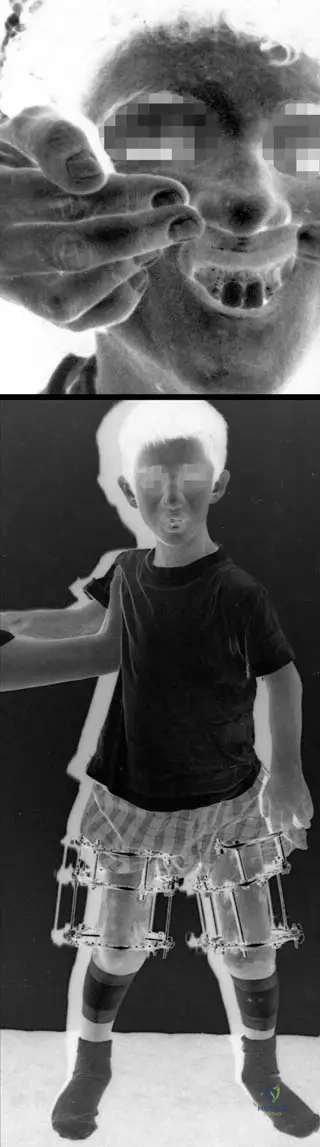
A 3-year-old child presents with disproportionate dwarfism and the oral anomaly shown in the clinical photograph below. Based on the most likely syndromic diagnosis, which of the following congenital cardiac defects is most classically associated with this condition?
Explanation
Correct Answer: Ventricular septal defect
The image demonstrates fusion of the upper lip to the gingival margin in a patient with disproportionate dwarfism, which is highly characteristic of Chondroectodermal Dysplasia (Ellis-van Creveld's syndrome). Congenital heart disease is a hallmark of this syndrome, most commonly presenting as a ventricular septal defect (VSD) or a common atrium.
Question 2
Ellis-van Creveld syndrome is a generalized disorder of the maturation of enchondral ossification. The genetic mutation associated with this syndrome is linked to the HOX7 marker, which is located proximal to the gene responsible for the achondroplasia phenotype. Which of the following is that gene?
Explanation
Correct Answer: FGFR3
The link of the Ellis-van Creveld's syndrome gene to marker HOX7 is in a region proximal to the FGFR3 gene. Mutations in the FGFR3 (Fibroblast Growth Factor Receptor 3) gene are responsible for the achondroplasia phenotype. Both conditions present with dwarfism, but they have distinct genetic loci and inheritance patterns.
Question 3
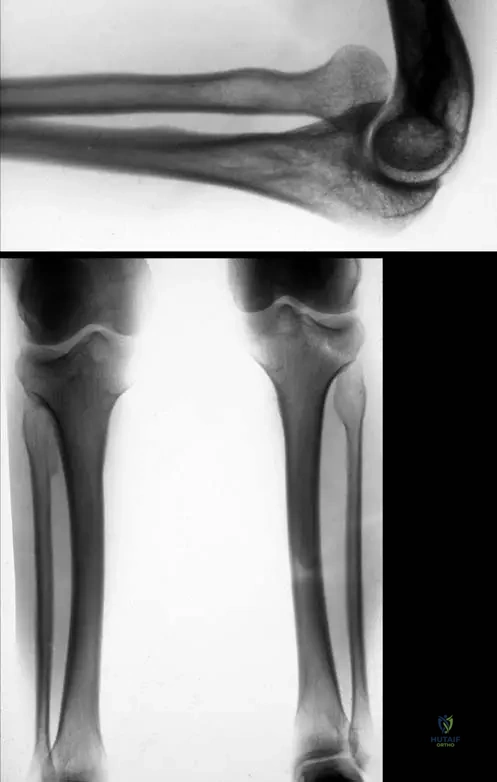
A 4-year-old patient with a known genetic dysplasia presents for evaluation. Radiographs of the lower extremities and elbow are shown below. What is the primary underlying pathophysiological mechanism responsible for these specific radiographic findings?
Explanation
Correct Answer: Generalized disorder of enchondral ossification maturation
The radiographs demonstrate short and thick tubular bones characteristic of Ellis-van Creveld's syndrome. This syndrome is primarily a generalized disorder of the maturation of enchondral ossification, leading to disproportionate dwarfism and short limbs. Intramembranous ossification (e.g., cranial vault) is typically spared.
Question 4
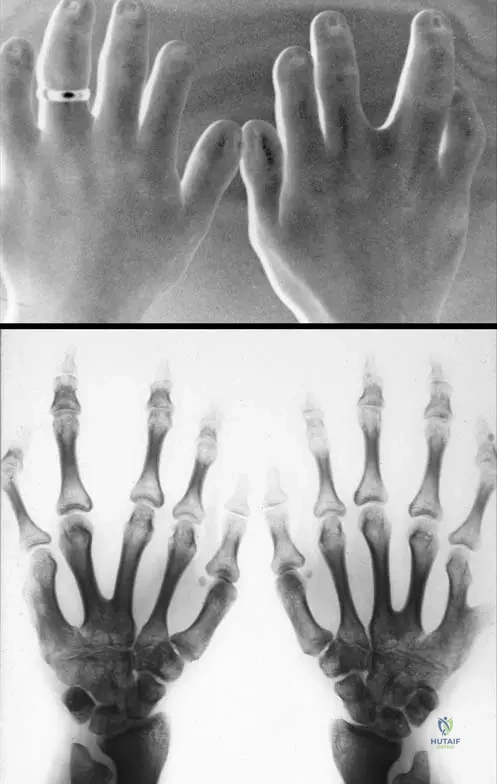
The clinical and radiographic images below belong to a patient with Chondroectodermal Dysplasia. Based on the typical presentation of this syndrome, which specific hand anomaly was most likely resected prior to these photographs being taken?
Explanation
Correct Answer: Postaxial polydactyly
The images show the hands of a patient with Ellis-van Creveld syndrome after the resection of bilateral postaxial polydactyly. Postaxial polydactyly (extra digit on the ulnar side) is a classic hallmark of this syndrome, along with dystrophic nails and shortening of the digits.
Question 5
A multidisciplinary team is evaluating a newborn with suspected Chondroectodermal Dysplasia. Which of the following skeletal or systemic anomalies is classically associated with this syndrome and should be screened for?
Explanation
Correct Answer: Absence of clavicles
Ellis-van Creveld's syndrome is associated with several systemic and skeletal anomalies, including the absence of clavicles, a narrow chest (not broad/barrel-shaped), a hypoplastic maxilla (not hyperplastic), and urinary tract anomalies. It is inherited in an autosomal recessive pattern.
Question 6
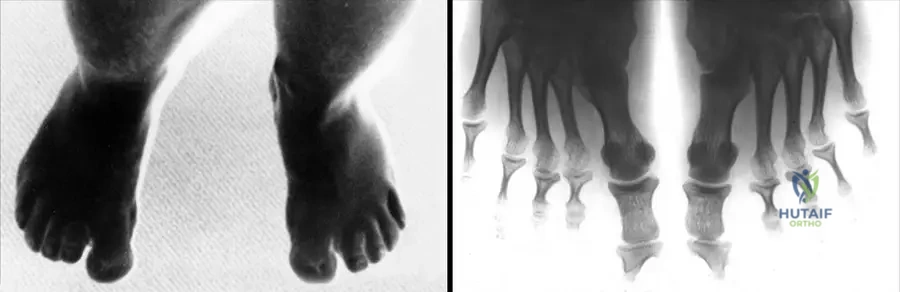
A patient presents with the foot deformities and corresponding radiographs shown below. If this patient is diagnosed with Ellis-van Creveld syndrome, what is the inheritance pattern of this condition?
Explanation
Correct Answer: Autosomal recessive
The images show shortening of the digits of the toes and feet with short tubular bones on the radiograph, consistent with Ellis-van Creveld's syndrome. This syndrome is inherited in an autosomal recessive manner, unlike achondroplasia which is autosomal dominant.
Question 7
A neonate is evaluated for disproportionate short stature and short limbs. Oral examination reveals multiple frenula and notching of the lower alveolar process. Which of the following dental findings is also highly characteristic of this patient's suspected syndrome?
Explanation
Correct Answer: Neonatal teeth
Oral findings play an important role in the diagnosis of Ellis-van Creveld syndrome. These include fusion of the upper lip to the gingival margin, multiple frenula, abnormally shaped and microdontic (not macrodontic) teeth, congenital missing teeth, malocclusion, neonatal teeth, and notching of the lower alveolar process.
Question 8
Review the hand radiograph of the patient with Ellis-van Creveld syndrome shown below. In addition to the shortening of the digits, what other characteristic skeletal anomaly is evident in the metacarpals?
Explanation
Correct Answer: Partial fusion of the metacarpal bases
The radiograph demonstrates shortening of the digits and partial fusion of the metacarpal bases. This is a recognized skeletal manifestation in the hands of patients with Ellis-van Creveld syndrome, often seen in conjunction with postaxial polydactyly.
Question 9
Ellis-van Creveld syndrome shares some phenotypic similarities with achondroplasia, such as disproportionate dwarfism. However, which of the following features is a hallmark of Ellis-van Creveld syndrome that helps distinguish it clinically from achondroplasia?
Explanation
Correct Answer: Postaxial polydactyly
Postaxial polydactyly is a classic feature of Ellis-van Creveld syndrome (Chondroectodermal Dysplasia) and is not a typical feature of achondroplasia. Furthermore, Ellis-van Creveld is autosomal recessive, whereas achondroplasia is autosomal dominant. Achondroplasia is more classically associated with frontal bossing and rhizomelic shortening.
Question 10
A 5-year-old boy is diagnosed with Chondroectodermal Dysplasia. In addition to skeletal and cardiac anomalies, the orthopedic surgeon should be aware of the ectodermal manifestations of this disease. Which of the following dermatological or appendageal findings is commonly associated with this syndrome?
Explanation
Correct Answer: Plantar keratoderma
The 'ectodermal' component of Chondroectodermal Dysplasia (Ellis-van Creveld syndrome) includes anomalies of the hair, dystrophic nails, ichthyoids, and plantar keratoderma. Café-au-lait macules and neurofibromas are associated with Neurofibromatosis.
Question 11
A 5-year-old child presents with the hand deformities shown in the clinical and radiographic images below. The patient previously underwent surgical excision of extra digits. Based on the underlying syndrome, what type of polydactyly was most likely resected?
Explanation
Correct Answer: C
The images demonstrate dystrophic nails and shortening of the digits, characteristic of Chondroectodermal Dysplasia (Ellis-van Creveld syndrome). A hallmark feature of this syndrome is bilateral postaxial polydactyly, which is often surgically resected early in life.
Question 12
Ellis-van Creveld syndrome is primarily characterized as a generalized disorder affecting which of the following physiological processes?
Explanation
Correct Answer: B
Ellis-van Creveld syndrome is an autosomal recessive disorder that is mainly a generalized disorder of the maturation of enchondral ossification, leading to disproportionate dwarfism and short, thick tubular bones.
Question 13
A neonate is diagnosed with chondroectodermal dysplasia. The orthopedic surgeon notes short limbs and postaxial polydactyly. Which of the following cardiac anomalies is most classically associated with this syndrome and requires urgent pediatric cardiology evaluation?
Explanation
Correct Answer: C
Congenital heart disease is a major component of Ellis-van Creveld syndrome, most classically presenting as a ventricular septal defect (VSD) or a common atrium.
Question 14
The clinical photograph below shows a patient with disproportionate dwarfism and a characteristic oral anomaly. Which of the following oral or dental findings is also a hallmark of this syndrome?
Explanation
Correct Answer: C
The image shows fusion of the upper lip to the gingival margin. Other variable but characteristic oral findings in Ellis-van Creveld syndrome include multiple frenula, abnormally shaped and microdontic teeth, congenital missing teeth, malocclusion, neonatal teeth, and notching of the lower alveolar process.
Question 15
Genetic analysis of a patient with Ellis-van Creveld syndrome is likely to show a linkage to which of the following markers, located proximal to the FGFR3 gene?
Explanation
Correct Answer: B
The link of the Ellis-van Creveld syndrome gene to marker HOX7 in a region proximal to the FGFR3 gene is responsible for the achondroplasia-like phenotype seen in these patients.
Question 16
The radiographs of the elbow and lower legs of a patient with chondroectodermal dysplasia demonstrate short and thick tubular bones as seen below. What is the inheritance pattern of this condition?
Explanation
Correct Answer: B
Ellis-van Creveld syndrome (chondroectodermal dysplasia) is an autosomal recessive genetic disorder.
Question 17
In addition to skeletal and cardiac abnormalities, patients with Ellis-van Creveld syndrome frequently exhibit ectodermal defects. Which of the following dermatological or ectodermal findings is commonly associated with this condition?
Explanation
Correct Answer: B
Ectodermal manifestations of Ellis-van Creveld syndrome include dystrophic nails, anomalies of hair, ichthyoids, and plantar keratoderma.
Question 18
A patient presents with the foot deformities shown in the clinical and radiographic images below. Which of the following skeletal anomalies is also classically associated with this syndrome?
Explanation
Correct Answer: A
The images show shortening of the digits of the toes and feet typical of Ellis-van Creveld syndrome. Associated skeletal anomalies include the absence of clavicles, a narrow chest, and a hypoplastic maxilla.
Question 19
A 4-year-old boy with Ellis-van Creveld syndrome is being evaluated. Radiographs of his hands are taken to assess his skeletal development. Which of the following radiographic findings is characteristic of the metacarpals in this syndrome?
Explanation
Correct Answer: B
A characteristic radiographic finding in the hands of patients with Ellis-van Creveld syndrome is the partial fusion of the metacarpal bases, alongside shortening of the digits and postaxial polydactyly.
Question 20
Chondroectodermal dysplasia (Ellis-van Creveld syndrome) shares phenotypic similarities with achondroplasia due to the proximity of its genetic marker to the FGFR3 gene. However, it can be distinguished clinically by the presence of specific features. Which of the following features is characteristic of Ellis-van Creveld syndrome but NOT typical of achondroplasia?
Explanation
Correct Answer: C
While both conditions present with short stature and disproportionate dwarfism, postaxial polydactyly is a hallmark of Ellis-van Creveld syndrome and is not a typical feature of achondroplasia.
Question 21
A 5-year-old child presents with the hand deformities and radiographic findings shown below. The patient has a history of a congenital heart defect and short stature. Based on the radiograph provided, what specific skeletal anomaly is present at the proximal aspect of the hand?
Explanation
Correct Answer: Partial fusion of the metacarpal bases
The radiograph demonstrates shortening of the digits and partial fusion of the metacarpal bases, which is a characteristic radiographic finding in the hands of patients with Ellis-van Creveld syndrome (chondroectodermal dysplasia). The clinical image also shows dystrophic nails and the post-operative state of postaxial polydactyly resection.
Question 22
Ellis-van Creveld syndrome is a generalized disorder of the maturation of enchondral ossification. Genetic studies have linked the syndrome to the marker HOX7. This region is located proximal to the gene responsible for which of the following skeletal dysplasias?
Explanation
Correct Answer: Achondroplasia (FGFR3)
The gene for Ellis-van Creveld syndrome is linked to the marker HOX7, which is located in a region proximal to the FGFR3 gene. Mutations in the FGFR3 gene are responsible for achondroplasia. This genetic proximity is thought to be responsible for the achondroplasia-like phenotype (disproportionate dwarfism) seen in Ellis-van Creveld syndrome.
Question 23
A neonate is evaluated for disproportionate short stature and the radiographic findings shown below. Echocardiography reveals a structural heart defect. What is the primary pathophysiological mechanism underlying the skeletal abnormalities in this patient?
Explanation
Correct Answer: Disorder of the maturation of enchondral ossification
The radiograph shows short and thick tubular bones typical of Ellis-van Creveld syndrome. This syndrome is primarily a generalized disorder of the maturation of enchondral ossification, leading to the characteristic short limbs and disproportionate dwarfism.
Question 24
A multidisciplinary team is managing a 3-year-old child diagnosed with chondroectodermal dysplasia. The orthopedic surgeon notes short limbs and postaxial polydactyly. Which of the following cardiac anomalies is most classically associated with this syndrome and requires screening?
Explanation
Correct Answer: Ventricular septal defect
Ellis-van Creveld syndrome is classically characterized by short stature, disproportionate dwarfism, short limbs, polydactyly, and congenital heart disease. The most common congenital heart defect associated with this syndrome is a ventricular septal defect (VSD).
Question 25
A pediatric patient with suspected Ellis-van Creveld syndrome is being examined. Alongside short stature and polydactyly, the examiner evaluates the patient's oral cavity. Which of the following oral findings is highly characteristic of this syndrome?
Explanation
Correct Answer: Fusion of the upper lip to the gingival margin
Variable oral findings play an important role in the diagnosis of Ellis-van Creveld syndrome. These include fusion of the upper lip to the gingival margin, multiple frenula, abnormally shaped and microdontic teeth, congenitally missing teeth, malocclusion, neonatal teeth, and notching of the lower alveolar process.
Question 26
A patient presents with the foot deformities shown in the clinical and radiographic images below. In addition to these skeletal findings, which of the following dermatological manifestations is commonly associated with this syndrome?
Explanation
Correct Answer: Plantar keratoderma
The image demonstrates shortening of the digits of the toes and feet, characteristic of Ellis-van Creveld syndrome. Associated ectodermal and dermatological findings in this disease include ichthyoids, plantar keratoderma, anomalies of hair, and dystrophic nails.
Question 27
Parents of a child recently diagnosed with Ellis-van Creveld syndrome are seeking genetic counseling regarding the risk of their future children being affected. What is the inheritance pattern of this condition?
Explanation
Correct Answer: Autosomal recessive
Ellis-van Creveld syndrome (chondroectodermal dysplasia) is an autosomal recessive disorder. This means that both parents must be carriers of the mutated gene for a child to be affected, giving a 25% chance of recurrence in subsequent pregnancies.
Question 28
A 7-year-old child presents with the clinical appearance shown below. The patient has a history of neonatal teeth and a narrow chest. Which of the following additional skeletal anomalies is frequently associated with this patient's condition?
Explanation
Correct Answer: Absence of clavicles
The image shows a patient with short stature, disproportionate dwarfism, and fusion of the upper lip to the gingival margin, characteristic of Ellis-van Creveld syndrome. Other skeletal and systemic associations include the absence of clavicles, a narrow chest, hypoplastic maxilla, and urinary tract anomalies.
Question 29
A newborn is diagnosed with chondroectodermal dysplasia. The orthopedic surgeon is consulted for the management of the patient's hand deformities. Based on the classic presentation of this syndrome, what type of polydactyly is most likely present?
Explanation
Correct Answer: Postaxial polydactyly
Ellis-van Creveld syndrome is classically associated with bilateral postaxial polydactyly (extra digits on the ulnar/fibular side of the hands/feet), along with dystrophic nails and shortening of the tubular bones.
Question 30
Genetic mapping of Ellis-van Creveld syndrome has linked the responsible gene to the marker HOX7. This region is proximal to the FGFR3 gene. According to the provided literature, this genetic proximity is responsible for which aspect of the patient's clinical presentation?
Explanation
Correct Answer: The achondroplasia phenotype (disproportionate dwarfism)
The link of the Ellis-van Creveld syndrome gene to the marker HOX7 in a region proximal to the FGFR3 gene is responsible for the achondroplasia phenotype, which manifests clinically as disproportionate dwarfism and short limbs.
Question 31
A 5-year-old child presents with disproportionate short stature and a history of congenital heart disease. The clinical and radiographic appearance of the hands is shown below. Based on the diagnosis, which of the following specific radiographic features is classically noted in the metacarpals of patients with this condition?
Explanation
Correct Answer: Partial fusion of the metacarpal bases
The image demonstrates the hands of a patient with Ellis-van Creveld syndrome (chondroectodermal dysplasia) after resection of bilateral postaxial polydactyly. A classic radiographic finding in the hands of these patients is the partial fusion of the metacarpal bases, along with shortening of the digits.
Question 32
Chondroectodermal dysplasia (Ellis-van Creveld syndrome) is an autosomal recessive disorder characterized by short limbs and polydactyly. The genetic defect responsible for this syndrome is linked to which of the following markers, located proximal to the FGFR3 gene?
Explanation
Correct Answer: HOX7
The link of the Ellis-van Creveld's syndrome gene to marker HOX7 in a region proximal to the FGFR3 gene is responsible for the achondroplasia-like phenotype seen in this condition.
Question 33
A toddler with a known genetic disorder presents for orthopedic evaluation. Radiographs of the lower extremities are shown below. Which of the following best describes the primary underlying pathology affecting these bones?
Explanation
Correct Answer: Generalized disorder of the maturation of enchondral ossification
The radiographs show short and thick tubular bones characteristic of Ellis-van Creveld syndrome. This syndrome is mainly a generalized disorder of the maturation of enchondral ossification, leading to disproportionate dwarfism and short limbs.
Question 34
A neonate is evaluated for short limbs and postaxial polydactyly. The pediatrician suspects Ellis-van Creveld syndrome. Which of the following oral findings is highly characteristic and plays an important role in the clinical diagnosis of this syndrome?
Explanation
Correct Answer: Fusion of the upper lip to the gingival margin
Variable oral findings play an important role in the diagnosis of Ellis-van Creveld syndrome. These include fusion of the upper lip to the gingival margin, multiple frenula, abnormally shaped and microdontic teeth, congenital missing teeth, malocclusion, neonatal teeth, and notching of the lower alveolar process.
Question 35
The clinical and radiographic images below belong to a patient with chondroectodermal dysplasia. In addition to the skeletal anomalies shown, which of the following dermatological/ectodermal manifestations is commonly associated with this syndrome?
Explanation
Correct Answer: Plantar keratoderma
Ellis-van Creveld syndrome (chondroectodermal dysplasia) is associated with several ectodermal anomalies. Alongside skeletal issues like shortening of the digits, patients frequently exhibit ichthyoids, plantar keratoderma, anomalies of the hair, and dystrophic nails.
Question 36
A 2-year-old child with Ellis-van Creveld syndrome is scheduled for surgical excision of postaxial polydactyly. Preoperative clearance is essential due to the high incidence of congenital heart disease in this population. Which of the following is the most common cardiac anomaly associated with this syndrome?
Explanation
Correct Answer: Ventricular septal defect
Ellis-van Creveld syndrome is classically characterized by congenital heart disease, most commonly due to a ventricular septal defect (VSD) or a common atrium.
Question 37
The patient shown below presents with disproportionate dwarfism and specific facial/oral features. Which of the following skeletal anomalies is also classically associated with this patient's underlying syndrome?
Explanation
Correct Answer: Absence of clavicles
The image shows a patient with Ellis-van Creveld syndrome. Associated skeletal and systemic anomalies of this disease include the absence of clavicles, a narrow chest, a hypoplastic maxilla, and urinary tract anomalies.
Question 38
Parents of a child recently diagnosed with chondroectodermal dysplasia are seeking genetic counseling regarding the risk of having another affected child. What is the inheritance pattern of this syndrome?
Explanation
Correct Answer: Autosomal recessive
Ellis-van Creveld syndrome is an autosomal recessive disorder. Therefore, if both parents are carriers, there is a 25% chance with each pregnancy of having an affected child.
Question 39
A patient with Ellis-van Creveld syndrome presents to the orthopedic clinic for evaluation of their hands. They have a history of postaxial polydactyly resection. Upon physical examination of the hands, which of the following findings is most likely to be observed as part of the ectodermal dysplasia?
Explanation
Correct Answer: Dystrophic nails
As a chondroectodermal dysplasia, Ellis-van Creveld syndrome affects ectodermal tissues. Patients characteristically present with dystrophic nails, in addition to hair anomalies and dental defects.
Question 40
A multidisciplinary team is managing a newborn with Ellis-van Creveld syndrome. The neonatologist is particularly concerned about respiratory function. Which of the following anatomical features associated with this syndrome most directly contributes to potential respiratory difficulties in the neonatal period?
Explanation
Correct Answer: Narrow chest
Patients with Ellis-van Creveld syndrome typically have a narrow chest (thoracic dysplasia), which can lead to pulmonary hypoplasia and significant respiratory distress in the neonatal period. Other features include a hypoplastic (not hyperplastic) maxilla and absence of clavicles.
Question 41
Which of the following genetic markers is closely linked to the gene responsible for the syndrome characterized by the clinical findings shown below?
Explanation
Correct Answer: HOX7
The clinical image demonstrates short stature and disproportionate dwarfism characteristic of Ellis-van Creveld's syndrome (Chondroectodermal Dysplasia). The text specifies that the link of the Ellis-van Creveld's syndrome gene is to the marker HOX7, located in a region proximal to the FGFR3 gene.
Question 42
A patient with disproportionate dwarfism and a history of congenital heart disease presents with the hand radiograph shown below. What specific skeletal anomaly is classically highlighted in the metacarpal region in this condition?
Explanation
Correct Answer: Partial fusion of the metacarpal bases
The radiograph demonstrates shortening of the digits and partial fusion of the metacarpal bases, which is a characteristic radiographic finding in the hands of patients with Ellis-van Creveld's syndrome.
Question 43
A neonate is diagnosed with Chondroectodermal Dysplasia. Which of the following cardiac anomalies is most classically associated with this condition?
Explanation
Correct Answer: Ventricular septal defect
Ellis-van Creveld's syndrome is characterized by short stature, disproportionate dwarfism, short limbs, polydactyly, and congenital heart disease, specifically due to a ventricular septal defect (VSD).
Question 44
Review the radiographs of the lower extremities provided below. In the context of Ellis-van Creveld syndrome, what is the primary underlying pathophysiological defect leading to this appearance?
Explanation
Correct Answer: Generalized disorder of the maturation of enchondral ossification
The radiograph shows short and thick tubular bones. Ellis-van Creveld's syndrome is mainly a generalized disorder of the maturation of enchondral ossification, leading to the characteristic short limbs and disproportionate dwarfism.
Question 45
Which of the following oral findings is a characteristic feature of the syndrome associated with the clinical presentation shown below?
Explanation
Correct Answer: Fusion of the upper lip to the gingival margin
Variable oral findings play an important role in the diagnosis of Ellis-van Creveld's syndrome. These include fusion of the upper lip to the gingival margin, multiple frenula, abnormally shaped and microdontic teeth, congenitally missing teeth, malocclusion, neonatal teeth, and notching of the lower alveolar process.
Question 46
A 5-year-old child with short stature and a history of polydactyly is being evaluated. The hands are shown below. Which of the following ectodermal manifestations is also commonly associated with this syndrome?
Explanation
Correct Answer: Plantar keratoderma
The image shows dystrophic nails and hands post-resection of polydactyly, typical of Chondroectodermal Dysplasia. Associated ectodermal and systemic anomalies include ichthyoids, plantar keratoderma, anomalies of hair, and urinary tract anomalies.
Question 47
What is the inheritance pattern of the syndrome characterized by the foot deformities shown below, along with short limbs and congenital heart disease?
Explanation
Correct Answer: Autosomal recessive
The image demonstrates shortening of the digits of the toes and feet, consistent with Ellis-van Creveld's syndrome. This syndrome is inherited in an autosomal recessive pattern.
Question 48
In addition to the short and thick tubular bones seen in the radiograph below, what other skeletal anomaly is frequently associated with this syndrome?
Explanation
Correct Answer: Absence of clavicles
Ellis-van Creveld's syndrome is associated with several other skeletal and systemic anomalies, including the absence of clavicles, a narrow chest, and a hypoplastic maxilla.
Question 49
The clinical photograph below shows the hands of a patient after surgical intervention for a congenital anomaly. Based on the typical presentation of Ellis-van Creveld syndrome, what specific type of anomaly was most likely resected?
Explanation
Correct Answer: Postaxial polydactyly
The image shows the hands after the resection of bilateral postaxial polydactyly. Postaxial polydactyly (extra digits on the ulnar/fibular side) is a hallmark feature of Ellis-van Creveld's syndrome.
Question 50
The genetic mutation responsible for the syndrome depicted below is linked to the HOX7 marker. This region is located proximal to a gene that, when mutated, causes which of the following conditions?
Explanation
Correct Answer: Achondroplasia
The text notes that the Ellis-van Creveld's syndrome gene is linked to the marker HOX7 in a region proximal to the FGFR3 gene. Mutations in the FGFR3 gene are responsible for the achondroplasia phenotype.
Question 51
Which of the following describes the inheritance pattern and genetic mutation most commonly associated with Ellis-van Creveld syndrome?
Explanation
Question 52
A neonate is diagnosed with Ellis-van Creveld syndrome. Which of the following patterns of limb shortening is most characteristic of this condition?
Explanation
Question 53
Radiographs of the wrist in a 12-year-old child with chondroectodermal dysplasia will most likely reveal which of the following characteristic carpal anomalies?
Explanation
Question 54
An infant with short stature, postaxial polydactyly, and hypoplastic nails is being evaluated. Which congenital cardiac anomaly is most classically associated with this patient's syndrome?
Explanation
Question 55
A newborn presents with postaxial polydactyly and dental anomalies. Which syndrome is allelic to Ellis-van Creveld syndrome (caused by mutations in the same EVC genes), but is inherited in an autosomal dominant fashion and lacks the severe dwarfism and thoracic hypoplasia?
Explanation
Question 56
When assessing the oral cavity of a newborn with Ellis-van Creveld syndrome, which of the following findings is most commonly observed?
Explanation
Question 57
A 14-year-old with Ellis-van Creveld syndrome requires surgical intervention for recurrent patellar instability. The instability in this syndrome is primarily driven by which of the following combined structural factors?
Explanation
Question 58
Look at the provided image of a patient with Ellis-van Creveld syndrome.
What is the typical distribution of the hand polydactyly seen in this condition?
Explanation
Question 59
The genetic defect in Ellis-van Creveld syndrome disrupts the Hedgehog signaling pathway. Which zone of the physis is primarily affected by this disrupted endochondral ossification?
Explanation
Question 60
Which of the following conditions shares the feature of postaxial polydactyly with Ellis-van Creveld syndrome but is differentiated by the presence of hydrometrocolpos and the absence of a generalized skeletal dysplasia?
Explanation
Question 61
Which of the following best describes the inheritance pattern and genetic locus classically associated with Ellis-van Creveld syndrome?
Explanation
Question 62
A neonate is diagnosed with chondroectodermal dysplasia. An echocardiogram is urgently ordered by the pediatric team. What is the most common cardiac anomaly expected in this condition?
Explanation
Question 63
A 6-year-old child with Ellis-van Creveld syndrome presents to the orthopedic clinic with progressive, severe genu valgum. What is the primary anatomic abnormality responsible for this specific deformity in this syndrome?
Explanation
Question 64
In a patient evaluated for suspected Ellis-van Creveld syndrome, which of the following hand deformities is most consistently observed and serves as a classic diagnostic criterion?
Explanation
Question 65
Look at the image provided.
A 7-year-old boy with short stature and dystrophic nails presents with severe knock-knees. Radiographs show a characteristic defect. Which underlying mechanism best explains this patient's syndrome?
Explanation
Question 66
Ellis-van Creveld syndrome is characterized by a specific pattern of limb shortening that differentiates it from other skeletal dysplasias. Which of the following describes the typical pattern seen in these patients?
Explanation
Question 67
A 12-year-old with chondroectodermal dysplasia undergoes bilateral wrist radiographs to evaluate for pain and stiffness. Which of the following carpal anomalies is most characteristic of this condition?
Explanation
Question 68
Ellis-van Creveld syndrome has an unusually high prevalence in which of the following specific populations due to a founder effect?
Explanation
Question 69
Both Ellis-van Creveld syndrome and Jeune syndrome (asphyxiating thoracic dystrophy) can present with narrow thoraces, short limbs, and pelvic radiographic changes. Which of the following features is uniquely prominent in Ellis-van Creveld syndrome but typically absent in Jeune syndrome?
Explanation
Question 70
A 5-year-old with Ellis-van Creveld syndrome has progressive, symptomatic genu valgum due to lateral tibial plateau hypoplasia. Which of the following is the most appropriate initial surgical intervention?
Explanation
Question 71
The "ectodermal" component of Chondroectodermal Dysplasia (Ellis-van Creveld syndrome) is classically manifested by which of the following physical findings?
Explanation
Question 72
Which of the following radiographic findings in the hands is highly specific to Ellis-van Creveld syndrome when accompanied by postaxial polydactyly?
Explanation
Question 73
The EVC and EVC2 genes associated with Ellis-van Creveld syndrome encode proteins that localize to the basal body of primary cilia. This ciliary dysfunction primarily disrupts which of the following cellular signaling pathways vital for chondrocyte proliferation?
Explanation
Question 74
A newborn presents with short-limbed dwarfism, postaxial polydactyly of the hands, and dysplastic nails. Echocardiogram reveals a single atrium. The underlying genetic mutation responsible for this syndrome most directly disrupts which of the following cellular pathways?
Explanation
Question 75
A 6-year-old boy with Ellis-van Creveld syndrome presents for evaluation of a progressive lower extremity deformity. Which of the following is the most likely cause of his genu valgum?
Explanation
Question 76
Before proceeding with corrective orthopedic surgery for a patient with chondroectodermal dysplasia (Ellis-van Creveld syndrome), a thorough cardiology evaluation is mandatory. Which congenital cardiac anomaly is most characteristically associated with this syndrome?
Explanation
Question 77
A 4-year-old child with chondroectodermal dysplasia is undergoing radiographic evaluation for hand deformities. Which of the following findings is most commonly seen in the wrist and hand of patients with this condition?
Explanation
Question 78
In patients with Ellis-van Creveld syndrome, the disproportionate short stature is primarily characterized by which of the following patterns of limb shortening?
Explanation
Question 79
Both Ellis-van Creveld syndrome and Jeune syndrome share features of short-rib polydactyly and are considered ciliopathies. Which of the following clinical findings is a hallmark of Ellis-van Creveld syndrome that helps distinguish it from Jeune syndrome?
Explanation
Question 80
A 2-year-old girl is diagnosed with a syndrome characterized by short limbs, a single atrium, and postaxial polydactyly. Upon oral examination, which of the following findings is most pathognomonic for her condition?
Explanation
Question 81
When taking a family history from parents of a child suspected of having Ellis-van Creveld syndrome, recognizing population genetics is helpful. This autosomal recessive syndrome occurs with an unusually high frequency in which of the following populations due to a founder effect?
Explanation
Question 82
A 10-year-old patient with Ellis-van Creveld syndrome has progressive, symptomatic genu valgum secondary to lateral proximal tibial hypoplasia. The physes remain widely open. Which of the following is the most appropriate initial surgical intervention?
Explanation
Question 83
A patient presents with the classical clinical phenotype of Ellis-van Creveld syndrome. Based on the typical extremity manifestations associated with this condition, which of the following patterns of polydactyly is overwhelmingly present?
Explanation
Question 84
Ellis-van Creveld syndrome is classified as a ciliopathy. The genetic mutation (EVC1 or EVC2) primarily disrupts which of the following cellular signaling pathways, ultimately leading to defective endochondral ossification?
Explanation
Question 85
A 5-year-old child of Amish descent presents with disproportionate short stature. In Ellis-van Creveld syndrome, which specific segments of the limbs are typically the most severely shortened?
Explanation
Question 86
A 10-year-old girl with Ellis-van Creveld syndrome presents with progressive genu valgum and lateral patellar instability. What is the primary underlying anatomic basis for this characteristic knee deformity?
Explanation
Question 87
Radiographs of the hands and wrists in a patient with Ellis-van Creveld syndrome are most likely to demonstrate which of the following characteristic carpal anomalies?
Explanation
Question 88
A newborn is evaluated for a suspected skeletal dysplasia. Physical examination reveals extra digits. In Ellis-van Creveld syndrome, what is the most consistent and classic pattern of polydactyly?
Explanation
Question 89
You are evaluating a 4-year-old with disproportionate dwarfism. Which of the following radiographic features best differentiates Ellis-van Creveld syndrome from achondroplasia?
Explanation
Question 90
Along with skeletal anomalies, Ellis-van Creveld is classified as a chondroectodermal dysplasia. Which of the following non-skeletal clinical findings is a classic hallmark of the ectodermal defect in these patients?
Explanation
Question 91
A newborn is diagnosed with Ellis-van Creveld syndrome. Approximately 50% of these infants do not survive infancy. What is the most frequent cause of mortality in the neonatal period for this syndrome?
Explanation
Question 92
A 7-year-old boy with Ellis-van Creveld syndrome requires surgical intervention for bilateral severe genu valgum with lateral patellar tracking. Which surgical strategy is most appropriate to correct the deformity while addressing the underlying pathoanatomy?
Explanation
Question 93
An anteroposterior pelvic radiograph of an infant with suspected Ellis-van Creveld syndrome is obtained. Which of the following findings is most characteristic of this condition?
Explanation
Question 94
A classic oral anomaly is associated with Ellis-van Creveld syndrome, which contributes to dental spacing issues and early tooth loss. This anomaly is best described as:
Explanation
Question 95
Radiographs of the hands of a 6-year-old child with Ellis-van Creveld syndrome are reviewed. Besides postaxial polydactyly, what unique phalangeal characteristic is highly characteristic?
Explanation
Question 96
Ellis-van Creveld syndrome follows an autosomal recessive inheritance pattern. Genetic testing most commonly reveals mutations located on which of the following chromosomes?
Explanation
Question 97
A newborn presents with a narrow, bell-shaped thorax, short limbs, and postaxial polydactyly. Renal ultrasound reveals early cystic dysplasia, while an echocardiogram is strictly normal. Given the specific clinical overlap, which condition is the most likely alternative diagnosis to Ellis-van Creveld syndrome?
Explanation
Question 98
What is the primary pathophysiological basis for the severe respiratory difficulties commonly observed in infants with Ellis-van Creveld syndrome?
Explanation
Question 99
Ellis-van Creveld syndrome is notably prevalent in the Old Order Amish population of Lancaster County, Pennsylvania. This exceptionally high frequency in a geographically and culturally isolated group is best explained by which genetic principle?
Explanation
None
