AAOS Spine Surgery MCQs (Set 3): Degenerative, Trauma & Deformity | ABOS Board Review
Key Takeaway
This high-yield question set (Set 3) for AAOS, ABOS, and OITE exams covers essential spine surgery topics. Focus on diagnosis and management of degenerative spine disease, acute spinal trauma, and complex spinal deformities, crucial for board preparation.
AAOS Spine Surgery MCQs (Set 3): Degenerative, Trauma & Deformity | ABOS Board Review
Comprehensive 100-Question Exam
00:00
Start Quiz
Question 1
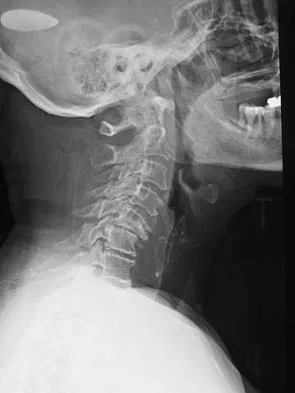
Figure 16 shows the radiograph of a 56-year-old man who has neck pain after a rollover accident on his lawnmower. The injury appears to be isolated, and he is neurologically intact. Management of the fracture should consist of
Explanation
Question 2
Degenerative spondylolisthesis of the cervical spine is most commonly seen at which of the following levels?
Explanation
Question 3
Thoracic disk herniations are most frequently found in what area of the spine?
Explanation
Question 4
In a patient who has had low back pain for less than 2 weeks, which of the following findings is an indication for continued observation and symptomatic treatment rather than more aggressive evaluation and/or treatment?
Explanation
Question 5
Radiographs of an 80-year-old woman with back pain reveal a compression fracture. Which of the following imaging studies best evaluates the acuity of the fracture?
Explanation
Question 6
A 24-year-old professional football player underwent surgery for a symptomatic cervical disk herniation with radiculopathy 9 months ago. A current radiograph is shown in Figure 17. He has normal neurologic findings, no pain, and full range of motion. A CT scan shows a solid fusion. When can he expect to return to play?
Explanation
Question 7
When treating thoracic disk herniations, which of the following surgical approaches has the highest reported rate of neurologic complications?
Explanation
Question 8
When harvesting iliac crest bone graft during a posterior spinal decompression and fusion, injury to what structure can result in painful neuromas or numbness over the skin of the buttocks?
Explanation
Question 9
A 42 year-old-woman who underwent surgery for lumbar scoliosis 2 years ago now has fixed sagittal plane imbalance and severe back pain. Which of the following is considered a contraindication to isolated pedicle subtraction osteotomy for the treatment of iatrogenic flatback syndrome in this patient?
Explanation
Question 10
A 42-year-old man sustained a burst fracture at L2 in a motor vehicle accident. Examination reveals that he is neurologically intact. Figure 18 shows a cross-sectional CT scan through the fracture. If the fracture is managed nonsurgically for the next 2 years, the retained fragments can be expected to
Explanation
Question 11
A 50-year-old man reports the onset of back pain and incapacitating pain radiating down his left leg posterolaterally and into the first dorsal web space of his foot 1 day after doing some yard work. He denies any history of trauma. Examination reveals ipsilateral extensor hallucis longus weakness. MRI scans are shown in Figures 19a through 19c. What nerve root is affected?
Explanation
Question 12
Which of the following pharmacologic agents is most likely to adversely affect the success rate of bony union after lumbar arthrodesis?
Explanation
Question 13
A 69-year-old woman is seen in the emergency department with a bilateral C5-6 facet dislocation and complete quadriplegia after falling down a flight of stairs. After initial evaluation and treatment by the trauma service, she is moved to the intensive care unit. Examination reveals a blood pressure of 90/50 mm/Hg, a pulse rate of 50/min, a respiration rate of 12/min, and urine output of 1 mL/kg/h. Her hemodynamic status should be addressed by
Explanation
Question 14
What region of the spine is most susceptible to changes in the vascular supply to the spinal cord during an anterior approach?
Explanation
Question 15
What is the most common presenting sign or symptom in an adult with lumbar pyogenic infection?
Explanation
Question 16
The natural history of cervical spondylolytic myelopathy is best described as
Explanation
Question 17
Figures 20a and 20b show lateral and AP radiographs of a 49-year-old man who sustained a gunshot wound through the left shoulder. He reports neck pain and examination reveals weakness in all four extremities. What is the priority of evaluation?
Explanation
Question 18
A 35-year-old woman undergoes an L4-5 anterior fusion via a left retroperitoneal approach. Postoperative examination reveals that her right foot is cool and pale. Her neurologic examination is normal, and her pedal pulses are asymmetric. What is the most likely reason for the right foot finding?
Explanation
Question 19
What type of thoracolumbar spinal injury is associated with an increased risk of neurologic deterioration following admission to the hospital?
Explanation
Question 20
A 30-year-old man has had a 3-day history of severe, incapacitating lower back pain without radiation. He reports improvement with rest. He denies any history of trauma, has no constitutional symptoms, and his neurologic examination is normal. What is the best course of action?
Explanation
Question 21
Which of the following patient factors is associated with recurrent radicular pain following lumbar diskectomy for sciatica?
Explanation
Question 22
Figure 21 shows the tomogram of a 26-year-old woman who sustained an axial load injury to her neck in a fall off a horse. What ligament is injured?
Explanation
Question 23
Based on the findings shown in Figures 22a and 22b, corrective surgery to obtain maximal safe correction and optimal instrumentation fixation should be performed at which of the following locations?
Explanation
Question 24
A 65-year-old woman has significant neck pain after falling and striking her head. A radiograph and sagittal CT scan are shown in Figures 23a and 23b. What is the most likely diagnosis?
Explanation
Question 25
Immediately after undergoing lumbar instrumentation, a patient reports severe right leg pain and has 4+/5 weakness. Figure 24 shows an axial CT scan of L5. Exploratory surgery will most likely reveal
Explanation
Question 26
A 78-year-old man presents with severe neck pain following a ground-level fall. Imaging reveals a Type II odontoid fracture with 3 mm of posterior displacement. He is neurologically intact. What is the most appropriate definitive management?
Explanation
Question 27
A 65-year-old woman with adult spinal deformity is undergoing surgical planning. Her pelvic incidence (PI) is 60 degrees. To optimize her postoperative sagittal alignment, what should be the target lumbar lordosis (LL)?
Explanation
Question 28
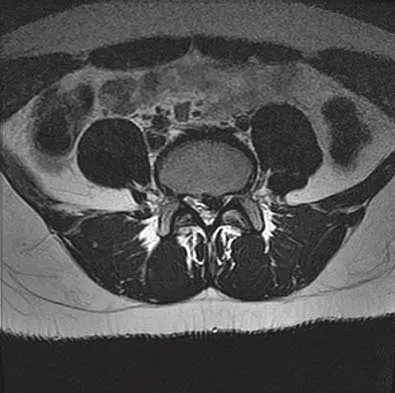
A 35-year-old construction worker falls from a height and presents with paraplegia at the T10 level.
Imaging demonstrates a T10 flexion-distraction injury with posterior ligamentous complex disruption. What associated injury must be urgently ruled out?
Explanation
Question 29
In a patient with cervical spondylotic myelopathy (CSM), which of the following physical examination findings is considered the earliest indicator of myelopathy?
Explanation
Question 30
A 14-year-old girl with adolescent idiopathic scoliosis (AIS) has a right main thoracic curve of 55 degrees and a left lumbar curve of 35 degrees. On lateral bending radiographs, the lumbar curve reduces to 15 degrees. According to the Lenke classification, what type of curve pattern is this?
Explanation
Question 31
A 45-year-old man presents with right leg pain, numbness over the dorsum of his foot, and weakness in great toe extension. MRI shows a paracentral disc herniation. Which nerve root is most likely compressed?
Explanation
Question 32
A 22-year-old man arrives in the trauma bay after a diving accident. He is awake, alert, and cooperative. He has no movement or sensation below the C6 level. Plain films show a unilateral facet dislocation at C5-C6. What is the most appropriate next step in management?
Explanation
Question 33
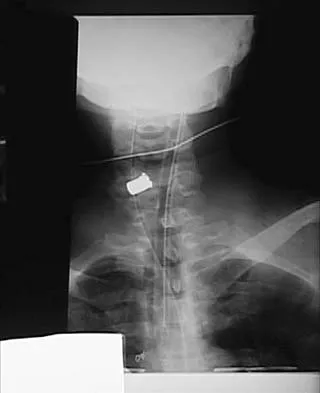
A 68-year-old man with ankylosing spondylitis presents to the ED with neck pain after a minor low-speed motor vehicle collision.
Neurologic examination is normal. Initial AP and lateral cervical spine radiographs show no obvious fracture. What is the next most appropriate step?
Explanation
Question 34
A 60-year-old woman underwent a primary L4-L5 microdiscectomy 6 months ago. She was symptom-free for 5 months but now presents with recurrent, severe right-sided L5 radiculopathy failing 6 weeks of conservative treatment. MRI shows a recurrent focal disc extrusion at L4-L5. What is the recommended surgical intervention?
Explanation
Question 35
Which of the following congenital spinal anomalies has the highest risk of rapid deformity progression, nearly always requiring early surgical intervention?
Explanation
Question 36
A 75-year-old man with known cervical spinal stenosis falls forward, striking his forehead. He presents with severe weakness in his bilateral hands and arms, but is able to move his legs against gravity. Proprioception and pain sensation are diminished distally. What is the most likely diagnosis?
Explanation
Question 37
A 65-year-old man presents with progressive clumsiness in his hands and a wide-based gait. Physical exam shows a positive Hoffman's sign and hyperreflexia. MRI of the cervical spine is ordered. Which of the following MRI findings is the strongest independent predictor of a poor surgical outcome after decompression for degenerative cervical myelopathy?
Explanation
Question 38
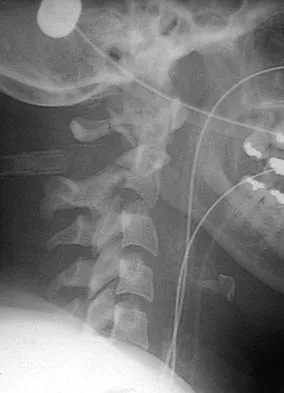
A 55-year-old man with long-standing ankylosing spondylitis falls and sustains an undisplaced C6-C7 fracture seen on initial CT. He is neurologically intact on presentation. Twelve hours later, he develops progressive bilateral lower extremity weakness. What is the most likely cause of his delayed neurological deterioration?
Explanation
Question 39
Degenerative spondylolisthesis in the lumbar spine most commonly occurs at the L4-L5 level. Which of the following anatomic variations is most strongly associated with the development of this specific condition?
Explanation
Question 40
A 72-year-old man presents with an isolated Type II odontoid fracture after a ground-level fall. Anterior odontoid screw fixation is being considered. Which of the following is an absolute contraindication to this specific procedure?
Explanation
Question 41
In adult spinal deformity surgery, achieving optimal sagittal balance is critical to prevent hardware failure and adjacent segment disease. If a patient has a measured Pelvic Incidence (PI) of 58 degrees, what is the ideal postoperative target for Lumbar Lordosis (LL)?
Explanation
Question 42
A 68-year-old man with underlying cervical spondylosis presents after a hyperextension injury. Examination reveals 2/5 motor strength in his upper extremities and 4/5 strength in his lower extremities. The disproportionate upper extremity weakness is primarily due to the anatomic arrangement of which spinal tract?
Explanation
Question 43
A 65-year-old woman presents with severe back pain, forward-leaning posture, and difficulty standing upright. Radiographs reveal adult spinal deformity. Her pelvic incidence (PI) is 60 degrees. To achieve a harmonious sagittal alignment postoperatively, what is the ideal target for her lumbar lordosis (LL)?
Explanation
Question 44
An 82-year-old man presents with neck pain after a low-speed motor vehicle collision. CT scan of the cervical spine demonstrates a displaced Type II odontoid fracture. He is neurologically intact but has significant medical comorbidities. Which of the following is the most appropriate initial management?
Explanation
Question 45
A 60-year-old man undergoes a posterior C3-C6 laminectomy and fusion for cervical spondylotic myelopathy. On postoperative day 2, he develops isolated right deltoid and biceps weakness (grade 2/5) without sensory deficits or lower extremity changes. What is the most likely etiology?
Explanation
Question 46
A 68-year-old man with known cervical spondylosis presents after a hyperextension injury. He has 2/5 motor strength in his bilateral upper extremities, particularly the hands, and 4/5 strength in his lower extremities. He has variable sensory loss but retains bladder function. What is the classic mechanism and diagnosis?
Explanation
Question 47
A 14-year-old girl with adolescent idiopathic scoliosis has a primary right thoracic curve of 55 degrees and a left lumbar curve of 35 degrees. On lateral bending radiographs, the lumbar curve corrects to 15 degrees. According to the Lenke classification, what type of curve does she have?
Explanation
Question 48
A 45-year-old man presents with progressive lower extremity weakness and myelopathy. MRI reveals a large, calcified central disc herniation at T8-T9 causing severe cord compression. Which of the following surgical approaches is CONTRAINDICATED?
Explanation
Question 49
A 55-year-old man with a long-standing history of ankylosing spondylitis presents with severe neck pain after a low-energy fall. Radiographs are inconclusive, but CT reveals a transverse fracture through the C5-C6 intervertebral space extending through the posterior elements. What is the most appropriate management?
Explanation
Question 50
A 16-year-old boy presents with back pain and a prominent thoracic kyphosis. Radiographs reveal a thoracic kyphosis of 65 degrees. Which of the following radiographic criteria is required to confirm the diagnosis of Scheuermann's disease?
Explanation
Question 51
A 68-year-old woman presents with neurogenic claudication and L4 radiculopathy. Imaging demonstrates a L4-L5 degenerative spondylolisthesis with severe central canal and lateral recess stenosis. She has failed 6 months of conservative management. According to the SPORT trial, which of the following statements regarding surgical intervention is true?
Explanation
Question 52
A 22-year-old woman involved in a high-speed motor vehicle collision as a rear-seat passenger wearing a lap belt presents with severe back pain. Imaging shows an L2 fracture with a horizontal split through the spinous process, pedicles, and vertebral body. What associated injury must be most highly suspected?
Explanation
Question 53
A 35-year-old man fell 30 feet from a roof. Pelvic radiographs and CT demonstrate a transverse sacral fracture through the S1/S2 neural foramina connecting bilateral vertical sacral fractures. He has saddle anesthesia and sphincter dysfunction. This injury pattern represents:
Explanation
Question 54
A 48-year-old man presents with right arm pain, numbness in his index and middle fingers, and weakness with triceps extension and wrist flexion. His triceps reflex is diminished. Which cervical nerve root is most likely compressed?
Explanation
Question 55
A 14-year-old gymnast presents with chronic lower back pain. Radiographs reveal a Grade II isthmic spondylolisthesis at L5-S1. She has failed 6 months of bracing and physical therapy. If surgery is performed, what is the most appropriate procedure?
Explanation
Question 56
A 65-year-old woman presents with severe low back pain and an inability to stand up straight. Preoperative standing radiographs demonstrate a pelvic incidence (PI) of 60 degrees. To achieve optimal sagittal balance postoperatively and minimize the risk of adjacent segment disease, her lumbar lordosis (LL) should be restored to within what range?
Explanation
Question 57
A 60-year-old man presents with progressive clumsiness in his hands and difficulty walking. Examination reveals a positive Hoffmann sign and hyperreflexia in the lower extremities. MRI shows severe cervical stenosis at C4-C5 and C5-C6. Which of the following MRI findings is the most significant predictor of a poor neurological recovery following surgical decompression?
Explanation
Question 58
A 45-year-old man falls from a height and sustains an L1 burst fracture. He is neurologically intact. MRI demonstrates that the integrity of the posterior ligamentous complex (PLC) is indeterminate. Based on the Thoracolumbar Injury Classification and Severity (TLICS) score, what is the most appropriate management approach?
Explanation
Question 59
A 72-year-old man sustains a Type II odontoid fracture after a low-speed motor vehicle collision. He is considered for nonoperative management. Which of the following factors most significantly increases his risk of nonunion if treated with a cervical collar?
Explanation
Question 60
A 68-year-old man with known cervical spondylosis presents after a hyperextension injury to his neck. He is able to ambulate but has profound motor weakness in his hands and arms. Perianal sensation and bladder function are intact. What is the most likely diagnosis?
Explanation
Question 61
A 55-year-old man with longstanding ankylosing spondylitis sustains a minor ground-level fall. He has severe neck pain but is neurologically intact. Radiographs demonstrate a displaced extension-type fracture through the C6-C7 disc space. What is the standard of care for definitive management?
Explanation
Question 62
In a patient with ankylosing spondylitis who sustains an acute cervical spine fracture, which of the following is the most common occult complication leading to delayed neurological deterioration?
Explanation
Question 63
A 60-year-old woman with severe rheumatoid arthritis is evaluated prior to a total knee arthroplasty. Flexion-extension cervical radiographs reveal an anterior atlantodental interval (ADI) of 11 mm. What is the most appropriate next step in her management?
Explanation
Question 64
A 65-year-old woman presents with neurogenic claudication and a grade 1 degenerative spondylolisthesis at L4-L5. Which of the following anatomic features is most strongly implicated in the pathogenesis of her spondylolisthesis?
Explanation
Question 65
A 25-year-old man involved in a high-speed motor vehicle collision while wearing a lap belt sustains a flexion-distraction injury (Chance fracture) of the L2 vertebra. Which associated injury must be strongly suspected and ruled out?
Explanation
Question 66
A 32-year-old man presents with severe neck pain and right-sided C6 radiculopathy after a motorcycle crash. Lateral cervical radiographs reveal an anterior subluxation of C5 on C6 of approximately 25 percent. What is the primary mechanism of injury?
Explanation
Question 67
A 15-year-old boy presents with progressive mid-back pain and a rounded posture. Lateral radiographs of the thoracic spine demonstrate anterior wedging of 7 degrees at T7, T8, and T9, along with prominent Schmorl's nodes. He has a flexible kyphosis measuring 60 degrees. What is the most appropriate initial management?
Explanation
Question 68
A 58-year-old man underwent an L4-S1 posterior instrumented fusion 5 years ago. He now presents with new-onset L3 radiculopathy due to adjacent segment disease. Which of the following intraoperative factors during the index surgery is most strongly associated with accelerated adjacent segment degeneration?
Explanation
Question 69
A 40-year-old man sustains a traumatic spondylolisthesis of the axis (Hangman's fracture) following a high-speed motor vehicle rollover. The classic mechanism of injury responsible for this fracture pattern is:
Explanation
Question 70
A 42-year-old man presents with right leg pain radiating down the lateral aspect of his calf to the dorsum of his foot, accompanied by weakness in great toe extension. MRI of the lumbar spine reveals a paracentral disc herniation. At which level is the disc herniation most likely located?
Explanation
Question 71
A 65-year-old woman presents with severe neurogenic claudication and an L4-L5 degenerative spondylolisthesis. She has failed 6 months of supervised physical therapy and epidural steroid injections. What is the most appropriate surgical intervention to optimize long-term clinical outcomes?
Explanation
Question 72
An 80-year-old man sustains a Type II odontoid fracture after a ground-level fall. He is neurologically intact. Which of the following radiographic findings is the strongest predictor of nonunion if treated conservatively with a rigid cervical collar?
Explanation
Question 73
A 14-year-old girl with adolescent idiopathic scoliosis presents with a right thoracic curve measuring 55 degrees on standing radiographs. Her Risser stage is 0 and she is pre-menarchal. What is the most appropriate management?
Explanation
Question 74
In the assessment of adult spinal deformity, which of the following spinopelvic parameters is considered a fixed morphological characteristic of the pelvis that remains constant regardless of patient positioning?
Explanation
Question 75
A 35-year-old man sustains an L1 burst fracture after falling from a ladder. He is neurologically intact. Imaging reveals 15 degrees of kyphosis, 30% canal compromise, and an intact posterior ligamentous complex (PLC). What is the most appropriate treatment?
Explanation
Question 76
A 45-year-old man presents with severe right thigh pain and weakness in knee extension. MRI reveals a far-lateral (extraforaminal) disc herniation at the L4-L5 level. Which nerve root is most likely compressed?
Explanation
Question 77
During the physical examination of a patient with progressive gait difficulties, flicking the volar nail of the middle finger results in brisk flexion of the thumb and index finger. This clinical sign indicates an upper motor neuron lesion typically located where?
Explanation
Question 78
A 70-year-old man with advanced ankylosing spondylitis presents to the emergency department complaining of neck pain after a low-speed motor vehicle collision. Initial plain radiographs of the cervical spine demonstrate an ossified anterior longitudinal ligament but no obvious fracture. What is the most appropriate next step in management?
Explanation
Question 79
A patient is diagnosed with a Levine-Edwards Type IIA traumatic spondylolisthesis of the axis (Hangman's fracture). Which of the following conservative management techniques is strictly contraindicated for this specific injury pattern?
Explanation
Question 80
What is the primary radiographic requirement for the diagnosis of classic Scheuermann's kyphosis according to the Sorensen criteria?
Explanation
Question 81
A 68-year-old man with baseline cervical spondylosis is involved in a rear-end motor vehicle accident causing a hyperextension injury. He presents with bilateral upper extremity weakness (2/5) but relatively preserved lower extremity strength (4/5). What is the most likely diagnosis?
Explanation
Question 82
Following a multi-level posterior cervical laminectomy and instrumented fusion for severe myelopathy, a patient develops profound, isolated weakness in shoulder abduction and elbow flexion postoperatively. Sensation remains largely intact. What is the most likely complication?
Explanation
Question 83
A 22-year-old man presents with chronic low back pain and radicular symptoms. Imaging reveals a bilateral L5 pars interarticularis defect (isthmic spondylolisthesis) with a Grade 2 slip. Which nerve root is most commonly compressed in this specific condition?
Explanation
Question 84
A 25-year-old woman wearing only a lap belt is involved in a high-speed frontal collision. She sustains a flexion-distraction injury (Chance fracture) to the L2 vertebra. What associated injury must be aggressively ruled out?
Explanation
Question 85
A 65-year-old man presents with progressive dysphagia. Cervical spine radiographs reveal flowing ossification along the anterior longitudinal ligament. To confirm Diffuse Idiopathic Skeletal Hyperostosis (DISH) using Resnick's criteria, how many contiguous vertebral bodies must be involved?
Explanation
Question 86
A 55-year-old woman is evaluated for clumsiness of her hands and gait instability. Striking the distal brachioradialis tendon with a reflex hammer elicits isolated flexion of her fingers, without the normal elbow flexion. What does this 'inverted brachioradialis reflex' indicate?
Explanation
Question 87
When evaluating a lateral cervical spine radiograph for traumatic occipitocervical dissociation, the Powers ratio is calculated. A ratio greater than what value is considered highly sensitive for anterior occipitoatlantal subluxation?
Explanation
Question 88
A 30-year-old man arrives in the emergency department following a rugby tackle. He is fully awake, alert, and cooperative. Imaging reveals a unilateral cervical facet dislocation at C5-C6. He has right-sided arm pain and C6 weakness. What is the most appropriate initial management?
Explanation
Question 89
A 28-year-old man sustains a gunshot wound to the lumbar spine. He arrives with bilateral lower extremity weakness, saddle anesthesia, and urinary retention. CT scan shows a retained bullet fragment within the spinal canal at L3. What is the optimal surgical management?
Explanation
Question 90
During preoperative planning for a long-segment fusion to correct adult spinal deformity, the surgeon calculates the patient's spinopelvic parameters. To achieve an optimal sagittal balanced profile and minimize the risk of adjacent segment disease, the surgical goal should be to restore Lumbar Lordosis (LL) to within how many degrees of the Pelvic Incidence (PI)?
Explanation
Question 91
A 35-year-old man presents to the emergency department after a high-speed motor vehicle collision. He complains of severe neck pain and exhibits bilateral upper extremity weakness (deltoids and biceps 3/5, triceps 4/5) with normal lower extremity strength. Radiographs demonstrate a 50% anterior translation of C5 on C6. The patient is awake, alert, and cooperative. What is the most appropriate next step in management?
Explanation
Question 92
A 65-year-old woman presents with severe neurogenic claudication and MRI-confirmed L4-L5 degenerative spondylolisthesis. She has failed 6 months of comprehensive conservative management. Based on the Spine Patient Outcomes Research Trial (SPORT) for degenerative spondylolisthesis, what outcome should she expect if she elects to undergo surgical intervention compared to continued nonoperative treatment?
Explanation
Question 93
A 68-year-old woman with severe back pain and forward-flexed posture is being evaluated for an adult spinal deformity correction. Her preoperative full-length standing radiographs demonstrate a Pelvic Incidence (PI) of 62 degrees. To achieve optimal postoperative sagittal balance and minimize the risk of adjacent segment disease or hardware failure, what should her target Lumbar Lordosis (LL) be?
Explanation
Question 94
A 42-year-old construction worker falls 10 feet and sustains an L1 burst fracture. He is neurologically intact on examination. CT and MRI show 40% anterior body height loss, 30% retropulsed bone causing canal compromise, and a completely intact posterior ligamentous complex (PLC). According to the Thoracolumbar Injury Classification and Severity (TLICS) score, what is the most appropriate treatment recommendation?
Explanation
Question 95
A 72-year-old man presents with deteriorating handwriting, frequent dropping of objects, and a wide-based gait. On physical examination, striking the brachioradialis tendon results in diminished reflex finger flexion but elicits brisk finger flexion of the ipsilateral hand. This specific physical exam finding (an inverted brachioradialis reflex) localizes the primary spinal cord compression to which of the following cervical levels?
Explanation
Question 96
A 15-year-old boy presents with progressive mid-back pain and an increasing rounded appearance to his upper back. You suspect Scheuermann's kyphosis. Which of the following radiographic findings represents the classic diagnostic criteria (Sorensen's criteria) for this condition?
Explanation
Question 97
A 78-year-old man trips on a rug and sustains an isolated Type II odontoid fracture. He is neurologically intact. You are discussing nonoperative management in a hard cervical collar versus surgical stabilization. Which of the following injury characteristics is most strongly associated with an increased risk of nonunion if treated nonoperatively?
Explanation
Question 98
A 60-year-old woman is scheduled for an L4-L5 posterior lumbar interbody fusion (PLIF) with pedicle screw instrumentation. Which of the following intraoperative technical errors is most significantly linked to the accelerated development of adjacent segment disease at the L3-L4 level?
Explanation
Question 99
A 65-year-old man with underlying cervical stenosis presents with weakness in his upper and lower extremities following a hyperextension injury to his neck during a fall. His exam shows 2/5 strength in his hands bilaterally and 4/5 strength in his legs, with preserved sacral sensation. Which of the following best describes the typical expected pattern of neurologic recovery in this condition?
Explanation
Question 100
A 13-year-old premenarchal female (Risser stage 0) presents for evaluation of a spinal deformity. Radiographs confirm adolescent idiopathic scoliosis with a primary right thoracic curve measuring 35 degrees. What is the most appropriate evidence-based management strategy for this patient?
Explanation
None
