Orthopedic Foot & Ankle 2026 MCQs: Board Review Questions & Answers (Part 2)
Key Takeaway
Your ultimate guide to Orthopedic Foot & Ankle 2026 MCQs: Board Review Questions & Answers (Part 2) starts here. Top-rated Orthopedic Foot & Ankle 2026 MCQs bank. Practice with clinical case questions, orthopedic surgery board review, and evidence-based answers updated for 2026.
Orthopedic Foot & Ankle 2026 MCQs: Board Review Questions & Answers (Part 2)
Comprehensive 100-Question Exam
00:00
Start Quiz
Question 1
A 45-year-old man is seen in the emergency department after returning from a 2-hour airplane flight. He is reporting severe pain in his right leg but has no trouble moving his ankle, leg, or knee. Venous doppler testing reveals no evidence of deep venous thrombosis. He is placed on IV cephazolin but continues to worsen. On the third day in the hospital he has increased pain, some respiratory distress, and trouble maintaining his blood pressure. His leg takes on the appearance seen in Figure 15. An urgent MRI scan shows thickening of the subcutaneous tissues and superficial swelling in the leg but no evidence of an abscess. What is the next most appropriate step in management?
Explanation
Question 2
A 17-year-old girl with Charcot-Marie-Tooth disease reports the development of progressive instability when walking on uneven surfaces. Her involved heel is positioned in varus when viewed from behind. Examination reveals that she walks on the outer border of the involved foot. She has full passive motion of the ankle and hindfoot joints. She is able to dorsiflex the ankle against resistance. The heel varus fully corrects with the Coleman block test. Standing radiographs reveal a cavus deformity with valgus of the forefoot. She would like to avoid using an ankle-foot orthosis. What is the best surgical option?
Explanation
Question 3
A 58-year-old man with type 1 diabetes mellitus is seen in the emergency department and he reports a 3-day history of a red swollen foot but no history of trauma. Examination reveals that the skin is intact, and the patient has discomfort with passive range of motion at the ankle, hindfoot, and midfoot joints. He denies any fever. Laboratory studies show a WBC count of 7,800/mm3, an erythrocyte sedimentation rate of 40 mm/h, a C-reactive protein level of 23, and a serum glucose of 100. A radiograph and MRI scans are shown in Figures 16a through 16c. What is the next most appropriate step in management?
Explanation
Question 4
Which of the following conditions is not associated with an increased risk of developing Achilles tendinopathy?
Explanation
Question 5
Figures 17a through 17c show the radiographs of a 38-year-old man following a motorcycle accident. The posterior portion of the talus extruded through a posterolateral wound. The extruded talar body is visible in the wound along with some road debris. Management should now consist of surgical irrigation, debridement, and
Explanation
Question 6
Figures 18a and 18b show the radiographs of a patient who has pain with walking. On careful questioning, it is determined that the discomfort occurs at push-off, or when the patient attempts to climb stairs. What nonsurgical option is most likely to ameliorate the symptoms?
Explanation
Question 7
An 18-year-old football player reports acute pain and swelling after a direct injury to his plantar flexed foot. Examination reveals midfoot swelling and tenderness. Nonstanding radiographs are normal. What is the next most appropriate step in management?
Explanation
Question 8
A 36-year-old woman is wearing an ankle-foot orthosis for a foot drop secondary to spastic hemiplegia following a postpartum stroke 2 years ago. Knee and hip motion and strength are within normal ranges. She has undergone multiple rounds of physical therapy but has seen no improvement over the past several months. No improvement has been recorded by electromyography (EMG) studies over the past year. Examination reveals a 5-degree plantar flexion contracture with clonus, heel varus, and compensatory knee hyperextension when standing. She has 4/5 power in the tibialis anterior and gastrocnemius soleus complex with resistance testing. Everters are 2/5 to resistance testing. EMG gait studies show that the tibialis anterior demonstrates activity during both swing and stance phase that is increased during swing phase. Premature firing of the triceps surae is noted when positioning the foot in equinus prior to floor contact. What is the most appropriate management?
Explanation
Question 9
A 52-year-old woman slipped on ice in her driveway. Radiographs are shown in Figures 19a and 19b. The patient was treated in a short leg cast with weight bearing as tolerated for 6 weeks. Due to persistent tenderness at the fracture site, a CAM walker was used for an additional 8 weeks. Nine months after the injury, the patient still walks with a limp and reports pain with deep palpation at the fracture site. What is the next most appropriate step in management?
Explanation
Question 10
What is the most frequent complication of percutaneous repair of an acute Achilles tendon rupture?
Explanation
Question 11
A 2-year-old child is brought in by his parents for evaluation of intoeing. The child has a normal neuromuscular examination, but the heel bisector line is in the fourth web space, indicating a severe flexible metatarsus adductus deformity. The remainder of the lower extremity examination is unremarkable. What is the most appropriate treatment?
Explanation
Question 12
A 34-year-old man has had a 13-month history of an equinovarus deformity of the foot and ankle after a motorcycle accident. His foot and ankle are flexible, but bracing has become uncomfortable. Active dorsiflexion and eversion are absent. What is the most appropriate treatment?
Explanation
Question 13
Figures 20a and 20b show the radiographs of a 14-year-old boy who sustained a twisting injury to his ankle. If attempted closed reduction is unsuccessful, what is the primary reason to proceed with surgical treatment?
Explanation
Question 14
A 75-year-old woman reports foot pain and states that her foot has become progressively "flatter" in the past 3 years. Custom inserts and physical therapy have failed to provide relief. Examination reveals a flexible hindfoot and mild heel cord contracture. The patient is able to perform a single limb heel rise. Weight-bearing radiographs are shown in Figures 21a through 21d. What is the most appropriate surgical management?
Explanation
Question 15
A 52-year-old woman who underwent cheilectomy 1 year ago for hallux rigidus now reports continued pain in the first metatarsophalangeal joint. She did not have any incision healing problems, and has not had any fevers, erythema, or drainage. Which of the following procedures will provide the best combination of pain relief and function?
Explanation
Question 16
During a posterior approach to the right Achilles tendon, the surgeon encounters a nerve running with the small saphenous vein as shown in Figure 22. This nerve innervates what part of the foot?
Explanation
Question 17
A 23-year-old woman has had a 14-month history of ankle pain after surgical treatment of multiple injuries resulting from a motor vehicle accident. Weight bearing began 4 months after surgery. The pain occurs with weight bearing and motion, but there is very little pain at rest. She has no pertinent medical history and does not smoke. Figures 23a and 23b show current radiographs. What is the most appropriate surgical option?
Explanation
Question 18
What type of physical therapy is most effective for chronic noninsertional Achilles tendinopathy?
Explanation
Question 19
A 27-year-old man was struck by a taxi cab and sustained comminuted right distal third tibia and fibula fractures; treatment consisted of placement of an intramedullary nail in the tibia the following morning. At his 6-month follow-up, he has clawing of all five toes. Examination reveals flexion deformities of the distal and proximal interphalangeal joints that are flexible with plantar flexion and rigid with dorsiflexion. Calluses are present on the dorsum and tip of the toes. Single heel rise is normal. He has a mild equinus contracture (relative to the left leg) that is not relieved with knee flexion. What is the most appropriate treatment option?
Explanation
Question 20
A 24-year-old man reports the development of a foot drop following a knee dislocation 1 year ago. The common peroneal nerve was found to be in continuity at the time of surgical reconstruction of the posterolateral corner of the knee joint. He would like to eliminate the need for an ankle-foot orthosis. What is the best option to achieve elimination of the orthosis?
Explanation
Question 21
A 21-year-old male construction worker fell from a roof and sustained an injury to his left foot. Radiographs and CT scans are shown in Figures 24a through 24e. Compared to nonsurgical management, surgical treatment offers which of the following advantages?
Explanation
Question 22
A 51-year-old plumber has a failed peroneus brevis tendon repair. He reports continued pain and swelling in the distal retrofibular area. MRI shows longitudinal tears of the peroneus longus and peroneus brevis. What is the surgical treatment of choice at this time?
Explanation
Question 23
Which of the following imaging modalities is most accurate in locating a toothpick in the plantar arch of the foot?
Explanation
Question 24
A 35-year-old man is seen in the emergency department with a bullet wound to the foot that occurred 2 hours ago. Examination reveals a 0.5-cm entrance wound on the dorsum of the foot and a 1.5-cm exit wound on the plantar aspect. Exploration of the plantar wound in the emergency department reveals bone and metal fragments. Radiographs reveal a comminuted, unstable fracture of the base of the first metatarsal and cuneiform. Management should consist of tetanus toxoid, and
Explanation
Question 25
What is the most frequent location of entrapment of the deep peroneal nerve?
Explanation
Question 26
A 25-year-old professional athlete sustains a twisting injury to his midfoot. Non-weight-bearing radiographs are normal. However, weight-bearing radiographs reveal a 3-mm diastasis between the base of the first and second metatarsals without any evidence of osseous avulsion fractures. Which of the following is the most appropriate definitive management to maximize his chances of returning to high-level athletics?
Explanation
Question 27
A 40-year-old man undergoes a percutaneous repair of an acute Achilles tendon rupture. Postoperatively, he complains of numbness along the lateral border of his foot. Injury to which of the following nerves is the most likely cause of his symptoms?
Explanation
Question 28
A 50-year-old woman presents with medial ankle pain and an acquired flatfoot deformity. Examination reveals a flexible hindfoot valgus. Weight-bearing radiographs show greater than 30% uncoverage of the talar head on the AP view, indicating significant forefoot abduction. She has failed conservative management. Which surgical reconstruction is most appropriate for this Stage IIb posterior tibial tendon dysfunction?
Explanation
Question 29
A 60-year-old man presents with advanced ankle osteoarthritis and is inquiring about total ankle arthroplasty (TAA). Which of the following is considered an absolute contraindication for TAA?
Explanation
Question 30
A 22-year-old collegiate basketball player sustains a fracture at the metaphyseal-diaphyseal junction of the fifth metatarsal base. What is the most appropriate management to minimize the risk of nonunion and allow for an expedited return to play?
Explanation
Question 31
A 45-year-old woman presents with a painful bunion. Weight-bearing radiographs reveal an intermetatarsal angle (IMA) of 16 degrees and a hallux valgus angle (HVA) of 38 degrees. Clinical examination demonstrates significant hypermobility of the first tarsometatarsal (TMT) joint. Which of the following surgical procedures is most appropriate?
Explanation
Question 32
A 20-year-old cross-country runner complains of vague midfoot pain. Radiographs are normal, but an MRI demonstrates a nondisplaced, incomplete stress fracture involving the central third of the navicular. What is the most appropriate initial management?
Explanation
Question 33
A 35-year-old construction worker falls from a ladder and sustains a displaced intra-articular calcaneus fracture. The surgeon plans an extensile lateral approach. Which vascular structure is most critical to the blood supply of the apex of the subperiosteal corner flap?
Explanation
Question 34
A 28-year-old professional football player suffers a severe hyperextension injury to his first metatarsophalangeal (MTP) joint. MRI reveals a complete rupture of the plantar plate with 4 mm of proximal retraction of the sesamoids. What is the most appropriate management?
Explanation
Question 35
A 55-year-old man requires surgery for chronic insertional Achilles tendinopathy with a large retrocalcaneal exostosis after failing conservative therapy. Intraoperatively, the diseased Achilles tendon is debrided. At what threshold of tendon detachment or debridement is a flexor hallucis longus (FHL) tendon transfer primarily indicated to augment the repair?
Explanation
Question 36
A 30-year-old man sustains a displaced talar neck fracture with subluxation of the subtalar joint but an intact ankle joint (Hawkins Type II) after a motor vehicle collision. What is the approximate risk of developing avascular necrosis (AVN) of the talar body?
Explanation
Question 37
A 24-year-old woman has persistent deep ankle pain following an inversion sprain 6 months ago. MRI demonstrates an isolated 12-mm purely cartilaginous osteochondral lesion on the anterolateral aspect of the talar dome. What is the most appropriate first-line surgical treatment?
Explanation
Question 38
A 45-year-old man presents with chronic heel pain that worsens at the end of the day. He has focal tenderness over the medial calcaneal tuberosity, and compression reproduces radiating pain. EMG reveals denervation of the abductor digiti minimi muscle. Which nerve is most likely entrapped?
Explanation
Question 39
A 40-year-old man sustains a high-energy distal tibia pilon fracture. Clinical examination reveals massive soft tissue swelling and multiple fracture blisters over the anterior ankle. What is the safest and most appropriate initial management?
Explanation
Question 40
A 26-year-old man undergoes evaluation for a pronation-external rotation ankle sprain. Radiographs are negative for fractures. Intraoperatively, the "Cotton test" is strongly positive. Which of the following ligaments is definitively disrupted in this scenario?
Explanation
Question 41
A 55-year-old man reports chronic dorsal midfoot pain at the first metatarsophalangeal (MTP) joint, worst during toe-off. Radiographs display moderate dorsal osteophytes but preservation of the plantar joint space (Coughlin/Shurnas Grade 2). Conservative measures have failed. Which surgical option is most indicated?
Explanation
Question 42
A 28-year-old man sustains a high-energy motor vehicle collision and presents with a closed Hawkins Type II talar neck fracture. Which of the following best represents the approximate rate of avascular necrosis (AVN) of the talar body associated with this specific injury pattern?
Explanation
Question 43
A 45-year-old woman presents with severe bunion pain. Weight-bearing radiographs reveal a hallux valgus angle (HVA) of 45 degrees, an intermetatarsal angle (IMA) of 18 degrees, and clinical examination demonstrates gross hypermobility of the first tarsometatarsal (TMT) joint. Which of the following procedures is most appropriate?
Explanation
Question 44
A 55-year-old woman reports medial ankle pain and a progressively collapsing arch over the past year. Examination reveals a flexible flatfoot deformity and an inability to perform a single-leg heel rise on the affected side. Radiographs show no degenerative joint disease. What is the most appropriate surgical management if conservative care fails?
Explanation
Question 45
A 14-year-old boy presents with a rigid flatfoot and recurrent ankle sprains. Radiographs demonstrate a continuous bony bridge between the calcaneus and the navicular. He has failed 6 months of non-operative management including orthotics and casting. There is no evidence of subtalar arthritis. What is the best surgical option?
Explanation
Question 46
A 60-year-old man requires surgical intervention for chronic insertional Achilles tendinopathy. Intraoperatively, after resecting the Haglund deformity and debriding the degenerative tendinosis, it is noted that 60% of the Achilles tendon insertion has been removed. What is the most appropriate adjunctive procedure?
Explanation
Question 47
A 22-year-old elite collegiate football player sustains a proximal fifth metatarsal fracture at the metaphyseal-diaphyseal junction (Zone 2) during practice. To optimize his chance of union and early return to play, what is the recommended treatment?
Explanation
Question 48
A 50-year-old man presents with a painful, stiff great toe. Examination reveals 15 degrees of dorsiflexion with pain at the extremes of motion. Radiographs demonstrate a dorsal osteophyte but well-preserved plantar joint space (Coughlin Grade 2 hallux rigidus). Which of the following is the most appropriate surgical treatment?
Explanation
Question 49
When evaluating a patient with end-stage ankle osteoarthritis for surgical intervention, which of the following is considered an absolute contraindication for total ankle arthroplasty (TAA)?
Explanation
Question 50
A 45-year-old female presents with a severe bunion deformity. Examination reveals hypermobility of the 1st tarsometatarsal (TMT) joint. Radiographs show a Hallux Valgus Angle of 45 degrees and an Intermetatarsal Angle of 18 degrees.
What is the most appropriate surgical intervention?
Explanation
Question 51
A 28-year-old competitive runner sustains a subtle midfoot injury. Weight-bearing radiographs demonstrate 3 mm of diastasis between the medial and middle cuneiforms with no associated fractures. According to recent literature, what is the most appropriate definitive management for this purely ligamentous injury?
Explanation
Question 52
A 55-year-old woman presents with a flexible flatfoot deformity, medial ankle pain, and inability to perform a single heel raise. The hindfoot valgus completely corrects when the patient sits. Which surgical intervention is most appropriate after failure of nonoperative management?
Explanation
Question 53
A 45-year-old man presents with dorsal midfoot pain and limited dorsiflexion of his first metatarsophalangeal (MTP) joint. Radiographs show a dorsal osteophyte and joint space narrowing isolated to the dorsal half of the 1st MTP joint. Which procedure is most appropriate?
Explanation
Question 54
A 45-year-old man has severe insertional Achilles tendinopathy with a Haglund deformity. MRI shows tendinosis affecting 60% of the Achilles tendon insertion. What is the recommended surgical procedure after failed conservative therapy?
Explanation
Question 55
Which of the following patient factors is considered an absolute or strong relative contraindication to a total ankle arthroplasty (TAA)?
Explanation
Question 56
A 21-year-old collegiate basketball player sustains an acute transverse fracture at the metaphyseal-diaphyseal junction of the fifth metatarsal. What is the most appropriate management to minimize nonunion risk and expedite return to play?
Explanation
Question 57
A 62-year-old man with poorly controlled diabetes presents with an acutely swollen, erythematous, and warm right foot without ulcers. Radiographs reveal fragmentation of the midfoot. WBC count is normal. What is the most appropriate initial management?
Explanation
Question 58
A 30-year-old sustains a Hawkins Type III talar neck fracture. Which of the following best describes the disruption of the blood supply associated with this injury pattern?
Explanation
Question 59
A professional athlete sustains a hyperextension injury to his first MTP joint. MRI confirms a complete tear of the plantar plate with proximal sesamoid retraction. He is unable to push off. What is the most appropriate management?
Explanation
Question 60
A 35-year-old male sustains a high-energy motor vehicle collision resulting in a Hawkins Type III talar neck fracture. Despite urgent reduction, the patient is counseled on the high risk of avascular necrosis. Which of the following arterial structures provides the primary blood supply to the talar body that is disrupted in this injury pattern?
Explanation
Question 61
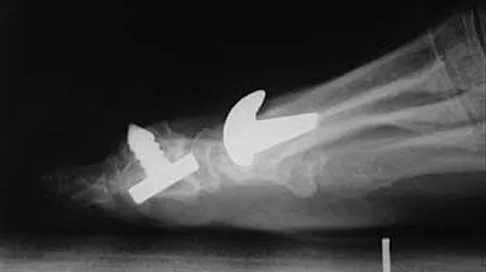
A 24-year-old professional football player sustains an axial load to a plantarflexed foot. Clinical evaluation and the radiograph shown indicate a midfoot injury.
Which of the following ligaments represents the primary stabilizer disrupted in this classic injury pattern?
Explanation
Question 62
A 45-year-old female presents with severe pain over the medial eminence of her left foot. Weight-bearing radiographs reveal a hallux valgus angle of 45 degrees, an intermetatarsal angle of 21 degrees, and marked hypermobility of the first tarsometatarsal joint. Which of the following procedures is most appropriate to achieve durable correction?
Explanation
Question 63
A 55-year-old female presents with progressive flattening of her left foot. On examination, she is unable to perform a single-leg heel rise, and her hindfoot is in valgus but passively correctable. AP radiographs show 45% talonavicular uncoverage. What is the most appropriate surgical intervention?
Explanation
Question 64
A 30-year-old male sustains an acute, closed mid-substance Achilles tendon rupture. He elects for non-operative management. To achieve functional outcomes and rerupture rates most comparable to operative repair, what is the most critical element of his non-operative protocol?
Explanation
Question 65
A 28-year-old male presents with a suspected syndesmotic injury following an external rotation ankle injury. During intraoperative assessment, a hook test reveals significant diastasis. Biomechanically, which of the following ligaments provides the greatest resistance to diastasis of the distal tibiofibular syndesmosis?
Explanation
Question 66
An orthopedic surgeon is performing an extensile lateral approach for open reduction and internal fixation of a displaced intra-articular calcaneus fracture. During the inferior horizontal limb of the incision, which neurological structure is at highest risk of iatrogenic injury?
Explanation
Question 67
A 22-year-old competitive skier presents with chronic posterolateral ankle pain and a snapping sensation behind the lateral malleolus. Examination demonstrates visible anterior subluxation of the retromalleolar tendons during resisted dorsiflexion and eversion. Attenuation or rupture of which structure is the primary cause of this condition?
Explanation
Question 68
A 60-year-old male presents with dorsal foot pain and stiffness of the great toe. Radiographs show a dorsal osteophyte at the first metatarsophalangeal (MTP) joint, but the joint space is relatively preserved with minimal subchondral sclerosis. Pain is reproduced strictly at terminal dorsiflexion. What is the most appropriate surgical treatment?
Explanation
Question 69
A 12-year-old boy presents with recurrent ankle sprains and a rigid, painful flatfoot. A lateral weight-bearing radiograph of the foot reveals a continuous bony bridge outlining the posterior talar dome and sustentaculum tali, often referred to as the 'C-sign'. Which of the following is the most appropriate initial management?
Explanation
Question 70
A 21-year-old Division I basketball player sustains an acute fifth metatarsal base fracture located at the metaphyseal-diaphyseal junction without comminution. To minimize the risk of nonunion and allow the fastest return to play, what is the treatment of choice?
Explanation
Question 71
A 24-year-old female track athlete complains of vague dorsal midfoot pain that worsens with running. Radiographs are normal, but an MRI demonstrates an incomplete fracture through the central third of the navicular body. The pathophysiology of this fracture is heavily influenced by the region's blood supply. Which of the following best describes the vascularity of the navicular?
Explanation
Question 72
A 45-year-old male undergoes surgery for severe insertional Achilles tendinopathy and a large Haglund's deformity. Intraoperatively, after aggressive debridement of calcific tendinosis, approximately 60% of the Achilles tendon insertion is detached. What is the most appropriate next step in surgical management?
Explanation
Question 73
A 55-year-old male with poorly controlled type 2 diabetes presents with a red, hot, and swollen right foot. Radiographs demonstrate periarticular debris, osseous fragmentation, and subluxation of the tarsometatarsal joints. No ulcers or wounds are present. According to the Eichenholtz classification, what stage is this, and what is the best initial management?
Explanation
Question 74
A 16-year-old female ballet dancer presents with chronic pain localized to the plantar aspect of the second metatarsal head. Radiographs show flattening, sclerosis, and widening of the second metatarsal head. Which of the following is the underlying pathophysiology of this condition?
Explanation
Question 75
A 45-year-old distance runner presents with chronic medial heel pain that radiates into the plantar-lateral foot. The pain worsens toward the end of the day and lacks the classic 'first-step' morning stiffness. MRI of the foot is notable for isolated fatty atrophy of the abductor digiti minimi muscle. Entrapment of which nerve is most likely responsible?
Explanation
Question 76
A 26-year-old female reports persistent anteromedial ankle pain 6 months after an inversion injury. MRI demonstrates a 1.2 cm by 1.0 cm osteochondral lesion on the medial talar dome with intact overlying cartilage but deep subchondral edema. Conservative management has failed. What is the most appropriate initial surgical treatment?
Explanation
Question 77
A 28-year-old man sustains a Hawkins Type II talar neck fracture and undergoes urgent open reduction and internal fixation. At his 8-week follow-up, an anteroposterior radiograph of the ankle demonstrates a subchondral radiolucent band in the talar dome. What does this radiographic finding indicate?
Explanation
Question 78
A 35-year-old recreational athlete sustains an acute complete Achilles tendon rupture. After discussing treatment options, he opts for nonoperative management. What is the primary advantage of utilizing an early functional rehabilitation protocol compared to traditional cast immobilization?
Explanation
Question 79
A 52-year-old woman presents with medial ankle pain and a progressive flatfoot deformity. Examination reveals a flexible hindfoot with inability to perform a single-leg heel rise. Standing radiographs show greater than 40% uncoverage of the talonavicular joint. What is the best surgical management?
Explanation
Question 80
A 40-year-old manual laborer sustains a purely ligamentous Lisfranc injury involving the first, second, and third tarsometatarsal (TMT) joints. Which surgical treatment has shown superior long-term functional outcomes and lower reoperation rates for this specific injury pattern?
Explanation
Question 81
A 22-year-old elite collegiate football player sustains a fracture of the base of the fifth metatarsal at the metaphyseal-diaphyseal junction (Zone 2). To minimize the risk of nonunion and expedite his return to play, what is the most appropriate management?
Explanation
Question 82
A 60-year-old woman presents with severe bunion pain. Radiographs reveal an intermetatarsal angle (IMA) of 22 degrees, a hallux valgus angle (HVA) of 55 degrees, and clinical hypermobility of the first tarsometatarsal (TMT) joint. What is the most appropriate surgical procedure?
Explanation
Question 83
A 45-year-old construction worker undergoes open reduction and internal fixation of a displaced intra-articular calcaneus fracture using an extensile lateral approach. Postoperatively, he reports numbness along the lateral border of his foot. Which nerve was most likely injured during the exposure?
Explanation
Question 84
A 12-year-old boy presents with recurrent ankle sprains and rigid, painful flatfeet. Oblique radiographs demonstrate the "anteater nose" sign. Nonoperative management has failed. What is the best initial operative intervention?
Explanation
Question 85
A 24-year-old professional rugby player sustains a severe hyperextension injury to his first metatarsophalangeal (MTP) joint. MRI confirms a complete tear of the plantar plate and proximal migration of the sesamoids (Grade 3 Turf Toe). What is the recommended management?
Explanation
Question 86
A 65-year-old man with end-stage post-traumatic ankle osteoarthritis is being evaluated for a total ankle arthroplasty (TAA). He has a well-aligned hindfoot but a history of prior osteomyelitis in the distal tibia that was successfully treated 10 years ago. Which of the following is an absolute contraindication to total ankle arthroplasty?
Explanation
Question 87
A 55-year-old poorly controlled diabetic patient presents with a warm, swollen, and erythematous right foot. Elevation of the foot above the heart for 10 minutes results in complete resolution of the erythema.
Radiographs reveal early midfoot fragmentation. What is the most appropriate initial management?
Explanation
Question 88
A 25-year-old woman presents with deep, chronic anterior ankle pain 1 year after a severe inversion sprain. MRI shows a 1.2 cm^2 (10 mm diameter) primary osteochondral lesion of the medial talar dome. Nonoperative management has failed. What is the most appropriate next step?
Explanation
Question 89
A 48-year-old man undergoes a dorsal cheilectomy for Grade 2 hallux rigidus. He reports pain primarily with push-off during terminal stance. To achieve a successful outcome, approximately how much of the dorsal articular surface of the first metatarsal head is typically resected?
Explanation
Question 90
A 28-year-old skier experiences a sudden forced dorsiflexion and inversion injury. He presents with pain posterior to the lateral malleolus and a snapping sensation when actively everting the foot. What anatomic structure is compromised in this injury?
Explanation
Question 91
A 40-year-old man sustains a high-energy pilon fracture with severe soft tissue swelling and multiple fracture blisters over the medial and lateral ankle. What is the standard staged surgical protocol for this injury?
Explanation
Question 92
A 13-year-old boy presents after an external rotation injury to his ankle. Radiographs show a Salter-Harris III fracture of the anterolateral distal tibia. The avulsed fragment in this injury is primarily pulled by which ligament?
Explanation
Question 93
A 55-year-old man presents with chronic posterior heel pain that has failed 6 months of physical therapy, heel lifts, and shoe modifications. Examination reveals swelling and point tenderness directly over the central Achilles tendon insertion. A lateral radiograph reveals a prominent posterosuperior calcaneal exostosis.
Intraoperatively, extensive degenerative tearing and intrasubstance calcification are noted, necessitating debridement and detachment of 60% of the Achilles tendon from its insertion. Along with reattachment of the remaining tendon using suture anchors and calcaneal exostectomy, what is the most appropriate additional step in management?
Explanation
None
