Orthopedic Foot & Ankle 2026 MCQs: Board Review Questions & Answers (Part 2)
Key Takeaway
This article provides essential research regarding Orthopedic Foot & Ankle 2026 MCQs: Board Review Questions & Answers (Part 2). Top-rated Orthopedic Foot & Ankle 2026 MCQs bank. Practice with clinical case questions, orthopedic surgery board review, and evidence-based answers updated for 2026.
Orthopedic Foot & Ankle 2026 MCQs: Board Review Questions & Answers (Part 2)
Comprehensive 100-Question Exam
00:00
Start Quiz
Question 1
What nerve is at the highest risk for injury with a percutaneous repair of an Achilles tendon injury?
Explanation
Question 2
Which of the following tendons is the primary antagonist of the posterior tibialis tendon?
Explanation
Question 3
Which of the following is considered the most common infectious organism causing osteochondritis in pediatric puncture wounds of the foot?
Explanation
Question 4
An 18-year-old man sustains an injury to his lateral ankle after being kicked while playing soccer. He reports persistent pain on the lateral ankle as well as a popping sensation with attempted ankle dorsiflexion and eversion. Which of the following structures anatomically restrains the retracted structure shown in Figure 12?
Explanation
Question 5
A 22-year-old man who sustained a Gustilo-Anderson grade IIIC open fracture of the right tibia and fibula was treated with an immediate open transtibial amputation. After two serial debridements, he underwent wound closure with a posterior myocutaneous soft-tissue flap. What is the preferred method of early rehabilitation?
Explanation
Question 6
Figure 13 shows the clinical photograph of a 66-year-old man who has had an increasingly painful right foot deformity for the past 3 years. Examination reveals that the subtalar joint is fixed in 15 degrees of valgus, and forefoot supination can be corrected to 10 degrees from neutral. Nonsurgical management has failed to provide relief. Treatment should now consist of
Explanation
Question 7
When evaluating a patient with hallux rigidus, what is the most important clinical factor indicating the need for an arthrodesis as opposed to a cheilectomy?
Explanation
Question 8
A patient who has recalcitrant medial plantar heel pain and pain directly over the medial side of the heel undergoes open release of the plantar fascia. After releasing a portion of the plantar fascia, the deep fascia of the abductor hallucis muscle is released to relieve pressure on which of the following structures?
Explanation
Question 9
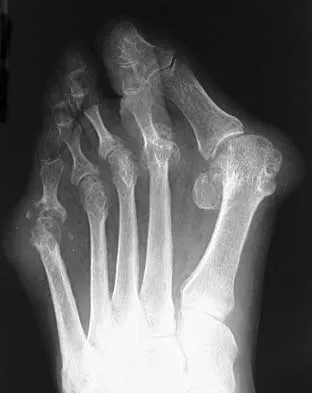
A 47-year-old woman has a painful bunion of the right foot, and shoe wear modifications have failed to provide relief. Examination reveals a severe hallux valgus with dorsal subluxation of the second toe. Radiographs are shown in Figures 14a and 14b. The most appropriate management should include
Explanation
Question 10
What is the most appropriate orthosis for hallux rigidus?
Explanation
Question 11
While experts disagree whether the postpolio syndrome is caused by a reactivation of the dormant virus or by an attritional aging phenomena of muscles that have been overworked over a period of time, both groups recommend which of the following guidelines for optimizing function in this population?
Explanation
Question 12
Figures 15a through 15c show the radiographs of a 23-year-old football player who was injured when another player fell on his flexed and planted foot. He reports severe pain in the midfoot with a feeling of numbness on the dorsum of the foot, and he is unable to bear weight on the limb. Examination reveals mild swelling. Management should consist of
Explanation
Question 13
Which of the following methods best aids in diagnosis of an interdigital neuroma?
Explanation
Question 14
A 58-year-old man has had a 3-year history of recurrent ulcerations of the left ankle and instability despite multiple attempts at custom bracing, contact casting, and surgical debridement. He has an ankle-brachial index of 0.76. A clinical photograph and radiographs are shown in Figures 16a through 16c. Treatment should now consist of
Explanation
Question 15
Figures 17a and 17b show the radiographs of a 32-year-old professional athlete who sustained an injury to the first metatarsal. A view of the opposite noninjured side is shown in Figure 17c. Management of the fracture should consist of
Explanation
Question 16
Which of the following are considered appropriate nonsurgical bracing/orthotic options for a supple adult-acquired flatfoot deformity with forefoot abduction, secondary to posterior tibial tendon insufficiency?
Explanation
Question 17
A 28-year-old man underwent open reduction and internal fixation of a closed, displaced, intra-articular calcaneal fracture 8 weeks ago. Examination now reveals that the lateral wound is red and draining purulent material. Cultures obtained from the wound grow out Staphylococcus aureus. Radiographs show early healing of the fracture. What is the next most appropriate step in management?
Explanation
Question 18
A 37-year-old man with a history of congenital flatfoot reports worsening pain on the medial aspect of his ankle for the past year. The pain is worse with weight bearing and is better with rest and the use of an ankle brace. What findings are shown on the MRI scans shown in Figures 18a through 18c?
Explanation
Question 19
A 60-year-old man reports increasing pain in his right foot with limited ankle dorsiflexion and anterior ankle pain after sustaining a fracture of the calcaneus in a fall several years ago. Bracing, nonsteroidal anti-inflammatory drugs, and cortisone injections have failed to provide significant relief. Radiographs are shown in Figures 19a and 19b. What is the next most appropriate step in management?
Explanation
Question 20
A 58-year-old woman sustained a ruptured Achilles tendon 1 year ago, and management consisted of an ankle-foot orthosis. She now reports increasing difficulty with ambulation and increasing pain. An MRI scan shows a 6-cm defect in the right Achilles tendon. Management should now consist of
Explanation
Question 21
A 29-year-old woman reports dysesthesias and burning after undergoing bunion surgery that consisted of a proximal crescentic first metatarsal osteotomy 6 months ago. Examination reveals a positive Tinel's sign at the proximal aspect of the healed incision. What injured nerve is responsible for her continued symptoms?
Explanation
Question 22
Figure 20 shows the clinical photograph of a man who has had diabetes mellitus controlled with oral medication for the past 10 years. He wears soft-soled shoes and only uses leather-soled shoes for important business meetings. Examination reveals palpable dorsalis pedis and posterior tibial pulses, although they are somewhat diminished. He is insensate to pressure with the Semmes-Weinstein 5.07 monofilament. The ulcer heals after treatment with a full contact cast. What is the best course of action at this time?
Explanation
Question 23
Figures 21a and 21b show the clinical photograph and radiograph of a 15-year-old girl who has a deformity of her feet. Her parents are concerned because there is a family history of Charcot-Marie-Tooth disease. The patient reports some mild instability of the ankle and has noticed mild early callosities; however, she is not having any significant pain. Coleman block testing reveals a forefoot valgus and supple hindfoot. She has weakness to eversion and dorsiflexion. Initial management should consist of
Explanation
Question 24
A 50-year-old woman reports a burning sensation on the plantar aspect of her left forefoot, distal to the metatarsal heads between her third and fourth digits. Palpation of the third web space recreates her symptoms. Which of the following will most accurately aid in confirming a diagnosis?
Explanation
Question 25
A 21-year-old collegiate track athlete increased her training 4 months ago in anticipation of starting the season. Two months into her training program, she reported pain followed by a 1-month history of diffuse pain in the first metatarsophalangeal joint that was aggravated by weight bearing. A removable walker boot partially relieved the pain, and she was able to complete the season. Her pain has now returned; however, she denies any history of injury. Examination reveals tenderness over the medial sesamoid but no deformities. A radiograph and bone scan are shown in Figures 22a and 22b. What is the best treatment option at this time?
Explanation
Question 26
A 24-year-old male presents with bilateral cavovarus foot deformity and reports frequent ankle sprains. Examination shows a plantarflected first ray and weakness in certain muscle groups. In the pathogenesis of a cavovarus foot deformity in Charcot-Marie-Tooth disease, which muscle typically retains its strength and drives the initial plantar flexion of the first ray?
Explanation
Question 27
A 25-year-old athlete sustains a hyperplantarflexion injury to his midfoot. Weight-bearing radiographs show a 3 mm diastasis between the base of the first and second metatarsals. He is diagnosed with a purely ligamentous Lisfranc injury. Which of the following surgical interventions has been shown to result in better functional outcomes and lower rates of hardware removal for a purely ligamentous Lisfranc injury?
Explanation
Question 28
A 65-year-old patient with end-stage post-traumatic ankle osteoarthritis undergoes a total ankle arthroplasty using the standard anterior approach. During the superficial dissection and placement of retractors, which of the following nerves is at greatest risk of iatrogenic injury?
Explanation
Question 29
A 21-year-old collegiate track athlete presents with insidious onset of vague midfoot pain. Plain radiographs are normal, but an MRI confirms a navicular stress fracture extending through the dorsal cortical margin without complete displacement or fragmentation. What is the most appropriate initial management for this patient?
Explanation
Question 30
A 28-year-old professional soccer player sustains an acute, non-displaced fracture at the metaphyseal-diaphyseal junction of the fifth metatarsal during a game. He wishes to return to play as quickly and safely as possible. What is the most appropriate definitive management for this patient to minimize the risk of nonunion and allow early return to sport?
Explanation
Question 31
A 55-year-old female presents with severe pain and stiffness in her first metatarsophalangeal (MTP) joint. Radiographs demonstrate marked dorsal osteophytes, total loss of joint space, and subchondral sclerosis consistent with Coughlin and Shurnas Grade 3 hallux rigidus. Conservative measures have failed. Which of the following surgical procedures is considered the gold standard for long-term pain relief and functional improvement?
Explanation
Question 32
A 45-year-old avid runner presents with posterior heel pain. MRI shows insertional Achilles tendinosis with retrocalcaneal bursitis and a Haglund's deformity. She has failed 6 months of nonoperative management. If surgical intervention is planned, what percentage of the Achilles tendon insertion can typically be detached without requiring augmentation?
Explanation
Question 33
A 23-year-old football player presents with an acute rotational ankle injury. A syndesmotic sprain is suspected. On a standard AP radiograph of the ankle, what is the normal threshold for the tibiofibular clear space, measured 1 cm proximal to the tibial plafond?
Explanation
Question 34
A 30-year-old male is involved in a high-speed motor vehicle collision and sustains a talar neck fracture with subluxation of the subtalar joint and complete dislocation of the tibiotalar joint. The talonavicular joint remains anatomically reduced. According to the Hawkins classification, what type of fracture is this, and what is the approximate risk of avascular necrosis (AVN) of the talar body?
Explanation
Question 35
A 42-year-old construction worker falls from a ladder, sustaining a joint-depressed, intra-articular calcaneus fracture. During an extensile lateral approach for open reduction and internal fixation (ORIF), the surgeon must carefully plan the incision to avoid a nerve that crosses the lateral hindfoot. Which of the following structures is most at risk during flap elevation?
Explanation
Question 36
A 24-year-old male presents with a long-standing history of frequent ankle sprains and progressive foot deformity. Clinical examination reveals a cavovarus foot posture with a positive "peek-a-boo" heel sign. During the Coleman block test, the hindfoot varus corrects completely to neutral. Based on this physical examination finding, which of the following surgical interventions is most appropriate?
Explanation
Question 37
A 45-year-old female undergoes a modified Lapidus procedure (first tarsometatarsal arthrodesis) for a severe hallux valgus deformity. Three months postoperatively, she returns complaining of a new, severe plantar foot pain directly beneath the second metatarsal head. Which of the following technical errors during the index procedure is the most likely cause of her new symptom?
Explanation
Question 38
A 32-year-old male sustains a closed talar neck fracture following a motor vehicle collision. Radiographs demonstrate a displaced fracture of the talar neck with posterior displacement of the talar body, which is extruded from both the subtalar and tibiotalar joints. The talonavicular joint remains reduced. Which of the following vessels provides the primary blood supply to the talar body and is at highest risk of catastrophic disruption in this specific fracture pattern?
Explanation
Question 39
A 55-year-old female presents with medial ankle pain and a progressive flatfoot deformity. Examination demonstrates a flexible hindfoot valgus and inability to perform a single-leg heel raise. Weight-bearing radiographs reveal greater than 40% talonavicular uncoverage and significant forefoot abduction. In addition to a flexor digitorum longus (FDL) to navicular transfer and medializing calcaneal osteotomy, which of the following procedures is indicated to adequately correct her deformity?
Explanation
Question 40
A 22-year-old collegiate football player sustains an axial loading injury to his plantarflexed foot. Weight-bearing radiographs demonstrate subtle widening of the interval between the first and second metatarsal bases, and a "fleck sign" is noted in this space. The ligament represented by this bony avulsion normally originates from which of the following bony structures?
Explanation
Question 41
A 60-year-old male with long-standing, poorly controlled type 2 diabetes presents with a red, hot, swollen right foot. He denies any recent trauma, fever, or open ulcerations. Laboratory studies reveal a normal white blood cell count and a mildly elevated CRP. Radiographs show extensive periarticular fragmentation, subluxation of the tarsometatarsal joints, and bony debris, without definitive signs of osteomyelitis. What is the most appropriate initial management for this condition?
Explanation
Question 42
A 40-year-old roofer falls from a ladder and sustains a displaced intra-articular Sanders Type IIB calcaneus fracture. He is indicated for open reduction and internal fixation via an extensile lateral approach. Which of the following neurovascular structures is at the highest risk of iatrogenic injury during the creation of the full-thickness soft tissue flap, particularly at the superior and anterior aspect of the vertical limb?
Explanation
Question 43
A 38-year-old recreational athlete sustains an acute, closed mid-substance Achilles tendon rupture. After discussing treatment options with his orthopedic surgeon, he elects for non-operative management utilizing an early functional rehabilitation protocol. Compared to open surgical repair, which of the following clinical outcomes is most strongly supported by current Level I evidence for this patient?
Explanation
Question 44
A 26-year-old female presents with an external rotation injury to her right ankle. Weight-bearing radiographs show no fracture, but there is an isolated widening of the medial clear space to 6 mm. An MRI confirms an acute syndesmotic rupture. On a standard radiographic ankle series, which of the following parameters is considered the most reliable indicator of a normal distal tibiofibular syndesmosis?
Explanation
Question 45
A 19-year-old elite collegiate basketball player presents with acute lateral foot pain after landing awkwardly. Radiographs reveal a transverse fracture of the proximal fifth metatarsal at the metaphyseal-diaphyseal junction, extending into the fourth-fifth intermetatarsal articulation. Which of the following is the most appropriate management for this patient to minimize the risk of nonunion and expedite his return to competitive play?
Explanation
Question 46
A 32-year-old male sustains a high-energy motor vehicle accident resulting in a displaced talar neck fracture. Radiographs demonstrate a talar neck fracture with both subtalar and tibiotalar joint dislocation. Based on the Hawkins classification, what is his injury grade and the approximate associated risk of avascular necrosis (AVN) of the talar body?

Explanation
Question 47
A 55-year-old female presents with medial foot pain and a progressive flatfoot deformity. Examination shows a flexible hindfoot valgus and inability to perform a single-leg heel raise. Weight-bearing radiographs demonstrate >40% uncovering of the talonavicular joint. If conservative management fails, which of the following surgical interventions is most appropriate?
Explanation
Question 48
A 45-year-old female presents with a painful bunion. Weight-bearing radiographs reveal a Hallux Valgus Angle (HVA) of 45 degrees, an Intermetatarsal Angle (IMA) of 18 degrees, and clinical hypermobility of the first tarsometatarsal (TMT) joint. Which of the following surgical procedures is most biomechanically appropriate to correct her deformity?
Explanation
Question 49
A 40-year-old roofer falls from a ladder, sustaining a Sanders type III calcaneus fracture. An open reduction and internal fixation via an extensile lateral approach is planned. To minimize the risk of the most common postoperative wound complication associated with this approach, how should the surgical flap be managed?
Explanation
Question 50
A 25-year-old professional athlete sustains a purely ligamentous Lisfranc injury with 3 mm of displacement between the medial cuneiform and second metatarsal base. Based on recent prospective studies evaluating primarily ligamentous Lisfranc injuries, primary arthrodesis compared to open reduction and internal fixation (ORIF) is associated with which of the following?
Explanation
Question 51
A 58-year-old male with poorly controlled type II diabetes presents with a swollen, erythematous, and warm right foot. He denies any trauma. Radiographs reveal periarticular fragmentation, subluxation of the tarsometatarsal joints, and osseous debris. According to the Eichenholtz classification, what stage does this represent, and what is the standard initial treatment?
Explanation
Question 52
A 22-year-old running back sustains an acute hyperextension injury to his great toe. MRI demonstrates a complete tear of the plantar plate with proximal retraction of the sesamoids. Which of the following is an absolute indication for operative repair in this type of injury?
Explanation
Question 53
A 20-year-old collegiate basketball player complains of lateral foot pain for 3 months. Radiographs demonstrate a radiolucent line with cortical hypertrophy distal to the fourth-fifth intermetatarsal articulation in the fifth metatarsal. What is the most appropriate management to ensure the fastest return to play with the lowest risk of nonunion?

Explanation
Question 54
During an open reduction and internal fixation of a bimalleolar equivalent ankle fracture, the surgeon performs an intraoperative Cotton test to evaluate the syndesmosis. Which fluoroscopic measurement objectively indicates syndesmotic instability requiring operative fixation?
Explanation
Question 55
A 42-year-old recreational runner presents with 6 months of posterior ankle pain. Physical exam reveals a palpable, tender nodule 4 cm proximal to the calcaneal insertion of the Achilles tendon. MRI shows fusiform thickening and mucoid degeneration involving >50% of the tendon substance. Conservative treatment has failed. During surgical debridement of the tendinosis, if more than 50% of the tendon is debrided, what is the most appropriate adjunctive procedure to preserve plantarflexion strength?
Explanation
Question 56
A 30-year-old male sustains a high-energy motor vehicle collision resulting in a closed injury to his foot and ankle. Radiographs reveal a displaced fracture of the talar neck with subluxation of the subtalar joint, while the tibiotalar joint remains completely congruent. According to the Hawkins classification, what is the injury type and the approximate associated risk of avascular necrosis (AVN) of the talar body?
Explanation
Question 57
A 55-year-old female presents with progressive, painful flatfoot deformity. Examination reveals a flexible hindfoot valgus and an inability to perform a single-limb heel rise. When viewing the foot from behind, 'too many toes' are visible. Radiographs demonstrate an uncoverage of the talar head of 45%. Which of the following surgical strategies is most appropriate for addressing this specific stage of adult acquired flatfoot deformity?
Explanation
Question 58
A 24-year-old male with a history of Charcot-Marie-Tooth disease presents with a bilateral symptomatic cavovarus foot deformity. During the Coleman block test, the patient's lateral foot and heel are placed on a 1-inch wooden block while the first metatarsal is allowed to hang freely in plantarflexion. During this test, the hindfoot varus completely corrects to neutral. What does this clinical finding indicate regarding the primary driver of the deformity?
Explanation
Question 59
A 22-year-old collegiate football player sustains a hyperplantarflexion injury to his midfoot. Weight-bearing radiographs show a 3 mm diastasis between the base of the first and second metatarsals. CT scan confirms a pure ligamentous Lisfranc injury with no associated osseous fractures. To optimize functional outcomes and minimize the risk of hardware failure or post-traumatic arthritis, which of the following is the most evidence-based surgical treatment?
Explanation
Question 60
A 45-year-old female presents with a painful bunion. Clinical examination demonstrates significant hypermobility of the first tarsometatarsal (TMT) joint in the sagittal plane. Weight-bearing radiographs reveal a hallux valgus angle (HVA) of 42 degrees and an intermetatarsal angle (IMA) of 16 degrees. Which of the following surgical options is most appropriate?
Explanation
Question 61
A 21-year-old elite collegiate basketball player sustains an acute, non-displaced fracture at the metaphyseal-diaphyseal junction of the fifth metatarsal (Zone 2). To facilitate the fastest safe return to play and minimize the risk of delayed union or nonunion, what is the treatment of choice?
Explanation
Question 62
A 58-year-old male with poorly controlled type 2 diabetes and peripheral neuropathy presents with a red, hot, and swollen left foot. He denies any trauma. The skin is intact with no ulceration. Radiographs show osteopenia and early fragmentation of the navicular. To differentiate between acute Charcot neuroarthropathy and osteomyelitis, which of the following nuclear medicine imaging studies is considered the most specific?
Explanation
Question 63
During open reduction and internal fixation of a pronation-external rotation (PER) ankle fracture, a syndesmotic diastasis is confirmed using the intraoperative hook test. When placing a trans-syndesmotic positional screw, which of the following represents the most accurate anatomic and biomechanical principle?
Explanation
Question 64
A 35-year-old male presents with an isolated, complete, and irreversible common peroneal nerve palsy following a traumatic knee dislocation 2 years ago. He has a flexible hindfoot and a passively correctable equinus contracture. Which tendon transfer is considered the gold standard to restore active dorsiflexion and prevent foot drop in this patient?
Explanation
Question 65
A 62-year-old male with end-stage post-traumatic ankle osteoarthritis is being evaluated in the clinic to discuss surgical options, including total ankle arthroplasty (TAA) versus ankle arthrodesis. Which of the following is widely considered an absolute contraindication to Total Ankle Arthroplasty (TAA)?
Explanation
Question 66
A 55-year-old female presents with stage IIB posterior tibial tendon dysfunction. During her surgical reconstruction, a lateral column lengthening is performed in addition to a medializing calcaneal osteotomy and flexor digitorum longus (FDL) transfer. What is the primary biomechanical purpose of the lateral column lengthening in this setting?
Explanation
Question 67
A 32-year-old male undergoes anterior ankle arthroscopy for an osteochondral lesion of the talus. During the establishment of the anterolateral portal, a nerve is inadvertently injured. Which of the following functional deficits is most likely to result from this specific injury?
Explanation
Question 68
A 58-year-old patient with poorly controlled type 2 diabetes presents with a swollen, erythematous, and warm right foot without any open ulcers. Radiographs show periarticular osteopenia and early subluxation of the tarsometatarsal joints. Which of the following MRI findings best differentiates acute Charcot arthropathy from osteomyelitis in this patient?
Explanation
Question 69
A 40-year-old male undergoes open reduction and internal fixation of a displaced intra-articular calcaneus fracture via an extensile lateral approach. At his 6-week follow-up, he is noted to have significant clawing of the lesser toes. What is the most likely cause of this complication?
Explanation
Question 70
A 28-year-old motorcyclist sustains a Hawkins type III talar neck fracture. Which of the following arteries provides the majority of the blood supply to the talar body, placing it at the highest risk for avascular necrosis (AVN) in this injury pattern?
Explanation
Question 71
A 45-year-old female presents with symptomatic hallux valgus that has failed nonoperative management. Weight-bearing radiographs demonstrate an intermetatarsal angle (IMA) of 18 degrees and a hallux valgus angle (HVA) of 42 degrees. There is no evidence of first tarsometatarsal hypermobility or osteoarthritis. Which of the following surgical options is most appropriate?
Explanation
Question 72
A 22-year-old American football player sustains a severe hyperextension injury to his first metatarsophalangeal (MTP) joint. Clinical examination reveals marked ecchymosis, swelling, and plantar tenderness over the joint. MRI confirms a complete rupture of the plantar plate complex with 5 mm proximal retraction of the sesamoids. What is the most appropriate management?
Explanation
Question 73
A 38-year-old recreational athlete sustains an acute Achilles tendon rupture and elects for nonoperative management. Based on recent high-level evidence, which of the following nonoperative protocols is most strongly recommended to minimize the risk of re-rupture while optimizing functional outcome?
Explanation
Question 74
A 24-year-old skier presents with lateral ankle pain and a palpable snapping sensation behind the lateral malleolus after a forced dorsiflexion and eversion injury. On examination, the peroneal tendons subluxate anterior to the posterior cortex of the fibula with resisted ankle eversion. Injury to which of the following anatomic structures is the primary cause of this condition?
Explanation
Question 75
A 27-year-old soccer player sustains an external rotation injury to his ankle. Radiographs show a proximal fibular fracture (Maisonneuve fracture). Intraoperatively, after placing a syndesmotic screw, fluoroscopic evaluation is performed. Which of the following radiographic parameters is considered the most reliable indicator of syndesmotic reduction on a standard AP and Mortise view?
Explanation
Question 76
A 55-year-old poorly controlled diabetic male presents with a red, hot, swollen right foot. Radiographs reveal fragmentation of the navicular and cuneiforms with a collapse of the medial longitudinal arch. Laboratory markers show a normal white blood cell count and a mildly elevated ESR. He is diagnosed with acute Eichenholtz stage I Charcot arthropathy. What is the most appropriate initial management?
Explanation
Question 77
A 45-year-old female presents with progressive foot pain and a bunion deformity. Weight-bearing radiographs show a hallux valgus angle of 45 degrees, an intermetatarsal angle (IMA) of 18 degrees, and evidence of hypermobility at the first tarsometatarsal (TMT) joint. Which of the following surgical interventions is most appropriate to minimize the risk of recurrence?
Explanation
Question 78
A 32-year-old male sustains a severe hyperdorsiflexion injury to his right ankle in a motor vehicle collision. Radiographs reveal a displaced talar neck fracture with subluxation of the subtalar joint, but the ankle mortise and talonavicular joints remain congruent. According to the Hawkins classification, what is the approximate risk of developing avascular necrosis (AVN) of the talar body?
Explanation
Question 79
A 28-year-old professional soccer player sustains a twisting injury to his ankle. Examination reveals tenderness over the anterior inferior tibiofibular ligament (AITFL) and a positive external rotation stress test. Weight-bearing radiographs show widening of the medial clear space and decreased tibiofibular overlap. What is the most reliable intraoperative method to confirm accurate syndesmotic reduction?
Explanation
Question 80
A 22-year-old football player presents with midfoot pain and an inability to bear weight after a competitor fell on his plantarflexed foot. Radiographs show a 2 mm widening between the base of the 1st and 2nd metatarsals. An MRI confirms a complete rupture of the Lisfranc ligament with no associated fractures (purely ligamentous injury). What is the recommended operative treatment to maximize his long-term functional outcome?
Explanation
Question 81
A 40-year-old male sustains an acute, closed midsubstance Achilles tendon rupture. He is treated with functional bracing and an early mobilization rehabilitation protocol. Compared to surgical repair, which of the following statements is true regarding his non-operative management?
Explanation
Question 82
A 45-year-old construction worker falls from a roof and sustains a closed, displaced intra-articular calcaneus fracture (Sanders Type III). He undergoes open reduction and internal fixation via an extensile lateral approach. Which of the following patient factors is the most significant independent predictor for postoperative wound necrosis and deep infection?
Explanation
Question 83
A 14-year-old boy presents with frequent ankle sprains and a rigid, painful flatfoot. Clinical examination demonstrates markedly decreased subtalar motion and peroneal spasticity. Lateral radiographs demonstrate an elongation of the anterior process of the calcaneus, known as the 'anteater sign'. Which condition is most likely present?
Explanation
Question 84
A 60-year-old female presents with medial ankle pain and a progressive flatfoot deformity. She is unable to perform a single-limb heel rise. Weight-bearing radiographs show an uncovered talonavicular joint and plantarflexion of the talus. She is diagnosed with Stage II posterior tibial tendon dysfunction (PTTD). What is the primary functional role of the spring ligament, which is often attenuated in this condition?
Explanation
Question 85
A 24-year-old collegiate athlete presents with severe pain at the base of his great toe after being tackled while his foot was planted and dorsiflexed. Examination reveals exquisite tenderness over the plantar aspect of the first MTP joint, with gross instability on Lachman testing. Fluoroscopy demonstrates proximal migration of the sesamoids compared to the contralateral side. What is the most appropriate management?
Explanation
Question 86
A 45-year-old female presents with pain and medial deviation of her great toe 6 months after a chevron osteotomy and distal soft tissue release for hallux valgus. On physical examination, she has a flexible hallux varus deformity. Radiographs demonstrate a negative intermetatarsal angle and medial subluxation of the first metatarsophalangeal (MTP) joint. Which of the following intraoperative technical errors is most likely responsible for this complication?
Explanation
Question 87
A 35-year-old male is involved in a high-speed motor vehicle collision and sustains a displaced talar neck fracture. Radiographs show a fracture of the talar neck with subluxation of the subtalar joint, while the tibiotalar and talonavicular joints remain concentrically reduced. According to the Hawkins classification, what is the grade of this injury and the approximate historically reported risk of developing avascular necrosis (AVN) of the talar body?
Explanation
Question 88
A 55-year-old female presents with progressive flattening of her left foot, medial arch pain, and an inability to perform a single-leg heel raise. Examination reveals a flexible flatfoot deformity with notable forefoot abduction. Weight-bearing radiographs reveal greater than 40% uncovering of the talonavicular joint on the AP view. Non-operative management has failed. Which of the following surgical strategies is most appropriate?
Explanation
Question 89
A 62-year-old male with poorly controlled type 2 diabetes and profound peripheral neuropathy presents with a swollen, erythematous, and warm right foot. He denies any prior trauma or systemic symptoms. Inflammatory markers are mildly elevated. Radiographs demonstrate periarticular debris, fragmentation of the tarsometatarsal joints, and subluxation, but no soft tissue gas or focal osteomyelitis. Which of the following is the most appropriate initial management?
Explanation
Question 90
A 68-year-old male with end-stage post-traumatic ankle osteoarthritis is being evaluated for surgical management. Which of the following conditions is considered an ABSOLUTE contraindication to performing a total ankle arthroplasty (TAA)?
Explanation
Question 91
A 22-year-old collegiate basketball player sustains a fracture at the metaphyseal-diaphyseal junction of the fifth metatarsal (Zone 2). He is counseled on the high rate of nonunion in this region, which is primarily attributed to a vascular watershed area. This watershed area exists between the metaphyseal blood supply and which of the following arterial structures?
Explanation
Question 92
A 45-year-old distance runner presents with chronic, recalcitrant heel pain. The pain is maximal at the medial aspect of the heel and radiates into the plantar-lateral foot. Physical exam reveals point tenderness over the medial calcaneal tuberosity and pain exacerbation with eversion and dorsiflexion of the ankle. Electromyography (EMG) reveals isolated denervation of the abductor digiti minimi muscle. Entrapment of which of the following nerves is the most likely diagnosis?
Explanation
Question 93
A 21-year-old football player sustains a severe hyperextension injury to his first metatarsophalangeal (MTP) joint. Examination demonstrates gross instability of the joint with dorsal subluxation of the proximal phalanx. Weight-bearing radiographs reveal significant proximal migration of the sesamoid apparatus compared to the uninjured foot. What is the most appropriate management for this injury?
Explanation
Question 94
A 35-year-old construction worker falls from a height and sustains a displaced, joint-depression type intra-articular calcaneus fracture. Surgical fixation is planned via an extensile lateral approach. During the development of the full-thickness flap, which of the following neurologic structures is at greatest risk of iatrogenic injury?
Explanation
Question 95
A 40-year-old recreational athlete sustains an acute, complete mid-substance rupture of the Achilles tendon. He is discussing operative versus non-operative management with his surgeon. Based on recent high-level randomized controlled trials and meta-analyses, which of the following statements is true regarding non-operative management utilizing an early functional rehabilitation protocol compared to surgical repair?
Explanation
Question 96
A 55-year-old patient with long-standing, poorly controlled diabetes mellitus presents with a unilaterally swollen, warm, and erythematous right foot. The patient denies any trauma and has no open wounds or ulcers. Pedal pulses are bounding. Plain radiographs demonstrate periarticular fragmentation, debris, and subluxation at the tarsometatarsal joints. Laboratory markers including CRP and ESR are mildly elevated. What is the most appropriate initial management for this condition?
Explanation
Question 97
A 24-year-old rugby player sustains an axial load injury to a plantarflexed foot. Weight-bearing radiographs reveal 2.5 mm of diastasis between the bases of the first and second metatarsals. What is the precise anatomic origin and insertion of the primary ligamentous structure disrupted in this injury?
Explanation
Question 98
A 28-year-old male sustains a Hawkins Type II fracture of the talar neck and is treated with open reduction and internal fixation. He returns to the clinic for an 8-week postoperative follow-up. Which of the following radiographic findings reliably indicates that the talar body has a sufficient vascular supply and is unlikely to develop avascular necrosis?
Explanation
Question 99
During a reconstructive procedure for a flexible stage II adult acquired flatfoot deformity (posterior tibial tendon dysfunction), the surgeon evaluates the primary static stabilizer of the talonavicular joint. Attenuation of this structure is a major contributor to the classic 'too many toes' sign. What is the most critical anatomical component of this stabilizing complex?
Explanation
Question 100
A 22-year-old professional running back sustains a hyperextension injury to his first metatarsophalangeal (MTP) joint during a game. Clinical examination reveals marked ecchymosis, swelling, a palpable gap, and localized plantar tenderness. MRI confirms a complete tear of the plantar plate with proximal retraction of the sesamoids. What is the most appropriate definitive management for this injury in an elite athlete?
Explanation
None
