Sprengel's Deformity: Pathogenesis, Omovertebral Bone & Associated Syndromes | Part 33

Key Takeaway
Sprengel's deformity is a congenital abnormal elevation of one or both scapulas, often associated with Klippel-Feil syndrome, congenital scoliosis, and an omovertebral bone. Its pathogenesis involves failure of scapular descent due to intrauterine pressure or defective muscular tension, leading to characteristic upward and forward scapular displacement and smaller size.
Question 1
A 9-year-old boy with Sprengel's deformity undergoes a comprehensive radiographic evaluation. The anteroposterior radiograph of the cervicothoracic spine reveals a high standing scapula and associated vertebral anomalies. Which of the following syndromes is commonly associated with Sprengel's deformity and characterized by cervical vertebral fusion?

View Answer & Explanation
Correct Answer: C
Rationale: Figure 13.5 description lists "Klippel–Feil’s syndrome" as one of the most common associated malformations. Options A, B, D, and E are not listed as commonly associated with Sprengel's deformity in the provided text. The main distractor, A, is a connective tissue disorder not directly linked here.
Question 2
A newborn is diagnosed with Sprengel's deformity. The parents are concerned about the etiology. One theory for the failure of scapular descent suggests an environmental factor during gestation. Which of the following is proposed as a potential cause related to intrauterine pressure?
View Answer & Explanation
Correct Answer: C
Rationale: The text states that failure of descent can be caused by "great intrauterine pressure, due to either an increased or a diminished amount of amniotic fluid." Options A, B, D, and E are not mentioned as specific causes of intrauterine pressure leading to Sprengel's deformity in the provided text. The main distractor, E, is a general cause of congenital anomalies but not specifically linked to intrauterine pressure in this context.
Question 3
A 7-year-old female presents with a congenital high left scapula. On physical examination, the affected scapula is noted to be elevated and rotated. What other characteristic regarding the size of the affected scapula is often observed?
View Answer & Explanation
Correct Answer: B
Rationale: Figure 13.3 description states, "The left scapula is elevated, and its size is smaller than that at the opposite side." Options A, C, D, and E contradict this observation. The main distractor, A, is the opposite of the correct finding.
Question 4
A 5-year-old male with Sprengel's deformity is found to have an omovertebral bone. Histologically, what is the typical composition of this trapezoid-shaped structure?
View Answer & Explanation
Correct Answer: C
Rationale: The text describes the omovertebral bone as a "trapezoid-shaped structure of cartilage or bone." Options A, B, D, and E are incorrect compositions. The main distractor, A, is only one possible component if it's a fibrous band, but the structure itself is described as cartilage or bone.
Question 5
A 6-year-old girl with Sprengel's deformity undergoes a skeletal survey. In addition to the elevated scapula, the radiologist notes anomalies in the thoracic rib cage. Which of the following rib anomalies is commonly associated with Sprengel's deformity?
View Answer & Explanation
Correct Answer: C
Rationale: Figure 13.5 description lists "absent or fused ribs" as one of the most common anomalies in the thoracic rib cage associated with Sprengel's deformity. Options A, B, D, and E are either unrelated conditions or not specifically listed as common associations in the provided text. The main distractor, B, is a chest wall deformity but not specifically listed as a common rib anomaly.
Question 6
A pediatrician refers a 1-year-old infant for evaluation of Sprengel's deformity. The definition of this condition includes the abnormal elevation of which scapulas?
View Answer & Explanation
Correct Answer: D
Rationale: The definition states, "Sprengel’s deformity... is defined as a congenital abnormal elevation of one or both scapulas." Options A, B, C, and E are too restrictive or incorrect. The main distractor, C, is partially correct but misses the possibility of bilateral involvement.
Question 7
A 4-year-old boy presents with a congenital high scapula. Besides the theory of failure of descent, another possible etiology for the changes in scapular shape and size is proposed. What is this alternative theory?
View Answer & Explanation
Correct Answer: B
Rationale: The text states, "Second possible etiology is that the changes in the shape and size of the scapula are an arrest of development due to improper or defective muscular tension." Options A, C, D, and E are not mentioned as etiologies in the provided text. The main distractor, A, is a general cause of bone anomalies but not specifically mentioned here.
Question 8
A 8-year-old female is brought to the clinic due to her parents noticing a difference in her shoulder appearance. On examination, the most striking clinical finding is the asymmetry of the shoulders. What is the primary cause of this asymmetry in Sprengel's deformity?
View Answer & Explanation
Correct Answer: C
Rationale: Figure 13.3 description states, "The asymmetry of the shoulder is caused by the upward and forward displacement of the scapula." Options A, B, D, and E are either unrelated conditions or not the primary cause of shoulder asymmetry in Sprengel's deformity as described. The main distractor, D, can be an associated anomaly but is not the direct cause of the shoulder asymmetry itself.
Question 9
A 3-year-old male with Sprengel's deformity has an omovertebral bone connecting his scapula to his cervical spine. This connection can manifest in several ways. Which of the following is NOT described as a possible type of union for the omovertebral bone?
View Answer & Explanation
Correct Answer: D
Rationale: The text states the omovertebral bone "may be attached to the vertebral border of the scapula in a number of ways: by bony continuity, by cartilaginous union, or by a fibrous band." Muscular attachment is not listed as a type of union for the omovertebral bone itself. The main distractor, E, is incorrect because muscular attachment is not listed.
Question 10
A 12-year-old girl with Sprengel's deformity undergoes an MRI of her spine due to neurological concerns. The imaging reveals an associated malformation of the cervical vertebrae. Which of the following congenital spinal anomalies is specifically mentioned as an associated malformation?
View Answer & Explanation
Correct Answer: C
Rationale: Figure 13.5 description lists "cervical spina bifida" as one of the common associated malformations. Options A, B, D, and E are either unrelated conditions or not specifically listed as common associations in the provided text. The main distractor, E, is a known cervical spine issue but not explicitly listed here.
Question 11
A 6-month-old infant is diagnosed with Sprengel's deformity. The two primary possibilities for the pathogenesis of this deformity are generally categorized as a failure of descent or which other developmental issue?
View Answer & Explanation
Correct Answer: C
Rationale: The text outlines two main possibilities for pathogenesis: "first, that it is a failure of descent" and "Second possible etiology is that the changes in the shape and size of the scapula are an arrest of development due to improper or defective muscular tension." Options A, B, D, and E are not described as primary pathogenic theories in the provided text. The main distractor, D, is a general genetic concept but not the specific mechanism described.
Question 12
A 5-year-old boy presents with a congenital high scapula on his right side. Clinical examination confirms the diagnosis of Sprengel's deformity. In addition to elevation, what is the characteristic direction of displacement of the scapula?
View Answer & Explanation
Correct Answer: B
Rationale: Figure 13.3 description states, "The asymmetry of the shoulder is caused by the upward and forward displacement of the scapula." Options A, C, D, and E describe incorrect displacement directions. The main distractor, D, gets the upward component correct but the anterior-posterior incorrect.
Question 13
A 7-year-old female with Sprengel's deformity is undergoing a thorough evaluation for associated anomalies. Radiographs reveal a high standing scapula and other malformations. Which of the following is listed as a common associated anomaly affecting the chest wall?
View Answer & Explanation
Correct Answer: B
Rationale: Figure 13.5 description lists "chest-wall asymmetry" as one of the most common associated malformations. Options A, C, D, and E are either unrelated conditions or not specifically listed as common associations in the provided text. The main distractor, A, is a chest wall deformity but not specifically mentioned as a common association here.
Question 14
A 4-year-old girl presents with her parents due to noticeable asymmetry of her shoulders. On physical examination, the left shoulder appears elevated and displaced anteriorly compared to the right. Radiographs confirm a high-standing left scapula. This condition is best described as a congenital abnormal elevation of the scapula.
View Answer & Explanation
Correct Answer: C
Rationale: Sprengel's deformity is defined as a congenital abnormal elevation of one or both scapulas from the normal anatomic position, precisely matching the clinical presentation. Winged scapula involves prominence of the medial border, not necessarily elevation. Scapulothoracic dissociation is a traumatic injury. Klippel-Feil syndrome is an associated condition, not the primary scapular deformity itself. Pectoralis major agenesis affects the chest wall and shoulder contour but not primarily scapular elevation.
Question 15
A 6-year-old boy is diagnosed with Sprengel's deformity of the right shoulder. His parents inquire about other potential health issues. Which of the following statements regarding associated anomalies is most accurate for Sprengel's deformity?
View Answer & Explanation
Correct Answer: C
Rationale: The clinical text explicitly states that Sprengel's deformity "is often associated with other anomalies of the skeletal system and other organs." This makes option C the most accurate. Options A, B, D, and E contradict this fundamental characteristic of the deformity.
Question 16
A 3-year-old girl presents with a congenitally elevated left scapula. During a discussion about the possible causes of Sprengel's deformity, the orthopedic surgeon explains various pathogenic theories. Which of the following is considered a possible mechanism for the failure of scapular descent?
View Answer & Explanation
Correct Answer: C
Rationale: One of the possibilities for the pathogenesis of Sprengel's deformity is a failure of descent caused by "great intrauterine pressure, due to either an increased or a diminished amount of amniotic fluid." Options A, B, D, and E are not described as pathogenic mechanisms in the provided text.
Question 17
A 7-year-old boy with Sprengel's deformity undergoes a comprehensive evaluation. The orthopedic surgeon suspects the presence of an omovertebral bone. What is the approximate prevalence of an omovertebral bone in patients with Sprengel's deformity?
View Answer & Explanation
Correct Answer: B
Rationale: The clinical text states, "One third of patients has omovertebral bone." This makes option B the correct answer. The omovertebral bone is a significant associated anomaly, but not universally present.
Question 18
A 5-year-old girl with Sprengel's deformity is found to have an omovertebral bone on advanced imaging. Her parents ask about the nature of this structure. Which of the following best describes the typical composition and shape of an omovertebral bone?
View Answer & Explanation
Correct Answer: C
Rationale: The text describes the omovertebral bone as a "trapezoid-shaped structure of cartilage or bone." This directly matches option C. Other options describe different shapes or compositions not consistent with the provided information.
Question 19
A 10-year-old boy with Sprengel's deformity is being evaluated for surgical correction. Preoperative imaging reveals an omovertebral bone. From which part of the scapula does the omovertebral bone typically originate?
View Answer & Explanation
Correct Answer: C
Rationale: The text states that the omovertebral bone "extends from the superomedial border of the scapula." This makes option C the correct origin point. The other options are incorrect anatomical locations for its origin.
Question 20
A 6-year-old girl with Sprengel's deformity has an omovertebral bone identified on MRI. This structure connects the scapula to which of the following vertebral column elements?
View Answer & Explanation
Correct Answer: D
Rationale: The text specifies that the omovertebral bone extends "to the spinous processes, lamina, or transverse processes of the cervical spine." This directly corresponds to option D. The other options refer to incorrect vertebral regions or structures.
Question 21
A 4-year-old boy presents with a congenitally elevated right scapula and limited shoulder abduction. Imaging confirms Sprengel's deformity and an omovertebral bone. Which cervical vertebral levels are most commonly associated with the attachment of the omovertebral bone?
View Answer & Explanation
Correct Answer: B
Rationale: The text states that the omovertebral bone attaches to the cervical spine, "most commonly the fourth to seventh cervical vertebrae (C4-C7)." This makes option B the correct answer. The other options refer to incorrect cervical or thoracic levels.
Question 22
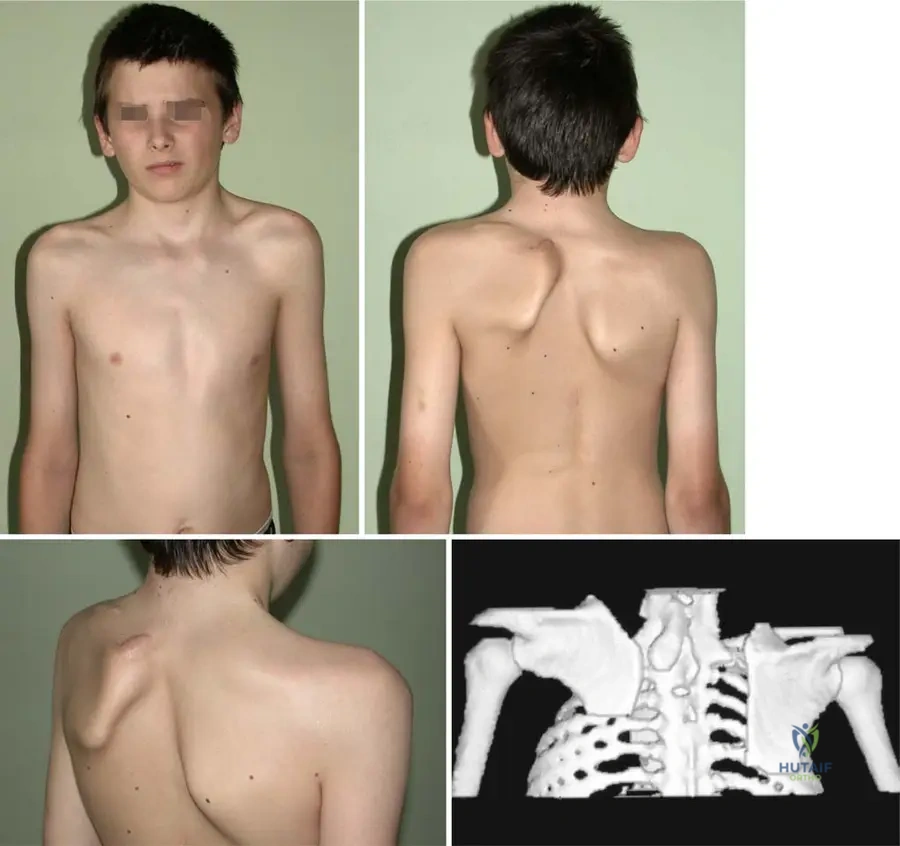
A 5-year-old girl is brought to the clinic due to a noticeable asymmetry of her shoulders. Physical examination reveals an elevated left scapula. The provided image further illustrates the typical displacement seen in this condition.
View Answer & Explanation
Correct Answer: B
Rationale: The clinical context for Fig. 13.3 states, "The asymmetry of the shoulder is caused by the upward and forward displacement of the scapula." This directly matches option B. The image itself visually supports this description of the elevated and anteriorly positioned scapula.
Question 23
A 7-year-old boy presents with a congenitally high right scapula. On examination, the affected scapula appears different in size compared to the contralateral side. Which of the following statements accurately describes the typical size of the affected scapula in Sprengel's deformity?
View Answer & Explanation
Correct Answer: B
Rationale: The clinical context for Fig. 13.3 states, "The left scapula is elevated, and its size is smaller than that at the opposite side." This directly supports option B. The image visually depicts the affected scapula appearing smaller.
Question 24
A 4-year-old girl is diagnosed with Sprengel's deformity of the left shoulder. Clinical examination and imaging reveal not only elevation but also a characteristic rotational deformity of the scapula. How is the scapula typically rotated in this condition?
View Answer & Explanation
Correct Answer: A
Rationale: The clinical context for Fig. 13.3 states, "The scapula is rotated about the sagittal axis, bringing the upper medial angle away from the spinal column and the lower angle close to it." This description perfectly matches option A. The image helps visualize this rotational component.
Question 25
A 2-year-old boy is evaluated for Sprengel's deformity. His parents are concerned about the underlying cause. Among the proposed pathogenic mechanisms related to muscle function, which of the following is considered a possibility for the failure of scapular descent?
View Answer & Explanation
Correct Answer: C
Rationale: The text lists "a defective musculature, unable to draw the scapula caudally" as a possible cause for the failure of descent. This directly supports option C. The other options are not mentioned as pathogenic mechanisms in the provided text.
Question 26
A 9-year-old girl with Sprengel's deformity is being discussed in a multidisciplinary conference. One of the proposed etiologies for the changes in scapular shape and size is an arrest of development. What is this arrest of development primarily attributed to?
View Answer & Explanation
Correct Answer: B
Rationale: The text states, "Second possible etiology is that the changes in the shape and size of the scapula are an arrest of development due to improper or defective muscular tension." This directly matches option B. The other options are not mentioned as etiologies in the provided text.
Question 27
A 6-year-old boy with Sprengel's deformity is undergoing a workup for associated anomalies. Radiographs of the spine are obtained. Which of the following cervicothoracic vertebral anomalies is commonly associated with Sprengel's deformity?
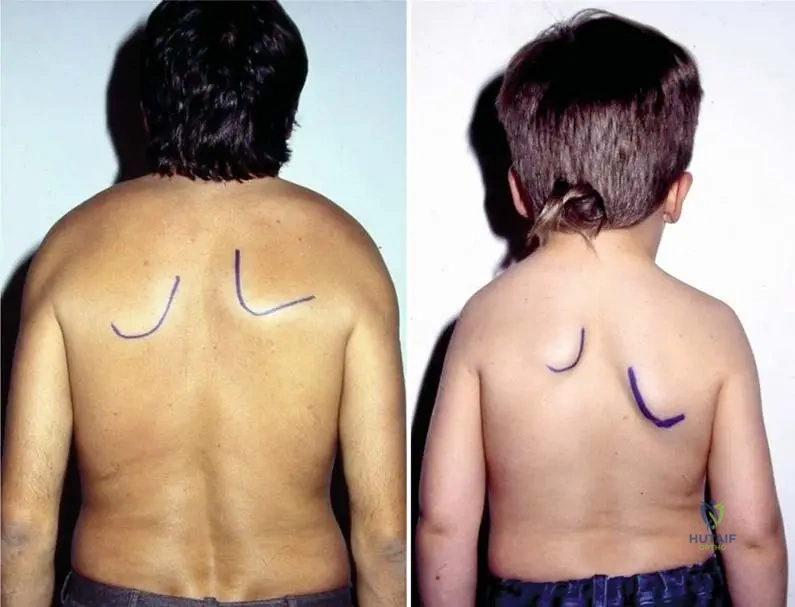
View Answer & Explanation
Correct Answer: C
Rationale: The clinical context for Fig. 13.5 lists "Klippel–Feil’s syndrome" as one of the most common associated anomalies involving the cervicothoracic vertebrae. The other options are either not listed as common associations or are not primarily cervicothoracic vertebral anomalies in this context.
Question 28
A 3-year-old girl with Sprengel's deformity is being evaluated for potential associated malformations. Her chest wall appears somewhat asymmetric. Which of the following thoracic rib cage anomalies is frequently observed in patients with Sprengel's deformity?
View Answer & Explanation
Correct Answer: B
Rationale: The clinical context for Fig. 13.5 explicitly states, "The most common anomalies are absent or fused ribs, chest-wall asymmetry..." This directly supports option B. The other options are not listed as common associated thoracic rib cage anomalies in the provided text.
Question 29
A 7-year-old boy with Sprengel's deformity is noted to have a short neck and restricted cervical range of motion. Radiographs reveal congenital fusion of multiple cervical vertebrae. This specific constellation of findings is most consistent with which associated syndrome?
View Answer & Explanation
Correct Answer: C
Rationale: The clinical context for Fig. 13.5 lists "Klippel–Feil’s syndrome" as a common associated malformation. Klippel-Feil syndrome is characterized by congenital fusion of two or more cervical vertebrae, leading to a short neck and restricted motion, which aligns with the vignette. The other syndromes are not specifically listed as common associations with Sprengel's deformity in the text.
Question 30
A 12-year-old girl with Sprengel's deformity presents for follow-up. Her physical examination reveals a noticeable lateral curvature of her spine. Radiographic evaluation confirms a spinal deformity. Which of the following spinal conditions is commonly associated with Sprengel's deformity?
View Answer & Explanation
Correct Answer: B
Rationale: The clinical context for Fig. 13.5 lists "congenital scoliosis" as one of the most common associated malformations. The vignette describes a lateral curvature of the spine, which is characteristic of scoliosis. The other options are not listed as common associations with Sprengel's deformity in the provided text.
Question 31
A 5-year-old boy with Sprengel's deformity is undergoing a comprehensive evaluation. Imaging of his spine reveals a defect in the posterior elements of the cervical vertebrae. Which of the following specific spinal anomalies is listed as a common association with Sprengel's deformity?
View Answer & Explanation
Correct Answer: B
Rationale: The clinical context for Fig. 13.5 lists "cervical spina bifida" as one of the most common associated malformations. Spina bifida involves a defect in the posterior elements of the vertebrae. The other options are not listed as common associations with Sprengel's deformity in the provided text.
Question 32
A 4-year-old girl presents with her parents who are concerned about the appearance of her shoulders. On examination, the left shoulder is visibly higher than the right, and the scapula appears to be positioned more anteriorly. This overall presentation of shoulder asymmetry is a hallmark of Sprengel's deformity.
View Answer & Explanation
Correct Answer: B
Rationale: The clinical context for Fig. 13.3 states, "The asymmetry of the shoulder is caused by the upward and forward displacement of the scapula." This directly translates to the affected shoulder appearing higher and more anterior, matching option B. The image visually confirms this characteristic asymmetry.
