AAOS Foot & Ankle MCQs (Set 1): Fractures, Deformities & Sports Injuries | Board Prep
Key Takeaway
This high-yield question set for AAOS/ABOS exams focuses on Foot & Ankle Orthopedics. Topics include diagnosis and management of common foot and ankle fractures (e.g., calcaneus, talus, metatarsals), ligamentous injuries, congenital and acquired deformities, and various sports-related pathologies. Ideal for board preparation.
AAOS Foot & Ankle MCQs (Set 1): Fractures, Deformities & Sports Injuries | Board Prep
Comprehensive 100-Question Exam
00:00
Start Quiz
Question 1
The main advantage of surgical repair of an acute Achilles tendon rupture, when compared with nonsurgical management, is reduced
Explanation
Question 2
A 25-year-old farm worker sustained a grade III open fracture of the midshaft of the left tibia after falling from a ladder. Which of the following antibiotic regimens is best for this patient?
Explanation
Question 3
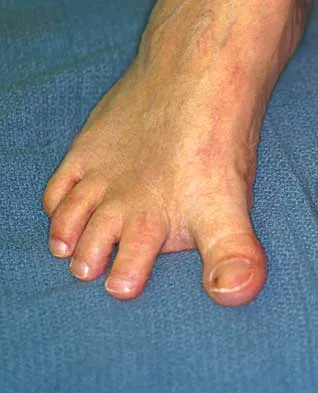
A 60-year-old man reports that he has had shoe pressure pain over his right great toe for several years but has minimal discomfort when barefoot or in sandals. A clinical photograph and radiographs are shown in Figures 1a through 1c. Management should consist of
Explanation
Question 4
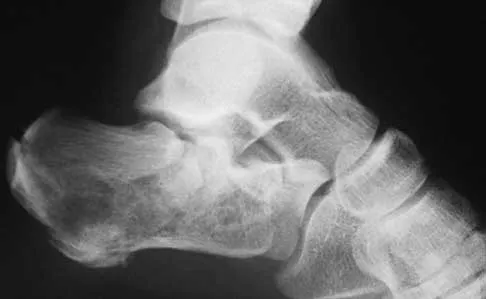
A 45-year-old man is seeking evaluation of an injury sustained in a motor vehicle accident 10 weeks ago. Current radiographs are shown in Figures 2a and 2b. Based on the radiographic findings, what is the most likely diagnosis?
Explanation
Question 5
A 28-year-old woman who is training for the New York Marathon reports pain in the posteromedial aspect of her right ankle. Examination reveals tenderness just posterior to the medial malleolus. Radiographs are normal. An MRI scan is shown in Figure 3. What is the most likely diagnosis?
Explanation
Question 6
A 50-year-old laborer sustained an isolated closed injury to his heel after falling 11 feet off a wall. A radiograph and a CT scan are shown in Figures 4a and 4b. To minimize the patient's temporary disability and allow him to return to work most rapidly, management should consist of
Explanation
Question 7
Figures 5a and 5b show the clinical photograph and radiograph of a patient who has difficulty wearing shoes and has persistent symptoms medially and laterally at the first and fifth metatarsophalangeal joints. Because shoe modifications have failed to provide relief, management should now consist of
Explanation
Question 8
What is the most appropriate orthotic management for the lesion shown in Figure 6?
Explanation
Question 9
Examination of a 45-year-old man with Charcot-Marie-Tooth disease reveals a cavus foot, a tight Achilles tendon, and forefoot callus formation. Radiographs reveal advanced degenerative changes in the hindfoot. Shoe wear modifications have failed to provide relief. Treatment should now consist of
Explanation
Question 10
A Canale view best visualizes which of the following structures?
Explanation
Question 11
A 45-year-old woman with a long-standing history of diabetes mellitus has a large draining plantar ulcer of the right foot. Examination reveals some local cellulitis and erythema surrounding the ulcer. A clinical photograph is shown in Figure 7. Based on these findings, what is the most appropriate antibiotic?
Explanation
Question 12
A 35-year-old man reports forefoot pain with weight-bearing activities. He reports that he has had high arches since adolescence but has never been treated. Examination reveals stiff cavus feet. He has no plantar callus or hammer toe formation. The ankle can be passively dorsiflexed 10 degrees. Initial management should consist of
Explanation
Question 13
A 70-year-old woman had poliomyelitis as a young child, and the residual weakness she has as an adult principally involves the lower extremities. She now notes progressive weakness in both legs and she tires easily. What is the best course of action?
Explanation
Question 14
A patient with Charcot-Marie-Tooth disease has a progressively rigid cavovarus foot deformity. The patient states that the pain is restricted to the forefoot, where rigid claw toe deformities have developed. Which of the following structures is primarily involved in creation of a claw toe deformity?
Explanation
Question 15
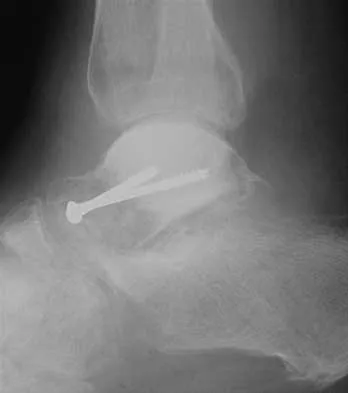
A 45-year-old man who underwent an ankle arthrodesis reports that for the first 6 years he had significant pain relief after the fusion healed. However, he now has increasing pain in the sinus tarsi. AP and lateral radiographs are shown in Figures 8a and 8b. What is the most likely cause of the patient's symptoms?
Explanation
Question 16
What is the most common surgical cause of the foot deformity shown in Figure 9?
Explanation
Question 17
What is the reported failure rate for surgical treatment of a Morton's neuroma?
Explanation
Question 18
A 35-year-old woman who runs long distance has had posterior calf tenderness for the past 3 months. A clinical photograph is shown in Figure 10a, and MRI scans are shown in Figures 10b and 10c. Management at this point should consist of
Explanation
Question 19
A 35-year-old laborer who sustained a forefoot injury 10 years ago has returned to work but reports a progressively painful deformity of the hallux and continued midfoot pain that is aggravated by weight-bearing activities. Shoe wear modifications have failed to provide relief. Direct palpation reveals no pain at the first metatarsocuneiform joint. A radiograph is shown in Figure 11. What is the next most appropriate step in management?
Explanation
Question 20
The use of posting (a wedge added to the medial or lateral side of an insole) is useful to balance forefoot or hindfoot malalignment. Assuming normal subtalar joint pronation, what is the maximum amount of recommended hindfoot posting?
Explanation
Question 21
A 40-year-old woman has a symptomatic mass on the anterior aspect of the ankle. She reports no constitutional symptoms. An MRI scan is shown in Figure 12. What is the most likely diagnosis?
Explanation
Question 22
A 35-year-old woman who is training for a triathlon has had a 2-month history of heel pain with weight bearing and is unable to run. History reveals that she is amenorrheic. Examination reveals that she is thin and has pain over the heel that is exacerbated with medial and lateral compression. Range of motion and motor and sensory function are normal. Radiographs are normal. What is the most likely diagnosis?
Explanation
Question 23
A 28-year-old woman has a moderate hallux valgus deformity and a prominence of the medial eminence. She can participate in all activities and reports that she could wear 3-inch heels in the past, but she now notes medial eminence pain even while wearing a soft leather flat shoe with a cushioned sole. She requests recommendations regarding surgical correction. Examination reveals a 1-2 intermetatarsal angle of 10 degrees. A clinical photograph and radiograph are shown in Figures 13a and 13b. What is the best course of action?
Explanation
Question 24
A 20-year-old woman has lateral foot and ankle pain after sustaining an inversion injury of the ankle while playing soccer 3 months ago. Activity modifications and physical therapy have failed to provide relief. She describes burning pain that extends from the anterior aspect of the ankle to the foot and lateral two toes. The pain is often worse at night. Plain radiographs, a bone scan, and an MRI scan are normal. Stress examination reveals no instability. What is the most likely diagnosis?
Explanation
Question 25
A 35-year-old runner has pain beneath the second metatarsophalangeal joint. He reports that he has significantly decreased his running distance since the onset of the pain. He denies any history of trauma or injury to the foot. A radiograph is shown in Figure 14. Initial management should consist of
Explanation
Question 26
A 24-year-old football player sustains a hyperplantarflexion injury to his midfoot. Weight-bearing radiographs reveal a 3 mm diastasis between the base of the first and second metatarsals. What is the most appropriate definitive management?
Explanation
Question 27
A 55-year-old woman complains of painful bunions. Examination reveals a hallux valgus angle (HVA) of 45 degrees, an intermetatarsal angle (IMA) of 18 degrees, and hypermobility of the first tarsometatarsal (TMT) joint. Which of the following procedures is most appropriate?
Explanation
Question 28
A 21-year-old collegiate basketball player sustains an acute fifth metatarsal fracture in the metaphyseal-diaphyseal junction (Zone 2). To minimize the risk of nonunion and expedite return to play, what is the best treatment?
Explanation
Question 29
A 30-year-old man falls from a height and sustains a Hawkins Type III talar neck fracture. This fracture pattern involves displacement of the talar neck with subluxation or dislocation of which joints?
Explanation
Question 30
A 58-year-old patient with poorly controlled type 2 diabetes presents with a red, hot, swollen right foot. There is no history of trauma or open wounds. Radiographs show periarticular debris, joint subluxation, and fragmentation of the midfoot. What is the most appropriate initial management?
Explanation
Question 31
A 40-year-old recreational tennis player feels a 'pop' in his posterior ankle. Examination shows a positive Thompson test. If he elects for non-operative management with early functional rehabilitation, he should be counseled that compared to surgical repair, he has a:
Explanation
Question 32
A 24-year-old athlete sustains a midfoot injury after an axial load was applied to his plantarflexed foot. Weight-bearing radiographs reveal a 3 mm diastasis between the base of the first and second metatarsals, alongside a "fleck sign". Which of the following is the most common mechanism for this specific injury pattern?
Explanation
Question 33
When comparing functional rehabilitation protocols to open surgical repair for the management of an acute Achilles tendon rupture, recent randomized controlled trials demonstrate which of the following regarding functional non-operative management?
Explanation
Question 34
A 28-year-old football player sustains a high ankle sprain. A positive stress radiograph confirms a syndesmotic injury. During surgical repair, an understanding of the syndesmotic anatomy is critical. Which of the following ligaments provides the greatest structural strength and primary stabilization to the distal tibiofibular syndesmosis?
Explanation
Question 35
A 35-year-old man sustains a Hawkins type II fracture of the talar neck after a motor vehicle collision. By definition, a Hawkins type II talar neck fracture is characterized by displacement and subluxation or dislocation at which of the following articulations?
Explanation
Question 36
A 45-year-old woman presents with painful bilateral bunions. Examination reveals significant hypermobility of the first tarsometatarsal (TMT) joint. Weight-bearing radiographs show a hallux valgus angle (HVA) of 38 degrees and an intermetatarsal angle (IMA) of 16 degrees. Which of the following is the most appropriate surgical intervention?
Explanation
Question 37
A 55-year-old woman with stage IIb adult-acquired flatfoot deformity (posterior tibial tendon dysfunction) presents for surgical evaluation. She has a flexible flatfoot, inability to perform a single heel rise, and >40% uncovering of the talonavicular joint indicating substantial forefoot abduction. Which of the following is the most appropriate combination of surgical procedures?
Explanation
Question 38
A 40-year-old construction worker falls from a ladder and sustains an isolated tongue-type calcaneus fracture. Clinical examination reveals severe posterior skin tenting and blanching with impending tissue necrosis.
What is the most urgent step in management?
Explanation
Question 39
A 60-year-old patient with poorly controlled type 2 diabetes presents with a unilaterally swollen, red, and warm foot without any open ulceration or history of trauma. Radiographs reveal fragmentation and periarticular debris around the tarsometatarsal joints.
What is the gold standard initial management?
Explanation
Question 40
A 22-year-old alpine skier reports a painful "snapping" sensation behind his lateral malleolus during a run. Examination reveals swelling and tenderness posterior to the lateral malleolus, with visible subluxation of tendons upon resisted foot eversion. Which retinacular structure is most likely disrupted?
Explanation
Question 41
A 45-year-old woman complains of burning pain in the third web space of her foot, which radiates into her toes. A "click" is palpated when compressing the metatarsal heads together (Mulder's sign). She has failed conservative management. When proceeding with surgical excision, what is the primary advantage of a dorsal approach over a plantar approach?
Explanation
Question 42
A 21-year-old collegiate basketball player sustains a fracture at the metaphyseal-diaphyseal junction of the fifth metatarsal (Zone 2) during practice. To optimize his return to play and minimize the risk of nonunion, what is the most appropriate management strategy?
Explanation
Question 43
A 30-year-old runner presents with deep, aching ankle pain 6 months after a severe ankle sprain. MRI confirms an osteochondral lesion on the posteromedial aspect of the talar dome. Based on classic descriptions of injury mechanics, this specific lesion is most commonly caused by which of the following mechanisms?
Explanation
Question 44
A professional American football player sustains a severe hyperextension injury to his great toe. MRI demonstrates a complete rupture of the plantar plate from the base of the proximal phalanx, with dorsal subluxation of the MTP joint. What grade is this injury, and what is the standard recommended treatment for an elite athlete?
Explanation
Question 45
A patient presents with burning and tingling on the plantar aspect of the foot, which worsens at night. Tinel's sign is positive over the posteromedial ankle. Tarsal tunnel syndrome is suspected. This syndrome is caused by entrapment of which nerve beneath which anatomic structure?
Explanation
Question 46
A 14-year-old boy presents with bilateral cavovarus feet. A Coleman block test is performed by placing his heel and lateral border of the foot on a block, allowing the first metatarsal to hang free. Upon doing so, his hindfoot varus corrects to neutral. What does this test result indicate regarding his deformity?
Explanation
Question 47
A 68-year-old man with end-stage post-traumatic ankle arthritis is discussing surgical options with his orthopedic surgeon. He is considering a total ankle arthroplasty (TAA) versus an ankle arthrodesis. Which of the following conditions is considered an absolute contraindication to performing a total ankle arthroplasty?
Explanation
Question 48
A 22-year-old football player sustains a hyperplantarflexion injury to his midfoot. Weight-bearing radiographs demonstrate a 2 mm diastasis between the base of the first and second metatarsals, with a 'fleck sign' present. What is the most appropriate management?
Explanation
Question 49
A 22-year-old collegiate football player sustains a high-energy axial load injury to his plantarflexed foot. Weight-bearing radiographs and MRI confirm a purely ligamentous Lisfranc injury with 3 mm of widening between the medial and middle cuneiforms. What is the most appropriate surgical management to minimize the risk of long-term disability and reoperation?
Explanation
Question 50
A 35-year-old man sustains a Hawkins Type III talar neck fracture following a motor vehicle collision. Which of the following blood vessels, which provides the dominant blood supply to the talar body, is most likely disrupted in this injury?
Explanation
Question 51
A 45-year-old woman presents with a symptomatic hallux valgus deformity. Clinical examination reveals profound hypermobility of the first tarsometatarsal (TMT) joint. Which of the following surgical procedures is most appropriate to address both the deformity and the underlying pathomechanics?
Explanation
Question 52
A 28-year-old aggressive skier experiences a sudden "pop" behind her lateral malleolus while aggressively edging. She now reports a painful snapping sensation over the lateral ankle with active dorsiflexion and eversion. Disruption of which of the following structures is the primary cause of this condition?
Explanation
Question 53
A 55-year-old woman presents with progressive medial ankle pain and a new-onset flatfoot deformity. She is unable to perform a single-limb heel rise on the affected side, but her hindfoot remains passively correctable to neutral. What is the most appropriate surgical treatment?
Explanation
Question 54
An 18-year-old man with Charcot-Marie-Tooth disease presents with bilateral progressive cavovarus foot deformities. A Coleman block test demonstrates that the hindfoot varus is fully correctable. Which of the following muscle imbalances is the primary driver of the plantarflexed first ray in this patient?
Explanation
Question 55
A 40-year-old man presents with chronic lateral heel and ankle pain one year after being treated non-operatively for a joint-depressed calcaneus fracture. Examination reveals tenderness below the lateral malleolus and an inability to accommodate uneven terrain. Impingement of which of the following structures is most likely contributing to his pain?
Explanation
Question 56
A 21-year-old Division I basketball player sustains a fracture at the metaphyseal-diaphyseal junction of the fifth metatarsal. Given his athletic status, what is the most appropriate definitive management to ensure the fastest return to play and lowest nonunion risk?
Explanation
Question 57
A professional American football lineman sustains a severe hyperextension injury to his first metatarsophalangeal (MTP) joint. MRI shows a complete disruption of the plantar plate with 5 mm proximal retraction of the sesamoids. What is the most appropriate management?
Explanation
Question 58
A 50-year-old man undergoes surgical debridement for chronic, refractory insertional Achilles tendinopathy with a prominent Haglund's deformity. Intraoperatively, extensive calcifications are removed, resulting in detachment of 60% of the Achilles tendon insertion. What is the most appropriate next step in the procedure?
Explanation
Question 59
During a pronation-external rotation (PER) injury of the ankle, the distal tibiofibular syndesmosis is subjected to significant stress. Which of the following syndesmotic ligaments is typically the first to rupture in this sequence?
Explanation
Question 60
A 60-year-old man presents with dorsal midfoot pain during push-off. Radiographs reveal a dorsal osteophyte at the first metatarsophalangeal (MTP) joint, mild dorsal joint space narrowing, but preservation of the plantar articular cartilage (Coughlin and Shurnas Grade 2). He has failed conservative management. What is the most appropriate surgical intervention?
Explanation
Question 61
A 25-year-old woman complains of deep, aching anterior ankle pain 8 months after a severe ankle sprain. MRI demonstrates an intact lateral ligament complex but reveals a 1.1 cm x 1.1 cm osteochondral lesion on the anterolateral talar dome with no subchondral cyst. What is the most appropriate first-line surgical treatment?
Explanation
Question 62
A 22-year-old track athlete presents with an 8-week history of vague, ill-defined midfoot pain that worsens with sprinting. A CT scan confirms a non-displaced stress fracture of the tarsal navicular. The high risk of delayed union or nonunion of this fracture is primarily due to relative avascularity in which region of the navicular?
Explanation
Question 63
A 55-year-old patient with poorly controlled type 2 diabetes presents with a unilaterally swollen, erythematous, and warm foot. There are no skin breaks or ulcers, and inflammatory markers are normal. Radiographs demonstrate fragmentation, periarticular debris, and subluxation at the tarsometatarsal joints. What is the most appropriate immediate management?
Explanation
Question 64
A 34-year-old man sustains a displaced talar neck fracture. At 8 weeks postoperatively, a plain AP radiograph of the ankle demonstrates subchondral lucency in the dome of the talus. What does this radiographic finding indicate?
Explanation
Question 65
During the surgical reconstruction of a severe Lisfranc injury, anatomic restoration of the primary Lisfranc ligament is essential. What are the correct anatomical attachments of this ligament?
Explanation
Question 66
A 45-year-old woman presents with severe hallux valgus. Clinical examination reveals hypermobility of the first tarsometatarsal (TMT) joint. Radiographs show an intermetatarsal angle (IMA) of 19 degrees and a hallux valgus angle (HVA) of 45 degrees. Which of the following surgical procedures is most appropriate?
Explanation
Question 67
A 55-year-old woman presents with a flexible flatfoot deformity, marked forefoot abduction, and an inability to perform a single-leg heel raise. Radiographs demonstrate more than 40% uncoverage of the talar head. What is the most appropriate surgical management for this Stage IIb posterior tibial tendon dysfunction?
Explanation
Question 68
A 22-year-old man with Charcot-Marie-Tooth disease presents with a rigid cavovarus foot deformity. A Coleman block test demonstrates that the hindfoot varus corrects to neutral when the first ray is allowed to drop off the block. Which of the following describes the primary deforming force in this condition?
Explanation
Question 69
An 18-year-old collegiate football player sustains an acute hyperextension injury to his great toe. MRI confirms a complete tear of the plantar plate at the first metatarsophalangeal joint. What is the most appropriate management for this athlete?
Explanation
Question 70
A 21-year-old professional basketball player sustains a fracture at the metaphyseal-diaphyseal junction of the fifth metatarsal. Which of the following anatomical factors most directly contributes to the high risk of nonunion in this specific fracture pattern?
Explanation
Question 71
A 28-year-old man presents with deep ankle pain after an inversion injury. MRI reveals a cup-shaped osteochondral lesion on the posteromedial aspect of the talar dome. What is the classic mechanism of injury that produces this specific lesion?
Explanation
Question 72
A 55-year-old diabetic patient presents with a severely swollen, erythematous, and warm foot with no history of trauma. Radiographs reveal periarticular debris, joint subluxation, and fragmentation of the midfoot. Which of the following is the most appropriate initial management?
Explanation
Question 73
Which of the following is considered an absolute contraindication for a total ankle arthroplasty in a patient with end-stage ankle osteoarthritis?
Explanation
Question 74
A 26-year-old runner complains of posterolateral ankle pain and a snapping sensation behind the lateral malleolus. Physical exam demonstrates subluxation of the peroneal tendons with resisted eversion. This condition is most directly associated with incompetence of which of the following structures?
Explanation
Question 75
A 13-year-old boy sustains a Salter-Harris III fracture of the anterolateral distal tibia. The avulsion of this fragment is caused by the pull of which of the following ligaments?
Explanation
Question 76
A 20-year-old track athlete presents with chronic midfoot pain. CT scan reveals a non-displaced stress fracture of the tarsal navicular. In which anatomic region of the navicular do these fractures predominantly occur and why?
Explanation
Question 77
During a percutaneous repair of an acute Achilles tendon rupture, the surgeon must be particularly careful to avoid injury to the sural nerve. At approximately what distance proximal to the calcaneal insertion does the sural nerve cross the lateral border of the Achilles tendon?
Explanation
Question 78
A 14-year-old girl presents with pain over the dorsal aspect of her forefoot. Radiographs show flattening, sclerosis, and fragmentation of the second metatarsal head. Which of the following is the most likely diagnosis?
Explanation
Question 79
A 40-year-old man falls from a roof and sustains a closed, highly comminuted pilon fracture with severe soft tissue swelling and fracture blisters. What is the most appropriate initial management?
Explanation
Question 80
A 35-year-old woman complains of burning pain in her forefoot that radiates into her toes, particularly when wearing tight shoes. Examination reveals a palpable click when compressing the metatarsal heads together. Which intermetatarsal space is most commonly affected in this condition?
Explanation
Question 81
A 28-year-old construction worker undergoes open reduction and internal fixation for a displaced intra-articular calcaneus fracture. Based on the Sanders classification, which utilizes coronal CT imaging, what specific anatomical structure is evaluated to determine the fracture grade?
Explanation
Question 82
A patient with refractory plantar fasciitis receives multiple local corticosteroid injections. Six weeks later, he experiences a sudden 'pop' in the arch of his foot followed by flattening of the longitudinal arch. What complication has most likely occurred?
Explanation
Question 83
In evaluating a patient with a suspected syndesmotic injury of the ankle, the 'Cotton test' is performed intraoperatively. Which of the following best describes this test?
Explanation
Question 84
A 22-year-old collegiate football player sustains a hyperplantarflexion injury to his midfoot. Weight-bearing radiographs demonstrate widening of the 1st and 2nd metatarsal bases without fracture. MRI confirms a purely ligamentous Lisfranc injury. What is the most appropriate definitive management?
Explanation
Question 85
A 20-year-old elite basketball player experiences acute lateral foot pain during practice. Radiographs reveal a fracture at the metaphyseal-diaphyseal junction of the fifth metatarsal.
What is the recommended treatment to minimize the risk of nonunion and allow early return to play?
Explanation
Question 86
A 55-year-old woman presents with medial ankle pain and a progressive flatfoot deformity. Examination reveals a "too many toes" sign laterally, and she is unable to perform a single-leg heel rise. Her hindfoot valgus deformity is passively correctable. What is the most appropriate surgical treatment?
Explanation
Question 87
Six weeks following open reduction and internal fixation of a Hawkins Type II talar neck fracture, an AP ankle radiograph demonstrates a subchondral radiolucent band in the talar dome. What does this radiographic finding indicate?
Explanation
Question 88
A 28-year-old man with a family history of neuropathy presents with a progressive cavovarus foot deformity. A Coleman block test demonstrates that his hindfoot varus corrects to neutral when the first ray drops off the block. Which of the following is the primary deforming force driving the forefoot deformity?
Explanation
Question 89
A 45-year-old roofer falls from a ladder, sustaining a closed, displaced intra-articular calcaneus fracture.
Examination reveals severe swelling with intact skin and fracture blisters. What is the most reliable clinical indicator that the soft tissues are ready for surgical intervention via an extensile lateral approach?
Explanation
Question 90
A professional running back sustains an injury to his great toe during a tackle, resulting in forced hyperextension of the first metatarsophalangeal (MTP) joint. MRI reveals a complete tear of the plantar plate with retraction of the sesamoids. Which of the following is the most appropriate management?
Explanation
Question 91
During an open reduction and internal fixation of a Weber C fibula fracture, the surgeon performs a Cotton test to assess the syndesmosis. Which of the following accurately describes this intraoperative assessment?
Explanation
Question 92
A 32-year-old woman presents with chronic deep ankle pain following an inversion sprain 2 years ago. MRI demonstrates a 12 mm x 10 mm deep osteochondral lesion on the posteromedial aspect of the talar dome. No cystic changes are noted. What is the best initial surgical intervention if conservative management fails?
Explanation
Question 93
A 48-year-old recreational runner complains of chronic, severe posterior heel pain located directly at the insertion of the Achilles tendon. Radiographs show a prominent Haglund deformity and intratendinous calcification. Conservative measures have failed. Surgical management should include:
Explanation
Question 94
A 21-year-old track athlete presents with insidious onset, vague midfoot pain that worsens with sprinting. Exam reveals tenderness localized over the dorsal aspect of the navicular (N-spot). Radiographs are negative. MRI shows a linear signal abnormality in the central third of the navicular.
Why is this region particularly prone to nonunion?
Explanation
Question 95
A 25-year-old snowboarder sustains an inversion injury to the ankle. He complains of pain and a snapping sensation over the lateral malleolus. Examination reveals swelling behind the lateral malleolus and subluxation of the peroneal tendons with resisted dorsiflexion and eversion. What is the primary anatomical structure injured in this condition?
Explanation
Question 96
A 52-year-old woman presents with a painful bunion. Weight-bearing radiographs show a hallux valgus angle of 45 degrees, an intermetatarsal angle of 18 degrees, and hypermobility at the first tarsometatarsal (TMT) joint. Which of the following surgical procedures is most appropriate?
Explanation
Question 97
Which of the following patients with end-stage tibiotalar osteoarthritis is considered the most ideal candidate for a Total Ankle Arthroplasty (TAA)?
Explanation
None
