العربية
Part of the Master Guide

AAOS & ABOS Foot & Ankle Board Review MCQs (Set 2): Ankle Fractures, Lisfranc, Diabetic Foot

AAOS & ABOS Orthopedic MCQs (Set 2): Foot & Ankle Trauma | Board Exam Prep
23 Apr 2026 54 min read 102 Views
Foot & Ankle 2006 MCQs - Part 2

Key Takeaway

This high-yield question set for the AAOS/ABOS exams (Set 2) specifically focuses on crucial topics in foot and ankle orthopedics. It includes multiple-choice questions on the diagnosis, classification, and management of various ankle fractures, common foot deformities, and significant ligamentous injuries, vital for board preparation.

AAOS & ABOS Orthopedic MCQs (Set 2): Foot & Ankle Trauma | Board Exam Prep

Comprehensive 100-Question Exam


00:00

Start Quiz

Question 1

What nerve is at the highest risk for injury with a percutaneous repair of an Achilles tendon injury?


Explanation

Cadaver and clinical studies have shown that the sural nerve is at the highest risk for injury with a percutaneous repair of the Achilles tendon.

Question 2

Which of the following tendons is the primary antagonist of the posterior tibialis tendon?


Explanation

The primary action of the posterior tibialis tendon is inversion of the foot; secondarily, it plantar flexes the ankle. The anterior tibialis tendon also inverts the foot and only partially antagonizes the posterior tibialis tendon. The primary action of the peroneus longus is plantar flexion of the first ray. It secondarily everts the posterior tibialis tendon. The action of the flexor digitorum longus tendon is synergistic with the posterior tibialis tendon. The primary action of the peroneus brevis tendon is eversion; therefore, it is the primary antagonist of the posterior tibialis tendon. Sarrafian SK: Anatomy of the Foot and Ankle: Descriptive, Topographic, Functional, ed 2. Philadelphia, PA, JB Lippincott, 1993, pp 550-551.


Question 3

Which of the following is considered the most common infectious organism causing osteochondritis in pediatric puncture wounds of the foot?


Explanation

Pseudomonas aeruginosa is the most common infectious organism causing osteochondritis in pediatric puncture wounds of the foot. Eikenella corrodens is found in human bites, and Pasteurella multocida is characteristically seen with animal bites. Serratia marcescens and Proteus mirabilis have been reported but are much less likely. Jacobs RF, Adelman L, Sack CM, et al: Management of pseudomonas osteochondritis complicating puncture wounds of the foot. Pediatrics 1982;69:432-435.


Question 4

An 18-year-old man sustains an injury to his lateral ankle after being kicked while playing soccer. He reports persistent pain on the lateral ankle as well as a popping sensation with attempted ankle dorsiflexion and eversion. Which of the following structures anatomically restrains the retracted structure shown in Figure 12?


Explanation

The peroneus brevis and peroneus longus muscles are the main evertors of the hindfoot. As they descend along the posterior fibula, they pass through the retromalleolar sulcus, formed by the concavity of the retromalleolar fibula. This sulcus is deepened by a fibrocartilaginous rim. The superior peroneal retinaculum covers the fibular groove and stabilizes the peroneal tendons within the retromalleolar sulcus. It originates from the posterolateral ridge of the fibula and inserts onto the lateral calcaneus. Richardson EG (ed): Orthopaedic Knowledge Update: Foot and Ankle 3. Rosemont, IL, American Academy of Orthopaedic Surgeons, 2003, pp 81-89.


Question 5

A 22-year-old man who sustained a Gustilo-Anderson grade IIIC open fracture of the right tibia and fibula was treated with an immediate open transtibial amputation. After two serial debridements, he underwent wound closure with a posterior myocutaneous soft-tissue flap. What is the preferred method of early rehabilitation?


Explanation

There is no evidence that early weight bearing enhances ultimate rehabilitation. At the other extreme, weight bearing should not be delayed for a prolonged period of time. In a young, healthy individual, the rigid plaster dressing appears to be the safest method of protecting the wound during the early postoperative period. If the wound appears to be secure, early partial weight bearing can be safely initiated. Burgess EM, Romano RL, Zettl JH: The Management of Lower Extremity Amputations. Washington, DC, US Government Printing Office, 1969, also at: www.prs-research.org.


Question 6

Figure 13 shows the clinical photograph of a 66-year-old man who has had an increasingly painful right foot deformity for the past 3 years. Examination reveals that the subtalar joint is fixed in 15 degrees of valgus, and forefoot supination can be corrected to 10 degrees from neutral. Nonsurgical management has failed to provide relief. Treatment should now consist of


Explanation

The most important determining factor for correction of an adult flatfoot without an arthrodesis is the flexibility of the subtalar and transverse tarsal joints. Rigid deformities cannot be corrected with a medial sliding calcaneal osteotomy with FDL transfer or a subtalar arthroereisis. Isolated subtalar or talonavicular arthrodesis does not correct the deformities entirely. If the patient has forefoot supination that can be corrected to less than 7 degrees, an isolated subtalar fusion is a possible alternative.


Question 7

When evaluating a patient with hallux rigidus, what is the most important clinical factor indicating the need for an arthrodesis as opposed to a cheilectomy?


Explanation

Cheilectomy has been shown to provide satisfactory pain relief and improved function in long-term studies. It is important to select patients appropriately when choosing a cheilectomy versus an arthrodesis. Pain at the midrange of motion and loss of more than 50% of the metatarsal head cartilage are predictors of a poor outcome following cheilectomy, and these patients should receive an arthrodesis. Coughlin MJ, Shurnas PS: Hallux rigidus: Grading and long-term results of operative treatment. J Bone Joint Surg Am 2003;85:2072-2088.


Question 8

A patient who has recalcitrant medial plantar heel pain and pain directly over the medial side of the heel undergoes open release of the plantar fascia. After releasing a portion of the plantar fascia, the deep fascia of the abductor hallucis muscle is released to relieve pressure on which of the following structures?


Explanation

The deep fascia of the abductor hallucis muscle is released to relieve pressure on the first branch of the lateral plantar nerve. The tibial nerve lies more proximal to this area. The medial plantar nerve has already passed dorsally and medially, while the sural nerve lies on the lateral side of the foot. The flexor hallucis brevis muscle lies deep to the plantar fascia, not the abductor fascia. Baxter DE, Pfeffer GB: Treatment of chronic heel pain by surgical release of the first branch of the lateral plantar nerve. Clin Orthop 1992;279:229-236.


Question 9

A 47-year-old woman has a painful bunion of the right foot, and shoe wear modifications have failed to provide relief. Examination reveals a severe hallux valgus with dorsal subluxation of the second toe. Radiographs are shown in Figures 14a and 14b. The most appropriate management should include


Explanation

The radiographs do not show significant arthrosis of the hallux metatarsophalangeal joint; therefore, arthrodesis is unnecessary. Orthotics will not correct the deformity. A distally based osteotomy will not achieve sufficient correction of the incongruity of deformity, and a Keller resection is not indicated in the younger population. The treatment of choice is a proximal metatarsal osteotomy with second toe correction.


Question 10

What is the most appropriate orthosis for hallux rigidus?


Explanation

A Morton's extension limits excursion of the first metatarsophalangeal joint. It also functions as a ground reaction stabilizer during the toe-off phase of gait and thus reduces torque and joint reaction force at the first metatarsophalangeal joint. The metatarsal arch pad and full-length semi-rigid longitudinal arch support may help by dorsiflexing the first metatarsal relative to the phalanx and thus decompress the first metatarsophalangeal joint. However, they are not as biomechanically effective as the Morton's extension. Both medial hindfoot and lateral forefoot posting are contraindicated because they increase ground reaction at the first metatarsophalangeal joint. Coughlin MJ: Arthritides, in Coughlin MJ, Mann RA (eds): Surgery of the Foot and Ankle, ed 7. St Louis, MO, Mosby, 1999, p 611.


Question 11

While experts disagree whether the postpolio syndrome is caused by a reactivation of the dormant virus or by an attritional aging phenomena of muscles that have been overworked over a period of time, both groups recommend which of the following guidelines for optimizing function in this population?


Explanation

Most leaders in orthopaedic surgery support Jacqueline Perry's theory that the postpolio syndrome is an attritional degenerative process that is the result of overuse of muscles and joints that are unable to adequately tolerate overload, and have little functional reserve. For that reason, aerobic conditioning and exercise are important. Overload and exhaustion of involved muscles should be avoided.


Question 12

Figures 15a through 15c show the radiographs of a 23-year-old football player who was injured when another player fell on his flexed and planted foot. He reports severe pain in the midfoot with a feeling of numbness on the dorsum of the foot, and he is unable to bear weight on the limb. Examination reveals mild swelling. Management should consist of


Explanation

Myerson and associates studied the outcomes of 19 patients with tarsometatarsal joint injuries during athletic activity. Injuries were classified as first- or second-degree sprains of the tarsometatarsal joint or a third-degree sprain with diastasis between the metatarsals or cuneiforms. Poor functional results were seen in those with a delay in diagnosis and with inadequate treatment. For patients with third-degree sprains, poor results were obtained with nonsurgical management. These patients required open reduction and internal fixation for optimal return to function. The anatomic reduction is critical to the outcome; therefore, open reduction is preferred. Baxter DE: The Foot and Ankle in Sport, ed 1. St Louis, MO, Mosby, 1995, pp 107-123. Curtis MJ, Myerson M, Szura B: Tarsometatarsal joint injuries in the athlete. Am J Sports Med 1993;21:497-502. Kuo RS, Tejwani NC, DiGiovanni CW, et al: Outcome after open reduction and internal fixation of Lisfranc joint injuries. J Bone Joint Surg Am 2000;82:1609-1618.


Question 13

Which of the following methods best aids in diagnosis of an interdigital neuroma?


Explanation

History and physical examination are still the gold standard for diagnosis of an interdigital neuroma. Ultrasound and MRI may be helpful adjuncts but are dependent on equipment and operator expertise. Web space injection may be helpful for diagnostic and therapeutic purposes. Electromyography and nerve conduction velocity studies are of little benefit for distal lesions. Richardson EG (ed): Orthopaedic Knowledge Update: Foot and Ankle 3. Rosemont, IL, American Academy of Orthopaedic Surgeons, 2004, pp 145-147.


Question 14

A 58-year-old man has had a 3-year history of recurrent ulcerations of the left ankle and instability despite multiple attempts at custom bracing, contact casting, and surgical debridement. He has an ankle-brachial index of 0.76. A clinical photograph and radiographs are shown in Figures 16a through 16c. Treatment should now consist of


Explanation

Nonsurgical management has failed to provide relief; therefore, the treatment of choice is arthrodesis with an intramedullary nail. Amputation may be indicated if the arthrodesis fails. The patient does have adequate circulation for an attempt at salvage. Total ankle arthroplasty is not indicated in a neuropathic patient. Pinzur MS, Kelikian A: Charcot ankle fusion with a retrograde locked intramedullary nail. Foot Ankle Int 1997;18:699-704.


Question 15

Figures 17a and 17b show the radiographs of a 32-year-old professional athlete who sustained an injury to the first metatarsal. A view of the opposite noninjured side is shown in Figure 17c. Management of the fracture should consist of


Explanation

Parameters for first metatarsal fracture management are different than for shaft fractures of the central second, third, and fourth metatarsals. The first metatarsal carries a greater load and if malunited, can create transfer lesions by virtue of uneven weight distribution; therefore, nonsurgical management is not indicated for this patient. Percutaneous pinning is not as likely to result in an anatomic reduction as open reduction and internal fixation. As his livelihood depends on an expeditious return to function, the choice of open reduction and internal fixation allows for earlier motion and rehabilitation. Richardson EG (ed): Orthopaedic Knowledge Update: Foot and Ankle 3. Rosemont, IL, American Academy of Orthopaedic Surgeons, 2004, pp 64-65.


Question 16

Which of the following are considered appropriate nonsurgical bracing/orthotic options for a supple adult-acquired flatfoot deformity with forefoot abduction, secondary to posterior tibial tendon insufficiency?


Explanation

The initial stages of posterior tibial tendon insufficiency, where the deformity remains supple, may be treated with bracing or an orthotic for pain relief. The Arizona brace was introduced in 1988, and assists in pain relief and deformity correction by minimizing hindfoot valgus alignment, lateral calcaneal displacement, and medial ankle collapse. It is particularly helpful in those patients with advanced disease that cannot tolerate an ankle-foot orthosis. All other choices are incorrect because of the addition of lateral posting, which is not advantageous in valgus deformities. The addition of medial posting to any of the above choices would render them correct alternatives. A heel lift is applicable in Achilles tendon disorders, not posterior tibial tendon disorders. Chao W, Wapner KL, Lee TH, et al: Nonoperative management of posterior tibial tendon dysfunction. Foot Ankle Int 1996;17:736-741.


Question 17

A 28-year-old man underwent open reduction and internal fixation of a closed, displaced, intra-articular calcaneal fracture 8 weeks ago. Examination now reveals that the lateral wound is red and draining purulent material. Cultures obtained from the wound grow out Staphylococcus aureus. Radiographs show early healing of the fracture. What is the next most appropriate step in management?


Explanation

Intravenous antibiotics alone will not adequately treat this infection. At 8 weeks after surgery, the hardware must be removed because Staphylococcus aureus is a virulent microbe. VAC therapy alone is not adequate without debridement and hardware removal, but it may play a role in postoperative wound care. Calcanectomy is a salvage procedure for calcaneal osteomyelitis or recalcitrant heel ulceration. Benirschke SK, Kramer PA: Wound healing complications in closed and open calcaneal fractures. J Orthop Trauma 2004;18:1-6. Lim EV, Leung JP: Complications of intra-articular calcaneal fractures. Clin Orthop 2001;391:7-16.


Question 18

A 37-year-old man with a history of congenital flatfoot reports worsening pain on the medial aspect of his ankle for the past year. The pain is worse with weight bearing and is better with rest and the use of an ankle brace. What findings are shown on the MRI scans shown in Figures 18a through 18c?


Explanation

The MRI scans reveal an enlarged posterior tibial tendon, with degenerative signal within the tendon and an excessive amount of fluid in its sheath. This is a type II tear, as noted by Conti and associates, which is the most commonly seen tear. Slovenkai MP: Clinical and radiographic evaluation (Adult flatfoot: Posterior tibial tendon dysfunction). Foot Ankle Clin 1997;2:241-260.


Question 19

A 60-year-old man reports increasing pain in his right foot with limited ankle dorsiflexion and anterior ankle pain after sustaining a fracture of the calcaneus in a fall several years ago. Bracing, nonsteroidal anti-inflammatory drugs, and cortisone injections have failed to provide significant relief. Radiographs are shown in Figures 19a and 19b. What is the next most appropriate step in management?


Explanation

Following a calcaneal fracture, the patient has severe subtalar arthritis with loss of talar declination and shortening of the heel; therefore, the treatment of choice is subtalar distraction arthrodesis. Orthotics will not provide significant relief as bracing has failed. Ankle arthrodesis will not be beneficial because the arthritis is in the subtalar joint. Subtalar arthroscopy would only be helpful for a small area of arthrosis, and calcaneal osteotomy would not be beneficial given the extent of the arthritis of the subtalar joint.


Question 20

A 58-year-old woman sustained a ruptured Achilles tendon 1 year ago, and management consisted of an ankle-foot orthosis. She now reports increasing difficulty with ambulation and increasing pain. An MRI scan shows a 6-cm defect in the right Achilles tendon. Management should now consist of


Explanation

With a gap of less than 4 cm, a V-Y repair would be appropriate without a tendon transfer. For gaps greater than 5 cm, a lengthening with augmentation is the most appropriate treatment. Therefore, the treatment of choice is an Achilles tendon turndown with flexor hallucis longus tendon transfer. The plantaris tendon is not a strong enough repair, and direct repair is not possible given the large defect in the Achilles tendon. Continued use of the ankle-foot orthosis will not provide adequate relief for this patient.

Question 21

A 29-year-old woman reports dysesthesias and burning after undergoing bunion surgery that consisted of a proximal crescentic first metatarsal osteotomy 6 months ago. Examination reveals a positive Tinel's sign at the proximal aspect of the healed incision. What injured nerve is responsible for her continued symptoms?


Explanation

Painful incisional neuromas after bunion surgery frequently involve the dorsomedial cutaneous branch of the superficial peroneal nerve. This is the medial branch of the superficial peroneal nerve that terminates as the dorsomedial cutaneous nerve to the hallux. Branches of the deep peroneal nerve to this area are rare, and no branches to this area exist from the sural nerve. The saphenous nerve branches are generally more proximal, and the medial plantar nerve lies plantarly. Kenzora JE: Sensory nerve neuromas: Leading to failed foot surgery. Foot Ankle 1986;7:110-117.

Question 22

Figure 20 shows the clinical photograph of a man who has had diabetes mellitus controlled with oral medication for the past 10 years. He wears soft-soled shoes and only uses leather-soled shoes for important business meetings. Examination reveals palpable dorsalis pedis and posterior tibial pulses, although they are somewhat diminished. He is insensate to pressure with the Semmes-Weinstein 5.07 monofilament. The ulcer heals after treatment with a full contact cast. What is the best course of action at this time?


Explanation

The patient has not undergone a trial of foot-specific patient education and accommodative/therapeutic shoe wear. He must use therapeutic shoe wear at all times, as even the occasional use of pressure-concentrating shoe wear has a high likelihood of leading to the development of a diabetic foot ulcer. Pinzur MS, Kernan-Schroeder D, Emmanuele NV, et al: Development of a nurse-provided health system strategy for diabetic foot care. Foot Ank Int 2001;22:744-746. Pinzur MS, Shields N, Goelitz B, et al: American Orthopaedic Foot & Ankle Society shoe survey of diabetic patients. Foot & Ankle Int 1999;20:703-707.


Question 23

Figures 21a and 21b show the clinical photograph and radiograph of a 15-year-old girl who has a deformity of her feet. Her parents are concerned because there is a family history of Charcot-Marie-Tooth disease. The patient reports some mild instability of the ankle and has noticed mild early callosities; however, she is not having any significant pain. Coleman block testing reveals a forefoot valgus and supple hindfoot. She has weakness to eversion and dorsiflexion. Initial management should consist of


Explanation

Initial management of a young patient with a cavovarus deformity of the foot and a family history of Charcot-Marie-Tooth disease should focus on mobilization and strengthening of the weakening muscular units and an accommodative insert. Surgical intervention should be delayed until progression of the deformity begins to cause symptoms and/or weakness of the muscular units, resulting in contractures of the antagonistic muscle units. Pinzur MS: Charcot's foot. Foot Ankle Clin 2000;5:897-912. Holmes JR, Hansen ST Jr: Foot and ankle manifestations of Charcot-Marie-Tooth disease. Foot Ankle 1993;14:476-486.


Question 24

A 50-year-old woman reports a burning sensation on the plantar aspect of her left forefoot, distal to the metatarsal heads between her third and fourth digits. Palpation of the third web space recreates her symptoms. Which of the following will most accurately aid in confirming a diagnosis?


Explanation

The diagnosis of an interdigital neuroma is best made by a thorough history and careful physical examination. Radiographs are helpful in excluding other pathologic processes such as a metatarsal stress fracture. MRI and ultrasound have both been reported to aid in the diagnosis of an interdigital neuroma. Richardson EG (ed): Orthopaedic Knowledge Update: Foot and Ankle 3. Rosemont, IL, American Academy of Orthopaedic Surgeons, 2003, pp 145-151.

Question 25

A 21-year-old collegiate track athlete increased her training 4 months ago in anticipation of starting the season. Two months into her training program, she reported pain followed by a 1-month history of diffuse pain in the first metatarsophalangeal joint that was aggravated by weight bearing. A removable walker boot partially relieved the pain, and she was able to complete the season. Her pain has now returned; however, she denies any history of injury. Examination reveals tenderness over the medial sesamoid but no deformities. A radiograph and bone scan are shown in Figures 22a and 22b. What is the best treatment option at this time?


Explanation

The radiograph reveals either a fractured or bipartite sesamoid. The bone scan shows asymmetrically increased uptake over the medial sesamoid. Given the history and physical examination, a stress fracture is the most likely diagnosis. Medial sesamoidectomy reliably improves pain, and athletes return to sports on an average of 7 weeks after excision. Immobilization typically requires more than 4 to 8 weeks and is not always successful; however, it would be appropriate management for a patient who is not an elite athlete. Sanders R: Fractures of the midfoot and forefoot, in Coughlin MJ, Mann RA (eds): Surgery of the Foot and Ankle, ed 7. St Louis, MO, Mosby, 1999, pp 1601-1603.


Question 26

A 28-year-old sustains a Hawkins type III talus neck fracture. At 6 weeks post-injury, an AP radiograph of the ankle demonstrates the "Hawkins sign". Which of the following is true regarding this radiographic finding?


Explanation

The Hawkins sign is a subchondral lucency of the talar dome typically seen 6-8 weeks post-injury. It indicates osteoclastic bone resorption, which requires an intact blood supply, thereby predicting a lower risk of avascular necrosis.

Question 27

A 24-year-old athlete sustains an axial load injury to a plantarflexed foot. Radiographs demonstrate widening of the interval between the 1st and 2nd metatarsal bases without associated fracture. What is the most appropriate surgical treatment for this purely ligamentous Lisfranc injury?


Explanation

Current evidence demonstrates that primary arthrodesis for purely ligamentous Lisfranc injuries provides superior functional outcomes and lower reoperation rates compared to open reduction and internal fixation.

Question 28

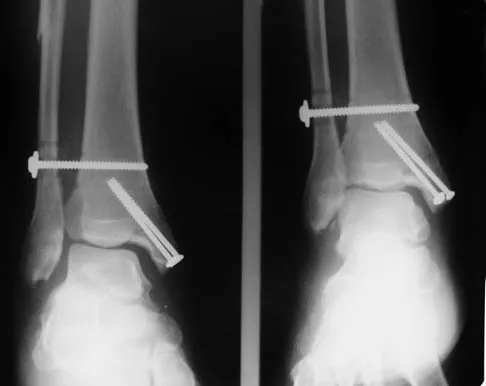
A 30-year-old man sustains a Hawkins type III talar neck fracture.

Six weeks postoperatively, an anteroposterior mortise radiograph reveals a subchondral radiolucent band in the talar dome. What does this radiographic finding indicate?


Explanation

The presence of a subchondral radiolucent band, known as Hawkins sign, indicates active bone resorption. This requires an intact blood supply, thereby prognosticating a low risk for avascular necrosis.

Question 29

A 45-year-old male sustains a high-energy closed tibial pilon fracture with severe soft tissue swelling, marked ecchymosis, and early fracture blisters. What is the most appropriate initial management strategy?


Explanation

High-energy pilon fractures have a high complication rate if fixed acutely. Staged management with spanning external fixation allows soft tissues to recover prior to definitive open reduction and internal fixation.

Question 30

When comparing operative versus non-operative management of acute Achilles tendon ruptures utilizing modern early functional rehabilitation protocols, operative treatment is most strongly associated with:


Explanation

Early functional rehabilitation protocols yield similar re-rupture rates and functional outcomes between operative and non-operative groups. However, operative management consistently carries a higher risk of soft tissue complications and infection.

Question 31

A 22-year-old collegiate basketball player sustains a fracture at the metaphyseal-diaphyseal junction of the fifth metatarsal. He desires to return to play as safely and quickly as possible. What is the standard of care?


Explanation

Zone 2 (Jones) fractures have a tenuous blood supply and higher risk of nonunion. Intramedullary screw fixation is recommended for elite athletes to minimize nonunion risk and expedite return to play.

Question 32

A 35-year-old sustains a lateral subtalar dislocation that is irreducible by closed means in the emergency department. Which anatomic structure is most commonly interpositioned, blocking reduction?


Explanation

In lateral subtalar dislocations, the tibialis posterior tendon is the most frequent structure to block closed reduction. In medial dislocations, the extensor digitorum brevis or talonavicular capsule typically blocks reduction.

Question 33

A 40-year-old sustains a severe rotational ankle injury. The lateral radiograph shows the proximal fibular shaft fragment displaced and incarcerated posterior to the posterior tubercle of the tibia. What is this specific injury pattern called?


Explanation

A Bosworth fracture-dislocation involves entrapment of the proximal fibular fragment behind the posterolateral ridge of the tibia. This injury is characteristically irreducible by closed means and requires emergent open reduction.

Question 34

A 20-year-old track athlete is diagnosed with an incomplete stress fracture in the central third of the tarsal navicular. What is the most appropriate initial non-operative management?


Explanation

The central third of the navicular is a relative watershed area, placing these stress fractures at high risk for nonunion. Strict non-weight-bearing in a cast for 6-8 weeks is the gold standard conservative treatment.

Question 35

During fixation of a pronation-external rotation ankle fracture, the syndesmosis is found to be unstable. Which of the following statements regarding modern syndesmotic screw fixation is most accurate?


Explanation

Biomechanical and clinical studies demonstrate no significant difference in outcomes or stability between engaging 3 versus 4 cortices with syndesmotic screws. Additionally, routine screw removal is no longer mandatory unless symptomatic.

Question 36

A patient undergoes open reduction and internal fixation of a displaced intra-articular calcaneus fracture via an extensile lateral approach. Which nerve is at greatest risk of iatrogenic injury during the flap elevation?


Explanation

The sural nerve courses along the lateral aspect of the hindfoot and is particularly vulnerable during the extensile lateral approach to the calcaneus. The incision must be meticulously planned to protect it.

Question 37

A 55-year-old patient with severe, poorly controlled diabetes and profound peripheral neuropathy sustains a displaced bimalleolar ankle fracture. What specific modification to surgical technique is recommended?


Explanation

Neuropathic diabetic patients are at high risk for Charcot arthropathy and hardware failure after ankle fractures. Augmenting standard fixation with multiple syndesmotic screws or tibiotalocalcaneal nailing is highly recommended.

Question 38

An elite football player sustains a forceful hyperextension injury to his first metatarsophalangeal joint. MRI reveals a Grade III turf toe injury with a complete tear of the plantar plate and marked proximal retraction of the sesamoids. What is the recommended management?


Explanation

A Grade III turf toe injury with gross instability and sesamoid retraction in a high-level athlete typically necessitates surgical repair. This restores the push-off mechanics and prevents long-term hallux rigidus.

Question 39

A 14-year-old boy sustains an ankle injury resulting in a Salter-Harris III fracture of the anterolateral distal tibia. Which ligament's avulsive force is primarily responsible for this specific fracture pattern?


Explanation

This describes a juvenile Tillaux fracture, caused by external rotation. The central and medial portions of the distal tibial physis close first, allowing the anterior inferior tibiofibular ligament (AITFL) to avulse the anterolateral epiphysis.

Question 40

A skier presents with posterolateral ankle swelling after a forced dorsiflexion and inversion injury. Radiographs show a small flake of bone avulsed from the posterolateral aspect of the fibula. This 'fleck sign' is pathognomonic for:


Explanation

A cortical avulsion from the posterolateral ridge of the distal fibula (fleck sign) indicates avulsion of the superior peroneal retinaculum. This injury is highly associated with subluxation or dislocation of the peroneal tendons.

Question 41

A 28-year-old snowboarder presents with lingering lateral ankle pain after a heavy landing. Plain radiographs are read as normal, but clinical tenderness is focused just anterior and inferior to the lateral malleolus. Which occult fracture should be highly suspected?


Explanation

Fracture of the lateral process of the talus is the classic 'snowboarder's fracture'. It is easily missed on initial plain radiographs and often requires a CT scan for definitive diagnosis and surgical planning.

Question 42

Which of the following descriptions best outlines the classical radiographic appearance of a triplane fracture of the pediatric distal tibia?


Explanation

A standard triplane fracture acts as a Salter-Harris IV equivalent. It appears as a Salter-Harris III (sagittal plane) on the anteroposterior view and as a Salter-Harris II (coronal plane) on the lateral radiograph.

Question 43

A 28-year-old male sustains a Hawkins type III talar neck fracture. Six weeks post-operatively, a radiograph reveals a subchondral lucent band in the talar dome. What does this finding indicate?


Explanation

The presence of subchondral radiolucency in the talar dome (Hawkins sign) at 6 to 8 weeks indicates intact vascularity and active bone resorption, meaning AVN is unlikely.

Question 44

Following an extensile lateral approach for open reduction and internal fixation of a displaced intra-articular calcaneus fracture, what is the most common postoperative complication?


Explanation

Wound healing complications at the apex of the L-shaped extensile lateral incision are the most common complication due to the precarious blood supply of the flap.

Question 45

In a 45-year-old patient with a purely ligamentous Lisfranc injury, primary arthrodesis of the 1st, 2nd, and 3rd tarsometatarsal joints compared to open reduction and internal fixation (ORIF) offers which of the following advantages?


Explanation

Primary arthrodesis for purely ligamentous Lisfranc injuries leads to comparable functional outcomes but significantly lowers the rate of planned hardware removal and secondary salvage arthrodesis compared to ORIF.

Question 46

A 22-year-old collegiate athlete sustains an acute fracture at the metaphyseal-diaphyseal junction of the fifth metatarsal. He wishes to return to play as soon as safely possible. What is the most appropriate management?


Explanation

Zone 2 fractures (Jones fractures) in elite athletes are best treated with intramedullary screw fixation to decrease time to union and lower the risk of nonunion compared to nonoperative management.

Question 47

A 32-year-old male sustains a Hawkins Type II talar neck fracture. At 8 weeks post-ORIF, AP radiographs reveal subchondral radiolucency in the talar dome. What does this finding indicate?


Explanation

Hawkins sign is a subchondral radiolucency of the talar dome, indicating intact vascularity and active resorption of subchondral bone. Its presence at 6 to 8 weeks strongly suggests the absence of avascular necrosis.

Question 48

When utilizing an extensile lateral approach for a displaced intra-articular calcaneus fracture, what is the most common postoperative complication?


Explanation

The extensile lateral approach to the calcaneus has a high rate of wound complications (up to 25%), particularly wound edge necrosis or dehiscence. Careful, full-thickness flap elevation and subperiosteal dissection are required to minimize this risk.

Question 49

According to Level I evidence, which of the following is a primary advantage of primary arthrodesis over open reduction internal fixation (ORIF) for purely ligamentous Lisfranc injuries?


Explanation

Primary arthrodesis of the first, second, and third tarsometatarsal joints for purely ligamentous Lisfranc injuries has similar functional outcomes to ORIF but significantly decreases the need for planned hardware removal and secondary salvage arthrodesis.

Question 50

A 25-year-old male sustains a closed lateral subtalar dislocation. Closed reduction in the emergency department is unsuccessful. Which of the following anatomic structures is most likely blocking the reduction?


Explanation

Lateral subtalar dislocations represent about 15% of subtalar dislocations and occur when the talar head is forced medially. An irreducible lateral subtalar dislocation is most commonly blocked by the interposition of the tibialis posterior tendon.

Question 51

A 22-year-old collegiate basketball player sustains an acute fracture of the fifth metatarsal at the metaphyseal-diaphyseal junction extending into the fourth-fifth intermetatarsal articulation. What is the most appropriate management?


Explanation

This describes a Zone 2 (Jones) fracture. Due to the high rate of nonunion from a tenuous watershed blood supply and the patient's elite athletic status, early intramedullary screw fixation is the treatment of choice to expedite return to play.

Question 52

A 45-year-old male presents with a high-energy closed severe pilon fracture with significant soft tissue swelling and fracture blisters. What is the standard staged protocol for managing this injury?


Explanation

Severe pilon fractures with massive soft tissue compromise are best treated with staged management. This involves immediate spanning external fixation to restore length and protect soft tissues, followed by definitive tibial ORIF once swelling resolves.

Question 53

During operative fixation of a Weber C ankle fracture with an associated syndesmotic rupture, what is the recommended position of the ankle during syndesmotic screw placement based on recent evidence?


Explanation

Historically, surgeons advocated placing the ankle in maximal dorsiflexion during syndesmosis fixation due to the wider anterior talar dome. However, recent biomechanical and clinical evidence demonstrates that ankle position during fixation does not affect postoperative range of motion or clinical outcomes.

Question 54

A 28-year-old male presents with lateral ankle pain after landing a jump while snowboarding. Radiographs appear normal, but a CT scan reveals a displaced, 1.5 cm fracture of the lateral process of the talus. What is the most appropriate treatment?


Explanation

"Snowboarder's fractures" involving the lateral process of the talus that are displaced (>2 mm) or involve a large intra-articular fragment should be treated with open reduction and internal fixation to restore the subtalar joint surface.

Question 55

Which of the following areas of the tarsal navicular is at the highest risk for a stress fracture due to its unique vascular supply?


Explanation

The central third of the tarsal navicular is a relative avascular watershed zone, receiving its blood supply from a network of dorsal and plantar vessels. This relative ischemia makes it highly susceptible to stress fractures in running and jumping athletes.

Question 56

When comparing functional rehabilitation (non-operative with early mobilization) to operative repair for acute Achilles tendon ruptures, how do the complication profiles differ?


Explanation

Modern functional rehabilitation protocols for Achilles tendon ruptures have similar re-rupture rates to operative repair. Operative repair, however, carries a significantly higher risk of surgical site infections, wound healing issues, and sural nerve injury.

Question 57

A 13-year-old boy sustains a Salter-Harris III fracture of the anterolateral distal tibial epiphysis. What is the primary mechanism and the specific deforming ligament responsible for this fracture pattern?


Explanation

A Tillaux fracture is a pediatric transitional fracture involving the anterolateral distal tibial epiphysis. It is caused by external rotation of the foot, where the strong anterior inferior tibiofibular ligament avulses the epiphysis.

Question 58

On an AP radiograph of an ankle fracture, you note a transverse fracture of the medial malleolus and a short oblique fracture of the fibula originating at the joint line and extending posterosuperiorly. According to Lauge-Hansen, what was the mechanism of injury?


Explanation

A Supination-External Rotation (SER) injury typically presents with an oblique or spiral fibular fracture starting at the level of the syndesmosis (anterior-inferior to posterior-superior). A transverse medial malleolus fracture represents the stage 4 avulsion injury in this sequence.

Question 59

Following a severe crush injury to the foot, a patient develops a clinically suspected compartment syndrome. Which of the following is the most appropriate initial surgical approach to release the 9 compartments of the foot?


Explanation

The foot contains 9 anatomical compartments. Complete fasciotomy is typically achieved via two dorsal longitudinal incisions (over the 2nd and 4th metatarsals) and a medial utility incision to ensure adequate release of all compartments.

Question 60

The Sanders classification for intra-articular calcaneus fractures is based on the number of fracture lines through which articular facet, as seen on a coronal CT scan?


Explanation

The Sanders classification is determined by the number and location of primary fracture lines through the posterior articular facet of the calcaneus, utilizing coronal CT images at the widest point of the posterior facet.

Question 61

A professional athlete presents with severe pain at the first metatarsophalangeal (MTP) joint after hyperextending his big toe. MRI demonstrates a complete tear of the plantar plate and retraction of the sesamoids. What is the most appropriate management?


Explanation

This is a Grade 3 "Turf Toe" injury with a complete tear of the plantar plate and sesamoid retraction. In elite athletes, surgical repair is recommended to restore push-off strength and prevent chronic instability.

Question 62

A 30-year-old patient sustains a displaced talar neck fracture and undergoes open reduction and internal fixation. At 8 weeks post-operation, standard radiographs reveal a subchondral radiolucent band in the talar dome. What does this radiographic finding indicate?


Explanation

The Hawkins sign is a subchondral radiolucent band seen 6-8 weeks post-injury in the talar dome. It indicates subchondral bone resorption, confirming intact vascularity and absence of avascular necrosis.

Question 63

In young, active patients with purely ligamentous Lisfranc injuries, which surgical intervention has been shown to yield the best long-term functional outcomes and lowest reoperation rates?


Explanation

Recent studies demonstrate that primary arthrodesis of the 1st, 2nd, and 3rd TMT joints yields better functional outcomes and lower reoperation rates than ORIF for purely ligamentous Lisfranc injuries.

Question 64

A 25-year-old sustains a lateral subtalar dislocation after a fall from a height. A closed reduction in the emergency department is unsuccessful due to a soft tissue block. What is the most likely anatomic structure preventing reduction?


Explanation

In a lateral subtalar dislocation, the talar head is displaced medially and can become buttonholed through the posterior tibial tendon, blocking closed reduction. Medial dislocations are typically blocked by the EDB or extensor retinaculum.

Question 65

A 22-year-old collegiate track athlete presents with chronic midfoot pain. MRI confirms a stress fracture of the tarsal navicular. Which anatomic region of the navicular is considered an avascular watershed zone, predisposing it to nonunion?


Explanation

The central third of the tarsal navicular has a tenuous blood supply, forming a vascular watershed area. This increases the risk of stress fractures and subsequent nonunion.

Question 66

A professional soccer player sustains an acute Zone 2 fracture of the proximal 5th metatarsal (Jones fracture). He desires to return to play as safely and rapidly as possible. What is the most appropriate surgical management?


Explanation

Zone 2 fractures (Jones fractures) involve the metaphyseal-diaphyseal junction, an area with limited blood supply. In high-level athletes, early IM screw fixation minimizes nonunion risk and accelerates return to play.

Question 67

A 35-year-old sustains a high-energy ankle injury. Radiographs reveal a Bosworth fracture-dislocation. What is the defining anatomic characteristic of this specific injury pattern?


Explanation

A Bosworth fracture-dislocation is a rare injury where the proximal fibular fragment entraps behind the posterior tibial tubercle. It is notoriously irreducible by closed means and requires emergent ORIF.

Question 68

A patient with a severe crush injury to the foot develops compartment syndrome and requires emergent surgical release. How many distinct fascial compartments are recognized in the foot for the purpose of fasciotomy?


Explanation

The foot contains nine distinct fascial compartments: medial, lateral, superficial central, three deep central, and three interosseous. All nine can be decompressed through a combined medial and dorsal approach or a dual dorsal approach.

Question 69

According to the Lauge-Hansen classification system, what is the initial stage (Stage I) of a pronation-external rotation (PER) ankle fracture?


Explanation

According to the Lauge-Hansen classification, the first stage of a pronation-external rotation (PER) injury is failure of the medial structures. This manifests as either a deltoid ligament rupture or a medial malleolus fracture.

Question 70

A 24-year-old presents with severe lateral ankle pain after landing off-balance during a snowboard jump. Plain radiographs are equivocal, but a CT scan reveals a "snowboarder's fracture" (lateral process of the talus). What is the most common mechanism of injury for this fracture?


Explanation

Fractures of the lateral process of the talus (snowboarder's fractures) typically occur from a forced dorsiflexion and inversion mechanism. They are frequently misdiagnosed as lateral ankle sprains and best visualized on CT.

Question 71

When utilizing an extensile lateral approach for open reduction and internal fixation of a displaced intra-articular calcaneus fracture, the viability of the full-thickness subperiosteal flap relies primarily on which artery?


Explanation

The extensile lateral approach creates a full-thickness subperiosteal flap. Its viability relies primarily on the lateral calcaneal artery, which must be protected during the posterior dissection.

Question 72

A 28-year-old male sustains a Hawkins type III talar neck fracture in a motor vehicle collision. He undergoes open reduction and internal fixation. At 8 weeks postoperatively, plain radiographs demonstrate a subchondral radiolucent band in the talar dome. What does this finding indicate?


Explanation

A subchondral radiolucent band in the talar dome at 6 to 8 weeks is known as the Hawkins sign. It represents subchondral atrophy from disuse and indicates that the talus has an intact blood supply, making avascular necrosis unlikely.

Question 73

A 24-year-old football player presents with midfoot pain after a forced plantarflexion injury. Weight-bearing radiographs reveal a 3 mm diastasis between the base of the first and second metatarsals. What is the most appropriate management?


Explanation

This patient has a subtle Lisfranc injury with instability (diastasis >2mm). Open reduction and internal fixation is the standard of care to restore anatomic alignment and provide stability, though primary arthrodesis may be considered for purely ligamentous injuries in some scenarios.

Question 74

A 22-year-old collegiate basketball player sustains an acute fifth metatarsal fracture in the metaphyseal-diaphyseal junction. He wishes to return to play as soon as possible. What is the most appropriate definitive treatment?


Explanation

Acute fractures of the metaphyseal-diaphyseal junction (Jones fractures) in high-level athletes are best treated with intramedullary screw fixation to decrease the time to union and lower the risk of nonunion compared to nonoperative management.

Question 75

When utilizing the extensile lateral approach for open reduction and internal fixation of a displaced intra-articular calcaneus fracture, which anatomic structure is at greatest risk of iatrogenic injury during flap elevation?


Explanation

The extensile lateral approach to the calcaneus involves creating a full-thickness subperiosteal flap. The sural nerve is at significant risk of injury during the vertical limb incision and flap retraction.

Question 76

A 35-year-old skier presents with acute medial ankle pain and swelling. Ankle radiographs show a widened medial clear space but no medial malleolus fracture. Proximal tibia/fibula radiographs show a proximal third fibula fracture. What is the mechanism of this specific injury pattern?


Explanation

A Maisonneuve fracture (proximal fibula fracture with medial ankle/syndesmotic injury) occurs via a Pronation-External Rotation mechanism according to the Lauge-Hansen classification. The energy travels from the medial side, through the syndesmosis, and exits proximally in the fibula.

Question 77

A 19-year-old cross-country runner complains of vague dorsal midfoot pain. Plain radiographs are negative, but an MRI demonstrates a nondisplaced incomplete stress fracture of the tarsal navicular. What is the most appropriate initial management?


Explanation

Nondisplaced or incomplete navicular stress fractures have a high risk of nonunion due to the precarious blood supply of the central third of the navicular. The gold standard for initial treatment is strict non-weight-bearing in a cast for 6 to 8 weeks.

Question 78

A 25-year-old professional football player suffers a hyperextension injury to his great toe. Exam reveals profound plantar ecchymosis and a lack of active plantarflexion at the MTP joint. MRI shows a complete tear of the plantar plate with proximal retraction of the sesamoids. What is the recommended treatment?


Explanation

A Grade 3 turf toe injury (complete plantar plate tear) with proximal retraction of the sesamoids and loss of push-off strength in an elite athlete requires surgical repair to restore the windlass mechanism and MTP joint stability.

Question 79

An orthopaedic surgeon is performing an anterolateral approach for a pilon fracture. The surgical interval is developed between the extensor digitorum longus (EDL) and the extensor hallucis longus (EHL). Which nerve must be identified and protected in this interval?


Explanation

The anterolateral approach to the distal tibia utilizes the internervous plane between the EDL and EHL. The deep peroneal nerve and anterior tibial artery lie between these tendons and must be carefully protected.

Question 80

The Sanders classification for intra-articular calcaneus fractures is based on the number of articular fracture lines seen on which specific imaging view?


Explanation

The Sanders classification system evaluates intra-articular calcaneal fractures based on the number and location of primary fracture lines through the posterior facet as seen on the widest section of the coronal plane CT scan.

Question 81

The Lisfranc ligament is critical for midfoot stability. Which of the following accurately describes the anatomic attachments of the Lisfranc ligament?


Explanation

The Lisfranc ligament is a strong interosseous ligament that runs obliquely from the lateral aspect of the medial cuneiform to the medial aspect of the base of the second metatarsal, providing key stabilization to the midfoot.

Question 82

A 40-year-old equestrian falls from a horse, landing with the foot in forced plantarflexion and abduction. Radiographs show a crushed and shortened cuboid with lateral column collapse. Which of the following is the most appropriate surgical treatment principle?


Explanation

A "nutcracker" fracture of the cuboid results in lateral column shortening. Treatment requires restoring the lateral column length to prevent late midfoot abduction deformity, typically via open reduction, structural bone grafting, and plate fixation.

Question 83

A 30-year-old male sustains a medial subtalar dislocation while playing basketball. After urgent closed reduction, the post-reduction CT scan demonstrates an impaction fracture of the anterolateral talar head. This lesion is conceptually analogous to which injury in the shoulder?


Explanation

In a medial subtalar dislocation, the navicular impacts the anterolateral talar head during dislocation, creating an impaction fracture. This is conceptually analogous to a Hill-Sachs lesion (humeral head impaction) seen in anterior shoulder dislocations.

Question 84

Recent prospective randomized trials comparing nonoperative management with early functional rehabilitation versus operative repair for acute Achilles tendon ruptures have demonstrated which of the following?


Explanation

Recent high-quality level I evidence shows that with modern functional rehabilitation protocols (early weight-bearing in a boot), nonoperative and operative treatments of acute Achilles tendon ruptures yield similar functional outcomes and comparable re-rupture rates.

Question 85

A 24-year-old skier catches an edge and forcefully dorsiflexes her inverted ankle. She notes a painful snapping sensation behind the lateral malleolus. Physical exam reveals a palpable clunk behind the fibula with active ankle eversion. Which of the following anatomic structures is primarily injured?


Explanation

Acute peroneal tendon subluxation or dislocation is typically caused by forceful dorsiflexion and inversion, leading to a tear or avulsion of the superior peroneal retinaculum (SPR) from the posterior ridge of the distal fibula.

Question 86

When fixing a vertical shear fracture of the medial malleolus (supination-adduction type), what is the optimal orientation of the lag screws?


Explanation

Vertical medial malleolus fractures require fixation placed perpendicular to the fracture line to achieve optimal interfragmentary compression. Screws are typically placed horizontally (parallel to the joint surface), often supplemented with an anti-glide plate.

Question 87

A 35-year-old construction worker falls from a height and sustains a highly comminuted talar body fracture with complete extrusion of the talar body through an open wound. What is the most appropriate definitive management of the extruded talar body if it can be thoroughly debrided and cleansed?


Explanation

Current literature suggests that even in the setting of open extrusion, a thoroughly debrided and cleansed native talus should be reimplanted and stabilized. Reimplantation provides the best functional potential and preserves bone stock, with acceptable rates of infection.

Question 88

A 45-year-old male sustains a high-energy closed tibial pilon fracture with severe soft tissue swelling and fracture blisters. An external fixator is placed on the day of injury. What clinical sign indicates the soft tissues are ready for definitive open reduction and internal fixation?


Explanation

In staged management of high-energy pilon fractures, definitive fixation is delayed until soft tissue swelling resolves. The appearance of skin wrinkles (the "wrinkle sign") indicates that the edema has subsided sufficiently to allow safe surgical incisions and wound closure.

Question 89

Which of the following patients with a displaced intra-articular calcaneus fracture is statistically most likely to have equivalent or worse outcomes with operative management compared to nonoperative treatment?


Explanation

The landmark study by Buckley et al. showed that patients who receive workers' compensation and heavy smokers tend to do poorly with surgery, often having outcomes equal to or worse than nonoperative treatment for intra-articular calcaneus fractures.

Question 90

A 27-year-old gymnast sustains a hyper-plantarflexion midfoot injury. Radiographs reveal a fracture-dislocation at the Chopart joint. This joint is composed of which two articulations?


Explanation

The Chopart joint, or transverse tarsal joint, serves as the transition between the hindfoot and midfoot. It is comprised of the talonavicular and calcaneocuboid articulations.

None

Clinic OS
Medically Verified Content by
Prof. Clinic OS
Consultant Orthopedic & Spine Surgeon
Chapter Index
