Part of the Master Guide

Revision THA Acetabulum: Overcoming Paprosky IIIA & Metallosis

Acetabular Revision Cupcage: A Challenging Case Solved
17 Apr 2026 17 min read 130 Views
Illustration of acetabular revision cupcage - Dr. Mohammed Hutaif

Key Takeaway

This topic focuses on Acetabular Revision Cupcage: A Challenging Case Solved, An acetabular revision cupcage is a surgical construct employed in complex hip revision for severe acetabular bone loss, like Paprosky IIIB aseptic cup loosening. It typically involves a porous tantalum cup protected by a Burch-Schneider ring, with a cemented UHMWPE liner. This method restores hip stability, alleviates pain, and improves function in challenging revision cases.

Patient Presentation and History

A 68-year-old male presented to the tertiary orthopedic trauma and adult reconstruction clinic with a two-year history of worsening left hip pain, progressive instability, and a noticeable leg length discrepancy. His past surgical history was significant for a left primary total hip arthroplasty (THA) performed 15 years prior for end-stage primary osteoarthritis. This was subsequently followed by a revision THA 5 years ago due to aseptic loosening of the primary acetabular component. Operative reports from the prior revision detailed the removal of a loose porous-coated cup and the implantation of a larger, multi-hole cementless acetabular component. This was supplemented with multiple trans-acetabular screws and a bulk femoral head structural allograft to address a significant uncontained superior dome defect.

The patient described his current pain as deep-seated, constant, and severely exacerbated by weight-bearing and axial loading. He rated the pain as an 8/10 on the Visual Analog Scale (VAS) during ambulation. He had become entirely dependent on a front-wheeled walker for household and community ambulation. Furthermore, he reported a mechanical "clunking" sensation in his left hip during transitional movements, such as rising from a seated position or pivoting, which is highly suggestive of gross component instability and potential pelvic discontinuity. He denied systemic symptoms of infection, including fevers, chills, diaphoresis, or unexplained weight loss.

His medical comorbidities included essential hypertension (well-controlled on an ACE inhibitor), type 2 diabetes mellitus managed with oral hypoglycemic agents (recent HbA1c 6.8%), and Class I obesity with a Body Mass Index (BMI) of 32 kg/m². He is a former smoker with a 20 pack-year history, having achieved smoking cessation 10 years prior to presentation. There was no documented history of prior periprosthetic joint infection (PJI) or superficial surgical site infection.

Pathophysiology of Prior Construct Failure

The mechanism of the current construct failure appeared insidious and was characterized by progressive functional decline. This clinical picture strongly indicated mechanical failure secondary to particulate debris-induced osteolysis and subsequent massive periacetabular bone loss. The prior utilization of bulk structural allograft, while necessary at the time to achieve initial stability and restore the hip center of rotation, carries a known risk of late failure. Structural allografts frequently undergo creeping substitution, which can be incomplete, leading to central necrosis, structural collapse, and subsequent loss of component support.

Furthermore, the generation of wear debris from the articulating surfaces or modular junctions initiates a macrophage-mediated inflammatory cascade. The release of cytokines, including Interleukin-1 (IL-1), Tumor Necrosis Factor-alpha (TNF-alpha), and Receptor Activator of Nuclear Factor Kappa-B Ligand (RANKL), stimulates excessive osteoclastic bone resorption. In the setting of a previously compromised acetabulum with a large allograft, this osteolytic process rapidly compromises the remaining host-implant interface, leading to catastrophic failure, superior migration, and potential dissociation of the anterior and posterior columns. Given this complex history, a massive acetabular defect requiring advanced reconstructive techniques was anticipated.

Clinical Examination Findings

Objective Gait and Postural Assessment

Upon initial observation in the clinical setting, the patient exhibited a severely antalgic gait, heavily favoring the left lower extremity and relying on his assistive device for offloading. A profound, uncompensated Trendelenburg gait was evident during the stance phase on the left side. This finding indicated severe abductor insufficiency, which could be attributed to a combination of superior migration of the greater trochanter (shortening the abductor lever arm), prior surgical trauma to the gluteus medius and minimus, and disuse atrophy.

A clinical leg length assessment using the block method revealed a left lower extremity shortening of approximately 3.5 cm compared to the contralateral side. The Galeazzi test adaptation for the hip in the supine position confirmed that the shortening was originating proximal to the knee, consistent with superior migration of the acetabular component and the proximal femur.

Range of Motion and Provocative Testing

Palpation revealed diffuse, deep tenderness over the left hip joint, with maximal point tenderness localized along the greater trochanter and the anterior capsular reflection. There were no palpable soft tissue masses, fluctuance, or signs of active localized inflammation such as erythema or localized calor. The prior surgical incisions (a standard posterolateral approach scar) were well-healed with no evidence of sinus tract formation or wound dehiscence.

Passive range of motion (ROM) of the left hip was severely restricted and elicited significant apprehension and guarding. Measured ROM was as follows: flexion to 60 degrees, abduction to 10 degrees, adduction to 0 degrees, internal rotation to 5 degrees, and external rotation to 15 degrees. Flexion, abduction, and external rotation were particularly limited by pain and mechanical block. During internal and external rotation at 30 degrees of flexion, an audible and palpable mechanical clunk was appreciated. This finding was consistent with gross instability of the acetabular component within the massive bony defect, essentially functioning as a pseudoarthrosis.

Comprehensive Neurovascular Evaluation

Motor strength testing was limited by pain but revealed approximately 4/5 weakness in hip flexion (iliopsoas), hip abduction (gluteus medius/minimus), and hip extension (gluteus maximus) on the left side, compared to normal 5/5 strength on the contralateral right side.

Sensory examination was meticulously performed given the high risk of sciatic nerve tethering or compression in the setting of severe superior and medial component migration. Sensation was intact to light touch and pinprick in the dermatomal distributions of the femoral, obturator, superficial peroneal, deep peroneal, and tibial nerves. Extensor hallucis longus (EHL) and tibialis anterior strength were 5/5, indicating no current common peroneal nerve palsy. Distal pulses, including the femoral, popliteal, dorsalis pedis, and posterior tibial arteries, were palpable, symmetric, and graded as 2+ bilaterally. Capillary refill was less than 2 seconds in the distal digits. The contralateral right hip and bilateral knee examinations were entirely unremarkable, demonstrating full, painless range of motion and stability.

Imaging and Diagnostics

Standard Radiographic Evaluation

Initial radiographic assessment commenced with a comprehensive series of standard hip and pelvis views to evaluate the extent of component migration and periacetabular osteolysis.

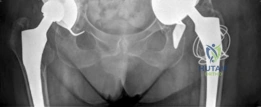
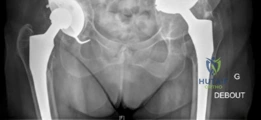
  • Anteroposterior Pelvis: The AP pelvis radiograph demonstrated catastrophic failure of the left acetabular construct. There was significant superior and medial migration of the cementless acetabular component, violating Kohler's line and indicating severe medial wall deficiency. Extensive periacetabular osteolysis was evident, with continuous radiolucent lines exceeding 2mm observed across all three DeLee and Charnley zones. The previously placed bulk femoral head allograft showed signs of advanced resorption, structural collapse, and failure to integrate into the host ilium. The superior dome was entirely deficient. The femoral component, a fully porous-coated diaphyseal fitting stem, appeared well-fixed with no evidence of subsidence, radiolucent lines, or distal pedestal formation.
    Image

Advanced Radiographic Imaging

To further delineate the integrity of the anterior and posterior columns, Judet oblique views were obtained.

  • Judet Views: The obturator oblique and iliac oblique radiographs provided critical information regarding the remaining column bone stock. The obturator oblique view revealed near-complete destruction of the anterior column and the quadrilateral plate. The iliac oblique view demonstrated severe posterior column osteolysis extending into the ischium. The discontinuity of the ilioischial line on the AP view, combined with the findings on the Judet views, raised an extremely high clinical suspicion for a complete pelvic discontinuity (a transverse fracture through the acetabulum separating the superior hemipelvis from the inferior hemipelvis).
    Image

Computed Tomography and Defect Analysis

To precisely quantify the volumetric bone loss, assess the remaining host bone available for fixation, and definitively diagnose pelvic discontinuity, a high-resolution Computed Tomography (CT) scan of the pelvis with Metal Artifact Reduction Sequence (MARS) was obtained.

  • CT Pelvis with MARS: The multi-planar reformatted images confirmed a massive Paprosky Type IIIB acetabular defect. There was a complete absence of the superior dome, medial wall, and significant portions of both the anterior and posterior columns. Crucially, the axial and coronal cuts confirmed a frank pelvic discontinuity. The inferior hemipelvis (ischium and pubis) was mechanically uncoupled from the superior hemipelvis (ilium). The remaining ischial bone stock was evaluated for potential flange fixation, revealing moderate osteolysis but sufficient cortical density for screw purchase. The teardrop was completely obliterated.
    Image

Preoperative laboratory diagnostics were also obtained to definitively rule out subacute periprosthetic joint infection prior to undertaking a massive reconstructive procedure. The Erythrocyte Sedimentation Rate (ESR) was 12 mm/hr (normal <20 mm/hr), and the C-Reactive Protein (CRP) was 0.4 mg/dL (normal <1.0 mg/dL). Given the normal inflammatory markers and the classic radiographic appearance of aseptic mechanical failure, preoperative joint aspiration was deemed unnecessary.

Differential Diagnosis

The presentation of a painful, unstable total hip arthroplasty with significant radiographic bone loss requires a meticulous differential diagnosis to guide appropriate surgical intervention. The primary differentials must distinguish between mechanical failure, biological failure (infection), and adverse tissue reactions.

Diagnosis Clinical Presentation Radiographic Findings Laboratory and Aspiration Findings
Aseptic Loosening with Severe Bone Loss (Paprosky IIIB / Discontinuity) Deep, activity-related pain, mechanical "clunking," progressive leg length discrepancy, antalgic gait. Superior/medial component migration, extensive osteolysis in multiple zones, violation of Kohler's line, visible fracture line separating superior and inferior hemipelvis. Normal ESR and CRP. If aspirated, synovial fluid white blood cell (WBC) count < 3,000 cells/µL with < 70% polymorphonuclear neutrophils (PMNs). Negative cultures.
Periprosthetic Joint Infection (PJI) Constant pain (often present at rest), potential fevers/chills, localized warmth, erythema, possible sinus tract. Periosteal reaction, rapid focal osteolysis, early component loosening, gas in soft tissues (rare but definitive). Elevated ESR (>30 mm/hr) and CRP (>1.0 mg/dL). Synovial fluid WBC > 3,000 cells/µL, > 70% PMNs. Positive Alpha-defensin. Positive synovial fluid cultures.
Adverse Local Tissue Reaction (ALTR) / Metallosis Groin or thigh pain, swelling, palpable pseudotumor, instability due to soft tissue destruction. Often subtle implant loosening, large cystic soft tissue masses on MARS MRI, potential corrosion at modular junctions. Elevated serum Cobalt and Chromium levels. Normal or mildly elevated ESR/CRP. Aspiration yields dark, metallic fluid with high macrophage count and negative cultures.

Surgical Decision Making and Classification

Paprosky Classification of Acetabular Defects

Accurate classification of the acetabular bone defect is paramount for determining the appropriate reconstructive strategy. The Paprosky Classification system is the most widely utilized framework, categorizing defects based on the integrity of the supportive host bone and the ability to achieve biological fixation.

  • Type I: Minimal bone loss, intact rim, normal hip center.
  • Type II: Distorted hemisphere, but intact columns and rim. Subdivided into IIA (superior bone loss), IIB (superior and lateral), and IIC (medial wall defect).
  • Type III: Severe bone loss with non-supportive rim and significant column compromise. Subdivided into IIIA (superior bone loss >3cm, moderate column destruction) and IIIB (superior bone loss >3cm, severe destruction of the teardrop, Kohler's line, and both columns).
  • Pelvic Discontinuity: A distinct entity where a transverse fracture separates the superior and inferior halves of the pelvis.

Based on the clinical and radiographic findings, this patient presented with a Paprosky Type IIIB defect with an associated Pelvic Discontinuity. The superior migration exceeded 3 cm, Kohler's line was violated, the teardrop was absent, and the CT scan confirmed the uncoupling of the hemipelves.

Rationale for Cup Cage Reconstruction

The presence of a pelvic discontinuity in the setting of a massive Paprosky IIIB defect presents one of the most formidable challenges in revision hip arthroplasty. The reconstructive construct must achieve two primary objectives: 1) mechanically bridge and stabilize the discontinuity to allow for fracture healing, and 2) provide a stable foundation for a new articular surface.

Historical options for this degree of bone loss included impaction bone grafting with mesh, structural bulk allografts with reconstruction rings, or custom triflange acetabular components (CTAC). Impaction grafting has a high failure rate in the presence of discontinuity due to a lack of initial mechanical stability. Structural allografts carry a high risk of late resorption and collapse, as seen in this patient's prior revision. CTACs provide excellent stability but require extensive preoperative manufacturing time, are highly expensive, and offer limited intraoperative flexibility.

The Cup-Cage Reconstruction technique was selected as the optimal intervention for this patient. This technique utilizes a highly porous, trabecular metal hemispherical shell (the "cup") combined with an ilioischial reconstruction ring (the "cage").

The biomechanical rationale is synergistic:
1. Biological Fixation: The highly porous trabecular metal cup is impacted into the remaining viable host bone of the ilium and ischium. Despite limited contact (often <50%), the high coefficient of friction and osteoconductive properties of the trabecular metal promote rapid biological ingrowth, eventually providing long-term, durable fixation.
2. Mechanical Stability: The ilioischial cage is placed over the porous cup. Its flanges are secured with screws into the intact host bone of the ilium superiorly and the ischium inferiorly. This mechanically bridges the pelvic discontinuity, neutralizing shear forces and providing immediate rigid stability.
3. Construct Integration: The cage protects the porous cup from micromotion during the early postoperative phase, allowing for biological ingrowth. A polyethylene liner is then cemented into the cage, locking the entire construct together and allowing for precise adjustment of version and inclination independent of the host bone anatomy.

Surgical Technique and Intervention

Preoperative Optimization and Positioning

The patient underwent comprehensive preoperative medical optimization, including tight glycemic control and cardiovascular clearance. Two units of packed red blood cells were typed and crossed.

In the operating room, general endotracheal anesthesia was induced. A Foley catheter was placed to monitor urine output. The patient was positioned in the right lateral decubitus position on a radiolucent peg board. Meticulous padding was applied to all bony prominences, particularly the common peroneal nerve at the fibular head and the axilla. The pelvis was rigidly secured using anterior and posterior padded posts to prevent shifting during the application of significant torque required for implant removal and reaming. The left lower extremity and hemipelvis were prepped and draped in a standard sterile fashion, ensuring wide exposure to allow for proximal extension of the incision if necessary.

Surgical Approach and Exposure

An extended posterior approach to the hip was utilized, incorporating the patient's previous surgical incision. The skin and subcutaneous tissues were incised, and the fascia lata and gluteus maximus were split in line with their fibers. Extensive scar tissue from the previous surgeries was encountered.

Careful dissection was performed to identify and protect the sciatic nerve, which was found to be encased in dense fibrous tissue and tethered medially due to the superior migration of the acetabular construct. A formal sciatic nerve neurolysis was performed from the greater sciatic notch down to the proximal thigh to ensure its protection during the extensive acetabular reconstruction. The short external rotators, or what remained of them, were tagged and released. A complete capsulectomy was performed to fully expose the proximal femur and the failed acetabular component.

Acetabular Exposure and Explantation

The proximal femur was carefully dislocated posteriorly. The well-fixed femoral stem was protected with a sponge. Attention was then directed to the acetabulum. The loose acetabular component and the failed structural allograft were completely encased in a thick neocapsule and metallotic, osteolytic tissue.

The previously placed trans-acetabular screws were identified. Several were broken, and the remaining screws were carefully backed out. The multi-hole acetabular shell was grossly loose and was removed with minimal effort using a cup extractor, taking extreme care not to compromise any of the remaining, fragile host bone.

Extensive debridement of the acetabular defect was then performed. All necrotic bone, fibrous tissue, and remnants of the failed allograft were aggressively curetted until healthy, bleeding host bone was encountered. The extent of the bone loss was staggering.
Image
Intraoperative assessment confirmed a massive Paprosky IIIB defect. The superior dome was absent, the medial wall was completely deficient, and the anterior and posterior columns were severely compromised. Gentle manipulation of the ischium relative to the ilium confirmed gross motion, definitively confirming the preoperative diagnosis of a complete pelvic discontinuity.

Defect Preparation and Hemispherical Cup Insertion

The goal of acetabular preparation in this setting is not to ream to a hemispherical shape—which would destroy the remaining structural columns—but rather to gently prepare the remaining host bone of the ilium and ischium to accept a highly porous, multi-hole trabecular metal shell.

Sequential reaming was performed with extreme caution, directing the reamers superiorly and posteriorly into the remaining viable iliac bone stock. The objective was to create a bed for the porous cup that would maximize host bone contact while avoiding medialization into the true pelvis.

A jumbo, highly porous trabecular metal multi-hole acetabular shell (typically 66mm or larger depending on the defect) was selected. The cup was impacted into the prepared defect, spanning the discontinuity. Due to the massive bone loss, host bone contact was estimated at approximately 30-40%, primarily located superiorly against the ilium and inferiorly against the ischium. Multiple locking and non-locking screws were placed through the cup into the superior ilium and the posterior column to achieve initial press-fit stability. Despite the screws, the cup alone did not provide sufficient rigidity to neutralize the pelvic discontinuity, necessitating the cage construct.

Cage Application and Liner Cementation

An ilioischial reconstruction cage was then contoured to fit the patient's specific anatomy. The inferior flange of the cage was carefully slotted into the ischium. This is a critical step; the ischium must be meticulously prepared with a burr or osteotome to accept the flange without fracturing the remaining posterior column or endangering the sciatic nerve.

The superior flange of the cage was then contoured to lay flat against the lateral aspect of the ilium. The cage was positioned over the previously placed trabecular metal cup. Multiple cortical screws were placed through the superior flange into the dense bone of the ilium. Additional screws were placed through the central dome of the cage, passing through the multi-hole trabecular metal cup and into the host bone, effectively locking the cage and the cup together into a single, rigid construct.

Once the cage was rigidly fixed, bridging the discontinuity and neutralizing all motion between the superior and inferior hemipelves, the construct was thoroughly irrigated and dried. A highly cross-linked polyethylene liner was selected. To ensure optimal stability and prevent dislocation, a dual-mobility articulation was chosen.

High-viscosity polymethylmethacrylate (PMMA) bone cement was mixed and applied to the inner surface of the cage and the back of the polyethylene liner. The liner was then cemented into the cage. This step allows the surgeon to independently set the final version and inclination of the articular surface (targeting 15-20 degrees of anteversion and 40-45 degrees of inclination), regardless of the orientation of the underlying cage or host bone defect. The cement mantle was pressurized, and excess cement was carefully removed.

Final Construct Evaluation and Closure

Following the curing of the cement, a trial reduction was performed using a dual-mobility femoral head on the existing well-fixed femoral stem. The hip was taken through a full range of motion. The construct was remarkably stable, with no impingement or tendency for dislocation in extreme flexion, internal rotation, or external rotation. Leg length was assessed and found to be restored to within 5mm of the contralateral side, correcting the preoperative 3.5cm discrepancy. Tissue tension was excellent.

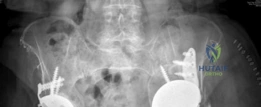
Intraoperative fluoroscopy was utilized to confirm the final component position. The AP radiograph demonstrated excellent restoration of the hip center of rotation, secure fixation of the ilioischial cage bridging the discontinuity, and appropriate seating of the cemented dual-mobility liner.
Image

The wound was thoroughly irrigated with pulsatile lavage. A deep subfascial hemovac drain was placed. The soft tissues were closed in multiple layers. The remaining external rotators and posterior capsule were meticulously repaired to the greater trochanter through transosseous drill holes to enhance posterior soft tissue stability. The fascia lata, subcutaneous tissues, and skin were closed in a standard fashion. A sterile occlusive dressing was applied.

Post Operative Protocol and Rehabilitation

Immediate Postoperative Management

The patient was transferred to the Post-Anesthesia Care Unit (PACU) and subsequently to the orthopedic surgical ward. Intravenous antibiotics (Cefazolin) were continued for 24 hours postoperatively. Deep Vein Thrombosis (DVT) prophylaxis was initiated with low-molecular-weight heparin (Enoxaparin) and mechanical sequential compression devices, given the high-risk nature of the prolonged pelvic surgery. Pain management utilized a multimodal approach, including scheduled acetaminophen, NSAIDs, gabapentin, and oral narcotics for breakthrough pain, minimizing the use of intravenous opioids to facilitate early mobilization.

The subfascial drain was removed on postoperative day 2 when output decreased to less than 30 cc per shift. Routine postoperative laboratory monitoring showed an expected drop in hemoglobin, which stabilized without the need for an allogeneic blood transfusion.

Phased Rehabilitation Strategy

Rehabilitation following a massive acetabular reconstruction with a cup-cage construct for pelvic discontinuity requires a delicate balance between protecting the fragile biological fixation and preventing complications of immobility.

  • Phase 1: Protection and Early Mobilization (Weeks 0-8)
    • Weight Bearing: Strict Toe-Touch Weight Bearing (TTWB) or Flat-Foot Weight Bearing (FFWB) on the operative extremity. This is absolutely critical. The initial stability of the construct relies on the mechanical fixation of the cage. However, long-term success requires biological bone ingrowth into the trabecular metal cup. Excessive early axial loading can cause micromotion, leading to fibrous encapsulation rather than osseointegration.
    • Precautions: Strict posterior hip precautions (no flexion past 90 degrees, no adduction past midline, no internal rotation) to protect the posterior soft tissue repair and prevent dislocation, although the dual-mobility construct significantly mitigates this risk.
    • Therapy: Physical therapy focuses on bed mobility, safe transfers

Dr. Mohammed Hutaif
Medically Verified Content by
Prof. Dr. Mohammed Hutaif
Consultant Orthopedic & Spine Surgeon
Chapter Index