Orthopedic Prometric Exam Preparation MCQs - Part 5
Orthopedic Prometric Exam Preparation MCQs - Part 5
Comprehensive 100-Question Exam
00:00
Start Quiz
Question 1
When counseling a patient concerning the treatment of an acute Achilles tendon rupture, which of the following is true:
Explanation
Question 2
Following open repair of an Achilles tendon rupture, which of the following is true:
Explanation
Question 3
Which of the following is the most useful symptom or sign of a foot compartment syndrome:
Explanation
Question 4
Which of the following is the most useful sign in diagnosing a foot compartment syndrome:
Explanation
Question 5
Which of the following compartments are most commonly involved (increased tissue pressure) in compartment syndrome of the foot:
Explanation
Question 6
Which of the following is the most commonly accepted number of foot compartments:
Explanation
Question 7
Which of the following structures is in the calcaneal compartment of the foot:
Explanation
Question 8
Which of the following structures is in the medial compartment of the foot:
Explanation
Question 9
Which of the following foot compartments communicates with the deep posterior tibial compartment:
Explanation
Question 10
A 45-year-old man has severe, unremitting pain after sustaining a displaced calcaneus fracture. He is immobilized in a bulky compression dressing with plaster splints. After removing his dressing, he is noted to have marked swelling with no resolution of his pain. The next step in management is:
Explanation
Question 11
A 45-year-old man has severe, unremitting pain after sustaining a displaced calcaneus fracture. His hindfoot is swollen. The calcaneal compartment tissue pressure is 47 mm Hg. His diastolic pressure is 70 mm Hg. The next step in management is:
Explanation
Question 12
Which of the following groups of muscles are located in the first layer of the foot muscles:
Explanation
Question 13
Which of the following muscles are in the second layer of the foot:
Explanation
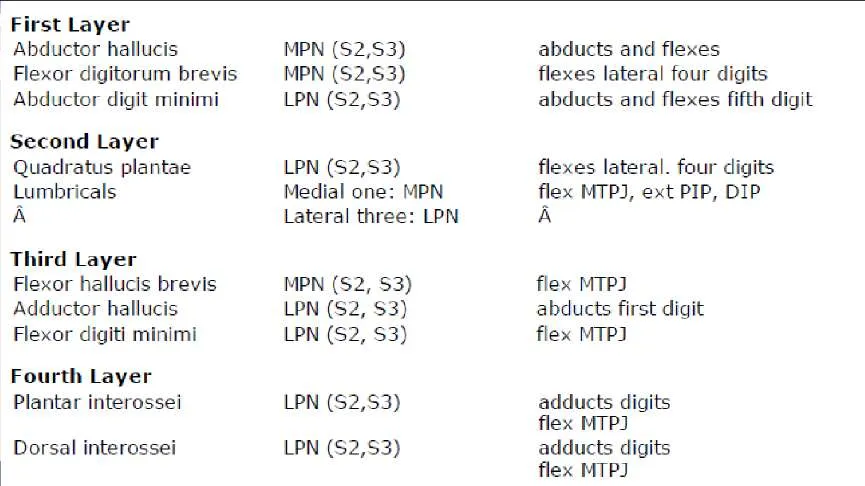 The muscles of the foot and their innervations are as follows: Abbreviations: MPN=medial plantar nerve, LPN=lateral plantar nerve, MTPJ=metatarsophalangeal joint, PIP=proximal interphalangeal joint, and DIP=distal interphalangeal joint.
Question 14
Which of the following groups of muscles are in the third layer of the foot:
Explanation
Question 15
Which of the following muscles are innervated by the medial plantar nerve:
Explanation
Question 16
Which of the following is true of interdigital neuromas:
Explanation
Question 17
Which of the following structures can cause chronic impingement-type posterior ankle pain athletes:
Explanation
Question 18
Which of the following may cause impingement-type posterior ankle pain in dancers?
Explanation
Question 19
Which of the following statements about the gait cycle is true:
Explanation
Question 20
Which of the following statements describes the subtalar joint during walking:
Explanation
Question 21
Which of the following tendons is the main inverter of the hind foot:
Explanation
Question 22
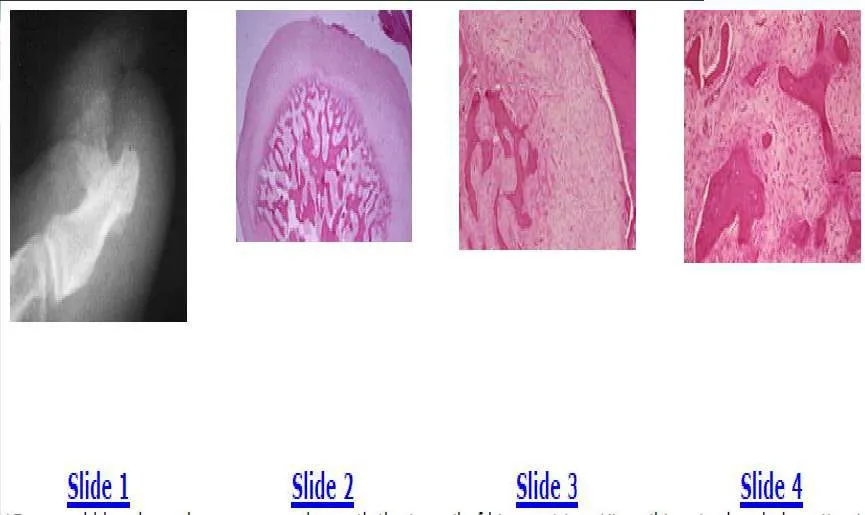
Slide 1 Slide 2 Slide 3 Slide 4 A 35-year-old woman has a swollen and painful small toe. The radiographs of her foot are shown in Slides 1 and 2, and biopsy specimens in Slides 3 and 4. The most likely diagnosis is:
Explanation
Question 23
A 35-year-old woman has a swollen and painful small toe. The radiographs of her foot are shown in Slides 1 and 2, and biopsy specimens are shown in Slides 3 and 4. The most appropriate treatment would be:
Explanation
Question 24
Which of the following statements about plantar fasciitis is true:
Explanation
Question 25
Which of the following statements describes the results of extracorporeal shock wave therapy for chronic plantar fasciitis:
Explanation
Question 26
A 40-year-old man has pain in his foot after minor trauma. A radiograph is shown in Slide 1 and biopsy specimens are shown in Slides 2 and 3. The most likely diagnosis is:
Explanation
Question 27
A 40-year-old man has pain in his foot after minor trauma. A radiograph is shown in Slide 1 and biopsy specimens are shown in Slides 2 and 3. Which of the following would be the most appropriate treatment:
Explanation
Question 28
A 40-year-old man has pain in his foot after minor trauma. A radiograph is shown in Slide 1 and biopsy specimens are shown in Slides 2 and 3. Which of the following best describes this condition:
Explanation
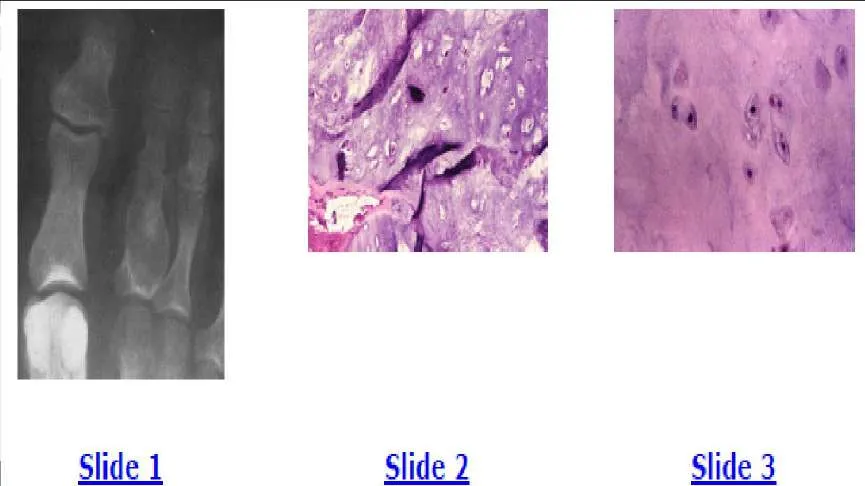
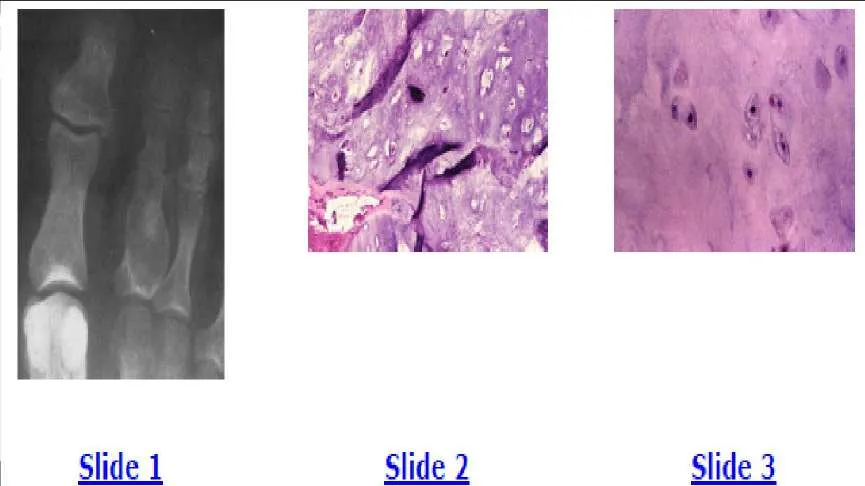 The radiograph shows a lucent lesion in the proximal phalanx of the second toe and expansion of the proximal phalanx. The bone is expanded with a thin periosteal rim. Faint calcifications are also seen within the medullary cavity. This radiographic appearance is fairly characteristic of an enchondroma. The low-power hematoxylin and eosin stain shows abundant blue hyaline matrix and a paucity of cells. The high-power hematoxylin and eosin stain shows the small dark and uniform nuclei present in enchondromas. No pleomorphism or nuclear atypia are present.
Question 29
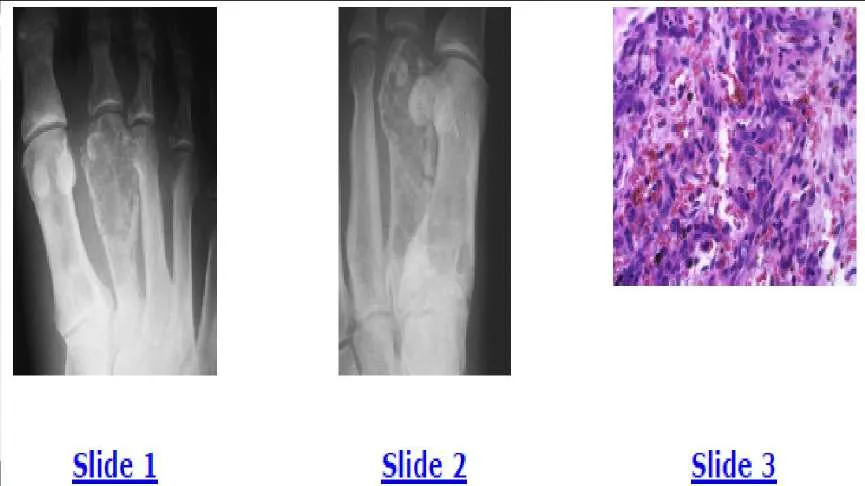
A 35-year-old man has experienced foot pain for 6 months. The anteroposterior and oblique radiographs are shown in Slides 1 and 2, and a biopsy specimen is shown in Slide 3. The most likely diagnosis is:
Explanation
Question 30
A 35-year-old man has foot pain for 6 months. The anteroposterior and oblique radiographs are shown in Slides 1 and 2, and a biopsy specimen is shown in Slide 3. Which of the following treatments is the most appropriate:
Explanation
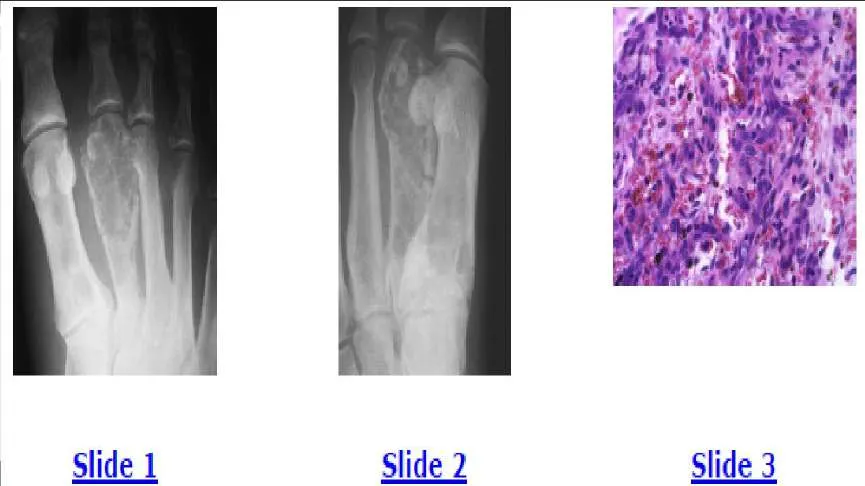 low-grade malignancy with a low risk of pulmonary metastases. Patients are typically treated with external beam irradiation. This patient opted for below-knee amputation. He could have also been treated with irradiation.
Question 31
A 35-year-old man has foot pain for 6 months. The anteroposterior and oblique radiographs are shown in Slides 1 and 2, and a biopsy specimen is shown in Slide 3. The etiology of this condition is most likely:
Explanation
Question 32
Which of the following medications is an effective alternative to intravenous vancomycin for the treatment of severe soft tissue infections caused by methicillin-resistant Staphylococcus aureus (MRSA):
Explanation
Question 33
The mechanism of action of linezolid is:
Explanation
Question 34
A 25-year-old minor league baseball player has a severe soft tissue infection on the sole of his foot. The infection has not responded to oral cephalexin. There is 4 cm of surrounding erythema and induration, and a small amount of exudate can be expressed. The most likely organism is:
Explanation
Question 35
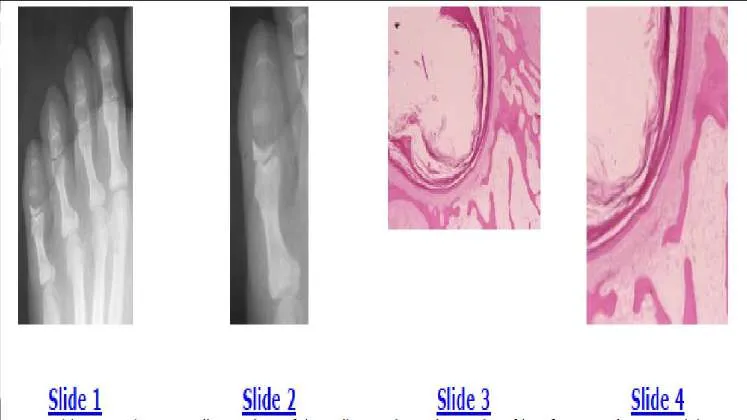
A 15-year-old boy has a large mass underneath the toenail of his great toe. His nail is raised and ulceration is present. The plain radiograph is shown in Slide 1, and biopsy specimens are shown in Slides 2, 3, and 4. The most likely diagnosis is:
Explanation
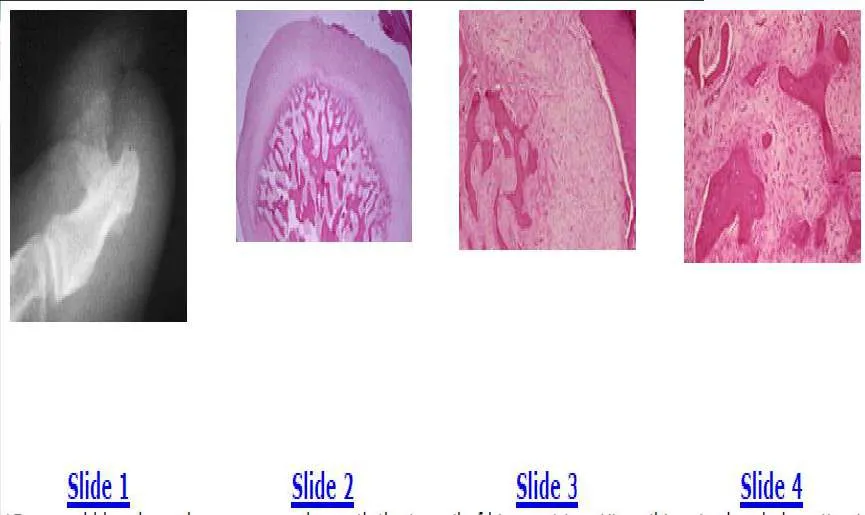 The biopsy specimens show the new bone formation and a fibroblastic stroma, which can be confused with osteosarcoma. The diagnosis is subungual exostosis and the treatment is simple excision.
Question 36
A 15-year-old boy has a large mass underneath the toenail of his great toe. His nail is raised and ulceration is present. The plain radiograph is shown in Slide 1, and biopsy specimens are shown in Slides 2, 3, and 4. Which of the following is the best form o treatment:
Explanation
Question 37
A 15-year-old boy has a large mass underneath the toenail of his great toe. His nail is raised and ulceration is present. The plain radiograph is shown in Slide 1, and biopsy specimens are shown in Slides 2, 3, and 4. Which of the following best describes this condition:
Explanation
 The biopsy specimens show the new bone formation and a fibroblastic stroma, which can be confused with osteosarcoma. The diagnosis is subungual exostosis and the treatment is simple excision.
Question 38
Deep infection following open reduction internal fixation (ORIF) for tibial pilon fractures is most commonly associated with:
Explanation
Question 39
Polyglycolide screws used for fixation of ankle fractures:
Explanation
Question 40
The most effective fixation technique that will ensure adequate visualization (imaging) of avascular necrosis changes following talar neck fracture is:
Explanation
Question 41
Treatment of significant loss of height and posttraumatic arthritis following nonoperative treatment of calcaneus fractures should include:
Explanation
Question 42
Incisions made through blood-filled fracture blisters have:
Explanation
Question 43
The plantar ecchymosis sign is:
Explanation
Question 44
The joint contact area of the second tarsometatarsal joint after Lisfranc dislocation diminishes the greatest with:
Explanation
Question 45
The â fleck signâ in midfoot injuries is a result of avulsion of the:
Explanation
Question 46
Delayed unions and nonunions of base of fifth metatarsal fractures have been demonstrated to heal by:
Explanation
Question 47
The main blood supply to the talar body is from the:
Explanation
Question 48
The strongest hardware configuration for fixation of talar neck fractures is:
Explanation
Question 49
The maximal joint reactive force in the ankle is approximately:
Explanation
Question 50
According to Sandersâ computed tomography (C T) classification for calcaneus fractures, a Sanders III fracture has:
Explanation
Question 51
A 30-year-old male sustains a Hawkins Type II fracture of the talar neck following a motor vehicle collision. Which of the following accurately describes the joint dislocation and the associated risk of avascular necrosis (AVN)?
Explanation
Question 52
Which of the following measurements is the most reliable threshold for diagnosing an acute compartment syndrome of the lower extremity requiring fasciotomy?
Explanation
Question 53
When evaluating a patient after a traumatic anterior shoulder dislocation, which of the following is the single greatest risk factor for recurrent instability?
Explanation
Question 54
In the Ponseti method for the treatment of idiopathic clubfoot, what is the correct sequential order of deformity correction?
Explanation
Question 55
The direct anterior approach to the hip for total hip arthroplasty utilizes a true internervous plane. Which two muscles define this superficial surgical interval?
Explanation
Question 56
A 22-year-old male presents with a proximal pole scaphoid fracture. The high risk of avascular necrosis in this region is primarily due to the retrograde blood supply from which vessel?
Explanation
Question 57
A 35-year-old female is diagnosed with a giant cell tumor of the distal femur. If medical therapy is considered for an unresectable lesion, denosumab may be used. What is the mechanism of action of denosumab?
Explanation
Question 58
A 45-year-old sustains a Hangman's fracture demonstrating severe angulation but minimal translation, classified as an Effendi/Levine-Edwards Type IIa. What is the appropriate initial management strategy?
Explanation
Question 59
A 68-year-old female on long-term bisphosphonate therapy presents with a non-traumatic thigh ache. Radiographs reveal an incomplete atypical femoral fracture. Where does the cortical thickening and fracture initiation typically occur in these injuries?
Explanation
Question 60
During surgical reconstruction of a Lisfranc injury, the surgeon must identify and recreate the Lisfranc ligament complex. Which of the following describes the anatomical attachments of the primary Lisfranc ligament?
Explanation
Question 61
A 6-year-old child sustains a severely displaced extension-type supracondylar fracture of the humerus. Which nerve is most commonly injured in this specific fracture pattern?
Explanation
Question 62
According to the Young-Burgess classification, an Anteroposterior Compression Type II (APC-II) pelvic ring injury is characterized by which of the following ligamentous disruptions?
Explanation
Question 63
Which of the following best describes the biomechanical consequence of an untreated posterior medial meniscal root tear?
Explanation
Question 64
During a primary total knee arthroplasty, the surgeon assesses the gaps with trial components. The extension gap is found to be symmetrically tight, while the flexion gap is well-balanced. What is the most appropriate next step to balance the knee?
Explanation
Question 65
A 55-year-old diabetic patient presents with severe back pain, fever, and progressive lower extremity weakness. MRI reveals a spinal epidural abscess. What is the most common causative organism?
Explanation
Question 66
A 60-year-old female complains of medial ankle pain and a progressively flattening arch. On examination, she is diagnosed with Stage II adult acquired flatfoot deformity (posterior tibial tendon dysfunction). Which clinical finding is characteristic of Stage II?
Explanation
Question 67
Recombinant human bone morphogenetic protein-2 (rhBMP-2) is utilized in orthopedic surgery to promote bone healing. According to the FDA, which of the following is an approved indication for the use of rhBMP-2?
Explanation
Question 68
A patient presents with a vague proximal forearm ache and weakness in the hand. The surgeon suspects anterior interosseous nerve (AIN) syndrome. Which of the following physical examination findings is most specific for this diagnosis?
Explanation
Question 69
A 35-year-old male sustains a pronation-external rotation ankle fracture. Following ORIF of the fibula, the syndesmosis remains unstable. Which of the following is true regarding syndesmotic screw fixation?
Explanation
Question 70
A 6-year-old boy presents with a completely displaced extension-type supracondylar humerus fracture. On examination, he is unable to flex the interphalangeal joint of his thumb and the distal interphalangeal joint of his index finger. What is the most likely injured nerve?
Explanation
Question 71
A 55-year-old active male underwent a total hip arthroplasty with a ceramic-on-ceramic bearing surface 3 years ago. He now complains of a high-pitched squeaking noise during activity. Which of the following factors is most strongly associated with this complication?
Explanation
Question 72
A 68-year-old male presents with neurogenic claudication. Which of the following history or physical examination findings most reliably differentiates neurogenic claudication from vascular claudication?
Explanation
Question 73
A 24-year-old athlete presents with chronic radial-sided wrist pain. Radiographs reveal a scaphoid nonunion advanced collapse (SNAC) pattern with arthritis involving the radioscaphoid and capitolunate joints, but sparing the radiolunate joint. What is the most appropriate surgical treatment?
Explanation
Question 74
During an anterior cruciate ligament (ACL) reconstruction using a bone-patellar tendon-bone (BTB) autograft, the surgeon must be aware of the biomechanical properties of the graft. Which of the following is true regarding a 10 mm BTB autograft compared to the native ACL?
Explanation
Question 75
In the setting of a polytraumatized patient with an Injury Severity Score (ISS) of 36, severe closed head injury, and a closed femoral shaft fracture, which of the following is the most appropriate initial management for the femur?
Explanation
Question 76
A 12-year-old boy presents with knee pain and a destructive, permeative diaphyseal lesion in the femur with a large soft tissue mass. Biopsy reveals small round blue cells. Which chromosomal translocation is most characteristic of this tumor?
Explanation
Question 77
A 25-year-old male sustains a twisting injury to his midfoot. Weight-bearing radiographs demonstrate a 3 mm diastasis between the base of the first and second metatarsals. What is the primary stabilizing structure of this interval?
Explanation
Question 78
A 70-year-old female presents with pseudoparalysis of the shoulder. Imaging reveals a massive, irreparable rotator cuff tear involving the supraspinatus and infraspinatus with superior migration of the humeral head, but an intact subscapularis and functioning deltoid. What is the most reliable surgical option to restore active forward elevation?
Explanation
Question 79
A 13-year-old obese male is diagnosed with a stable slipped capital femoral epiphysis (SCFE) of the left hip. Under what circumstance is prophylactic pinning of the contralateral right hip most strongly indicated?
Explanation
Question 80
Which of the following ligaments is most critical for the primary stability of the tarsometatarsal joint complex (Lisfranc joint), connecting two specific osseous structures?
Explanation
Question 81
A 25-year-old male presents with a closed, highly comminuted tibial shaft fracture following a motorcycle accident. Which of the following is the most sensitive and earliest clinical sign of developing acute compartment syndrome?
Explanation
Question 82
According to the Hawkins classification of talar neck fractures, a Type III fracture is characterized by which of the following dislocation patterns?
Explanation
Question 83
In a patient with an intra-articular calcaneus fracture, the Sanders classification system is most heavily based on the fracture pattern seen on which of the following imaging modalities and planes?
Explanation
Question 84
A 55-year-old diabetic patient presents with a red, warm, and severely swollen foot. Radiographs reveal extensive periarticular bone fragmentation, joint subluxation, and intra-articular debris. According to the Eichenholtz classification of Charcot arthropathy, what stage does this represent?
Explanation
Question 85
A 22-year-old professional athlete sustains an acute fracture at the metaphyseal-diaphyseal junction of the fifth metatarsal (Jones fracture). Why is this specific fracture pattern uniquely prone to delayed union and nonunion?
Explanation
Question 86
A 40-year-old male sustains a severe high-energy closed tibial pilon fracture. Examination reveals significant soft tissue swelling and multiple fracture blisters. What is the most widely accepted initial management strategy?
Explanation
Question 87
When planning surgical correction for hallux valgus, a patient presents with a hallux valgus angle (HVA) of 38 degrees and an intermetatarsal angle (IMA) of 18 degrees. Which of the following procedures is most appropriate to predictably correct this deformity?
Explanation
Question 88
A 60-year-old overweight female presents with medial foot pain and a progressive flatfoot deformity. Which of the following physical examination findings is most specific for stage II posterior tibial tendon insufficiency?
Explanation
Question 89
During the radiographic evaluation of an acute ankle injury, which of the following findings on standard plain radiographs is considered the most reliable indicator of a distal tibiofibular syndesmotic disruption?
Explanation
None
