Acetabular Augment: Rebuilding Bone in Complex Revision
Key Takeaway
This topic focuses on Acetabular Augment: Rebuilding Bone in Complex Revision, An acetabular augment is a prosthetic component utilized to address significant acetabular bone deficiency, as seen in cases like fractured acetabulums with severe osteoporosis. It provides crucial structural support, facilitating stable cementless fixation in complex revision total hip arthroplasty, and helps reconstruct deficient areas such as the superior rim, improving patient mobility.
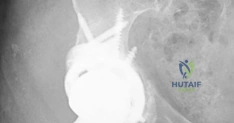
You are presented with this patient's pre-operative pelvic radiograph. This patient has a symptomatic, painful loose acetabular component. Describe your radiographic assessment and classify the bone loss according to Paprosky.
Candidate: I would assess the hip center, look for migration, evaluate Kohler’s line, and check the integrity of the ilioischial and iliopectineal lines. This appears to be a Paprosky Type IIB/IIC defect given the superior rim and medial wall involvement.
Failure to provide a systematic, anatomical evaluation. Candidates often blurt out a classification without referencing the radiographic landmarks (teardrop, Kohler's line, columns) that justify that classification.
Systematically evaluate: 1) Migration (horizontal/vertical), 2) Column integrity (ilioischial/iliopectineal lines), 3) Medial wall (teardrop/Kohler's line), 4) Rim integrity. "Based on the superior segmental loss and compromised medial wall, this represents a Paprosky Type IIB/IIC defect. I would confirm this with a CT scan to assess the extent of the columns and exclude pelvic discontinuity."
You have decided to proceed with revision surgery using a porous metal acetabular augment. Looking at the post-operative image below, what are the critical technical objectives achieved to ensure the long-term success of this reconstruction?
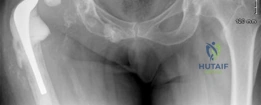
Candidate: The goals were to restore the hip center, achieve stable fixation of the augment, and ensure the definitive cup has enough host bone coverage for secondary osseointegration.
Focusing only on the implant. A poor answer neglects the biological environment: failing to mention that the augment provides a platform for load-sharing and that screw placement must respect neurovascular structures.
Structure the response: 1) Biomechanics (restoration of hip center to improve abductor lever arm), 2) Stability (achieving primary mechanical stability of the augment via multiple divergent screws), 3) Biological Fixation (creating a scaffold for bone ingrowth into the porous metal), and 4) Load Sharing (ensuring the augment transfers load to host bone, preventing stress shielding).
