AAOS Spine Surgery MCQs (Set 3): Degenerative Spine, Trauma & Deformity | ABOS & OITE Review
Key Takeaway
This high-yield question set for the AAOS/ABOS/OITE exams, Set 3, specifically targets spine surgery. It delves into the diagnosis and management of degenerative spinal conditions like stenosis, various vertebral trauma classifications, and complex spinal deformities, crucial for board preparation and clinical practice.
AAOS Spine Surgery MCQs (Set 3): Degenerative Spine, Trauma & Deformity | ABOS & OITE Review
Comprehensive 100-Question Exam
00:00
Start Quiz
Question 1
What is the most common complication of halo vest immobilization in adults?
Explanation
Question 2
What is the most common neurologic complication following an anterior cervical diskectomy and fusion?
Explanation
Question 3
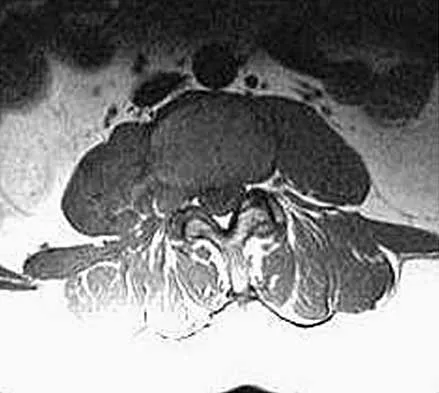
An otherwise healthy 45-year-old woman reports the onset of severe right leg pain. Figure 20a shows an axial MRI scan of the L4-5 level, and Figure 20b shows a sagittal view with the arrow at the L4-5 level. What nerve root is the most likely source of her pain?
Explanation
Question 4
Which of the following forms of nonsurgical management is considered best for acute low back pain without radiculopathy?
Explanation
Question 5
A type 2A hangman's fracture, which has the potential to overdistract with traction, has which of the following hallmark findings?
Explanation
Question 6
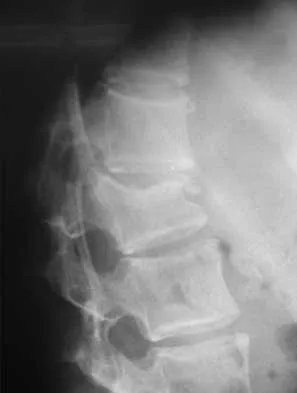
Figures 21a and 21b show the radiographs of a 22-year-old man who was shot through the abdomen the previous evening. An exploratory laparotomy performed at the time of admission revealed a colon injury. Current examination reveals no neurologic deficits. Management for the spinal injury should include
Explanation
Question 7
Stability at the atlanto-occipital joint is provided mainly by
Explanation
Question 8
Which of the following are considered characteristic features of degeneration of a disk?
Explanation
Question 9
What spinal nerves in the cauda equina are primarily responsible for innervation of the bladder?
Explanation
Question 10
Figures 22a and 22b show the radiograph and sagittal MRI scan of the upper cervical spine of a 62-year-old woman who has had a long history of rheumatoid arthritis. Following hospitalization and skeletal traction, her symptoms improve significantly, her neurologic examination returns to normal, and repeat radiographs show a normal occiput and C1-C2 relationship. Treatment should now include
Explanation
Question 11
What is the prognosis for ambulation, from best to worst, for patients with an incomplete spinal cord injury?
Explanation
Question 12
A skeletally mature 15-year-old girl who was thrown from the car in a rollover accident sustained the injuries shown in Figures 23a through 23d. Examination reveals no neurologic deficit, but the patient has moderate posterior spinal tenderness at the level of the injury. What is the most appropriate treatment?
Explanation
Question 13
The MRI scan shown in Figure 24 reveals a right-sided herniated nucleus pulposus at L4-5 in a patient with pain in the right leg. Administration of a caudal epidural steroid injection provides immediate relief. Over the next week he notes generalized weakness of the lower extremities and has one episode of urinary incontinence. What is the next most appropriate step in management?
Explanation
Question 14
At the L4-5 level, what is the location of the S2-5 nerve roots in relationship to the L5 and S1 nerve roots?
Explanation
Question 15
A comparison of dural tears repaired with suture alone and those treated by suture with fibrin glue supplementation will reveal which of the following findings?
Explanation
Question 16
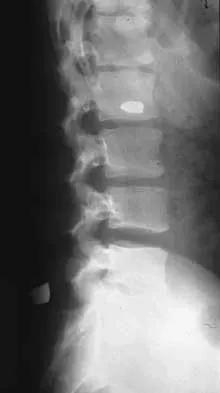
A 19-year-old woman reports lower back pain following a motor vehicle accident. Radiographs obtained immediately after the accident and a bone scan obtained 4 weeks later are shown in Figures 25a through 25c. The patient asks questions regarding the cause, genetics, and natural history of her condition. She should be informed that the condition was
Explanation
Question 17
A patient underwent an anterior cervical diskectomy and interbody fusion for a C5-6 herniated nucleus pulposus and left C6 radiculopathy 8 months ago. He now reports new onset of severe neck pain and left C6 radicular pain, with wrist extension weakness. The radiograph and CT scan shown in Figures 26a and 26b reveal pseudarthrosis at C5-6. The next step in management should consist of
Explanation
Question 18
A 44-year-old farmer involved in a rollover accident on his tractor sustained an L1 burst fracture with a 20% loss of anterior vertebral body height, 30% canal compromise, and 15 degrees of kyphosis. He remains neurologically intact. The preferred initial course of action should consist of
Explanation
Question 19
A 40-year-old carpenter has a 3-month history of right arm pain and neck pain that now leaves him unable to work. Examination reveals a positive Spurling test, weakness of the biceps, and a mildly positive Hoffman's sign on the right side. Electromyography and nerve conduction velocity studies show a right C6 deficit. Figures 27a through 27c show MRI scans that reveal two-level spondylotic disease at C5-6 and C6-7, a large herniated nucleus pulposus at C5-6, and a prominent ridge and hard disk at C6-7. Nonsurgical management fails to provide relief, so the patient elects surgical intervention. Which of the following surgical options would give the best long-term results?
Explanation
Question 20
A patient with rheumatoid arthritis has an unstable pseudarthrosis after undergoing C1-2 posterior fusion. No neurologic deficits are noted, and repair with posterior transarticular fixation screws and a posterior wiring technique at C1-2 is planned. Which of the following preoperative studies offers the best visualization?
Explanation
Question 21
An elderly patient falls and sustains an extension injury to the neck that results in upper extremity weakness, spared perianal sensation, and lower extremity spasticity. These findings best describe what syndrome?
Explanation
Question 22
In the treatment of thoracic disk herniations, what approach is associated with the highest risk of iatrogenic paraplegia?
Explanation
Question 23
Which of the following factors is the strongest predictor of vertebral fracture in postmenopausal women?
Explanation
Question 24
A 23-year-old man sustains a unilateral jumped facet with an isolated cervical root injury in a motor vehicle accident. Acute reduction results in some initial improvement of his motor weakness. Over the next 48 hours, examination reveals ipsilateral loss of pain and temperature sensation in his face, limbs, and trunk, as well as nystagmus, tinnitus, and diplopia. What is the most likely etiology for these changes?
Explanation
Question 25
A 60-year-old woman with a history of breast cancer has progressive paraparesis. The MRI scan is shown in Figure 28. What form of management is most likely to restore or maintain ambulation?
Explanation
Question 26
A 65-year-old man presents with progressive clumsiness in his hands and difficulty walking. Examination reveals hyperreflexia and a positive Hoffman sign. What is the most sensitive physical examination finding for early cervical spondylotic myelopathy?
Explanation
Question 27
A 72-year-old woman complains of neurogenic claudication. She fails 6 months of nonoperative management. A decompressive laminectomy is planned. Which of the following anatomic structures is the primary contributor to central canal stenosis in this condition?
Explanation
Question 28
A 35-year-old man falls from a roof and sustains an L1 burst fracture. He is neurologically intact. Which of the following radiographic parameters is the most important determinant for surgical intervention based on the TLICS classification?
Explanation
Question 29
When evaluating a patient with adult spinal deformity, which of the following spinopelvic parameters is a fixed morphologic feature of the pelvis that does not change with patient position?
Explanation
Question 30
A 60-year-old woman presents with lower back pain and left leg pain. Imaging reveals a grade 1 L4-5 degenerative spondylolisthesis. Which of the following is the most significant structural risk factor for the development of degenerative spondylolisthesis?
Explanation
Question 31
A 78-year-old man is involved in a low-speed motor vehicle collision. CT scan of the cervical spine reveals a displaced Type II odontoid fracture. Which of the following factors is most strongly associated with nonunion if treated conservatively with a halo vest?
Explanation
Question 32
A 16-year-old gymnast complains of chronic lower back pain. Radiographs reveal an L5-S1 isthmic spondylolisthesis. If surgical fusion and reduction are indicated, what is the most common neurologic complication during the reduction of a high-grade slip?
Explanation
Question 33
A 55-year-old man with a long history of ankylosing spondylitis presents with new-onset neck pain after a minor ground-level fall. Initial plain radiographs are read as normal. What is the most appropriate next step in management?
Explanation
Question 34
A 45-year-old man is involved in a high-speed accident. CT scan shows a traumatic spondylolisthesis of the axis (Hangman's fracture) with severe angulation and minimal translation. The C2-C3 disc space is significantly widened. What is the Levine-Edwards classification of this injury?
Explanation
Question 35
A 40-year-old man presents with right arm pain, numbness in his thumb, and weakness in wrist extension. The brachioradialis reflex is diminished. Which cervical nerve root is most likely affected?
Explanation
Question 36
A 48-year-old man presents with acute severe right leg pain following heavy lifting. An MRI demonstrates a far lateral (extraforaminal) disc herniation at the L4-L5 level. Which nerve root is most likely compressed?
Explanation
Question 37
A 65-year-old woman with pre-existing cervical spondylosis falls forward and strikes her chin. She presents with bilateral upper extremity weakness (hands worse than shoulders) and relatively preserved lower extremity strength. What is the most likely diagnosis?
Explanation
Question 38
In the Lenke classification for adolescent idiopathic scoliosis, a curve is considered 'structural' if it lacks flexibility on side-bending radiographs. What residual Cobb angle on side-bending defines a structural curve?
Explanation
Question 39
A 62-year-old man undergoes a C3-C6 posterior cervical laminectomy and fusion. On postoperative day 2, he develops profound weakness in bilateral deltoid and biceps muscles without new sensory changes. What is the most widely accepted pathophysiology of this complication?
Explanation
Question 40
A 52-year-old diabetic patient presents with severe back pain, fever, and progressive bilateral lower extremity weakness. MRI reveals a continuous ventral epidural fluid collection from L1 to L4. What is the most commonly isolated organism in spontaneous spinal epidural abscesses?
Explanation
Question 41
A 75-year-old woman with severe osteoporosis presents with an acute, painful T12 compression fracture. She has failed 6 weeks of aggressive conservative management, including bracing and narcotic analgesics. Which of the following is the most appropriate next step?
Explanation
Question 42
A 60-year-old woman with a 20-year history of rheumatoid arthritis requires elective total hip arthroplasty. Flexion-extension cervical radiographs reveal an anterior atlantodens interval (ADI) of 8 mm. She is neurologically intact. What is the most appropriate management regarding her cervical spine prior to hip surgery?
Explanation
Question 43
A 68-year-old man with adult degenerative scoliosis presents with a 45-degree lumbar curve. Surgery is planned. To minimize the risk of proximal junctional kyphosis (PJK), what is an important intraoperative consideration regarding the upper instrumented vertebra (UIV)?
Explanation
Question 44
A 45-year-old intravenous drug user presents with mid-back pain and fevers. MRI shows T8-T9 disc space narrowing with endplate destruction and a small epidural phlegmon without cord compression. The patient is neurologically intact. Blood cultures grow MRSA. What is the primary treatment?
Explanation
Question 45
A 25-year-old woman presents to the trauma bay after a high-speed motor vehicle collision where she was wearing only a lap belt. She has a large abdominal ecchymosis. Radiographs reveal a transverse fracture through the pedicles, pars, and vertebral body of L2. What associated injury must be heavily suspected?
Explanation
Question 46
A 70-year-old man presents with severe neck pain and weakness after a fall where he struck his forehead. Examination reveals significant motor weakness in the bilateral upper extremities, particularly the hands, with relatively preserved strength in the lower extremities. Which of the following is the most likely diagnosis?
Explanation
Question 47
A 25-year-old man is involved in a motor vehicle collision and sustains an isolated Jefferson (C1 ring) fracture. The 'Rule of Spence' on an open-mouth odontoid radiograph evaluates the combined overhang of the C1 lateral masses on C2. Overhang greater than what measurement suggests a rupture of the transverse atlantal ligament?
Explanation
Question 48
Which of the following spinopelvic parameters is a fixed morphological parameter that is NOT altered by patient positioning or spinal alignment changes?
Explanation
Question 49
A 45-year-old man presents with a far lateral (extra-foraminal) disc herniation at the L4-L5 level. Which nerve root is most likely compressed, and what clinical finding would be expected?
Explanation
Question 50
A 35-year-old woman undergoes a posterior cervical laminectomy and fusion for cervical myelopathy. Postoperatively on day 2, she develops isolated weakness in bilateral shoulder abduction and elbow flexion. There are no sensory changes or leg weakness. What is the most likely cause of her new deficit?
Explanation
Question 51
A 60-year-old man with a 10-year history of ankylosing spondylitis presents to the emergency department after a low-energy fall. He reports new-onset back pain but has intact neurology. Initial plain radiographs are inconclusive. What is the most appropriate next step in management?
Explanation
Question 52
A 22-year-old man sustains a seatbelt flexion-distraction (Chance) injury of the thoracolumbar spine in a motor vehicle collision. Which of the following associated injuries is most commonly found with this specific fracture pattern?
Explanation
Question 53
A 45-year-old man is diagnosed with a paracentral disc herniation at L5-S1. He presents with severe leg pain, numbness along the lateral aspect of his foot, and weakness. Which physical examination finding corresponds to this specific level of compression?
Explanation
Question 54
Which of the following factors is most strongly associated with a high rate of nonunion in Type II odontoid fractures treated with rigid cervical collar immobilization?
Explanation
Question 55
A 65-year-old patient undergoes a T10 to pelvis posterior spinal fusion for adult degenerative scoliosis. One year later, they complain of severe back pain and leaning forward. Radiographs show failure of the proximal construct with kyphosis above the upper instrumented vertebra. What is this complication called?
Explanation
Question 56
According to the ASIA Impairment Scale, a patient who has sensory preservation but no motor function preserved below the neurological level of injury is classified as:
Explanation
Question 57
A 30-year-old male is brought to the emergency department after a motor vehicle accident. He is comatose with a Glasgow Coma Scale score of 6. A CT scan demonstrates a right-sided C5-C6 unilateral facet dislocation. What is the most appropriate next step in management regarding his cervical spine injury?
Explanation
Question 58
A 65-year-old male presents with bilateral leg pain that worsens with walking and is relieved by leaning forward over a shopping cart. Examination reveals normal pedal pulses. Which of the following findings is most likely to be present on electrodiagnostic testing (EMG/NCS)?
Explanation
Question 59
A 16-year-old male presents with increasing thoracic kyphosis and mid-back pain. Radiographs reveal anterior wedging of multiple thoracic vertebrae. According to the Sorensen criteria, what specific radiographic finding is required to formally diagnose classic Scheuermann's kyphosis?
Explanation
Question 60
A 45-year-old construction worker falls 15 feet, sustaining an L1 burst fracture. He is neurologically intact on presentation. According to the Thoracolumbar Injury Classification and Severity (TLICS) score, which of the following radiographic parameters is the strongest indication for operative stabilization over nonoperative brace management?
Explanation
Question 61
A 72-year-old woman complains of deteriorating handwriting, clumsiness in her hands, and unsteadiness when walking in the dark. On examination, rapidly flicking the distal phalanx of her middle finger into flexion causes a reflex flexion of her thumb and index finger. What is the name of this clinical sign?
Explanation
Question 62
An 80-year-old male trips and falls, striking his chin. CT of the cervical spine shows a fracture through the base of the odontoid process extending down into the cancellous body of C2. According to the Anderson and D'Alonzo classification, what type of fracture is this, and what is the typical initial treatment for a neurologically intact elderly patient?
Explanation
Question 63
In the evaluation of Adolescent Idiopathic Scoliosis (AIS), the Lenke classification system utilizes the flexibility of curves on side-bending radiographs to determine fusion levels. A minor thoracic curve is considered "structural" if the Cobb angle on the side-bending radiograph fails to reduce below what specific threshold?
Explanation
Question 64
A 65-year-old man with pre-existing cervical stenosis is involved in a rear-end collision, sustaining a hyperextension injury. He presents with profound weakness in his hands and arms (1/5 strength), but retains functional 4/5 strength in his legs and is able to walk. What is the most likely diagnosis?
Explanation
Question 65
A 42-year-old male presents with severe right anterior thigh pain and weakness in knee extension. An MRI of the lumbar spine reveals a far-lateral (extra-foraminal) disc herniation at the L3-L4 level. Which nerve root is most likely compressed by this specific herniation?
Explanation
Question 66
A 45-year-old male with long-standing Ankylosing Spondylitis presents with a severe, rigid chin-on-chest cervicothoracic kyphotic deformity. He is unable to see straight ahead. Which of the following surgical procedures is the standard, safest choice at the cervicothoracic junction to correct this deformity?
Explanation
Question 67
A 35-year-old female sustains a pelvic ring injury and a sacral fracture following a fall from height. CT imaging shows the fracture line passes medial to the sacral foramina, involving the central sacral canal. According to the Denis classification of sacral fractures, what zone is involved, and what is the approximate risk of associated neurologic injury?
Explanation
Question 68
A 14-year-old competitive gymnast presents with chronic low back pain. Radiographs demonstrate a grade II L5-S1 spondylolisthesis. Which of the following pathoanatomical features is characteristic of this condition (isthmic spondylolisthesis) as opposed to degenerative spondylolisthesis?
Explanation
Question 69
A 55-year-old male undergoes a complex 9-hour posterior spinal fusion for adult spinal deformity. Upon waking, he complains of severe bilateral vision loss. A diagnosis of postoperative visual loss (POVL) is made. What is the most common etiology of POVL following prolonged posterior spine surgery?
Explanation
Question 70
According to the Canadian C-Spine Rules, which of the following is considered a "high-risk" factor that strictly mandates obtaining cervical spine radiography in an alert, stable trauma patient?
Explanation
Question 71
The off-label use of recombinant human bone morphogenetic protein-2 (rhBMP-2) in anterior cervical discectomy and fusion (ACDF) has been associated with a significantly increased risk of which of the following life-threatening postoperative complications?
Explanation
Question 72
A 12-year-old male with spastic quadriplegic cerebral palsy (Gross Motor Function Classification System level V) presents with a severe 90-degree sweeping thoracolumbar scoliosis and significant pelvic obliquity. When planning surgical correction and posterior fusion, what is the most appropriate distal extent of the instrumented fusion?
Explanation
Question 73
A 78-year-old man sustains a Type II odontoid fracture with 5 mm of posterior displacement after a fall. He is neurologically intact. Non-operative management with a halo vest is being considered. Compared to rigid cervical collar immobilization, halo vest placement in this specific patient population is associated with a significantly higher risk of:
Explanation
Question 74
A 65-year-old man with neurogenic claudication secondary to L4-L5 spinal stenosis fails conservative management and undergoes a lumbar decompression. During the procedure, which of the following anatomic structures must be partially resected to adequately decompress the traversing nerve root in the lateral recess?
Explanation
Question 75
A 13-year-old girl with adolescent idiopathic scoliosis (AIS) has a right thoracic curve of 55 degrees. She is Risser 0. Pulmonary function testing demonstrates a forced vital capacity (FVC) of 55% of predicted. What is the most appropriate surgical approach?
Explanation
Question 76
A 35-year-old man falls from a height and sustains an L1 burst fracture. He is neurologically intact. Upright radiographs demonstrate 20 degrees of kyphosis and 40% loss of anterior vertebral body height. CT shows 30% canal compromise. The posterior ligamentous complex is intact on MRI. What is the most appropriate management?
Explanation
Question 77
A 55-year-old man presents with progressive bilateral hand clumsiness and a broad-based gait. Physical examination reveals positive Hoffman signs bilaterally. MRI shows multi-level cervical stenosis from C3-C6 with focal cord signal changes. Which of the following is the most reliable clinical indicator of a poor prognosis for neurologic recovery after surgical decompression?
Explanation
Question 78
A 25-year-old woman is involved in a motor vehicle accident. She is awake and alert. Neurologic exam reveals 0/5 strength in the bilateral triceps and hand intrinsics, with absent sensation below C7. Radiographs show a bilateral C6-C7 facet dislocation. MRI cannot be obtained within the next 4 hours. What is the most appropriate next step?
Explanation
Question 79
A 68-year-old woman presents with severe low back pain and an inability to stand upright. Standing full-length radiographs reveal a sagittal vertical axis (SVA) of +12 cm, a pelvic incidence (PI) of 60 degrees, and a lumbar lordosis (LL) of 20 degrees. What are the primary radiographic targets for surgical correction of her sagittal balance?
Explanation
Question 80
A 30-year-old man presents after a motorcycle crash with a Denis zone 3 sacral fracture. He has loss of bowel and bladder control and perineal numbness. What is the likelihood of neurologic injury with this specific fracture zone compared to zones 1 and 2?
Explanation
Question 81
A 48-year-old man presents with severe right-sided anterior thigh pain, weakness in knee extension, and a diminished right patellar reflex. MRI demonstrates a right-sided far lateral (extraforaminal) disc herniation at L4-L5. Which nerve root is most likely compressed?
Explanation
Question 82
A 16-year-old boy presents with aching back pain and a rounded thoracic spine. Standing lateral radiographs reveal a thoracic kyphosis of 80 degrees and anterior wedging of 3 consecutive vertebrae of 10 degrees each. What other radiographic finding is a classic hallmark of this condition?
Explanation
Question 83
A 65-year-old man with cervical spondylosis sustains a hyperextension injury. He presents with profound weakness in his hands and arms, but is able to ambulate with mild lower extremity weakness. He has preserved perianal sensation. Which of the following best describes his expected prognosis for neurologic recovery?
Explanation
Question 84
A 60-year-old woman is 5 years status post an L4-S1 posterior spinal fusion. She presents with new-onset neurogenic claudication. Imaging reveals severe L3-L4 spinal stenosis and degenerative spondylolisthesis. Which biomechanical factor most significantly contributes to adjacent segment disease following lumbar fusion?
Explanation
Question 85
A 12-year-old boy wearing a lap belt is involved in a high-speed motor vehicle collision. Radiographs reveal a flexion-distraction injury (Chance fracture) at L2. Which of the following associated injuries must be most highly suspected and urgently evaluated?
Explanation
Question 86
A 15-year-old male athlete presents with chronic, severe axial low back pain exacerbated by extension. Imaging confirms bilateral L5 pars interarticularis defects without spondylolisthesis. MRI shows normal, hydrated discs. After 6 months of rest and core strengthening, pain prevents sports participation. What is the most appropriate surgical management?
Explanation
Question 87
A 55-year-old man with a 20-year history of ankylosing spondylitis presents with new severe neck pain after a low-speed rear-end motor vehicle collision. Radiographs appear unchanged from previous films, showing a continuous "bamboo spine". His neurologic exam is completely intact. What is the most appropriate next step in management?
Explanation
Question 88
A 65-year-old man with pre-existing cervical spondylosis sustains a hyperextension injury. He has severe upper extremity weakness and mild lower extremity weakness. What is the most appropriate initial management for this incomplete spinal cord injury if there is no acute instability or worsening compression?
Explanation
Question 89
When correcting adult spinal deformity, which of the following pelvic parameters represents a morphologic constant that dictates the required amount of lumbar lordosis (LL) for a balanced spine?
Explanation
Question 90
A 32-year-old involved in a motor vehicle accident presents with neck pain and right C6 radiculopathy. Radiographs reveal an isolated right unilateral C5-C6 facet dislocation. What is the most appropriate next step prior to closed reduction?
Explanation
Question 91
An 82-year-old man sustains a Type II odontoid fracture after a fall from standing. He is neurologically intact but has severe neck pain. He has multiple comorbidities including severe COPD. What is the most appropriate management?
Explanation
Question 92
A 25-year-old man wearing a lap seatbelt sustains a flexion-distraction injury to the L2 vertebra. Which of the following associated injuries is most highly correlated with this fracture pattern?
Explanation
Question 93
A 55-year-old man undergoes a posterior cervical laminectomy and fusion from C3-C7 for cervical spondylotic myelopathy. On postoperative day 2, he develops profound isolated weakness in right shoulder abduction and external rotation. What is the most likely etiology?
Explanation
Question 94
A 65-year-old woman presents with neurogenic claudication and L4-L5 degenerative spondylolisthesis. She fails conservative management. According to the SPORT trial, what is the expected outcome of surgical decompression and fusion compared to nonoperative care?
Explanation
Question 95
Which of the following radiographic criteria is strictly required for the classical diagnosis of Scheuermann's kyphosis?
Explanation
Question 96
In the Thoracolumbar Injury Classification and Severity (TLICS) score, which neurologic status receives the highest numerical value?
Explanation
Question 97
During an L4-L5 laminectomy for severe spinal stenosis, a 1 cm incidental durotomy occurs dorsally. What is the most appropriate intraoperative management?
Explanation
Question 98
A 14-year-old gymnast presents with persistent low back pain. Radiographs demonstrate a Grade II isthmic spondylolisthesis at L5-S1. Conservative treatment fails. What is the most common nerve root affected in this condition that causes radicular symptoms?
Explanation
Question 99
A 60-year-old man presents with progressive hand clumsiness and broad-based gait. MRI of the cervical spine shows severe stenosis at C4-C5 with T2 hyperintensity within the spinal cord. What does this MRI finding indicate regarding his prognosis?
Explanation
Question 100
A 55-year-old woman with a 20-year history of rheumatoid arthritis presents with neck pain and occipital headaches. Flexion-extension radiographs reveal an anterior atlantodental interval (ADI) of 11 mm. What is the most appropriate definitive management?
Explanation
None
