How to Manage Calcaneal Fracture After a 33-Year-Old Roofer Fell
Key Takeaway
Here are the crucial details you must know about How to Manage Calcaneal Fracture After a 33-Year-Old Roofer Fell. When a 33-year-old roofer fell 20 feet, landing on his feet, initial management prioritizes ATLS protocol. This involves assessing the whole patient, excluding associated injuries (e.g., spine, femur, knee, ankle), and addressing the calcaneal fracture with analgesia, splinting, elevation, and compartment syndrome monitoring. Cryotherapy is vital for swelling before CT planning.
A 33-year-old roofer presents after a 20-foot fall. You are presented with the lateral radiograph of his foot. Describe the radiological findings and discuss your immediate priorities.
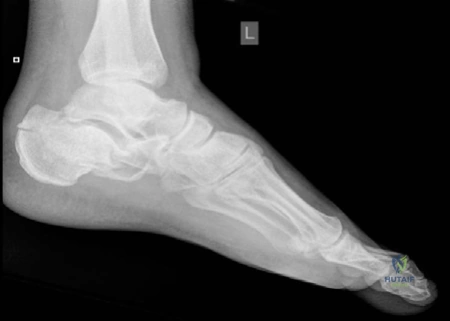
Candidate: The radiograph shows a displaced, intra-articular calcaneal fracture. There is loss of calcaneal height, reversal of Bohler’s angle, and a prominent fracture of the calcaneal tuberosity. Given the mechanism (fall from height), I must prioritize ATLS assessment, specifically ruling out spinal compression fractures, pilon/tibial plateau fractures, and other pedal injuries, alongside a thorough neurovascular assessment.
Jumping immediately into surgical technique (e.g., "I'll do an ORIF through an L-incision"). This fails to acknowledge the high-energy nature of the injury and the significant risk of associated "jumpers' fractures" (spine, femur, knee).
Systematic approach: 1. Radiological description (Bohler’s angle, Gissane’s angle, articular depression). 2. ATLS/Systemic survey (Spine 10-15%, bilateral calcaneal 10%). 3. "Soft tissue first" philosophy—emphasizing the danger of early intervention in an edematous foot to avoid wound dehiscence/infection.
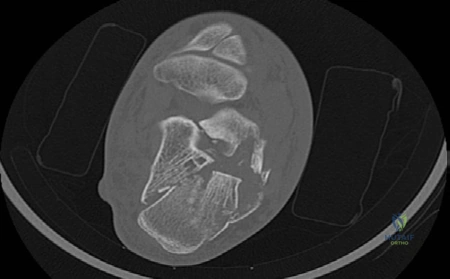
Following a period of elevation, the soft tissue envelope has settled. You now have the CT scan. Describe the anatomy of the injury and your surgical approach.
Candidate: The CT scan confirms a comminuted fracture with lateral wall blow-out, calcaneal widening, and a large sustentacular fragment. I would offer ORIF via an extended lateral approach. Key steps include full-thickness flap elevation, sural nerve protection, restoration of calcaneal height and width, and fixation with a low-profile plate, ensuring the sustentacular fragment is captured.
Neglecting the "Sustentacular Fragment." If a candidate fails to mention targeting this fragment—which is the "constant fragment" that remains attached to the talus—they miss the fundamental biomechanical goal of the surgery.
Detailing the "Constant Fragment" (sustentaculum tali). Mentioning the use of K-wires as "joysticks" to restore height. Demonstrating awareness of the "wrinkle sign" for soft tissue readiness. Defining the specific biomechanical goals: 1. Restore Height, 2. Correct Varus, 3. Reduce Articular Surface.
The patient is worried about his job as a roofer. How do you discuss the prognosis and potential complications of surgical versus non-operative treatment?
Candidate: I would be honest that these are life-changing injuries. While ORIF aims to restore anatomy, the incidence of post-traumatic subtalar arthritis remains high. I would reference the Buckley et al. (JBJS Am 2002) trial which suggests operative treatment is superior for specific displaced fractures, while highlighting that return to heavy manual labor (roofing) is often difficult regardless of the method chosen.
Promising a "return to normal" or ignoring the significant rate of complications, such as wound healing problems (the Achilles heel of calcaneal surgery) or chronic subtalar pain.
Balanced, evidence-based counseling. Acknowledge that outcomes are often determined by the initial injury severity (energy transfer) rather than just the surgery itself. Cite the "Gold Standard" literature (Buckley/Thordarson) to support the shared decision-making process.
