Orthopedic Pediatrics 2026 MCQs: Board Review Questions & Answers (Part 2)

Key Takeaway
Looking for accurate information on Orthopedic Pediatrics 2026 MCQs: Board Review Questions & Answers (Part 2)? Top-rated Orthopedic Pediatrics 2026 MCQs bank. Practice with clinical case questions, orthopedic surgery board review, and evidence-based answers updated for 2026.
Orthopedic Pediatrics 2026 MCQs: Board Review Questions & Answers (Part 2)
Comprehensive 100-Question Exam
00:00
Start Quiz
Question 1
Figures 11a and 11b show the clinical photograph and radiograph of a newborn. Based on these findings, what is the best course of action?
Explanation
Question 2
Figure 12 shows the radiograph of a patient who has anterior knee pain. History reveals a femoral fracture at age 5 years. What is the most likely cause of the deformity?
Explanation
Question 3
An 11-year-old boy has had a fever and pain and swelling over the lateral aspect of his right ankle for the past 3 days. Examination reveals warmth, swelling, and tenderness over the lateral malleolus, and he has a temperature of 103.2 degrees F (39.5 degrees C). Laboratory studies show a WBC count of 13,200/mm3 with 61% neutrophils, an erythocyte sedimentation rate of 112 mm/h, and a C-reactive protein of 15.7. Radiographs and a T2-weighted MRI scan are shown in Figures 13a through 13c. Aspiration yields 1 mL of purulent fluid. Management should now consist of
Explanation
Question 4
Figure 14 shows the clinical photographs and radiograph of an 8-year-old girl who has a progressive equinus deformity of the right ankle. There is no history of trauma or infection. What is the most likely diagnosis?
Explanation
Question 5
Which of the following patients is considered the most appropriate candidate for an isolated split posterior tendon transfer?
Explanation
Question 6
The mother of a 2-year-old boy reports that he had pain in the right hip all night and refuses to walk on the leg this morning. He is afebrile. Examination reveals pain on hip extension and adduction, but he is able to internally and externally rotate the hip approximately 20 degrees in each direction without pain. Laboratory studies reveal a WBC count of 7,400/mm3, with 62% polymorphonuclear neutrophil leukocytes. The AP radiograph shown in Figure 15 reveals a left teardrop distance of 8 mm, while the right side measures 10 mm. Which of the following diagnostic studies will best help confirm the diagnosis?
Explanation
Question 7
A senior resident is scheduled to perform a posterior medial release on a 10-month-old infant who has a congenital clubfoot deformity. Informed consent is obtained for the procedure. The supervising surgeon is obligated to give the parents what information?
Explanation
Question 8
Figure 16 shows the clinical photograph of a 3-month-old infant with a foot deformity that has been nonprogressive since birth. Examination reveals that the deformity corrects actively and with passive manipulation. There is no associated equinus. Management should consist of
Explanation
Question 9
Figure 17 shows the radiograph of an 11-year-old boy with Duchenne muscular dystrophy who has been nonambulatory for the past 2 years. Management of the spinal deformity should consist of
Explanation
Question 10
A 13-year-old girl with Down syndrome has bilateral chronic patellar dislocations. She denies knee pain. She is able to straighten her knees and walks with a symmetric but awkward gait. She does not flex her knees in midstance. Examination reveals that the patellae cannot be brought into a reduced position. Management should consist of
Explanation
Question 11
A 3-year-old patient with L3 myelomeningocele has bilateral dislocated hips. Management should consist of
Explanation
Question 12
A 4-year-old child sustains a spiral fracture to the tibia in an unwitnessed fall. History reveals three other fractures to long bones, and the parents are vague about the etiology of each. There is no family history of bone disease. The parents ask if the child has osteogenesis imperfecta (OI); however, there are no clinical or radiographic indications of this diagnosis. In addition to fracture care, management should include
Explanation
Question 13
A 10-year-old girl has been unable to walk for the past 5 days because of bilateral hip pain. Administration of IV morphine has provided some pain relief. She is afebrile. History reveals that she had an upper respiratory tract infection 3 weeks ago that resolved uneventfully. Examination reveals moderate pain with internal rotation and abduction, while log rolling maneuvers do not cause significant pain. An MRI scan shows a small effusion of one hip; however, a bone scan and plain radiographs are normal. Initial laboratory studies showed a markedly elevated WBC count, which subsequently declined to normal levels with IV antibiotics. Current studies show an erythrocyte sedimentation rate (ESR) of 100 mm/h. Aspiration of the hip obtains 3 mL of fluid; Gram stain is negative for bacteria, but a cell count shows a WBC count of 16,500/mm3. Streptozyme titer of the peripheral blood is 200 units (normal is less than 100 units). Management should now consist of
Explanation
Question 14
What is the best initial screening test for a patient with a limb-length discrepancy?
Explanation
Question 15
A 6-year-old girl has never been able to crawl or walk and can sit only when propped. History reveals no complications during pregnancy or delivery. Examination reveals a 30-degree scoliosis from T4 to L3. Deep tendon reflexes are absent, but fasciculations are present. The most likely genetic defect is the result of an abnormality in
Explanation
Question 16
Figure 18a shows the clinical photograph of a 2-year old boy who has a deformity of the right leg. Examination reveals eight cutaneous markings similar to those shown in Figure 18b. Radiographs are shown in Figure 18c. Management should consist of
Explanation
Question 17
What is the most common problem seen following epiphysiodesis for limb-length discrepancy?
Explanation
Question 18
Figure 19 shows the radiograph of a 6-month-old infant who has limited hip motion. History reveals no complications during pregnancy or delivery. Examination reveals that hip abduction is 45 degrees in flexion bilaterally. The neurologic examination is normal. What is the best course of action?
Explanation
Question 19
A 6-year-old boy with spastic diplegic cerebral palsy has a crouched gait. Examination reveals hip flexion contractures of 15 degrees and popliteal angles of 70 degrees. Equinus contractures measure 10 degrees with the knees extended. Which of the following surgical procedures, if performed alone, will worsen the crouching?
Explanation
Question 20
The parents of a 13-year-old boy with Down syndrome report that he has an increasing limp and decreased endurance with activities. Lateral flexion-extension radiographs of the cervical spine show no evidence of instability. Examination reveals a right Trendelenburg limp and an obvious limb-length discrepancy. Hip motion is symmetric except for some decreased abduction on the right side. A standing AP radiograph is shown in Figure 20. Management should consist of
Explanation
Question 21
A 9-year-old girl reports the immediate onset of severe groin pain and the inability to walk after tripping on a curb. Examination reveals marked hip pain with passive range of motion. A radiograph is shown in Figure 21. Regardless of treatment, what is the most common complication following this injury?
Explanation
Question 22
An 8-year-old boy reports progressive difficulty with walking. Examination reveals muscle weakness, with proximal groups more affected than distal muscles. Deep tendon reflexes are within normal limits. Laboratory studies show a creatine kinase level of 7,200 IU. Based on these findings, what is the most likely diagnosis?
Explanation
Question 23
A 7-year-old boy sustained a 2-cm laceration to the anterior aspect of his left knee after falling on a rock. Examination reveals that the joint surface is not visible through the wound. Radiographs show no evidence of a foreign body or free air in the joint. Management should consist of
Explanation
Question 24
What radiographic measurement is best used to assess the adequacy of deformity correction for the patient shown in Figure 22?
Explanation
Question 25
Figure 23 shows the radiograph of a 7 year-old girl with a low thoracic-level myelomeningocele. She has a history of skin ulcers over the apex of the deformity, but her current skin condition is good. Management of the spinal deformity should consist of
Explanation
Question 26
A 6-year-old boy presents with a completely displaced extension-type supracondylar humerus fracture. On examination, the hand is pink and warm, but the radial pulse is absent. Capillary refill is less than 2 seconds. What is the most appropriate next step in management?
Explanation
Question 27
A 12-year-old boy with a BMI of 32 presents with an acute-on-chronic stable left slipped capital femoral epiphysis (SCFE). Which of the following is the strongest indication for prophylactic pinning of the contralateral asymptomatic hip?
Explanation
Question 28
A 6-week-old girl is being treated with a Pavlik harness for developmental dysplasia of the hip. At her 2-week follow-up, she is noted to have decreased active extension of the knee on the treated side. Which of the following is the most appropriate next step?
Explanation
Question 29
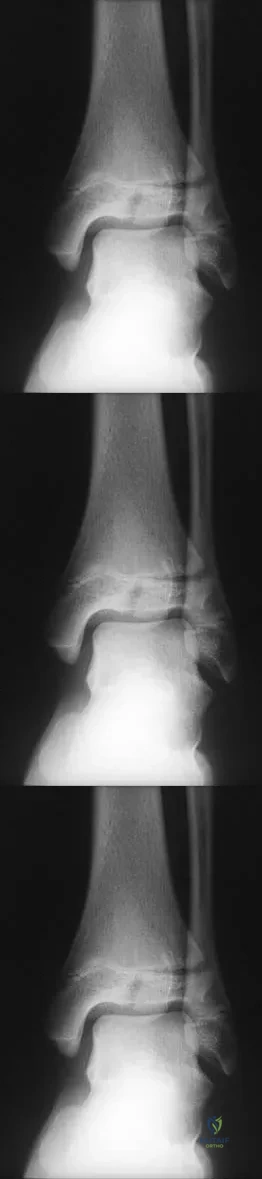
A 13-year-old girl sustains an ankle injury. Radiographs, similar to the example shown, demonstrate a Salter-Harris III fracture of the anterolateral distal tibia.
Which of the following describes the typical sequence of physeal closure in the distal tibia that predisposes to this specific injury pattern?
Explanation
Question 30
A 3-year-old boy treated successfully in infancy for idiopathic clubfoot with the Ponseti method presents with recurrent dynamic supination of the foot during the swing phase of gait. Passive range of motion of the foot is normal. What is the most appropriate surgical management?
Explanation
Question 31
An 11-year-old girl presents with an ill-defined, permeative lytic lesion in the diaphysis of the femur with a prominent soft tissue mass and "onion-skin" periosteal reaction. Biopsy confirms Ewing sarcoma. Which of the following chromosomal translocations is most commonly associated with this diagnosis?
Explanation
Question 32
A 6-week-old female is undergoing treatment with a Pavlik harness for developmental dysplasia of the hip (DDH). At her 1-week follow-up, the parents report she has stopped kicking her left leg. On examination, there is decreased active extension of the left knee, but normal ankle movements. What is the most appropriate next step in management?
Explanation
Question 33
A 2-week-old infant presents with idiopathic clubfoot. The Ponseti method is initiated. What is the correct sequence of deformity correction during serial casting?
Explanation
Question 34
A 12-year-old boy presents with left knee pain and a limp. Radiographs confirm a stable left slipped capital femoral epiphysis (SCFE). Which of the following is the most accepted indication for prophylactic pinning of the contralateral asymptomatic hip?
Explanation
Question 35
A 6-year-old boy sustains an extension-type Gartland III supracondylar humerus fracture. Examination reveals weakness in flexing the interphalangeal joint of the thumb and the distal interphalangeal joint of the index finger. Which nerve is most likely injured?
Explanation
Question 36
In a child with Legg-Calve-Perthes disease, which of the following radiographic findings during the fragmentation stage is considered a "head-at-risk" sign indicating a poorer prognosis?
Explanation
Question 37
Which of the following fracture patterns in a 4-month-old infant is most highly specific for non-accidental trauma?
Explanation
Question 38
An 8-month-old female presents with an untreated developmental dysplasia of the hip (DDH) with a dislocated left hip. What is the most appropriate initial management?
Explanation
Question 39
A 13-year-old boy presents with frequent ankle sprains and rigid flatfeet. Radiographs demonstrate an elongated anterior process of the calcaneus (anteater sign). Which of the following is the most likely diagnosis?
Explanation
Question 40
According to established hip surveillance guidelines for children with cerebral palsy, which Gross Motor Function Classification System (GMFCS) level is associated with the highest risk of hip displacement?
Explanation
Question 41
A 3-year-old child sustains an isolated closed spiral fracture of the femoral shaft after a fall. The child weighs 16 kg (35 lbs). What is the most appropriate definitive treatment?
Explanation
Question 42
A 14-year-old girl sustains an ankle injury. Radiographs reveal a Salter-Harris III fracture of the anterolateral distal tibial epiphysis. What is the mechanism of this injury?
Explanation
Question 43
A 12-year-old premenarchal girl presents with adolescent idiopathic scoliosis. Her primary thoracic curve measures 25 degrees. Her Risser stage is 0. What is her approximate risk of curve progression to greater than 50 degrees?
Explanation
Question 44
Osteogenesis imperfecta is most commonly caused by an autosomal dominant mutation affecting which of the following?
Explanation
Question 45
A 3-year-old boy presents with progressive bilateral genu varum. Radiographs reveal an increased metaphyseal-diaphyseal angle (Drennan angle) of 18 degrees and medial metaphyseal beaking. What is the most likely diagnosis?
Explanation
Question 46
According to the Kocher criteria, which of the following is NOT one of the four classic predictors used to differentiate septic arthritis of the hip from transient synovitis in children?
Explanation
Question 47
A 7-year-old girl presents with a painless snapping sensation in her lateral knee. MRI reveals a completely discoid lateral meniscus without any tears or instability. What is the most appropriate management?
Explanation
Question 48
An 8-year-old boy presents with a limp, fever, and refusal to bear weight on his right leg. Blood cultures are drawn and he is taken for aspiration and debridement of suspected acute hematogenous osteomyelitis. Which of the following organisms is the most common cause of this condition?
Explanation
Question 49
Children with achondroplasia are at highest risk for which of the following life-threatening neurologic complications during infancy?
Explanation
Question 50
A 9-year-old child sustains a displaced radial neck fracture with 45 degrees of angulation. Closed reduction attempts in the emergency department fail to improve the alignment. What is the next best step in management?
Explanation
Question 51
A 10-year-old boy with wide open physes sustains a complete anterior cruciate ligament (ACL) tear. He experiences recurrent instability despite bracing and physical therapy. Which surgical technique is most appropriate to minimize the risk of growth arrest?
Explanation
Question 52
A 14-year-old gymnast presents with persistent low back pain. Radiographs demonstrate a Grade II isthmic spondylolisthesis at L5-S1. She has failed 6 months of physical therapy and bracing. Which of the following is the most appropriate surgical intervention?
Explanation
Question 53
An 18-month-old girl presents with a limp. Pelvic radiographs reveal a completely dislocated left hip with an acetabular index of 42 degrees. She has had no prior treatment. What is the most appropriate management plan?
Explanation
Question 54
A 13-year-old obese boy presents to the emergency department unable to bear weight on his right leg after a minor slip. He reports a 3-month history of mild right knee pain. Examination shows the right hip resting in external rotation. Which of the following complications is most highly associated with this acute presentation?
Explanation
Question 55
A 4-year-old boy treated successfully in infancy for idiopathic clubfoot with the Ponseti method presents with an abnormal gait. Examination reveals dynamic supination of the foot during the swing phase of gait, with no fixed rigid deformities. What is the treatment of choice?
Explanation
Question 56
A 6-year-old boy sustains a completely displaced, extension-type supracondylar humerus fracture. On arrival, the hand is pink and well-perfused, but the radial pulse is absent. What is the most appropriate next step in management?
Explanation
Question 57
A 7-year-old girl with spastic quadriplegic cerebral palsy has bilateral hip pain. Pelvic radiographs show bilateral hip subluxation with a Reimers migration percentage of 60%. What is the most appropriate surgical intervention?
Explanation
Question 58
A 4-year-old obese boy presents with bilateral progressive bowing of the legs. Radiographs demonstrate a metaphyseal-diaphyseal angle of 18 degrees and profound depression of the medial proximal tibial physis (Langenskiold stage III). What is the recommended treatment?
Explanation
Question 59
A 14-year-old boy presents with rigid, painful flatfeet and a history of recurrent ankle sprains. Computed tomography confirms a talocalcaneal coalition. If non-operative management is chosen first, what is the most appropriate initial intervention?
Explanation
Question 60
A 2-year-old girl is evaluated for recurrent fractures following minimal trauma. Clinical examination reveals blue sclerae and dentinogenesis imperfecta. A defect in which of the following genes is most likely responsible?
Explanation
Question 61
A 7-year-old boy has been limping for 6 months and is diagnosed with Legg-Calve-Perthes disease. Radiographs show fragmentation of the femoral head. Which of the following radiographic findings represents the poorest prognostic factor?
Explanation
Question 62
Congenital pseudarthrosis of the tibia (CPT) is most frequently associated with which of the following systemic conditions?
Explanation
Question 63
A 12-year-old boy presents with thigh pain and a low-grade fever. Radiographs show a permeative diaphyseal lesion of the femur with an "onion-skin" periosteal reaction. Biopsy reveals sheets of small round blue cells. Which chromosomal translocation is highly diagnostic for this tumor?
Explanation
Question 64
A 3-year-old boy sustains an isolated, closed, spiral midshaft fracture of the right femur after a fall from a playground slide. He has no other injuries, and child abuse is not suspected. What is the most appropriate definitive management?
Explanation
Question 65
A 14-year-old girl presents with ankle pain after a twisting injury. Radiographs show a Salter-Harris III fracture of the anterolateral aspect of the distal tibial epiphysis. This injury (Tillaux fracture) is caused by avulsion from which of the following structures?
Explanation
Question 66
A 14-year-old female gymnast with chronic back pain has failed 6 months of non-operative management. Radiographs reveal an isthmic spondylolisthesis at L5-S1 with a 60% anterior slip (Meyerding Grade III). What is the most appropriate surgical treatment?
Explanation
Question 67
A 12-year-old obese boy presents to the emergency department with severe right groin pain and an inability to bear weight on his right leg after a minor fall. Radiographs confirm a severe slipped capital femoral epiphysis (SCFE). He undergoes urgent in situ pinning. Which of the following complications is most highly associated with this patient's specific type of presentation?
Explanation
Question 68
A 6-week-old infant is being treated with a Pavlik harness for developmental dysplasia of the hip (DDH). During the follow-up visit, the parents report that the infant is no longer actively extending the knee on the treated side. On examination, there is decreased spontaneous movement of the quadriceps. What is the most appropriate next step in management?
Explanation
Question 69
A 7-year-old boy is diagnosed with Legg-Calvé-Perthes disease (LCPD). Which of the following factors at the time of presentation is considered the most significant predictor of a poor long-term radiographic outcome?
Explanation
Question 70
A 5-year-old girl falls from monkey bars and sustains a widely displaced, extension-type Gartland III supracondylar humerus fracture. On initial evaluation, the hand is pink and warm, but the radial pulse is not palpable. What is the most appropriate initial management?
Explanation
Question 71
A 3-year-old boy sustains an isolated, closed, midshaft femur fracture with 2 cm of shortening. The child has no other injuries, and child abuse is not suspected. What is the gold standard of treatment for this patient?
Explanation
Question 72
A 2-year-old child with a history of idiopathic clubfoot successfully treated with the Ponseti method presents with a dynamic supination deformity during the swing phase of gait. Passive range of motion is full, and the foot is completely correctable. What is the most appropriate surgical intervention?
Explanation
Question 73
A 30-month-old obese child presents with bilateral severe genu varum and a noticeable lateral thrust during gait. Radiographs show medial beaking of the proximal tibia. Which radiographic parameter most reliably differentiates infantile Blount disease from physiologic bowing?
Explanation
Question 74
A 4-year-old boy presents with a 2-day history of right hip pain and a limp. He refuses to bear weight. His temperature is 38.8 C (101.8 F), ESR is 45 mm/hr, WBC count is 13,000/mm3, and serum CRP is 2.5 mg/dL. According to the classic Kocher criteria, what is the approximate probability that this child has septic arthritis?
Explanation
Question 75
A 5-year-old girl is evaluated for multiple long bone fractures following minimal trauma. Clinical examination reveals blue sclerae and opalescent, abnormally worn teeth. Mutations in which of the following genes are the most common cause of her condition?
Explanation
Question 76
An 8-year-old girl presents with a painless clicking and popping sound in her knee during extension. MRI reveals an abnormally thickened meniscus. The Wrisberg variant of this specific condition is characterized by the absence of which of the following stabilizing structures?
Explanation
Question 77
A 13-year-old boy sustains an ankle injury while playing soccer. Radiographs reveal a Salter-Harris type III fracture of the anterolateral aspect of the distal tibial epiphysis. What structure avulses this bone fragment during the injury mechanism?
Explanation
Question 78
A 14-year-old boy presents with a painful, rigid flatfoot and recurrent ankle sprains. Examination shows peroneal spasm. A lateral radiograph of the foot reveals a continuous "C-sign." This radiographic finding represents abnormal continuity between which of the following structures?
Explanation
Question 79
A 10-year-old girl with widely open physes sustains a mid-substance anterior cruciate ligament (ACL) tear. Surgical reconstruction is planned. To minimize the risk of physeal arrest, particularly at the distal femur and proximal tibia, which technique is most appropriate?
Explanation
Question 80
A 6-year-old boy is evaluated for an acute fracture through the growth plate of a major long bone. Which of the following physeal fracture locations carries the highest intrinsic incidence of premature physeal closure, even in the setting of non-displaced Salter-Harris I and II patterns?
Explanation
Question 81
Figure 37 shows a radiograph of a 13-year-old presenting with hip pain.
To assess for the condition seen, a line is drawn along the superior aspect of the femoral neck. In a normal hip, this line intersects the lateral aspect of the epiphysis. What is the eponymous sign when this line fails to intersect the epiphysis?
Explanation
Question 82
A 12-year-old non-ambulatory boy with Duchenne muscular dystrophy (DMD) has developed a progressive scoliosis of 35 degrees. His forced vital capacity (FVC) is 45% of predicted. What is the most widely accepted orthopaedic management for this patient's spinal deformity?
Explanation
Question 83
A 9-year-old male soccer player presents with bilateral posterior heel pain. The pain worsens with activity and is relieved by rest. Examination reveals a positive "squeeze test" with pain on mediolateral compression of the posterior calcaneus. What is the primary pathophysiologic mechanism of this condition?
Explanation
Question 84
A newborn is evaluated in the nursery for a significantly shortened left lower extremity. The hip is maintained in a flexed, abducted, and externally rotated position. Radiographs reveal a severe deficiency of the proximal femur. Which of the following congenital anomalies is most commonly associated with this presentation?
Explanation
Question 85
A 6-year-old child with spastic quadriplegic cerebral palsy is found to have a Reimer's migration percentage of 45% on a screening AP pelvis radiograph. Spasticity in which specific muscle groups is the primary deforming force leading to hip subluxation in this patient population?
Explanation
Question 86
A 9-month-old boy is referred for a left-sided thoracic scoliosis. Upright radiographs demonstrate a 25-degree curve. Measurement of the rib-vertebra angle difference (RVAD) of Mehta at the apical vertebra is 25 degrees. Based on these findings, what is the most likely natural history and the appropriate next step in management?
Explanation
Question 87
A 6-week-old female is treated with a Pavlik harness for developmental dysplasia of the hip (DDH). During a follow-up visit, it is noted that the harness is adjusted with excessive hip flexion. This specific malposition is most associated with which of the following complications?
Explanation
Question 88
A 13-year-old obese boy presents with a stable slipped capital femoral epiphysis (SCFE) of the left hip. What is the most established primary indication for prophylactic pinning of the asymptomatic contralateral hip?
Explanation
Question 89
An 8-year-old boy with Legg-Calve-Perthes disease presents with hip pain and a limp. Radiographs reveal greater than 50% maintenance of the lateral pillar height (Herring B). According to the Herring lateral pillar classification, what is the most appropriate management?
Explanation
Question 90
A 6-year-old boy sustains a completely displaced extension-type supracondylar humerus fracture. After anatomic closed reduction and percutaneous pinning in the operating room, the hand is pink and capillary refill is brisk, but the radial pulse remains absent. What is the most appropriate next step in management?
Explanation
Question 91
A 3-year-old girl presents with progressive bowing of her left leg. A clinical radiograph demonstrates medial physeal sloping and metaphyseal beaking.
Which radiographic measurement is most predictive of progression in this condition?
Explanation
Question 92
A 3-year-old boy with a history of idiopathic clubfoot successfully treated with the Ponseti method presents with a recurrent deformity. Gait analysis reveals dynamic supination of the foot during the swing phase, but passive hindfoot range of motion is normal. What is the most appropriate treatment?
Explanation
Question 93
A 9-year-old boy weighing 38 kg sustains an isolated, closed midshaft femur fracture. What is the current gold standard treatment modality for this patient?
Explanation
Question 94
A 14-year-old gymnast presents with chronic lower back pain and severe hamstring tightness. Radiographs reveal an L5-S1 isthmic spondylolisthesis with 60% anterior translation of L5 on S1 (Grade III). Nonoperative management has failed over 6 months. What is the most appropriate surgical intervention?
Explanation
Question 95
A 5-year-old boy with recurrent fractures, blue sclerae, and dentinogenesis imperfecta is initiated on intravenous pamidronate therapy. Which of the following best describes the primary mechanism of action of this medication in this patient?
Explanation
Question 96
A 12-year-old girl sustains a Salter-Harris type II fracture of the distal femur. She undergoes an anatomic closed reduction and percutaneous pinning. The parents are counseled regarding the prognosis. Which of the following complications is most notoriously common with this specific injury?
Explanation
Question 97
A 10-year-old boy sustains a completely displaced (Meyers and McKeever Type III) tibial eminence fracture during a bicycle accident. Closed reduction is attempted but is unsuccessful. Which of the following structures is most commonly entrapped, preventing an anatomic closed reduction?
Explanation
Question 98
A 13-year-old boy presents with recurrent ankle sprains and rigid, painful flatfeet. A lateral radiograph of the foot demonstrates a prominent "C sign." Which of the following is the most likely diagnosis?
Explanation
None
