Orthopedic Basic 2026 MCQs: Board Review Questions & Answers (Part 3)

Key Takeaway
Your ultimate guide to Orthopedic Basic 2026 MCQs: Board Review Questions & Answers (Part 3) starts here. Top-rated Orthopedic Basic 2026 MCQs bank. Practice with clinical case questions, orthopedic surgery board review, and evidence-based answers updated for 2026.
Orthopedic Basic 2026 MCQs: Board Review Questions & Answers (Part 3)
Comprehensive 100-Question Exam
00:00
Start Quiz
Question 1
Figure 26a shows the radiograph of a 55-year-old woman who has pain in her right leg after falling. Laboratory studies reveal an elevated alkaline phosphatase level. A biopsy specimen from the proximal tibia is shown in Figure 26b. What is the most likely diagnosis?
Explanation
Question 2
Radiographs of a pediatric patient reveal a suspected osteosarcoma of the distal femur. Additional staging studies should consist of
Explanation
Question 3
Which of the following factors are considered prognostic of survival in patients with soft-tissue sarcomas?
Explanation
Question 4
Figures 27a through 27c show the AP radiograph, MRI scan, and biopsy specimen of an otherwise healthy man who has a painful wrist. Serum chemistry studies are normal. What is the most likely diagnosis?
Explanation
Question 5
What is the most common primary malignant tumor of bone in childhood?
Explanation
Question 6
A 44-year-old woman has bilateral knee pain, and history reveals bilateral hip replacements. Radiographs are seen in Figure 28a, and histopathologic specimens from the total hip replacement are shown in Figures 28b and 28c. Laboratory studies reveal anemia. What is the most likely diagnosis?
Explanation
Question 7
In addition to pain, which of the following factors are considered most predictive of the risk of pathologic fracture?
Explanation
Question 8
Patients with which of the following primary carcinomas have the shortest overall survival rate after a solitary metastasis to bone?
Explanation
Question 9
A 63-year-old woman has a femoral neck fracture. A biopsy specimen obtained from the fracture site at the time of her hemiarthroplasty reveals metastatic carcinoma. Seven days after surgery, she becomes confused and lethargic. Which of the following laboratory values is most likely implicated in the patient's symptoms at this time?
Explanation
Question 10
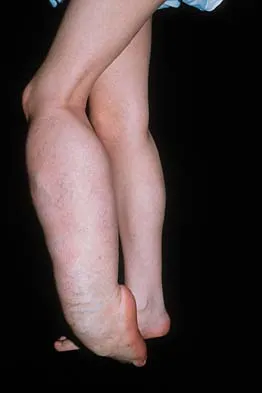
Figure 29a shows the clinical photograph of a 26-year-old woman who has had the leg deformity since birth. She reports difficulty with walking and weight bearing and notes increased discomfort and swelling when the leg is dependent. She denies any history of trauma or family history of a similar disorder. Examination reveals a fixed equinovarus deformity of the foot but no evidence of a limb-length discrepancy. No other cutaneous findings or soft-tissue masses are noted. Sagittal and axial T1- and T2-weighted MRI scans are shown in Figures 29b and 29c. What is the most likely diagnosis?
Explanation
Question 11
Figures 30a and 30b show the MRI scans of a 51-year-old woman who has had an enlarging soft-tissue mass in her right thigh for the past 18 months. Examination reveals no inguinal adenopathy. Results of a biopsy show a high-grade sarcoma. A bone scan is unremarkable, and a CT scan of the chest shows no evidence of pulmonary metastasis. According to the Musculoskeletal Tumor Society (MSTS) staging system, the tumor should be classified as what stage?
Explanation
Question 12
An otherwise healthy 45-year-old man has a 3-cm subcutaneous mass on his anterior thigh that is presumed to be a lipoma. Removal of the mass is performed in the office of his primary care physician. Pathologic evaluation shows a high-grade malignant fibrous histiocytoma. Staging reveals no evidence of metastatic disease. Management at this time should consist of
Explanation
Question 13
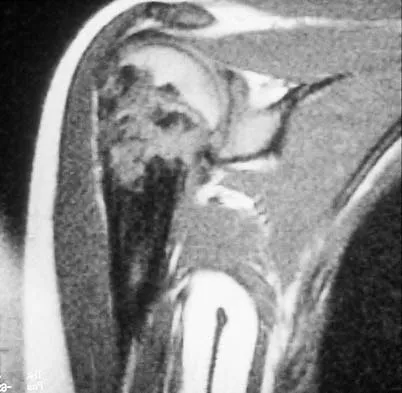
A 13-year-old girl has had a firm mass and pain in her right shoulder for the past several weeks. She denies any history of trauma. A radiograph and MRI scan are shown in Figures 31a and 31b. Biopsy specimens are shown in Figures 31c and 31d. What is the most likely diagnosis?
Explanation
Question 14
The use of radiation therapy is most effective in metastatic bone disease from which of the following tumors?
Explanation
Question 15
Figures 32a and 32b show the radiographs of an active 13-year-old boy who has persistent left thigh pain and a limp despite a trial of protected weight bearing. Management should consist of
Explanation
Question 16
The spread of malignant cells to the vertebrae is often through
Explanation
Question 17
A 10-year-boy has had thigh pain for the past several months. He denies any history of trauma. Examination reveals no soft-tissue mass, and mild tenderness. Figures 33a and 33b show the plain radiograph and MRI scan, and the biopsy specimens are shown in Figures 33c and 33d. What is the most likely diagnosis?
Explanation
Question 18
A 35-year-old patient has right hip pain. Figures 34a and 34b show the coronal MRI scan and the biopsy specimen. What is the most likely diagnosis?
Explanation
Question 19
A 16-year-old girl has a painful foot mass. A radiograph, MRI scan, and biopsy specimens are shown in Figures 35a through 35d. What is the most likely diagnosis?
Explanation
Question 20
What is the most common diagnosis in a patient older than age 40 years with a destructive bony lesion?
Explanation
Question 21
A 78-year-old man being seen for routine follow-up studies reports mild to moderate pain in his left arm. The patient has a history of lung cancer and severe heart disease. A radiograph and a bone scan are shown in Figures 36a and 36b. Treatment should consist of
Explanation
Question 22
Which of the following benign bone lesions can develop lung metastases?
Explanation
Question 23
The radiographic feature seen in Figure 37 that best indicates a slow-growing process is the
Explanation
Question 24
A 52-year-old man has a stage IIB malignant fibrous histiocytoma of the distal femur. Local treatment should consist of
Explanation
Question 25
A patient undergoes excision of a 3- x 3-cm soft-tissue sarcoma. The final histology results show tumor at the surgical margin. The surgical procedure performed is classified as
Explanation
Question 26
A 14-year-old boy presents with severe thigh pain and a low-grade fever. Radiographs show a permeative diaphyseal lesion in the femur with an "onion skin" periosteal reaction. Biopsy reveals sheets of uniform, small, round, blue cells. Which chromosomal translocation is most definitively associated with this patient's diagnosis?
Explanation
Question 27
When designing an orthopedic implant for diaphyseal fracture fixation, minimizing stress shielding is a primary goal. Which of the following implant materials possesses a Young's modulus most closely approximating that of human cortical bone?
Explanation
Question 28
Normal articular cartilage is structurally divided into four distinct zones. Which zone is characterized by having the highest concentration of proteoglycans, the lowest water content, and collagen fibrils oriented perpendicular to the articular surface?
Explanation
Question 29
The historical sterilization method of ultra-high-molecular-weight polyethylene (UHMWPE) components using gamma irradiation in air resulted in which of the following detrimental long-term material property changes?
Explanation
Question 30
A diaphyseal radius fracture is treated with rigid internal fixation using a dynamic compression plate, achieving absolute stability and anatomic reduction. This construct primarily dictates which pathway of bone healing?
Explanation
Question 31
A 22-year-old male presents with severe nocturnal anterior thigh pain that is reliably relieved by oral ibuprofen. Radiographs demonstrate a 1-cm radiolucent nidus surrounded by thick cortical sclerosis in the proximal femoral diaphysis. What is the most appropriate definitive management for this lesion?
Explanation
Question 32
A 30-year-old female presents with knee pain. Radiographs reveal an eccentric, lytic, epiphyseal lesion in the distal femur that extends to the subchondral bone. Histopathologic analysis shows multinucleated giant cells in a background of mononuclear cells. The targeted biologic therapy denosumab acts by inhibiting which of the following factors expressed by the neoplastic cells in this lesion?
Explanation
Question 33
Bone morphogenetic proteins (BMPs) are utilized in spine surgery for their potent osteoinductive properties. They primarily exert their effect by binding to cell membrane receptors, which subsequently phosphorylates which family of intracellular signaling proteins to transcribe osteogenic genes?
Explanation
Question 34
When optimizing the fixation of a pedicle screw in osteoporotic bone, the pullout strength of the screw is most significantly increased by maximizing which of the following screw design parameters?
Explanation
Question 35
A 55-year-old male incidentally presents with an expansile, radiolucent lesion featuring central "rings and arcs" calcifications in the proximal humerus. Biopsy confirms a grade 1 (low-grade) conventional central chondrosarcoma. Which of the following is the standard recommended surgical treatment for this appendicular lesion?
Explanation
Question 36
In fracture fixation, utilizing a stainless steel screw through a titanium plate in a saline-rich environment can lead to accelerated degradation of the implant. This process is best described as which type of corrosion?
Explanation
Question 37
A 10-year-old girl is evaluated for a leg length discrepancy and a "shepherd's crook" deformity of her proximal femur. Radiographs reveal an intramedullary lesion with a hazy, "ground-glass" matrix. This disorder is driven by a somatic postzygotic mutation in which of the following genes?
Explanation
Question 38
During the bone remodeling cycle, osteoclasts attach to the bone surface via integrins, creating an isolated resorption pit (Howship's lacuna). Which intracellular enzyme is critical for generating the protons needed to acidify this microenvironment and dissolve the inorganic bone mineral?
Explanation
Question 39
A surgeon applies a constant, continuous distraction force to a contracted joint capsule using a hinged external fixator. Over several days, the capsule gradually elongates without any increase in the applied force. What is the biomechanical term for this viscoelastic phenomenon?
Explanation
Question 40
Polymethylmethacrylate (PMMA) is widely used for implant fixation in joint arthroplasty. Which of the following statements accurately describes its biomechanical properties?
Explanation
Question 41
A 32-year-old male presents with a slowly growing, painful soft tissue mass near the knee joint. Biopsy demonstrates a biphasic tumor with both epithelial and spindle cell components. Molecular testing reveals a t(X;18) chromosomal translocation. This specific genetic alteration results in which oncogenic fusion protein?
Explanation
Question 42
The menisci of the knee play a crucial role in load distribution and shock absorption. The predominantly circumferential orientation of type I collagen bundles within the meniscus is specifically adapted to resist which biomechanical force during axial loading?
Explanation
Question 43
A 65-year-old man sustains a pathologic fracture of the humerus. Radiographs show multiple "punched-out" lytic lesions. Laboratory work reveals hypercalcemia, anemia, and an IgG kappa monoclonal spike. The severe osteolysis seen in this condition is primarily mediated by the neoplastic cells secreting factors that heavily upregulate which pathway?
Explanation
Question 44
A 45-year-old highly active patient requires a total hip arthroplasty. A ceramic-on-ceramic bearing couple is selected. Compared to a traditional metal-on-polyethylene bearing, what is the primary tribological advantage of the ceramic-on-ceramic articulation?
Explanation
Question 45
Following a severe crush injury to the forearm, a patient exhibits a complete median nerve palsy. According to the Sunderland classification, a third-degree peripheral nerve injury is characterized by the disruption of the axon and which other structural layer, while the perineurium remains intact?
Explanation
Question 46
A trauma surgeon uses a stainless steel dynamic compression plate but places titanium alloy screws for fixation of a diaphyseal femur fracture due to lack of inventory. Which type of corrosion is most likely to occur at the screw-plate interface?
Explanation
Question 47
A 70-year-old female with osteoporosis is prescribed a nitrogen-containing bisphosphonate. This medication inhibits bone resorption primarily by inhibiting which of the following intracellular targets within the osteoclast?
Explanation
Question 48
A 12-year-old boy presents with a painful, diaphyseal lesion of the femur. Biopsy reveals sheets of small, round, blue cells that strongly express CD99.
Which of the following chromosomal translocations is most characteristic of this diagnosis?
Explanation
Question 49
During the excitation-contraction coupling of skeletal muscle, the unmasking of the myosin-binding sites on the actin filament is directly triggered by the binding of calcium to which of the following proteins?
Explanation
Question 50
A 60-year-old man presents with a painful, enlarging mass in his proximal humerus. Radiographs demonstrate a lytic lesion with intralesional "popcorn" calcifications and endosteal scalloping. Core biopsy confirms a Grade II conventional chondrosarcoma. What is the most appropriate management?
Explanation
Question 51
When a constant tensile force is applied to a ligament over a prolonged period, the ligament gradually continues to elongate. Which biomechanical term best describes this time-dependent property?
Explanation
Question 52
A 35-year-old sustains a transverse radius shaft fracture that is treated with open reduction and internal fixation using a dynamic compression plate to achieve absolute stability. What is the primary mechanism of bone healing expected in this scenario?
Explanation
Question 53
A 55-year-old patient presents with diffuse bone pain and proximal muscle weakness. Laboratory evaluation reveals hypocalcemia, hypophosphatemia, elevated alkaline phosphatase, and elevated parathyroid hormone. Radiographs show Looser zones in the femoral neck. What is the primary histopathologic defect?
Explanation
Question 54
Which of the following sterilization methods for ultra-high-molecular-weight polyethylene (UHMWPE) acetabular liners is most strongly associated with increased free radical formation and subsequent in vivo oxidative degradation?
Explanation
Question 55
Articular cartilage is highly specialized to withstand distinct mechanical forces. In which histologic layer of articular cartilage are the type II collagen fibers oriented perpendicular to the joint surface to resist significant compressive loads?
Explanation
Question 56
A patient develops a chronic periprosthetic joint infection (PJI) three years after total knee arthroplasty. Cultures yield a coagulase-negative organism. Which of the following bacteria is most notorious for evading host defenses by producing a robust polysaccharide glycocalyx biofilm on the implant?
Explanation
Question 57
A 28-year-old man presents with a slow-growing, painful mass adjacent to his knee joint. Histology reveals a biphasic pattern consisting of spindle cells and epithelial cells.
Which cytogenetic abnormality is pathognomonic for this tumor?
Explanation
Question 58
Parathyroid hormone (PTH) plays a critical role in calcium homeostasis by modulating bone turnover. By what mechanism does PTH indirectly stimulate osteoclastic bone resorption?
Explanation
Question 59
A patient presents with a radial nerve palsy immediately following a closed midshaft humerus fracture. Electromyography at 4 weeks is consistent with a Sunderland Class II injury (axonotmesis). Which of the following best describes the microscopic pathology of the nerve at the injury site?
Explanation
Question 60
A patient is prescribed rivaroxaban for deep vein thrombosis (DVT) prophylaxis following a total hip arthroplasty. What is the specific molecular target of this pharmacological agent?
Explanation
Question 61
During the biomechanical loading of a normal human synovial joint, different lubrication mechanisms dominate depending on the applied load and velocity. During the initial high-load impact phase, such as heel strike during gait, which primary mechanism prevents immediate cartilage-to-cartilage contact?
Explanation
Question 62
A 65-year-old male with a history of advanced prostate carcinoma presents with severe back pain. Radiographs demonstrate multiple dense, osteoblastic lesions in the lumbar vertebrae. Prostate cancer cells predominantly stimulate this osteoblastic response by secreting which of the following factors?
Explanation
Question 63
A 4-year-old child presents with a history of multiple low-energy long bone fractures, blue sclerae, and dentinogenesis imperfecta. This clinical syndrome is most commonly caused by an autosomal dominant mutation affecting which of the following?
Explanation
Question 64
A surgeon plans to utilize recombinant human bone morphogenetic protein-2 (rhBMP-2) on a collagen sponge carrier to augment healing in a tibial nonunion. At the cellular level, BMP-2 promotes osteoinduction primarily by initiating an intracellular signaling cascade mediated by which proteins?
Explanation
Question 65
A 22-year-old athlete sustains a grade II medial collateral ligament (MCL) tear of the knee, which is managed conservatively. During the early proliferative phase of ligament healing (days to weeks), fibroblasts synthesize a disorganized extracellular matrix predominantly composed of which collagen type?
Explanation
Question 66
What is the primary mechanical disadvantage of increasing the radiation dose to produce highly cross-linked ultra-high-molecular-weight polyethylene (UHMWPE) for total joint arthroplasty?
Explanation
Question 67
A 14-year-old boy presents with a diaphyseal lesion of the femur and an 'onion-skin' periosteal reaction. Biopsy reveals sheets of small round blue cells.
Which chromosomal translocation is most characteristically associated with this diagnosis?
Explanation
Question 68
A pediatric patient with frequent fractures and cranial nerve palsies is evaluated. Radiographs demonstrate a diffuse 'bone-within-bone' appearance. The primary pathophysiologic defect in this condition is characterized by a failure of which of the following?
Explanation
Question 69
When evaluating normal adult articular cartilage histology, in which zone are the collagen fibers oriented perpendicular to the joint surface and the highest concentration of proteoglycans found?
Explanation
Question 70
A 68-year-old woman sustains an atypical subtrochanteric femur fracture after taking alendronate for 10 years. What is the primary cellular mechanism of action of this class of medication?
Explanation
Question 71
An 18-year-old male presents with dull back pain that is worse at night and relieved by NSAIDs. Radiographs show a distinct lesion in the posterior elements of L4. Which of the following features most reliably differentiates osteoblastoma from osteoid osteoma?
Explanation
Question 72
During the pathogenesis of periprosthetic joint infection, which phase of biofilm formation is characterized by the secretion of extracellular polymeric substances (EPS) leading to irreversible bacterial attachment?
Explanation
Question 73
In understanding the biomechanics of the native anterior cruciate ligament (ACL), the anteromedial (AM) bundle is most taut in which of the following knee positions?
Explanation
Question 74
Recombinant human bone morphogenetic protein-2 (rhBMP-2) is utilized to augment spinal fusion. BMPs primarily induce bone formation by binding to cell surface receptors and stimulating which of the following intracellular signaling pathways?
Explanation
Question 75
A 65-year-old male presents with bone pain and hypercalcemia. Radiographs demonstrate multiple 'punched-out' lytic lesions in the skull and long bones.
The profound lack of bone formation in the lytic lesions of this disease is primarily mediated by tumor cell secretion of which factor?
Explanation
Question 76
A patient undergoes total hip arthroplasty and is prescribed rivaroxaban for deep vein thrombosis prophylaxis. This medication achieves its antithrombotic effect through the direct inhibition of which component of the coagulation cascade?
Explanation
Question 77
A midshaft tibia fracture is treated with a reamed, statically locked intramedullary nail. Which type of bone healing predominates in this biomechanical environment?
Explanation
Question 78
A patient sustains a closed midshaft humerus fracture and presents with an immediate complete radial nerve palsy. If an electromyogram (EMG) is obtained, at what time point after injury are fibrillation potentials most likely to first appear?
Explanation
Question 79
When evaluating a new diagnostic test for periprosthetic joint infection, the positive predictive value (PPV) of the test is most heavily influenced by which of the following statistical parameters?
Explanation
Question 80
Acollegial review of a pediatric patient with rhizomelic short stature and frontal bossing is conducted. Achondroplasia is caused by a gain-of-function mutation in the FGFR3 gene. This mutation primarily causes the phenotype by which mechanism?
Explanation
Question 81
A 50-year-old male undergoes a biopsy of a 6 cm deep soft tissue mass in his thigh, which confirms high-grade pleomorphic sarcoma. Staging workup shows no metastases. According to the AJCC staging system, what is the most important prognostic factor for determining the stage of this localized tumor?
Explanation
Question 82
A patient undergoes revision total hip arthroplasty for unexplained pain and a pseudo-tumor associated with a modular neck prosthesis. Black particulate debris is noted at the head-neck junction. What type of corrosion primarily initiates this specific failure cascade?
Explanation
Question 83
A 30-year-old female is diagnosed with an advanced giant cell tumor of bone in the distal femur. Denosumab is recommended for neoadjuvant treatment. What is the exact mechanism of action of this medication?
Explanation
Question 84
During the evaluation of a patient with suspected osteomalacia, vitamin D metabolism is reviewed. Which enzyme is directly responsible for the conversion of 25-hydroxyvitamin D to its most active hormonal form, 1,25-dihydroxyvitamin D?
Explanation
Question 85
A surgeon plans to use demineralized bone matrix (DBM) to augment a tibial nonunion repair. Compared to an autologous iliac crest bone graft, DBM inherently possesses which of the following biologic properties for bone healing?
Explanation
Question 86
In the basic science of skeletal muscle contraction, which of the following events directly initiates the release of calcium ions from the sarcoplasmic reticulum?
Explanation
Question 87
A 50-year-old man presents with progressive weakness in right foot dorsiflexion following a traumatic knee dislocation. An EMG reveals a lesion localized to the common peroneal nerve. During its course, this nerve is most vulnerable to compression or tethering at which anatomical landmark?
Explanation
Question 88
A 40-year-old man sustains a fracture of the tibial shaft and undergoes reamed intramedullary nailing. Which of the following phases of fracture healing is most directly enhanced by the mechanical stability provided by the nail while still allowing controlled micromotion?
Explanation
Question 89
A 55-year-old woman with breast cancer presents with a destructive lesion in her proximal femur. According to Mirels' criteria, which of the following findings contributes the maximum points (3 points) toward indicating the need for prophylactic internal fixation?
Explanation
Question 90
A researcher is evaluating the mechanical properties of a newly developed orthopaedic alloy. On the generated stress-strain curve, the point at which the material ceases to deform elastically and begins to deform permanently is known as the:
Explanation
None
