Orthopedic Sports Medicine 2026 MCQs: Board Review Questions & Answers (Part 3)

Key Takeaway
Discover the latest medical recommendations for Orthopedic Sports Medicine 2026 MCQs: Board Review Questions & Answers (Part 3). Top-rated Orthopedic Sports Medicine 2026 MCQs bank. Practice with clinical case questions, orthopedic surgery board review, and evidence-based answers updated for 2026.
Orthopedic Sports Medicine 2026 MCQs: Board Review Questions & Answers (Part 3)
Comprehensive 100-Question Exam
00:00
Start Quiz
Question 1
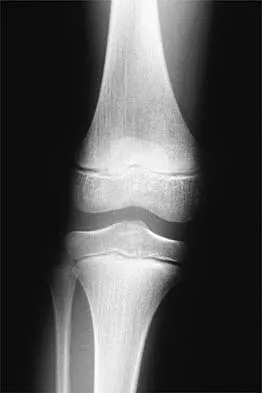
Figure 24 shows the radiograph of a 10-year-old boy who sustained a valgus injury to the knee. Examination reveals grade III medial laxity. Initial management should consist of
Explanation
Question 2
A right-handed 14-year-old pitcher has had a 3-month history of shoulder pain while pitching. Examination reveals full range of motion, a mildly positive impingement sign, pain with rotational movement, and no instability. Plain AP radiographs of both shoulders are shown in Figures 25a and 25b. Management should consist of
Explanation
Question 3
A 38-year-old man sustains a complete avulsion with retraction of the ischial attachment of the hamstring muscles in a fall while water skiing. He indicates that he is an aggressive athlete who participates regularly in multiple running and cutting-type sports, and he strongly desires to continue his athletic competition. Management should consist of
Explanation
Question 4
What mechanism contributes to strength gains during conditioning of the preadolescent athlete?
Explanation
Question 5
Following an episode of transient quadriplegia in contact sports, an athlete's return to play is absolutely contraindicated when
Explanation
Question 6
A 16-year-old snowboarder has significant pain and is still unable to bear weight after sustaining a lateral ankle injury in a fall 1 week ago. Examination reveals swelling and tenderness in the sinus tarsi. AP, lateral, and mortise radiographs of the ankle are unremarkable. Management should consist of
Explanation
Question 7
A 24-year-old man who plays golf noted the immediate onset of pain on the ulnar side of his hand and has been unable to swing a club for the past 6 weeks after striking a tree root with his club during his golf swing. Examination reveals full motion of the wrist, diminished grip strength, and tenderness over the hypothenar region. A CT scan of the hand and wrist is shown in Figure 26. Management should consist of
Explanation
Question 8
An 18-year-old football player sustains a contact injury to his right lower leg, and radiographs show a closed transverse fracture of the middle third of the tibia. Based on the clinical examination, a compartment syndrome is suspected. When measuring compartment pressures, the highest tissue pressure is recorded how many centimeters proximal or distal to the fracture site?
Explanation
Question 9
A 50-year-old patient who plays tennis sustained the deformity shown in Figure 27 following a high volley. Further diagnostic work-up should include
Explanation
Question 10
A 16-year-old ice hockey player is struck on the chest by the puck. He skates a few strides and then collapses. What is the most likely diagnosis?
Explanation
Question 11
A 24-year-old dancer sustains the injury shown in Figure 28. Management should consist of
Explanation
Question 12
A 22-year-old volleyball player has atrophy of the infraspinatus muscle. This deficit is the result of entrapment of what nerve?
Explanation
Question 13
Figure 29 shows the radiograph of a 25-year-old woman who has had a 3-month history of ankle pain after sustaining an inversion injury to the ankle. She reports occasional catching, but no sense of instability. Examination reveals ligament stability. Management should consist of
Explanation
Question 14
A 19-year-old college cross-country runner is amenorrheic and has recurrent stress fractures. Long-term management should consist of
Explanation
Question 15
A 47-year-old male tennis player has pain in his nondominant shoulder that has failed to respond to 4 months of nonsurgical management. Examination reveals acromial tenderness and pain at the supraspinatus tendon insertion. He has a positive impingement sign, pain on forward elevation, and minimal cuff weakness. The MRI scans are shown in Figures 30a and 30b. To completely resolve his symptoms, treatment should consist of
Explanation
Question 16
A 39-year-old competitive cyclist sustains an injury to her left hip in a fall. Gadolinium arthrography, with an accompanying MRI scan, is shown in Figure 31. A cleft, or defect, identified by the arrow, indicates a detachment of the
Explanation
Question 17
A cortisone injection in the subacromial space will most likely result in
Explanation
Question 18
A high school athlete reports the sudden onset of low back pain while performing a dead lift. Examination reveals a lumbar paraspinal spasm and a positive straight leg raising test. The deep tendon reflexes, motor strength, and sensation in the lower extremeties are normal. The radiographs are normal. If symptoms persist for more than a few weeks, management should consist of
Explanation
Question 19
A 22-year-old skier reports painful range of motion in the left thumb after falling forward on his outstretched hand while holding his ski pole. Examination of the left thumb reveals increased AP laxity and 45 degrees of valgus laxity at the metacarpophalangeal (MCP) joint. Examination of the right thumb shows 25 degrees of valgus laxity at the MCP joint. Radiographs are normal. Management should consist of
Explanation
Question 20
Which of the following structures is most commonly involved in lateral epicondylitis?
Explanation
Question 21
When comparing surgical and nonsurgical extremities in patients who underwent anterior cruciate ligament (ACL) reconstruction using patellar tendon or hamstrings autografts, isokinetic strength measurements obtained 6 months after the surgery would most likely reveal
Explanation
Question 22
A quarterback sustains a rough tackle after which he appears confused, has a dazed look on his face and an unsteady gait on standing. He denies loss of consciousness. Reexamination within 10 minutes is normal, the patient is lucid, and he wants to return to play. The coach and the player should be advised that he may
Explanation
Question 23
The bone avulsion shown in Figure 32 has a high correlation with tearing of the
Explanation
Question 24
A 21-year-old college defensive lineman sustains a minimally displaced (less than 1 mm) midthird scaphoid fracture during the first game of the season. Management should consist of
Explanation
Question 25
A 16-year-old football player sustains a direct blow to the anterior aspect of his flexed right knee. Examination reveals a contusion over the anterior tibial tubercle and a small effusion. MRI scans are shown in Figures 33a through 33c. What is the most likely diagnosis?
Explanation
Question 26
A 25-year-old professional soccer player undergoes ACL reconstruction with a bone-patellar tendon-bone autograft. During the procedure, the femoral tunnel is drilled through the anteromedial portal rather than transtibial. Which of the following is the most likely biomechanical advantage of this technique?
Explanation
Question 27
A 19-year-old collegiate football running back presents with an acute knee injury after being tackled. MRI demonstrates a complete, isolated PCL rupture. He has no gross instability with varus or valgus stress and a Grade II posterior drawer. What is the most appropriate initial management?
Explanation
Question 28
In Medial Patellofemoral Ligament (MPFL) reconstruction, placing the femoral tunnel too proximal will result in which of the following kinematic abnormalities?

Explanation
Question 29
A 22-year-old baseball pitcher presents with medial elbow pain during the late cocking phase of throwing and a decrease in velocity. Physical examination reveals a positive moving valgus stress test. An MRI arthrogram demonstrates a partial thickness tear of the UCL. Which bundle of the UCL is the primary restraint to valgus stress at 90 degrees of flexion?
Explanation
Question 30
A 35-year-old heavy laborer sustains an acute distal biceps tendon rupture. During a single-incision anterior repair using cortical button fixation, the surgeon must be particularly careful to protect which of the following nerves as it pierces the supinator muscle?
Explanation
Question 31
A 28-year-old rock climber presents with chronic shoulder pain. An MRI reveals a type II SLAP lesion. He fails conservative management and undergoes arthroscopic repair. Postoperatively, what is the most common complication following SLAP repair in this patient demographic?
Explanation
Question 32
A 45-year-old avid runner presents with deep gluteal pain and posterior thigh radiation that worsens with prolonged sitting. Examination shows tenderness over the ischial tuberosity and pain with resisted knee flexion while the hip is flexed. Which of the following conditions is most likely responsible for his symptoms?

Explanation
Question 33
A 16-year-old female gymnast presents with an insidious onset of anterior knee pain. Imaging reveals an open proximal tibial physis. Which of the following findings on a lateral radiograph indicates patella alta using the Caton-Deschamps index?
Explanation
Question 34
A 21-year-old collegiate swimmer complains of anterior shoulder pain. On examination, there is a positive O'Brien's test. During arthroscopy, an anterosuperior labral variant is noted where the labrum is absent from the 1 to 3 o'clock position with a cord-like middle glenohumeral ligament. What is the appropriate management of this anatomic variant?
Explanation
Question 35
During an arthroscopic rotator cuff repair, a massive, retracted, U-shaped tear involving the supraspinatus and infraspinatus is identified. Margin convergence sutures are utilized. What is the primary biomechanical goal of margin convergence?
Explanation
Question 36
A 10-year-old boy (Tanner stage 1) sustains a mid-substance complete tear of his anterior cruciate ligament (ACL) while playing soccer. Non-operative management has failed due to recurrent instability. Which of the following surgical techniques is most appropriate?
Explanation
Question 37
A 22-year-old male rugby player presents with recurrent anterior shoulder instability. Advanced imaging reveals 25% anterior glenoid bone loss and an engaging Hill-Sachs lesion.
Which of the following is the most appropriate surgical management?

Explanation
Question 38
When reconstructing the medial patellofemoral ligament (MPFL) for recurrent patellar instability, identifying the correct femoral attachment (Schöttle's point) is critical. Where is this anatomic point located radiographically?
Explanation
Question 39
A 28-year-old professional volleyball player is diagnosed with a posterior labral tear and an associated paralabral cyst located strictly at the spinoglenoid notch. Which of the following clinical exam findings is most expected?
Explanation
Question 40
A 30-year-old male sustains a severe knee injury. On physical examination, the Dial test demonstrates 15 degrees of increased external rotation of the tibia compared to the contralateral leg at 30 degrees of flexion, and 18 degrees of increased external rotation at 90 degrees of flexion. This pattern most strongly suggests injury to which structures?
Explanation
Question 41
A 24-year-old hockey player presents with chronic groin pain. Imaging reveals femoroacetabular impingement (FAI) with a cam lesion. Which radiographic view is best utilized to measure the alpha angle to quantify the cam deformity?
Explanation
Question 42
A medial meniscus posterior root tear is diagnosed in a 45-year-old active female. If left untreated, biomechanical studies demonstrate that this injury alters knee contact pressures most similarly to which of the following scenarios?
Explanation
Question 43
A 21-year-old cross-country runner is evaluated for chronic exertional compartment syndrome (CECS) of the lower legs. According to the modified Pedowitz criteria, which of the following intramuscular pressure measurements is diagnostic for CECS?
Explanation
Question 44
Histological evaluation of surgical specimens from patients undergoing operative management for chronic lateral epicondylitis (tennis elbow) most characteristically demonstrates which of the following?
Explanation
Question 45
During an ulnar collateral ligament (UCL) reconstruction in a baseball pitcher, understanding elbow biomechanics is crucial. Which anatomical band of the UCL is the primary restraint to valgus stress between 30 and 120 degrees of elbow flexion?
Explanation
Question 46
An 11-year-old Little League baseball pitcher presents with vague, gradual onset shoulder pain in his throwing arm. Radiographs reveal widening of the proximal humeral physis compared to the contralateral shoulder. What is the most appropriate initial management?
Explanation
Question 47
A 32-year-old male bodybuilder feels a tearing sensation in his anterior chest wall while performing a heavy bench press. Examination shows bruising and loss of the anterior axillary fold contour. During surgical repair, where should the sternal head of the pectoralis major be reattached?
Explanation
Question 48
A professional American football player sustains a 'turf toe' injury. Which of the following mechanisms is the primary cause of this condition?
Explanation
Question 49
A 20-year-old female dancer complains of a deep, audible clicking in her groin area when she brings her hip from flexion into extension. The phenomenon is reproducible and mildly painful. This specific form of 'snapping hip' syndrome involves which of the following structures?
Explanation
Question 50
A healthy 30-year-old professional athlete sustains an acute, mid-substance Achilles tendon rupture. When discussing operative versus non-operative treatment with modern functional rehabilitation protocols, operative management is primarily associated with which of the following outcomes?
Explanation
Question 51
A 22-year-old collegiate basketball player sustains a Zone 2 fifth metatarsal base fracture (Jones fracture). He desires to return to play as safely and quickly as possible. What is the most appropriate management?
Explanation
Question 52
Comparing quadriceps tendon ruptures to patellar tendon ruptures, which of the following demographic or clinical statements is most accurate?
Explanation
Question 53
A 19-year-old soccer player presents with anterior ankle pain after a twisting injury. Physical examination raises suspicion for a syndesmotic sprain (high ankle sprain). Which of the following physical examination tests has the highest inter-observer reliability and sensitivity for diagnosing a syndesmotic injury?
Explanation
Question 54
A 14-year-old female gymnast complains of insidious onset, mechanical low back pain exacerbated by extension. Plain radiographs of the lumbar spine are normal. What is the preferred next imaging modality to diagnose an early, pre-radiographic pars interarticularis stress reaction while avoiding ionizing radiation?
Explanation
Question 55
A 25-year-old recreational basketball player is diagnosed with chronic patellar tendinopathy. He has failed a 4-week course of rest and NSAIDs. What is the most evidence-based physical therapy intervention for this condition?
Explanation
Question 56
A 19-year-old female soccer player undergoes an anterior cruciate ligament (ACL) reconstruction using a bone-patellar tendon-bone autograft. Which of the following is the most frequently reported complication specific to this graft choice compared to a hamstring autograft?
Explanation
Question 57
A 25-year-old male sustains a direct blow to the proximal tibia with the knee flexed. Examination reveals a posterior sag sign and posterior translation of 8 mm at 90 degrees of flexion with a firm endpoint. What is the most appropriate initial management?
Explanation
Question 58
A 22-year-old college football player suffers a multiligament knee injury (KD-III). During the initial emergency department evaluation, his ankle-brachial index (ABI) is measured at 0.85. What is the most appropriate next step in management?
Explanation
Question 59
A 24-year-old male presents with recurrent anterior shoulder instability. CT scan with 3D reconstruction reveals a 25% anteroinferior glenoid bone loss. Which of the following is the most appropriate surgical treatment?
Explanation
Question 60
A 36-year-old recreational weightlifter complains of persistent deep anterior shoulder pain. MRI arthrogram demonstrates a Type II SLAP tear. Non-operative management has failed. What is the most appropriate surgical intervention for this patient?
Explanation
Question 61
A 45-year-old tennis player presents with shoulder pain. MRI shows a partial articular-sided supraspinatus tendon avulsion (PASTA) involving 60% of the tendon thickness. What is the recommended surgical management if conservative treatment fails?
Explanation
Question 62
During a physical examination for a suspected meniscal tear, the examiner flexes the knee, internally rotates the tibia, and applies a varus stress while bringing the knee into extension. Which specific test is being described?
Explanation
Question 63
A 28-year-old male hockey player presents with insidious onset groin pain. Radiographs demonstrate a pistol-grip deformity and an alpha angle of 65 degrees. What is the primary pathoanatomy in this condition?
Explanation
Question 64
A 55-year-old woman experiences a sudden pop in the back of her knee while descending stairs. MRI shows a medial meniscus posterior root tear with 4 mm of meniscal extrusion. If left untreated, this condition most closely simulates the biomechanical effects of:
Explanation
Question 65
During medial patellofemoral ligament (MPFL) reconstruction, identifying the correct femoral attachment is crucial. According to Schöttle's method, where is the radiographic femoral footprint located on a strict lateral radiograph?
Explanation
Question 66
A 29-year-old male cyclist falls on his shoulder. Radiographs show superior displacement of the clavicle with a coracoclavicular (CC) distance increased by 120% compared to the contralateral side. What Rockwood classification does this represent and what is the typical management?
Explanation
Question 67
A 34-year-old male suffers an acute mid-substance Achilles tendon rupture. He is treated non-operatively with a functional rehabilitation protocol. Compared to historical rigid cast immobilization, early functional rehabilitation demonstrates:
Explanation
Question 68
A 21-year-old cross-country runner reports bilateral lower leg pain that occurs 15 minutes into a run and resolves with rest. Intracompartmental pressure testing is performed. Which of the following values is diagnostic for chronic exertional compartment syndrome?
Explanation
Question 69
A 22-year-old collegiate football player sustains a multiligamentous knee injury resulting in a knee dislocation. Upon reduction, he has an asymmetric, diminished dorsalis pedis pulse compared to the contralateral side. An ankle-brachial index (ABI) is measured at 0.85. What is the most appropriate next step in management?
Explanation
Question 70
A 26-year-old professional baseball pitcher complains of vague posterior shoulder pain during the late cocking phase of throwing. Physical examination reveals a loss of 25 degrees of internal rotation compared to the non-throwing shoulder, with a positive O'Brien test. What is the initial recommended treatment for this condition?
Explanation
Question 71
During a medial patellofemoral ligament (MPFL) reconstruction for recurrent patellar instability, identifying the anatomic femoral footprint is critical. According to Schottle's method on a true lateral radiograph, where is the femoral attachment of the MPFL located?
Explanation
Question 72
A 16-year-old female high school soccer player is planning to undergo an anterior cruciate ligament (ACL) reconstruction. Which of the following graft choices is associated with the highest risk of graft failure in this specific patient population?
Explanation
Question 73
A 30-year-old weightlifter feels a sudden pop and pain in his anterior shoulder/chest while performing a heavy bench press. Examination reveals ecchymosis and loss of the anterior axillary fold. MRI confirms a complete rupture of the pectoralis major tendon. Which portion of the muscle is most commonly injured in this mechanism?
Explanation
Question 74
A 24-year-old gymnast presents with chronic lateral elbow pain. She has pain with valgus stress and a 15-degree extension deficit. Radiographs demonstrate a radiolucent lesion in the capitellum with a sclerotic margin. MRI shows a 12mm osteochondral defect with a detached fragment and fluid behind the fragment. What is the most appropriate definitive management?
Explanation
Question 75
A 45-year-old weekend warrior sustains an acute Achilles tendon rupture. He discusses operative versus non-operative management with you. Based on recent high-level evidence utilizing modern functional rehabilitation protocols, non-operative management compared to operative management is associated with:
Explanation
Question 76
A 20-year-old collegiate rugby player sustains an anterior shoulder dislocation. After reduction, a CT scan shows a glenoid bone loss of 25%. He is indicated for a Latarjet procedure. The primary stabilizing mechanism of the Latarjet procedure in this setting is:
Explanation
Question 77
A 50-year-old male presents with acute severe pain in the posterior knee after stepping off a curb. MRI demonstrates a complete radial tear of the posterior root of the medial meniscus with 4 mm of meniscal extrusion. If left untreated, this injury biomechanically behaves most similarly to:
Explanation
Question 78
A 19-year-old male sustains a complete distal biceps tendon rupture during a wrestling match. He undergoes an anatomic surgical repair. Which of the following complications is most frequently associated with a single-incision anterior approach using a cortical button?
Explanation
Question 79
A 21-year-old collegiate soccer player presents with a high ankle sprain (syndesmotic injury) confirmed by an increased tibiofibular clear space. He undergoes dynamic fixation using a suture-button construct. Compared to traditional syndesmotic screw fixation, the suture-button construct has been shown to:
Explanation
Question 80
A 28-year-old professional dancer undergoes hip arthroscopy for a symptomatic cam-type femoroacetabular impingement (FAI). Postoperatively, she reports numbness over the perineum and labia majora. This complication is most likely related to:
Explanation
Question 81
A 17-year-old male baseball pitcher complains of chronic medial elbow pain and decreased throwing velocity. Valgus stress testing reproduces pain at the medial epicondyle. MRI shows a high-grade partial tear of the ulnar collateral ligament (UCL). He is scheduled for UCL reconstruction. What is the optimal placement of the graft to best recreate the primary restraint to valgus stress?
Explanation
Question 82
A 35-year-old water skier falls forcefully while accelerating and sustains an avulsion of the proximal hamstring origin. MRI demonstrates a complete avulsion of the conjoined tendon and semimembranosus with 4 cm of distal retraction. During the surgical exposure, which of the following nerves is at greatest risk of injury and must be carefully protected?
Explanation
Question 83
A 25-year-old athlete sustains a posterolateral corner (PLC) injury of the knee. During a surgical reconstruction of the PLC using a fibular-based technique, care must be taken to avoid injury to the common peroneal nerve. Where does the common peroneal nerve typically cross in relation to the fibular head?
Explanation
Question 84
Which of the following statements regarding the anatomy and biomechanics of the posterior cruciate ligament (PCL) is true?
Explanation
Question 85
A 45-year-old woman presents with acute posterior knee pain after a deep squat. MRI reveals a medial meniscus posterior root tear. Which of the following is the most likely consequence if this injury is left untreated?
Explanation
Question 86
A 21-year-old collegiate rugby player with a history of recurrent anterior shoulder instability presents for surgical evaluation. A 3D CT scan reveals 26% anterior glenoid bone loss. What is the most appropriate surgical management?
Explanation
Question 87
A 28-year-old male is brought to the trauma bay after a motorcycle accident. He has a grossly unstable knee with a suspected multi-ligamentous injury (KD-III). His dorsalis pedis pulse is palpable, but the ankle-brachial index (ABI) is 0.85. What is the most appropriate next step in management?
Explanation
None
