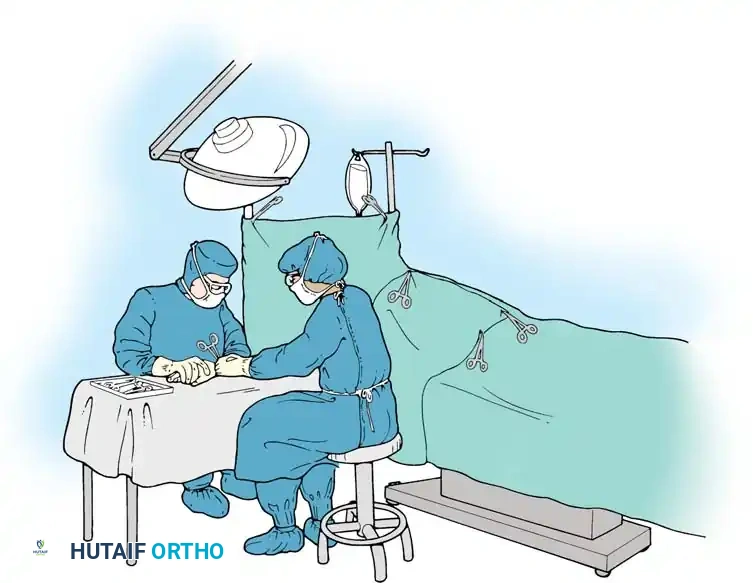
Operative Management and Ligament Repair of Scapholunate Instability
Key Takeaway
Rotary subluxation of the scaphoid requires precise anatomical reduction and ligamentous stabilization to prevent progressive carpal collapse. While acute injuries may respond to closed manipulation and percutaneous pinning, irreducible or complex instability patterns necessitate open reduction. This guide details the dual dorsal-volar approach, capsular flap elevation, and direct repair of the scapholunate interosseous ligament using Kirschner wires and suture anchors to restore carpal kinematics and prevent long-term degenerative arthropathy.
Introduction to Carpal Instability and Ligamentous Disruption
Carpal instability, particularly rotary subluxation of the scaphoid secondary to scapholunate (SL) ligament disruption, represents a critical biomechanical failure of the wrist. The scapholunate interosseous ligament (SLIL) is the primary stabilizer of the proximal carpal row, functioning in concert with secondary extrinsic stabilizers such as the radioscaphocapitate (RSC) and dorsal intercarpal (DIC) ligaments. When these structures are compromised, the scaphoid flexes and pronates, while the lunate extends, leading to a dorsal intercalated segment instability (DISI) deformity.
If left untreated, this kinematic uncoupling inevitably progresses to a predictable pattern of degenerative arthritis known as Scapholunate Advanced Collapse (SLAC). Therefore, the primary goal of surgical intervention—whether through closed reduction and percutaneous pinning or formal open ligament repair—is the precise anatomical restoration of the scapholunate relationship to preserve carpal kinematics and prevent long-term arthropathy.
Indications for Surgical Intervention
The decision to proceed with closed manipulation versus open ligament repair depends heavily on the chronicity of the injury, the degree of instability, and the reducibility of the carpal alignment.
- Closed Reduction and Percutaneous Pinning: Indicated for acute (less than 3–4 weeks old) rotary subluxation of the scaphoid where anatomical alignment can be achieved and maintained fluoroscopically without direct visualization.
- Open Reduction and Ligament Repair: Indicated when closed reduction fails to achieve satisfactory alignment, in subacute presentations where fibrous tissue prevents reduction, or when there is a clear indication of a repairable ligamentous avulsion (with or without an osteochondral fragment).
💡 Clinical Pearl
The "Terry Thomas sign" (a scapholunate gap >3 mm on a PA radiograph) and the "cortical ring sign" (indicating scaphoid flexion) are classic radiographic hallmarks of rotary subluxation. Always obtain bilateral clenched-fist PA views to assess dynamic instability, as static radiographs may appear deceptively normal in partial ligamentous tears.
Closed Reduction and Percutaneous Pinning: The Taleisnik Technique
For primary rotary subluxation of the scaphoid and other acute carpal instabilities, closed manipulation and pinning may be successful. However, the biomechanics of the wrist dictate that the positioning required to reduce and pin the subluxation often makes the spontaneous approximation of the torn ligaments difficult.
To address this, Taleisnik described a highly specific kinematic maneuver designed to optimize both bony reduction and ligamentous healing.
Biomechanical Rationale and Technique
- Wrist Dorsiflexion: The scaphoid is reduced by placing the wrist in extension (dorsiflexion) and ulnar deviation. This maneuver extends the flexed scaphoid, correcting its rotary subluxation and realigning its proximal pole with the lunate.
- Percutaneous Fixation: Once anatomical reduction is confirmed via fluoroscopy, the scaphoid is pinned to the capitate and the lunate using three 0.045-inch (1.16-mm) Kirschner wires (K-wires). This rigid triad fixation neutralizes the deforming forces of the surrounding musculature.
- Wrist Flexion for Ligament Approximation: After the scaphoid has been rigidly stabilized to the midcarpal and proximal rows, the wrist is gently brought into flexion. Because the scaphoid is now locked in its anatomical position, flexing the wrist relaxes the volar extrinsic ligaments (such as the RSC and long radiolunate ligaments), allowing them to approximate and heal with minimal tension.
⚠️ Surgical Warning
While the Taleisnik technique is elegant, blind percutaneous pinning carries a risk of iatrogenic injury to the superficial radial nerve or the radial artery. Always use a tissue protector and make small stab incisions with blunt dissection down to the capsule before advancing K-wires.
Open Reduction and Ligament Repair (Surgical Technique 69-42)
If closed reduction cannot be accomplished satisfactorily, or if the surgeon determines that direct repair of the dorsal SLIL is necessary for long-term stability, a formal open reduction is required. This often necessitates a combined dorsal and volar approach to fully address the complex three-dimensional deformity.
Preoperative Preparation and Positioning
- Anesthesia: Regional block (axillary or supraclavicular) or general anesthesia.
- Positioning: Supine with the operative arm extended on a radiolucent hand table.
- Tourniquet: A well-padded pneumatic tourniquet is applied to the proximal arm and inflated to 250 mm Hg after exsanguination with an Esmarch bandage.
The Volar Approach
The volar approach is utilized to inspect, debride, and repair the volar extrinsic ligaments, which are often stretched or torn in severe carpal instability patterns.
- Incision: Make a longitudinal incision on the palmar aspect, parallel to the thenar crease. Extend it proximally to cross the volar wrist crease in an oblique, medial direction to avoid crossing flexion creases at a right angle, which can lead to restrictive scarring.
- Neurovascular Protection: Carefully identify and protect the palmar cutaneous branch of the median nerve. Retract the median nerve and the digital flexor tendons ulnarward, and the flexor carpi radialis (FCR) tendon radially.
- Capsular Exposure: Expose the radiovolar aspect of the wrist to visualize the volar wrist capsule.
- Capsulotomy: Carefully incise the volar radioscaphocapitate (RSC) and radiolunate (RL) ligaments. It is imperative that this incision is made meticulously, leaving adequate tissue cuffs on both sides to allow for robust repair at the time of closure.
The Dorsal Approach
The dorsal approach provides direct access to the scapholunate interval and the critical dorsal component of the SLIL, which is the thickest and most biomechanically significant portion of the ligament complex.
- Incision: Make a longitudinal skin incision centered over the finger extensors, positioned just to the medial (ulnar) side of Lister's tubercle.
- Superficial Dissection: Elevate full-thickness skin flaps.
- Pitfall Avoidance: Strictly avoid injury to the branches of the superficial radial nerve and the radial artery on the dorsal-radial aspect.
- Extensor Retinaculum: Open the distal half of the extensor retinaculum. Raise a retinacular flap based on either the ulnar or the radial side of the fourth extensor compartment.
- Tendon Retraction: Retract the extensor digitorum communis (EDC) tendons ulnarward and the extensor pollicis longus (EPL) tendon radially. This provides a clear window to the dorsal wrist capsule.
- Capsular Flap Elevation: Wide exposure of the dorsum of the carpal bones is attained by raising a radially based capsular flap.
- Make an incision that follows the dorsal radial articular margin proximally.
- Extend the incision along the dorsal radiocarpal (DRC) ligament medially.
- Return radially along the dorsal intercarpal (DIC) ligament distally.
- This creates a robust, V-shaped or trapezoidal flap that preserves the integrity of the extrinsic dorsal ligaments for later repair.
Reduction and Internal Fixation
Once the scapholunate interval is exposed, the joint is irrigated, and any interposed fibrous tissue or hematoma is debrided.
- Joystick Technique: Insert 0.045-inch (1.16-mm) K-wires into the dorsal poles of the scaphoid and lunate to act as joysticks.
- Anatomical Reduction: Use the joysticks to correct the scaphoid flexion and lunate extension. The scaphoid is extended and supinated, while the lunate is flexed. The scapholunate gap is closed manually.
- Provisional and Definitive Fixation: Once anatomical reduction is achieved and confirmed visually and fluoroscopically, drive the scaphoid K-wire across the interval into the lunate.
- Supplemental Fixation: Fix the construct with a total of three 0.045-inch (1.16-mm) K-wires directed from the scaphoid into the lunate and the capitate. This neutralizes the midcarpal joint and protects the SL repair from shear forces during the healing phase.
💡 Clinical Pearl
When driving K-wires from the scaphoid to the lunate, aim for the center of the lunate to avoid penetrating the radiocarpal or midcarpal articular surfaces. Confirm wire placement with multiple fluoroscopic views, including a 30-degree supinated AP view to profile the SL interval.
Direct Ligament Repair
Although frequently difficult due to tissue attenuation, every attempt must be made to repair the dorsal scapholunate interosseous ligament.
- Mid-substance Tears: If the ligament is torn in its mid-substance, direct end-to-end repair using non-absorbable 3-0 or 4-0 braided sutures is performed.
- Avulsion Injuries: Ligament repair is often easier and more biomechanically sound if a small osteochondral fragment of bone has been avulsed from the scaphoid or lunate.
- Such fragments can be stabilized with small K-wires.
- Alternatively, very small suture anchors (1.5 mm to 2.0 mm) can be placed into the anatomical footprint of the avulsed ligament.
- If suture anchors are unavailable or contraindicated, transosseous sutures can be placed through small drill holes made in the scaphoid or lunate using a micro-burr or a 0.035-inch K-wire.
Closure
- Dorsal Closure: The radially based dorsal capsular flap is meticulously repaired using interrupted non-absorbable sutures. The extensor retinaculum is repaired over the EDC tendons, often leaving the EPL transposed subcutaneously to prevent attrition rupture against the retained hardware.
- Volar Closure: The wrist is slightly flexed to remove tension from the volar structures. The previously incised radioscaphocapitate and radiolunate ligaments are repaired with interrupted sutures.
- Skin: The skin is closed in a standard fashion, and a bulky, sterile compressive dressing is applied.
Postoperative Protocol and Rehabilitation
The success of a scapholunate ligament repair relies as much on strict postoperative immobilization as it does on surgical execution. The repaired ligaments require a prolonged period of protection to achieve mature collagen cross-linking.
- Initial Immobilization (Weeks 0–2): The patient is placed in a well-padded short-arm thumb-spica splint or cast. The wrist is immobilized in neutral to slight extension. Elevation and strict digital range of motion (ROM) exercises are initiated immediately to prevent tendon adhesions and complex regional pain syndrome (CRPS).
- Casting Phase (Weeks 2–8): Sutures are removed at 10 to 14 days. The patient is transitioned to a short-arm thumb-spica cast.
- Hardware Removal (Weeks 8–10): The K-wires are typically removed in the clinic or under local anesthesia between 8 and 10 weeks postoperatively, provided that radiographs demonstrate maintenance of the carpal arcs and no widening of the SL interval.
- Rehabilitation (Weeks 10+): Following pin removal, the patient is fitted with a removable thermoplastic thumb-spica splint. Formal hand therapy is initiated, focusing on active and active-assisted ROM. Passive stretching and aggressive strengthening are strictly avoided until at least 12 to 16 weeks postoperatively to prevent stretching out the delicate ligament repair.
Complications and Pitfalls
Surgeons undertaking open reduction and ligament repair of the carpus must be prepared to manage several potential complications:
- Pin Tract Infection: Percutaneous K-wires are prone to superficial infections. Meticulous pin care and early oral antibiotics are usually curative. If deep infection occurs, premature pin removal may be necessary.
- Loss of Reduction: Failure of the ligament repair or premature pin removal can lead to recurrent rotary subluxation. If this occurs, salvage procedures such as a scaphotrapeziotrapezoid (STT) fusion, scaphoid excision with four-corner fusion, or proximal row carpectomy (PRC) may eventually be required.
- Postoperative Stiffness: A mild to moderate loss of terminal wrist flexion and extension is almost universal following open capsulotomies and prolonged immobilization. Patients must be counseled preoperatively that a stable, pain-free wrist with a functional arc of motion is the primary goal, rather than a return to normal flexibility.
- Hardware Breakage: K-wires crossing the midcarpal joint are subjected to immense shear forces. Using adequately sized wires (0.045-inch minimum) and strictly prohibiting wrist motion while pins are in place minimizes this risk.
Conclusion
The management of rotary subluxation of the scaphoid demands a profound understanding of carpal kinematics and meticulous surgical technique. While closed reduction and percutaneous pinning utilizing the Taleisnik maneuver remains a viable option for acute, reducible injuries, open reduction and direct ligament repair provide the most reliable means of restoring anatomical alignment in complex or subacute cases. By employing a systematic dual-incision approach, preserving capsular flaps, and achieving rigid multi-planar K-wire fixation, the orthopedic surgeon can effectively restore the integrity of the scapholunate complex and halt the progression of degenerative carpal collapse.
You Might Also Like