
العربية
Comprehensive Master Guide · Medically Reviewed

Mastering Humeral Shaft Fractures: Diagnosis & Treatment

Ace your orthopedic oral exams with our guide on humeral shaft fractures. Discover essential tips for accurate diagnosis, epidemiology, and treatment.

15 Detailed Chapters
15 min read
Updated: Jun 2026
Dr. Mohammed Hutaif Clinic
Medically Reviewed by
Prof. Dr. Mohammed Hutaif Clinic
Verified Content Expert Reviewed

Quick Medical Answer

For anyone wondering about Mastering Humeral Shaft Fractures: Diagnosis & Treatment, Humeral shaft fractures are breaks in the diaphysis of the humerus, representing 3-5% of all fractures. They are often associated with radial nerve injury. Diagnosis is confirmed using orthogonal radiographs, which determine the fracture's location and morphology. Treatment options are nonoperative or operative, tailored to the fracture's specific characteristics and any associated ipsilateral injuries.

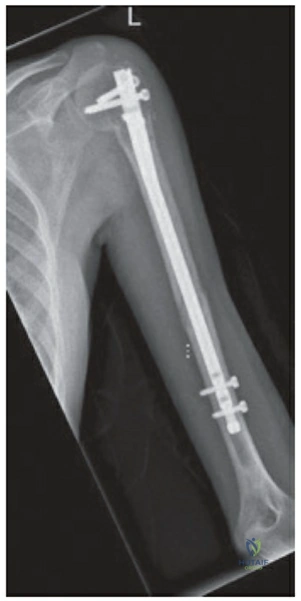
X-ray image of humeral shaft fracture
🎓

FRCS Masterclass: Clinical Viva

Interactive Examiner Scenario • Test your knowledge before revealing the answers.

👨‍⚕️ Examiner Scenario

Good morning, candidate. You are presented with a 35-year-old male patient who reports left arm pain after slipping and falling on a flexed elbow at work. Please interpret the provided X-ray image. Describe your findings and classify the type of fracture shown.
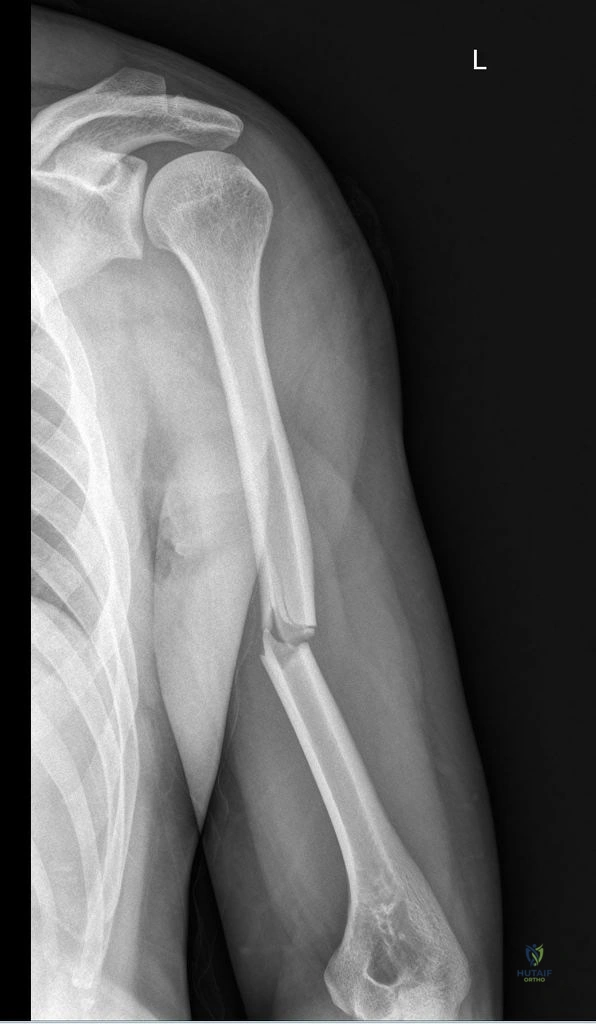
Initial Radiograph
Figure 1: Initial Radiograph

Candidate: "The radiograph shows a displaced, comminuted mid-shaft fracture of the left humerus. There is no evidence of articular involvement at the shoulder or elbow. I would classify this as a mid-diaphyseal humeral shaft fracture."

❌ Common Pitfall (Poor Answer)

Jumping immediately to treatment plans ("I'd put him in a brace") before describing the injury. Failing to comment on the joints above and below (shoulder/elbow) is a critical omission in an FRCS-level examination.

⭐ The Gold Standard (Perfect Answer)

Systematically address the: (1) View (AP/Lateral), (2) Bone (Humerus), (3) Location (Mid-diaphyseal), (4) Fracture pattern (Transverse/Oblique/Comminuted), (5) Displacement/Angulation, and (6) Joint integrity. Mention that "I have excluded articular extension at the shoulder and elbow joints."

👨‍⚕️ Examiner Scenario

This patient has an associated radial nerve palsy at initial presentation. What is the incidence of this complication in closed fractures, and what is your immediate management strategy?
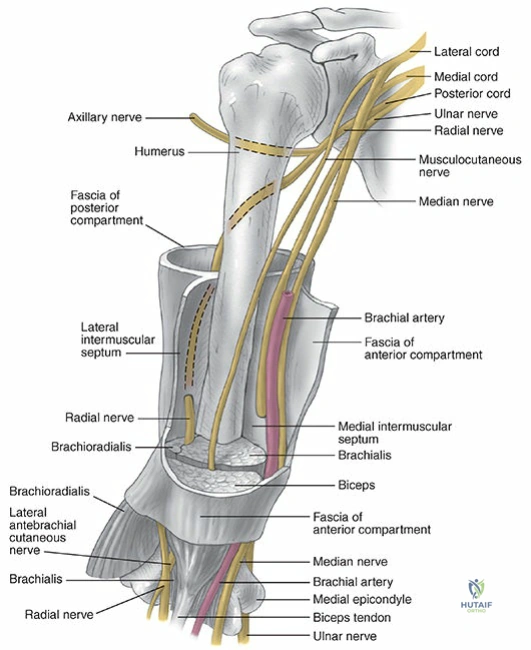
Neurovascular Anatomy
Figure 2: Neurovascular Anatomy

Candidate: "The incidence of radial nerve palsy in closed humeral shaft fractures is 8-15%. Since this is a closed injury, the vast majority are neurapraxias. I would manage this nonoperatively with a functional brace, monitor serial neuro exams, and consider EMG studies at 6-8 weeks if no recovery is seen."

❌ Common Pitfall (Poor Answer)

Suggesting immediate surgical exploration. At the FRCS level, examiners expect you to know that primary radial nerve palsy in a closed fracture has a very high rate of spontaneous recovery and is not an indication for immediate surgery.

⭐ The Gold Standard (Perfect Answer)

State the 8-15% incidence, acknowledge the high recovery rate (90%+), and define the 'observation' strategy. Correctly note that surgical exploration is only required for: 1) Open fractures, 2) Vascular injury, or 3) No clinical/EMG recovery after 3-6 months.

👨‍⚕️ Examiner Scenario

Suppose you opt for operative management. Compare the indications for plate fixation versus intramedullary nailing in these fractures.
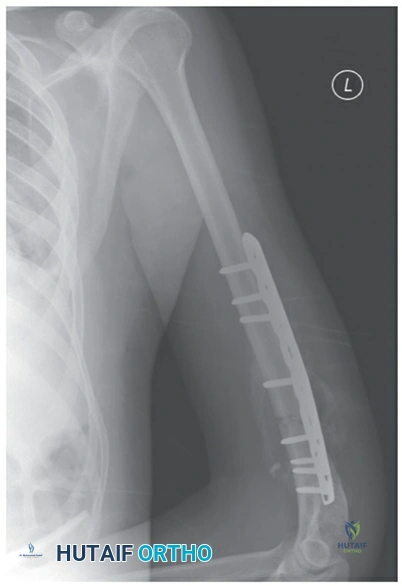
Fixation Techniques
Figure 3: Plate and Screw Fixation

Candidate: "Plating is generally considered the gold standard for most humeral shaft fractures as it allows for rigid fixation and avoids shoulder morbidity associated with nailing. Nailing is reserved for specific cases such as pathologic fractures, segmental fractures, or patients with poor bone quality where plate screws might not hold."

❌ Common Pitfall (Poor Answer)

Failing to mention the shoulder pain associated with antegrade nailing (rotator cuff injury) or failing to recognize that nailing is superior in specific 'host' conditions like osteoporotic bone or bone tumors.

⭐ The Gold Standard (Perfect Answer)

Structure the answer by: (1) Plating as the standard for anatomical reduction/compression, (2) Nailing as a load-sharing device for specific indications (pathologic, segmental, osteoporotic), and (3) Acknowledge the 'Nailing vs. Plating' literature regarding shoulder morbidity.

Detailed Chapters & Topics

Dive deeper into specialized chapters regarding orthopedic-md-oral-examination-diagnosis-and-management-of-humeral-shaft-fractures

15 Chapters
01
Chapter 1 17 min

Humeral Shaft IMN: Antegrade Technique Masterclass & Anatomical Pearls

Master the antegrade intramedullary nailing technique for humeral shaft fractures. Explore surgical anatomy, AO/ASIF cl…

02
Chapter 2 25 min

Posterior Approach to the Humeral Diaphysis: Anatomy, Techniques & Radial Nerve Protection

Master the posterior humeral approach for diaphyseal fractures. Discover key surgical anatomy, techniques, and crucial …

03
Chapter 3 13 min

Unlock the Anterior Compartment of the Forearm: Surgical Keys

Applied Surgical Anatomy of the Anterior Compartment of the Forearm Overview Muscles Two muscle groups form the muscula…

04
Chapter 4 22 min

Distal Humerus Lateral Approach: Surgical Anatomy, Indications, and Technique

Master the distal humerus lateral approach. Explore essential surgical anatomy, indications like condyle fractures, and…

05
Chapter 5 12 min

Mastering Approaches to the Upper Third of the Radius

APPROACHES TO THE FOREARM The Forearm Anterior Approach to the Radius Applied Surgical Anatomy of the Anterior Compartm…

06
Chapter 6 16 min

Mastering the Approach to the Distal Humerus: Safety & Skills

APPROACHES TO THE HUMERUS Two The Humerus Anterior Approach to the Humeral Shaft Minimally Invasive Anterior Approach t…

07
Chapter 7 18 min

Mastering Elbow Approaches: Applied Surgical Anatomy for Precision

APPROACHES TO THE ELBOW The Elbow Posterior Approach to the Elbow with Olecranon Osteotomy Posterior Approach to the El…

08
Chapter 8 10 min

Enhance Recovery: Humeral Plate Fixation for Brachialis & Brachioradialis

DEFINITION Humeral shaft fractures, which account for about 3% of adult fractures, usually result from a direct blow or…

09
Chapter 9 15 min

Lateral to Medial Nailing: Optimizing Humeral Fracture Fixation

r DEFINITION Incidence: 3% to 5% of all fractures 12 The AO/ASIF classification of humeral shaft fractures is based on …

10
Chapter 10 96 min

Humeral Shaft Fracture: Optimal Treatment & Orthopedic Board Prep MCQs

Master humeral shaft fracture treatments with our interactive orthopedic board prep MCQs. Test your knowledge, track sc…

11
Chapter 11 14 min

Humeral Shaft Fractures: Expert Insights on Diagnosis & Treatment

HUMERAL SHAFT FRACTURES EPIDEMIOLOGY It is a common injury, representing 3% to 5% of all fractures. Incidence is 14.5 p…

12
Chapter 12 22 min

Midshaft Humerus Fractures: Epidemiology, Surgical Anatomy, Biomechanics & Management

Explore the epidemiology, surgical anatomy, and biomechanics of midshaft humerus fractures. Learn about AO/OTA classifi…

13
Chapter 13 64 min

Orthopedic Shoulder 2026 MCQs: Board Review Questions & Answers (Part 1)

Ace the 2026 Orthopedic Shoulder exam with our interactive board review MCQs. Practice with expert questions and answer…

14
Chapter 14 62 min

Orthopedic Shoulder 2026 MCQs: Board Review Questions & Answers (Part 2)

Master your 2026 exams with Part 2 of our Orthopedic Shoulder MCQs. Practice essential board review questions, check an…

15
Chapter 15 65 min

Orthopedic Shoulder 2026 MCQs: Board Review Questions & Answers (Part 4)

Ace your 2026 Orthopedic Board exams with Part 4 of our interactive Shoulder MCQs. Test your knowledge with expert ques…

Dr. Mohammed Hutaif Clinic
Medically Verified Content by
Prof. Dr. Mohammed Hutaif Clinic
Consultant Orthopedic & Spine Surgeon
Guide Overview