ABOS Part I Orthopedic Review: Lisfranc Injuries, Foot Compartment Syndrome, Ankle Fractures | Part 22158

Key Takeaway
A Lisfranc injury is a disruption of the tarsometatarsal joint complex in the midfoot, often seen as diastasis between the first and second metatarsal bases. Diagnosis requires radiographs, stress views, or CT. Treatment varies from non-weightbearing casts for stable sprains to ORIF or arthrodesis for unstable fractures, with acute compartment syndrome being a critical exclusion.
ABOS Part I Orthopedic Review: Lisfranc Injuries, Foot Compartment Syndrome, Ankle Fractures | Part 22158
Comprehensive 100-Question Exam
00:00
Start Quiz
Question 1
Which of the following findings is most concerning for impending compartment syndrome in a patient with a closed tibial shaft fracture?
Explanation
Correct Answer: E
While all listed options are potential signs of compartment syndrome, 'pain with passive stretching of the toes' (for the deep posterior and anterior compartments) and 'severe pain unresponsive to increasing doses of opioids' (pain out of proportion to injury) are considered the most sensitive and earliest signs of evolving compartment syndrome. Paresthesia can be an early sign but may also indicate nerve injury unrelated to compartment syndrome. Diminished pulses and pallor are late signs, often indicating irreversible muscle ischemia and nerve damage, and are less reliable early indicators because compartment pressure often exceeds venous pressure long before arterial flow is compromised.
Question 2
Which ankle fracture classification system is based on the mechanism of injury and describes predictable patterns of ligamentous and osseous injury?
Explanation
Correct Answer: D
The Lauge-Hansen classification system categorizes ankle fractures based on the position of the foot at the time of injury and the deforming force applied. It describes a sequential pattern of injury to ligaments and bones, which can help predict the extent of damage and guide reduction. The Danis-Weber classification is based on the level of the fibular fracture relative to the syndesmosis. The Gustilo-Anderson classification is for open fractures. The AO classification is a comprehensive alphanumeric system for all fractures. The Salter-Harris classification is for physeal injuries in children.
Question 3
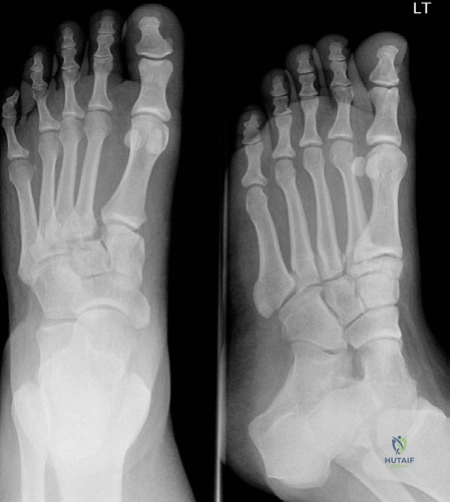
A 49-year-old female presents to the emergency department after falling down stairs, complaining of severe left foot pain, swelling, and inability to bear weight. Initial assessment reveals ecchymosis and tenderness over the midfoot. The following radiographs are obtained:
Which of the following radiographic findings is MOST indicative of a Lisfranc injury in this patient?
Explanation
Correct Answer: C
The case explicitly states, 'There is diastasis of > 2 mm between the base of the first and second metatarsals, features suggestive of Lisfranc tarsometatarsal fracture dislocation. There is a small avulsed fragment of bone in that interval. This avulsion fracture could be from the insertion of the Lisfranc ligament into the base of the second metatarsal, called a ‘fleck sign’.' This diastasis is a hallmark radiographic sign of a Lisfranc injury, indicating disruption of the Lisfranc ligament complex.
Option A (Fracture of the cuboid bone) is incorrect. While cuboid fractures can occur in foot trauma, they are not the primary diagnostic feature of a Lisfranc injury.
Option B (Widening of the space between the navicular and cuneiform bones) is incorrect. While midfoot widening is a general sign of trauma, the specific diastasis between the first and second metatarsal bases is more characteristic of a Lisfranc injury, reflecting disruption at the tarsometatarsal joint complex.
Option D (Avulsion fracture from the lateral malleolus) is incorrect. An avulsion fracture of the lateral malleolus is indicative of an ankle injury, not a midfoot Lisfranc injury.
Option E (Subtalar joint dislocation) is incorrect. Subtalar joint dislocation is a hindfoot injury and presents differently from a Lisfranc injury, which affects the midfoot.
Question 4
Following the initial diagnosis of a Lisfranc injury in the 49-year-old female, the emergency physician is considering the next steps in management. Beyond immediate analgesia and splinting, which of the following is the MOST critical assessment to perform in the acute setting for this patient?
Explanation
Correct Answer: C
The case specifically highlights the importance of excluding compartment syndrome in the initial management of a Lisfranc injury. The candidate states, 'Compartment syndrome must be excluded.' and 'On admission to hospital I would arrange for regular clinical examinations and monitoring in order not to miss an early developing compartment syndrome.' Lisfranc injuries, especially high-energy mechanisms, are associated with significant soft tissue swelling and can lead to acute compartment syndrome of the foot, which requires emergent surgical decompression to prevent permanent tissue damage.
Option A (Detailed assessment of ankle range of motion) is incorrect. While a general examination is important, the immediate priority in a midfoot trauma with significant swelling is to rule out limb-threatening conditions like compartment syndrome.
Option B (Evaluation for signs of deep vein thrombosis (DVT)) is incorrect. DVT is a potential complication of lower limb immobilization but is not an acute, limb-threatening emergency in the immediate post-injury period like compartment syndrome.
Option D (Assessment of hip and knee joint stability) is incorrect. While a thorough trauma assessment includes joints proximal and distal, the most critical acute assessment directly related to the foot injury itself is compartment syndrome.
Option E (Measurement of foot arch height) is incorrect. This is a biomechanical assessment that is not acutely critical in the emergency management of a Lisfranc fracture-dislocation.
Question 5
A 35-year-old male presents with midfoot pain after a motor vehicle accident. Initial AP and oblique radiographs of the foot are equivocal for a Lisfranc injury, showing only subtle widening of the first-second metatarsal space. The patient's pain is disproportionate to the radiographic findings, and he has tenderness over the tarsometatarsal joints. Based on the case discussion, what would be the MOST appropriate next step in imaging to definitively diagnose or rule out a Lisfranc injury?
Explanation
Correct Answer: C
The case directly addresses this scenario: 'What would you do if the radiographs were inconclusive in diagnosing this condition? CANDIDATE: I would consider further radiographic imaging, oblique and lateral view, stress views and a CT scan or may opt for an MRI scan.' Stress views can reveal instability not apparent on static radiographs, and a CT scan provides detailed bony anatomy, crucial for identifying subtle fractures, displacement, and joint incongruity in the complex midfoot region.
Option A (Repeat AP and oblique radiographs in 24 hours) is incorrect. Delaying definitive diagnosis can lead to worse outcomes for Lisfranc injuries. Repeat static radiographs are unlikely to provide more information if the initial ones were inconclusive.
Option B (Obtain a bone scan) is incorrect. While a bone scan can show increased metabolic activity, it is not specific enough for acute fracture-dislocation diagnosis and is not typically used as a primary diagnostic tool for Lisfranc injuries.
Option D (Order a weight-bearing lateral ankle radiograph) is incorrect. While a lateral view is part of a complete series, a weight-bearing ankle view is not the most appropriate next step for a suspected midfoot injury, and it may not provide the necessary detail for the tarsometatarsal joints.
Option E (Administer a local anesthetic injection and re-examine) is incorrect. This might help with pain but will not provide the necessary anatomical detail to diagnose a subtle Lisfranc injury.
Question 6
A 55-year-old active patient presents with a Lisfranc injury. Initial radiographs, including AP, oblique, and lateral views, show a 1.5 mm diastasis between the first and second metatarsal bases, with no obvious fracture or subluxation on static views. Stress radiographs, however, demonstrate a 3 mm increase in this diastasis. The patient is otherwise healthy. Based on the case discussion, what is the MOST appropriate management strategy for this patient?
Explanation
Correct Answer: B
The case states: 'There is a role for non-operative management of an undisplaced stable injury or sprain which includes a non-weightbearing cast for 6 weeks and regular clinical and radiological review. However, in the presence of subluxation or dislocation, accurate reduction and stable fixation is essential.' The 3 mm increase in diastasis on stress views indicates instability, which is equivalent to a subluxation or dislocation, even if not apparent on static views. Therefore, open reduction and internal fixation (ORIF) is required to achieve accurate reduction and stable fixation.
Option A (Non-weightbearing cast for 6 weeks with regular clinical and radiological review) is incorrect. This is appropriate only for undisplaced, stable injuries or sprains. The positive stress views indicate instability, making non-operative management inadequate.
Option C (Primary arthrodesis of the tarsometatarsal joints) is incorrect. Primary arthrodesis is typically reserved for severely comminuted fractures or chronic instability, not for an acute, reducible unstable injury without severe comminution.
Option D (Non-weightbearing cast for 2 weeks, then progressive weight-bearing) is incorrect. This duration is too short for a Lisfranc injury, even for stable sprains, and progressive weight-bearing would be contraindicated in an unstable injury.
Option E (Physical therapy with early range of motion exercises) is incorrect. Early range of motion would exacerbate the instability and prevent healing, leading to chronic pain and deformity.
Question 7
A 62-year-old patient with a history of diabetes and peripheral neuropathy sustains a high-energy Lisfranc injury, resulting in significant comminution of the tarsometatarsal joints and irreducible displacement. The patient is otherwise stable. Based on the treatment principles outlined in the case, what is the MOST appropriate surgical intervention for this specific presentation?
Explanation
Correct Answer: C
The case states: 'With a severely comminuted fracture, primary arthrodesis of tarsometatarsal joints may be required.' In cases of severe comminution and irreducible displacement, especially in patients with comorbidities that might affect healing (like diabetes and neuropathy), primary arthrodesis offers a more stable and predictable outcome by fusing the damaged joints, reducing the risk of post-traumatic arthritis and chronic pain associated with joint incongruity.
Option A (Closed reduction and percutaneous pinning) is incorrect. This technique is generally reserved for less severe, reducible injuries without significant comminution or displacement.
Option B (Open reduction and internal fixation (ORIF) with screws and plating) is incorrect. While ORIF is the standard for most displaced Lisfranc injuries, it may not be feasible or durable in the presence of severe comminution where anatomical reduction and stable fixation of fragments are difficult to achieve. In such cases, primary arthrodesis is often preferred.
Option D (External fixation with delayed definitive management) is incorrect. External fixation might be used for temporary stabilization in cases of severe soft tissue injury or open fractures, but it is not the definitive treatment for a severely comminuted, irreducible Lisfranc injury in a stable patient.
Option E (Non-weightbearing cast immobilization for 12 weeks) is incorrect. Non-operative management is only for undisplaced, stable injuries. A severely comminuted and irreducible injury requires surgical intervention.
Question 8
A 40-year-old construction worker undergoes open reduction and internal fixation for a Lisfranc fracture-dislocation. During the postoperative course, he develops persistent midfoot pain, stiffness, and difficulty returning to his previous activity level despite appropriate rehabilitation. Based on the prognosis discussed in the case, which of the following is the MOST likely long-term complication this patient is experiencing?
Explanation
Correct Answer: C
The case explicitly states regarding prognosis: 'This is a serious injury with potentially a poor outcome. Post-traumatic osteoarthritis may occur in more than 50% of cases despite surgical intervention. Residual pain and stiff foot are not uncommon complications of this injury.' The patient's symptoms of persistent pain and stiffness are highly consistent with the development of post-traumatic osteoarthritis in the tarsometatarsal joints, which is a common and significant long-term complication of Lisfranc injuries.
Option A (Avascular necrosis of the talus) is incorrect. Avascular necrosis of the talus is a complication associated with talar neck fractures or severe ankle dislocations, not typically Lisfranc injuries.
Option B (Chronic ankle instability) is incorrect. Lisfranc injuries affect the midfoot, and while they can alter foot mechanics, chronic ankle instability is not a direct or primary long-term complication of a Lisfranc injury itself.
Option D (Stress fracture of the fifth metatarsal) is incorrect. While stress fractures can occur in the foot, they are not a direct long-term complication of a Lisfranc injury, especially after ORIF and rehabilitation.
Option E (Tarsal tunnel syndrome) is incorrect. Tarsal tunnel syndrome involves compression of the posterior tibial nerve and can cause foot pain, but it is not listed as a common long-term complication of Lisfranc injuries in the case, nor is it as prevalent as post-traumatic osteoarthritis.
Question 9
A 49-year-old female presents with a Lisfranc injury after falling down stairs. During her initial hospital stay, she complains of increasing pain in her foot, which is disproportionate to the injury. On examination, her foot is tense, swollen, and she experiences severe pain with passive toe extension. Her dorsalis pedis pulse is palpable but weak. Based on these findings and the case discussion, what is the MOST appropriate immediate action?
Explanation
Correct Answer: C
The patient's symptoms (increasing pain disproportionate to injury, tense/swollen foot, pain with passive toe extension, weak dorsalis pedis pulse) are classic signs of acute compartment syndrome of the foot. The case emphasizes, 'Compartment syndrome must be excluded' and 'On admission to hospital I would arrange for regular clinical examinations and monitoring in order not to miss an early developing compartment syndrome.' While clinical diagnosis is paramount, urgent compartment pressure measurements can objectively confirm the diagnosis, especially when clinical signs are equivocal or in a patient with altered sensation. Once diagnosed clinically, emergency decompression is required.
Option A (Administer additional opioid analgesia and re-evaluate in 4 hours) is incorrect. This would delay critical intervention for compartment syndrome, potentially leading to irreversible tissue damage.
Option B (Elevate the limb further and apply ice packs) is incorrect. While elevation is part of initial management, it can worsen compartment syndrome by reducing perfusion pressure. Ice packs are generally contraindicated in suspected compartment syndrome as they can cause vasoconstriction.
Option D (Order an urgent MRI to assess soft tissue damage) is incorrect. MRI is not the primary diagnostic tool for acute compartment syndrome and would cause an unacceptable delay in diagnosis and treatment.
Option E (Consult physical therapy for early mobilization) is incorrect. Early mobilization is contraindicated in suspected compartment syndrome and would worsen the condition.
Question 10
A 49-year-old female with a Lisfranc injury develops acute compartment syndrome of the foot. She is taken to the operating theatre for emergency decompression. Based on the candidate's description in the case, how many incisions are typically used to decompress the nine compartments of the foot, and where are they located?
Explanation
Correct Answer: C
The case explicitly details the surgical approach for foot compartment syndrome: 'There is more than one technique described to decompress compartment syndrome of the foot, but I have been trained to decompress the nine compartments of the foot through three incisions, two dorsal over the second and third metatarsals and one on the medial side, just under the medial border of the first metatarsal.' This describes a common and effective approach to decompress all nine compartments of the foot.
Option A (One incision, located medially along the arch) is incorrect. A single incision is insufficient to decompress all nine compartments of the foot.
Option B (Two incisions, one dorsal and one plantar) is incorrect. While some techniques use dorsal and plantar approaches, the specific description in the case involves three incisions with precise locations.
Option D (Four incisions: two dorsal and two plantar) is incorrect. This is not the technique described in the case, which specifies three incisions.
Option E (Five incisions: one for each metatarsal space) is incorrect. This would be excessive and is not the standard approach described for foot fasciotomy.
Question 11
A 28-year-old athlete sustains a low-energy twisting injury to the foot while playing basketball. Initial radiographs are interpreted as normal. However, due to persistent midfoot pain and swelling, a follow-up MRI is performed, which reveals a subtle disruption of the Lisfranc ligament without significant bony displacement. Based on the case discussion, what is the MOST appropriate initial non-operative management for this stable Lisfranc sprain?
Explanation
Correct Answer: B
The case states: 'There is a role for non-operative management of an undisplaced stable injury or sprain which includes a non-weightbearing cast for 6 weeks and regular clinical and radiological review.' Even a stable Lisfranc sprain involves disruption of critical ligaments and requires a period of strict non-weightbearing immobilization to allow for healing and prevent progression to instability. Regular review is essential to ensure stability is maintained.
Option A (Immediate weight-bearing as tolerated with a supportive shoe) is incorrect. This would place undue stress on the healing ligaments and could lead to chronic instability and pain.
Option C (Partial weight-bearing in a walking boot for 2-3 weeks) is incorrect. This duration and level of activity are insufficient for a Lisfranc sprain, which requires longer non-weightbearing to heal adequately.
Option D (Aggressive physical therapy focusing on strengthening and flexibility) is incorrect. While physical therapy is crucial after immobilization, aggressive therapy too early would jeopardize ligament healing.
Option E (Corticosteroid injection into the tarsometatarsal joint) is incorrect. Corticosteroid injections are generally not indicated for acute ligamentous injuries and could potentially weaken the healing tissue.
Question 12
A 49-year-old female presents with a Lisfranc injury. The candidate in the case mentions the 'fleck sign' as an avulsed fragment of bone from the insertion of the Lisfranc ligament. Which specific anatomical structure is the Lisfranc ligament primarily connecting, and what is its biomechanical significance?
Explanation
Correct Answer: C
The Lisfranc ligament is a critical stabilizer of the midfoot. The case mentions the 'fleck sign' as an avulsion fracture from the insertion of the Lisfranc ligament into the base of the second metatarsal. This ligament primarily connects the medial cuneiform to the base of the second metatarsal. It is the strongest ligament in the tarsometatarsal joint complex and prevents dorsal and lateral displacement of the metatarsals relative to the tarsus, thus providing crucial stability to the midfoot arch.
Option A (Connects the navicular to the cuboid, stabilizing the transverse arch) is incorrect. This describes ligaments within the midtarsal joint, not the Lisfranc ligament.
Option B (Connects the calcaneus to the cuboid, supporting the lateral column) is incorrect. This describes the calcaneocuboid ligaments, part of the Chopart joint.
Option D (Connects the talus to the navicular, forming part of the talonavicular joint capsule) is incorrect. This describes ligaments of the talonavicular joint, part of the hindfoot.
Option E (Connects the first metatarsal to the medial cuneiform, preventing hallux valgus) is incorrect. While there are ligaments connecting the first metatarsal to the medial cuneiform, the Lisfranc ligament specifically refers to the connection between the medial cuneiform and the second metatarsal base, and its primary role is midfoot stability, not directly preventing hallux valgus.
Question 13
A 25-year-old professional athlete sustains a purely ligamentous Lisfranc injury. According to recent literature, what is the primary advantage of performing a primary arthrodesis of the first, second, and third tarsometatarsal joints rather than open reduction and internal fixation (ORIF)?
Explanation
Question 14
A patient develops unrecognized compartment syndrome of the foot following a severe crush injury mechanism. Which of the following deformities is the classic late complication characteristic of this missed diagnosis?
Explanation
Question 15
According to the Lauge-Hansen classification, which of the following represents the initial (Stage I) structural failure in a supination-external rotation (SER) ankle injury?
Explanation
Question 16
The Lisfranc ligament is an intra-articular structure crucial for midfoot stability. It originates on the lateral aspect of the medial cuneiform and inserts directly onto which of the following structures?
Explanation
Question 17
A 65-year-old poorly controlled diabetic patient with peripheral neuropathy requires surgical fixation for an unstable bimalleolar ankle fracture. To minimize the high risk of Charcot arthropathy and hardware failure, which surgical strategy is most recommended?
Explanation
Question 18
A dual dorsal incision approach (with incisions placed over the 2nd and 4th metatarsals) to the foot for fasciotomy is primarily designed to directly access and decompress which of the following fascial compartments?
Explanation
Question 19
A 32-year-old male sustains a trimalleolar ankle fracture where the posterior malleolus fracture involves 30% of the articular surface and is displaced. What is the most biomechanically sound rationale for direct anatomic fixation of the posterior malleolus compared to placing trans-syndesmotic screws alone?
Explanation
Question 20
What ligament provides the primary structural stability to the Lisfranc complex?
Explanation
Question 21
A 24-year-old athlete is diagnosed with a purely ligamentous Lisfranc injury involving the first, second, and third tarsometatarsal joints. Which of the following is the most appropriate definitive management for the medial columns?
Explanation
Question 22
According to the Lauge-Hansen classification, which structure is the first to be injured in a Supination-External Rotation (SER) ankle fracture?
Explanation
Question 23
A 45-year-old man presents with severe, intractable foot pain after a heavy object fell on his foot. Examination reveals tense swelling and extreme pain with passive toe extension. Which surgical approach is most commonly recommended to fully decompress all 9 compartments of the foot?
Explanation
Question 24
A 30-year-old patient sustains a severe ankle injury that cannot be reduced in the emergency department. Radiographs demonstrate a Bosworth fracture-dislocation. What is the defining anatomic characteristic of this injury?
Explanation
Question 25
A 22-year-old football player complains of midfoot pain after his plantarflexed foot was axially loaded. An AP radiograph reveals a small osseous fragment in the space between the bases of the first and second metatarsals, known as the 'fleck sign'. This represents an avulsion of the Lisfranc ligament from which bone?
Explanation
Question 26
Which of the following conditions is a well-recognized late sequela of an unrecognized or untreated foot compartment syndrome?
Explanation
Question 27
A 65-year-old diabetic female with advanced peripheral neuropathy presents with a displaced bimalleolar ankle fracture. To minimize her exceptionally high risk of postoperative complications, which surgical modification is most strongly recommended?
Explanation
Question 28
A 32-year-old female sustains a Pronation-External Rotation (PER) ankle fracture. According to Lauge-Hansen, what is the final (Stage IV) injury in this specific mechanistic pattern?
Explanation
Question 29
During fasciotomies for foot compartment syndrome, the surgeon must decompress the central compartment. Which of the following muscles is located within this compartment?
Explanation
Question 30
When utilizing the dual dorsal incision technique for foot fasciotomies, the surgical incisions are classically placed over or adjacent to which specific structures?
Explanation
Question 31
A 28-year-old male undergoes a midfoot arthrodesis for a severe Lisfranc injury. To preserve essential midfoot accommodation and flexibility during gait, which tarsometatarsal (TMT) joints should purposefully be spared from fusion?
Explanation
Question 32
A 40-year-old man falls from a height, sustaining a severely comminuted calcaneus fracture. Over the next 12 hours, his foot becomes massively swollen. Which clinical finding is the earliest and most reliable indicator of foot compartment syndrome?
Explanation
Question 33
A 35-year-old skier presents with an ankle fracture resulting from a Pronation-Abduction (PA) mechanism. What is the characteristic morphology of the fibular fracture in a Lauge-Hansen PA Stage III injury?
Explanation
Question 34
Recent biomechanical studies suggest that open reduction and internal fixation of a posterior malleolus fracture in the setting of a syndesmotic injury provides which of the following mechanical advantages?
Explanation
Question 35
A 20-year-old gymnast complains of medial ankle pain and proximal lateral calf pain after landing awkwardly. Radiographs reveal a widened medial clear space and a proximal third fibula fracture. What is the appropriate surgical management for this Maisonneuve injury?
Explanation
Question 36
During open reduction and internal fixation of a bimalleolar equivalent ankle fracture, the lateral malleolus is plated. A 'Cotton test' is then performed using a bone hook on the fibula, which demonstrates a 5 mm widening of the medial clear space. What is the most appropriate next step?
Explanation
Question 37
Which of the following describes the anatomical attachments of the Lisfranc ligament?
Explanation
Question 38
How many distinct fascial compartments are anatomically recognized in the foot for the purpose of fasciotomy?
Explanation
Question 39
The Lisfranc ligament is a crucial stabilizing structure of the midfoot. Anatomically, it connects which of the following two osseous structures?
Explanation
Question 40
What is the most reliable objective threshold for diagnosing foot compartment syndrome and indicating the need for emergent fasciotomy?
Explanation
Question 41
A patient suffers an unrecognized foot compartment syndrome following a crush injury. Months later, what is the most common late clinical sequela resulting from intrinsic muscle ischemia and contracture?
Explanation
Question 42
According to the Lauge-Hansen classification, what is the first sequential structural failure in a Supination-External Rotation (SER) type ankle fracture?
Explanation
Question 43
Recent randomized controlled trials comparing open reduction internal fixation (ORIF) to primary arthrodesis for Lisfranc injuries have shown primary arthrodesis is most strongly indicated for which specific injury pattern?
Explanation
Question 44
A 65-year-old patient with poorly controlled diabetes and severe peripheral neuropathy sustains an unstable bimalleolar ankle fracture. Which of the following modifications in surgical management is most appropriate to minimize postoperative complications?
Explanation
Question 45
When evaluating a patient for suspected foot compartment syndrome, which compartment is considered the most clinically crucial to measure as it is the largest and frequently exhibits the highest pressures?
Explanation
Question 46
During surgical fixation of a trimalleolar ankle fracture, anatomical reduction and internal fixation of the posterior malleolus (Volkmann's fragment) primarily restores syndesmotic stability by reconstructing which structure?
Explanation
Question 47
A "fleck sign" on an AP or internal oblique radiograph of the foot is pathognomonic for a Lisfranc injury. This represents an osseous avulsion of the Lisfranc ligament typically from which location?
Explanation
Question 48
In a Pronation-External Rotation (PER) type ankle fracture according to the Lauge-Hansen classification, what is the most characteristic finding of the fibular fracture?
Explanation
Question 49
A patient presents with an irreducible fracture-dislocation of the ankle. Radiographs demonstrate a posterior dislocation of the fibula relative to the tibia. What is the pathomechanical block to reduction in this Bosworth fracture?
Explanation
Question 50
A 26-year-old athlete with a missed Lisfranc injury from 8 months ago now presents with chronic, debilitating midfoot pain and a severe flatfoot deformity. Weight-bearing radiographs confirm chronic dorsal subluxation of the 2nd TMT joint. What is the most appropriate surgical treatment?
Explanation
Question 51
During a twisting ankle injury, an avulsion fracture of the anterior inferior tibiofibular ligament (AITFL) from the distal tibia is observed. What is the anatomical eponym for this specific fracture fragment?
Explanation
Question 52
A patient undergoes an open fasciotomy for foot compartment syndrome via the standard double dorsal incision approach. Which neurovascular structure is at greatest iatrogenic risk during the placement of the medial dorsal incision?
Explanation
Question 53
Which of the following describes the most common mechanism of injury for a subtle, sports-related Lisfranc sprain?
Explanation
Question 54
A 30-year-old male presents with isolated medial ankle pain after a severe twisting injury. Radiographs reveal an isolated transverse medial malleolus fracture with widening of the medial clear space, but no fibular fracture at the ankle. What is the most critical next step in clinical evaluation?
Explanation
Question 55
In a bimalleolar equivalent ankle fracture involving a lateral malleolus fracture and complete deltoid ligament rupture, the deep deltoid ligament serves as the primary restraint against which abnormal talar motion?
Explanation
Question 56
The calcaneal compartment of the foot communicates proximally with which anatomical compartment, allowing for the potential proximal spread of infection or compartment syndrome?
Explanation
Question 57
A 24-year-old football player presents with midfoot pain after a twisting injury.
If initial non-weight-bearing radiographs of the foot appear normal despite a high clinical suspicion for a Lisfranc injury, what is the MOST appropriate next diagnostic step?
Explanation
Question 58
When evaluating standard AP and mortise radiographs of the ankle to rule out syndesmotic injury, the tibiofibular clear space (measured 1 cm above the joint line) is considered abnormal if it exceeds what measurement?
Explanation
Question 59
Which of the following correctly describes the anatomical origin and insertion of the Lisfranc ligament?
Explanation
Question 60
How many distinct fascial compartments are recognized in the foot, and which compartment contains the quadratus plantae muscle?
Explanation
Question 61
According to the Lauge-Hansen classification, what is the correct sequential order of structural failure in a Supination-External Rotation (SER) ankle injury?
Explanation
Question 62
In a 50-year-old patient with a purely ligamentous Lisfranc injury, what is the primary advantage of primary arthrodesis of the first, second, and third tarsometatarsal joints compared to open reduction and internal fixation (ORIF)?
Explanation
Question 63
During operative fixation of a Weber C ankle fracture, an intraoperative external rotation stress test reveals widening of the medial clear space. Following placement of a syndesmotic screw, which radiographic parameter best confirms anatomic reduction of the syndesmosis on a true anteroposterior (AP) radiograph?
Explanation
Question 64
A 32-year-old male sustains a severe crush injury to his foot. Examination reveals tensely swollen compartments, pain with passive toe extension, and paresthesias. To definitively measure the pressure of the central compartment, where should the needle be optimally introduced?
Explanation
Question 65
A 45-year-old female presents with a trimalleolar ankle fracture.
According to recent biomechanical and clinical literature, what is the primary rationale for open reduction and internal fixation of the posterior malleolus?
Explanation
Question 66
A patient presents with a swollen midfoot following a high-energy motor vehicle collision. An AP radiograph of the foot reveals a small bony avulsion fragment in the space between the base of the first and second metatarsals. What is this radiographic finding called, and what does it indicate?
Explanation
None
