Posttraumatic Elbow Arthritis in Young Adults: Comprehensive Management Strategies
Key Takeaway
Posttraumatic elbow arthritis (PTEA) in young adults requires specialized management due to high functional demands and long-term considerations. Treatment emphasizes joint preservation, restoring range of motion, and alleviating pain. Strategies range from non-operative care to advanced surgical interventions, all guided by a thorough understanding of elbow anatomy and biomechanics to optimize outcomes.
A 32-year-old active laborer presents with a 6-month history of worsening right elbow pain and progressive stiffness following a complex fracture-dislocation 3 years ago. He is currently unable to perform overhead lifting. Examination shows a flexion-extension arc of 40-90 degrees. Radiographs are presented below.
How would you approach the management of this patient, and what are the specific risks you must address during your clinical counseling?
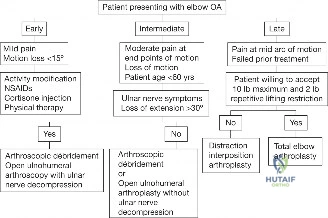
Candidate: I would assess the patient's functional limitations and pain levels. Given his age and occupation, I would first offer non-operative management with activity modification and physiotherapy. If he fails to improve, I would consider surgical intervention, likely an open arthrolysis to remove osteophytes and release the capsule, and possibly consider a total elbow arthroplasty if the joint is destroyed. I would warn him about nerve injury and infection.
Candidates often suggest Total Elbow Arthroplasty (TEA) too quickly for a 32-year-old. They also often fail to mention the high risk of Heterotopic Ossification (HO) recurrence, lack a systematic plan for the ulnar nerve (which is critical in post-traumatic cases), and omit the specific rehabilitation requirements such as HO prophylaxis (e.g., indomethacin or radiotherapy).
A structured approach is required: 1. Assessment: Confirm the mechanical arc of motion and confirm the diagnosis via CT to map osteophyte burden and loose bodies. 2. Management Strategy: Advocate for joint-preserving surgery first—arthroscopic or open arthrolysis—given his young age and occupation. Explicitly state that TEA is a salvage procedure due to the finite lifespan of the implant and high risk of loosening in this demographic. 3. Technical Considerations: Detail the need for ulnar nerve management (prophylactic neurolysis or transposition) and the use of HO prophylaxis post-operatively. 4. Counseling: Discuss the high risk of stiffness recurrence, the mandatory lifelong activity restrictions if TEA is ever performed, and the potential for complex regional pain syndrome (CRPS).
You have decided to proceed with an open arthrolysis for this patient. Describe your management of the ulnar nerve and your rationale for the timing and choice of prophylactic measures against heterotopic ossification.
Candidate: I would identify the ulnar nerve early, perform neurolysis, and if necessary, perform an anterior transposition to avoid post-operative tension. For HO, I would prescribe Indomethacin post-operatively.
Forgetting to mention the timing of HO prophylaxis or failing to explain why transposition is required (e.g., if there is significant medial osteophyte debridement or pre-existing nerve symptoms). Failing to specify the duration of Indomethacin (3–6 weeks) or mentioning radiotherapy as an alternative for high-risk patients.
The candidate should state: "I will identify and protect the ulnar nerve proximal to the cubital tunnel. I perform anterior transposition if there is pre-existing neuropathy, or if extensive medial capsulectomy/osteophyte resection is required to prevent secondary subluxation or entrapment. For HO, I use a multimodal approach: Indomethacin (25mg TID) for 3–6 weeks post-operatively, as the patient is high-risk due to the previous severe trauma. If the patient has a contraindication to NSAIDs or is at extreme risk, I would consider a single dose of 700 cGy external beam radiotherapy within 24–72 hours of surgery."
