Operative Management of Elbow Contractures and Advanced Rotator Cuff Pathology
Key Takeaway
The operative management of elbow contractures requires meticulous surgical technique to restore functional range of motion while preserving joint stability. The Morrey technique utilizes a lateral approach, allowing comprehensive anterior and posterior capsulectomies, triceps tenolysis, and osteophyte debridement. Concurrently, understanding the biomechanics of shoulder impingement and rotator cuff pathology is essential for upper extremity surgeons. This guide details the step-by-step surgical execution, indications, and postoperative protocols for optimizing patient outcomes in complex upper limb reconstruction.
Introduction to Upper Extremity Contractures and Cuff Pathology
The management of complex upper extremity pathology demands a profound understanding of both biomechanics and surgical anatomy. This masterclass chapter bridges two critical domains of upper limb orthopaedics: the surgical release of the stiff elbow and the advanced management of rotator cuff disease.
Elbow contractures, whether post-traumatic or degenerative, severely limit the functional arc of motion (typically defined as 30 to 130 degrees of flexion). The Morrey technique for anterior and posterior capsular release remains the gold standard for restoring kinematics. Concurrently, shoulder pathology—ranging from subacromial impingement to massive, irreparable rotator cuff tears—requires a nuanced, evidence-based approach. Drawing upon decades of foundational research, this guide provides a comprehensive, textbook-level analysis of these operative challenges.
Part I: Anterior and Posterior Release of Elbow Contracture (The Morrey Technique)
Indications and Patient Selection
Surgical intervention for elbow stiffness is indicated when conservative measures (dynamic splinting, physical therapy, intra-articular injections) have failed after a minimum of 6 months.
Primary Indications:
* Post-traumatic arthrofibrosis with a functional deficit (flexion < 130°, extension deficit > 30°).
* Degenerative joint disease with impinging osteophytes in the olecranon or coronoid fossae.
* Heterotopic ossification (following maturation).
Contraindications:
* Active joint infection.
* Severe articular incongruity requiring arthroplasty.
* Non-compliant patients unable to participate in rigorous postoperative rehabilitation.
Biomechanics and Pathoanatomy of Elbow Stiffness
The elbow is a highly constrained hinge joint. Its stability relies on the congruency of the ulnohumeral articulation, the anterior band of the medial collateral ligament (AMCL), and the lateral ulnar collateral ligament (LUCL). Contractures typically involve a thickened, fibrotic anterior capsule limiting extension, and a contracted posterior capsule limiting flexion. Osteophytic overgrowth at the tip of the olecranon and within the olecranon fossa further blocks terminal extension, while coronoid osteophytes block terminal flexion.
Preoperative Planning and Positioning
- Imaging: Standard AP and lateral radiographs are mandatory. A fine-cut CT scan with 3D reconstruction is highly recommended to map osteophytes, heterotopic bone, and the exact location of mechanical blocks.
- Positioning: The patient is placed in the lateral decubitus or supine position with the arm draped over a padded post. A sterile tourniquet is applied high on the brachium.
- Equipment: Standard orthopaedic soft tissue set, periosteal elevators, rongeurs, high-speed burr, and non-absorbable suture anchors for ligamentous repair.
Step-by-Step Surgical Approach (Technique 44-15: Morrey)
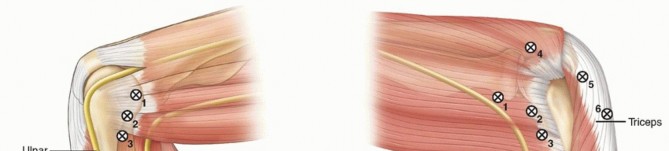
The Morrey technique utilizes an extensile lateral approach, providing access to both the anterior and posterior compartments while protecting the critical neurovascular structures.
1. Incision and Proximal Dissection
Begin the incision over the lateral supracondylar ridge of the humerus. Continue it distally across the lateral epicondyle, ending over the subcutaneous border of the ulna.
* Proximally, carry the dissection directly into the supracondylar ridge.
* Perform meticulous subperiosteal stripping anterior to the anterior aspect of the capsule.
SURGICAL WARNING: The radial nerve lies in close proximity to the anterior capsule laterally. Subperiosteal dissection and the placement of retractors directly on bone are critical to prevent iatrogenic nerve palsy.
2. Distal Exposure and Interval Development
Distally, identify and open the interval between the extensor carpi ulnaris (ECU) and the anconeus (the Kocher interval) to expose the lateral aspect of the elbow joint.
* Place blunt retractors deep to the extensor carpi radialis longus (ECRL), brachioradialis, and brachialis muscles to protect the anterior neurovascular bundle.
* Reflect the anconeus subperiosteally off the proximal ulna.
* Reflect the distal triceps off the posterior humerus and elevate its tendon subperiosteally off the olecranon to expose the posterior compartment.
3. Anterior Capsulectomy
Perform a comprehensive anterior capsulectomy from lateral to medial.
* To achieve this, the lateral collateral ligament (LCL) complex must be carefully reflected in a distally based flap.
* Excise the thickened anterior capsule entirely. Do not merely incise it, as leaving fibrotic tissue behind increases the risk of recurrent contracture.
CLINICAL PEARL: When completing the medial aspect of the anterior capsulectomy, exercise extreme caution. The ulnar nerve and the anterior band of the medial collateral ligament (AMCL) lie immediately adjacent to the medial capsule. Keep the dissection strictly intra-articular or subperiosteal.
4. Posterior Release and Osteophyte Debridement
Following the anterior release, attempt to completely extend the elbow.
* If extension remains incomplete, the mechanical block is likely posterior. Debride the olecranon fossa and the tip of the olecranon using a high-speed burr or rongeur. Remove any enlargement of the articular margins.
* To improve flexion, perform a tenolysis of the triceps and a complete posterior capsulectomy.
* If flexion to 135 degrees is still impossible, evaluate for a source of anterior impingement. Remove any scar tissue within the coronoid fossa or excise a portion of the coronoid tip proximal to the brachialis insertion.
5. Ligamentous Repair and Closure
The most critical step in preventing postoperative posterolateral rotatory instability (PLRI) is the anatomical restoration of the lateral ligamentous complex.
* Suture the lateral collateral ligament (specifically the LUCL) with heavy nonabsorbable sutures or suture anchors to its exact anatomical isometric origin on the lateral epicondyle.
* Carefully repair the entire lateral tissue sleeve (extensor origin and anconeus fascia).
* Deflate the tourniquet, achieve meticulous hemostasis, and close the wound in layers over a suction drain.
Postoperative Rehabilitation Protocol
- Immediate Phase (Days 0-3): Apply a well-padded posterior splint with the elbow in full extension to maximize the stretch on the anterior soft tissues.
- Early Motion Phase (Days 3-14): Remove the splint and initiate continuous passive motion (CPM) or active-assisted range of motion (AAROM) exercises. Night splinting in maximum extension is maintained for up to 3 months.
- Strengthening Phase (Weeks 6-12): Introduce isometric and progressive resistance exercises once the lateral ligament repair has healed sufficiently.
Part II: Advanced Management of Rotator Cuff Disease and Shoulder Impingement
While the elbow demands precise capsular management, the shoulder requires a deep understanding of dynamic force couples, acromial morphology, and tendon biology. The following sections synthesize the foundational literature regarding shoulder impingement, rotator cuff tears, and associated pathologies.
Pathomechanics of Impingement Syndrome
Subacromial impingement syndrome represents a continuum of pathology ranging from acute bursitis to massive rotator cuff arthropathy. The morphology of the acromion plays a pivotal role in the pathogenesis of bursal-sided rotator cuff tears.
* Acromial Morphology: Bigliani and Morrison famously classified acromial shapes into Type I (flat), Type II (curved), and Type III (hooked). A Type III acromion significantly decreases the subacromial space, leading to mechanical abrasion of the supraspinatus tendon.
* Acromial Slope: Aoki et al. demonstrated that a decreased slope of the acromion further exacerbates rotator cuff impingement.
* Coracoacromial Arch: The coracoacromial ligament acts as a secondary stabilizer against superior humeral head migration. Routine transection without rotator cuff repair can lead to catastrophic anterosuperior escape, a concept heavily emphasized by Flatow and colleagues.
Evaluation and Classification of Rotator Cuff Tears
Partial-Thickness Tears
Partial tears are classified by depth and location (articular-sided vs. bursal-sided).
* Articular-Sided Tears: Frequently seen in throwing athletes due to internal impingement (contact between the posterosuperior glenoid and the articular surface of the cuff during extreme abduction and external rotation).
* Management: As noted by Budoff and Andrews, arthroscopic debridement is often sufficient for tears involving less than 50% of the tendon thickness. If the tear exceeds 50%, completion of the tear and formal repair is indicated.
Full-Thickness and Massive Tears
A massive rotator cuff tear is classically defined as a tear involving two or more entire tendons, or a tear greater than 5 cm in diameter.
* Fatty Degeneration: The chronicity of the tear dictates reparability. Fuchs and Goutallier established that advanced fatty infiltration (Grade 3 or 4) of the rotator cuff musculature on CT or MRI is a poor prognostic indicator, rendering the tear functionally irreparable.
* Superior Migration: Altchek and colleagues highlighted that superior migration of the humeral head on standard AP radiographs indicates a loss of the coronal plane force couple, signifying a massive, chronic tear.
Operative Strategies for Rotator Cuff Repair
The evolution from open to arthroscopic repair has revolutionized shoulder surgery, though the biomechanical principles remain identical: achieve a tension-free, mechanically stable footprint reconstruction.
Margin Convergence
For massive, U-shaped tears that cannot be mobilized directly to the greater tuberosity, Burkhart introduced the concept of "margin convergence." By suturing the anterior and posterior leaves of the tear together side-to-side, the strain at the margin of the tear is exponentially reduced, allowing the remaining tendon to be repaired to the bone without undue tension.
Management of the Irreparable Tear
When primary repair is impossible due to tendon retraction and fatty atrophy, salvage procedures must be considered:
1. Arthroscopic Debridement and Biceps Tenotomy: Gartsman demonstrated that in low-demand elderly patients, simple debridement, subacromial decompression, and biceps tenotomy can provide significant pain relief, albeit with limited functional improvement.
2. Tendon Transfers: For younger, active patients with an isolated massive posterosuperior tear (supraspinatus and infraspinatus), Aoki and others have validated the transfer of the latissimus dorsi tendon to the greater tuberosity. This transfer restores active external rotation and depresses the humeral head.
3. Reverse Total Shoulder Arthroplasty (RTSA): In the presence of rotator cuff tear arthropathy (cuff failure combined with glenohumeral osteoarthritis), RTSA is the definitive treatment, medializing the center of rotation and recruiting the deltoid to elevate the arm.
CLINICAL PEARL: Never perform an isolated subacromial decompression in the setting of a massive, irreparable rotator cuff tear. Preserving the coracoacromial arch is vital to prevent superior escape of the humeral head.
Adhesive Capsulitis (Frozen Shoulder)
Adhesive capsulitis is a fibroproliferative disease characterized by a painful, gradual loss of both active and passive glenohumeral motion. Binder, Bulgen, and Hazleman extensively documented the immunological and clinical progression of the disease, which disproportionately affects patients with insulin-dependent diabetes mellitus.
- Pathology: The hallmark is contracture of the rotator interval and the coracohumeral ligament.
- Intervention: While the condition is often self-limiting over 18-24 months, refractory cases require intervention. Manipulation under anesthesia (MUA) is highly effective, as demonstrated by Dodenhoff. During MUA, the surgeon must stabilize the scapula and apply controlled, short-lever-arm forces to rupture the inferior capsule, followed by the anterior and posterior structures.
- Arthroscopic Release: For diabetic patients or those failing MUA, a 360-degree arthroscopic capsular release (including the rotator interval, middle glenohumeral ligament, and inferior capsule) provides reliable restoration of motion.
Associated Neurologic and Athletic Pathologies
Suprascapular Nerve Entrapment
Antoniadis and Bigliani have detailed the entrapment of the suprascapular nerve.
* Suprascapular Notch: Entrapment here affects both the supraspinatus and infraspinatus.
* Spinoglenoid Notch: Entrapment here (often due to a paralabral cyst associated with a posterior SLAP tear) results in isolated infraspinatus atrophy and weakness in external rotation. Arthroscopic cyst decompression and labral repair is the treatment of choice.
Quadrilateral Space Syndrome
A rare but critical cause of posterior shoulder pain, described by Cahill. It involves the compression of the axillary nerve and the posterior humeral circumflex artery within the quadrilateral space (bounded by the teres minor, teres major, long head of the triceps, and the surgical neck of the humerus). Diagnosis is confirmed via MRI or angiography, and surgical decompression is indicated for refractory cases.
Conclusion
The operative management of upper extremity contractures and tendinopathies requires a synthesis of precise surgical execution and deep biomechanical knowledge. Whether performing a complex Morrey release for an ankylosed elbow or navigating the geometric complexities of a massive rotator cuff tear, the orthopaedic surgeon must adhere strictly to anatomical principles. By respecting soft-tissue envelopes, restoring isometric ligamentous origins, and understanding the dynamic force couples of the shoulder, surgeons can reliably restore function and alleviate pain in the most challenging clinical scenarios.
You Might Also Like