UKA Versus Total Knee Replacement: Pros, Cons, & Your Decision Guide
Key Takeaway
Discover the latest medical recommendations for UKA Versus Total Knee Replacement: Pros, Cons, & Your Decision Guide. Regarding uka versus total knee replacement, UKA preserves more bone, offers faster recovery, and improved knee kinematics. While modern UKA outcomes are often comparable to TKA for appropriate patients, it demands careful selection. Historically, UKA had higher revision rates; recent data shows a 5-year TKA revision rate of 3% versus UKA's 9.4%, highlighting a key difference.
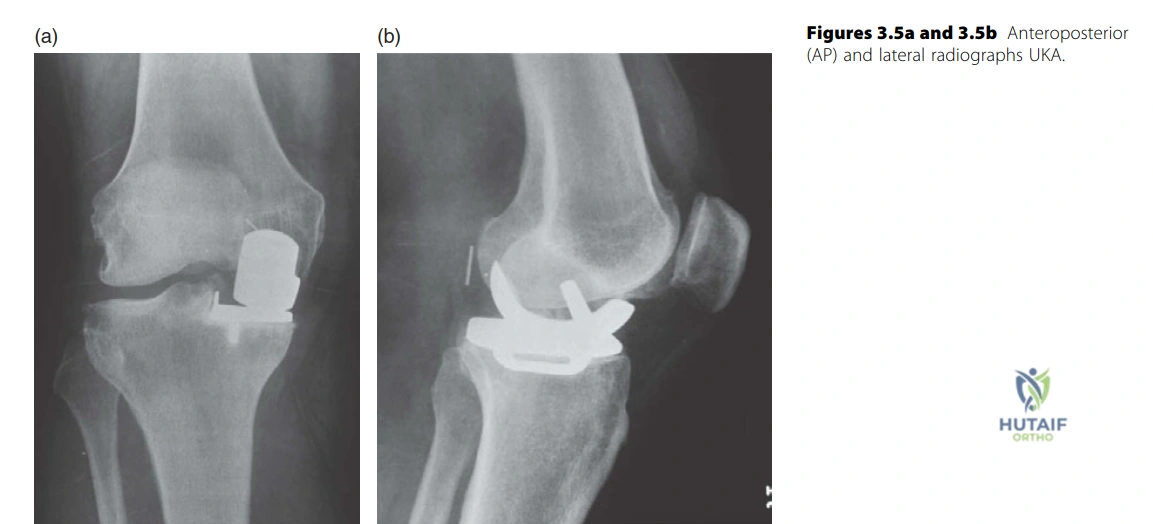
A 54-year-old male presents with a painful, swollen left knee after falling down the stairs. He has a history of a medial unicompartmental knee arthroplasty (UKA) performed 3 years ago. Look at the provided radiograph. What are your findings and what is your immediate concern?
Candidate: I see a medial unicompartmental knee arthroplasty. The components appear well-fixed without lucency. However, there is a radiopaque density posterior to the femoral component that is out of place. Given the history of a fall and inability to flex the knee, I suspect a dislocated mobile-bearing spacer.
Focusing only on the implant and failing to link the clinical history (fall, inability to flex) to the radiographic "extra-articular" density. Candidates often miss the urgency of a mobile-bearing dislocation, which is an orthopaedic emergency as the polyethylene insert can cause significant soft tissue damage or entrapment.
Systematically describe the radiograph: 1) Identify the implant (UKA), 2) Assess fixation/alignment, 3) Identify the abnormal findings (the dislocated polyethylene). Then, pivot to management: "This is a mobile-bearing dislocation. I would perform an urgent clinical assessment of neurovascular status, obtain a CT scan to confirm the position of the insert, and prepare for urgent closed reduction under sedation or open retrieval if trapped."
The patient has been stabilized. He is now asking you, "Should I have had a TKA instead of a UKA, given this complication?" How do you justify the use of UKA in appropriately selected patients?
Candidate: UKA offers several benefits over TKA for specific patients. It preserves bone stock, allows for a more 'natural' knee kinematic feel, requires less surgical exposure, results in faster rehabilitation, and has a lower complication profile such as thromboembolism and blood loss. It also facilitates an easier conversion to a primary TKA if revision becomes necessary.
Failing to mention the strict selection criteria. A good candidate must emphasize that these benefits only hold true if the patient is selected according to the Oxford/Goodfellow criteria (e.g., intact ACL, correctable deformity, no patellofemoral disease).
Structure the answer by categorizing benefits vs. risks. "I explain to the patient that UKA is a 'joint-preserving' approach compared to TKA. The primary advantages are faster recovery and improved proprioception due to ACL retention. However, I acknowledge the higher revision rate compared to TKA, as evidenced by the NJR data, which is a trade-off for the patient's functional gains. The key is that his previous anatomy and activity level justified the risk-benefit profile of the UKA at the time."
