Complex Revision THA Case Title: Impaction Grafting Success

Key Takeaway
Learn more about Complex Revision THA Case Title: Impaction Grafting Success and how to manage it. "Case title revision" often describes complex procedures like Revision THA addressing aseptic loosening. This includes impaction bone grafting for severe Paprosky type 2B socket and 3A femoral bone loss, or re-revision for acetabular Paprosky 2A defects. These interventions, utilizing techniques like mesh and constrained liners, aim to restore stability and function, managing significant bone loss and component loosening.
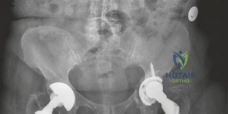
A 68-year-old male presents with a 12-month history of worsening right hip pain following a primary THA 15 years ago. On examination, he has a Trendelenburg gait and true leg length discrepancy. Radiographs are presented below. Describe your initial assessment and classify the acetabular bone loss.
Candidate: The radiograph shows evidence of aseptic loosening of the acetabular component. There is superior migration of the cup with significant osteolysis in the superior and medial zones. I would classify this as a Paprosky Type IIIB acetabular defect because there is massive bone loss, superior migration greater than 3 cm, and an incompetent superior dome.
Candidates often jump straight to the classification without describing the radiographic landmarks (teardrop, Kohler's line, zones of DeLee and Charnley). Failing to mention the status of the pelvic columns or the potential for pelvic discontinuity is a major oversight in a revision setting.
Start with a systematic description: "The AP pelvis shows a failed uncemented acetabular component with significant superior and medial migration. The teardrop is obliterated, and there is extensive periprosthetic osteolysis involving DeLee/Charnley zones 1 and 2. Based on the Paprosky classification, this is a Type IIIB defect, characterized by superior migration >3cm, massive cavitary bone loss, and a compromised superior dome, while pelvic continuity is preserved."
Given the findings on the CT scan, why is this patient specifically a candidate for Impaction Bone Grafting (IBG) rather than a jumbo cup or custom triflange component?
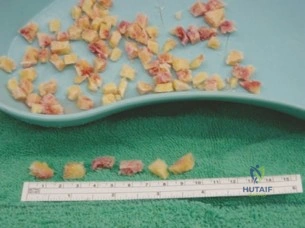
Candidate: IBG is chosen here for biological restoration of bone stock. Because the patient is relatively young (68), we want to preserve host bone for potential future revisions. IBG allows for the filling of cavitary voids and subsequent creeping substitution, effectively 'rebuilding' the acetabulum, whereas a jumbo cup might not get adequate host bone contact and a custom implant is reserved for pelvic discontinuity.
Ignoring the "biological" aspect. Candidates often focus purely on the technical difficulty or the cost, rather than the primary goal of IBG: long-term osteo-integration and restoration of the structural bone reservoir to avoid "burning bridges" for future surgeries.
Structure the answer by "Biological Rationale" and "Biomechanics". Mention: 1. Creeping substitution (osteoclastic resorption/osteoblastic deposition). 2. Restoration of host bone stock in a younger patient. 3. Immediate mechanical stability achieved through the tight packing of morselized cancellous allograft, which then remodels according to Wolff’s Law.
You mentioned the femoral side has a Paprosky Type III defect. Explain the biomechanical rationale for using the Exeter taper-slip stem in combination with femoral impaction bone grafting (FIBG).
Candidate: The Exeter stem is double-tapered and highly polished. This design allows it to subside within the cement mantle. This subsidence creates 'hoop stresses' that are transferred to the impacted allograft. This compression actually stimulates the graft to incorporate and consolidate, rather than shielding it from stress.
Failing to link the stem design (polished vs. matte) to the biological process. Many candidates say the stem is "stuck" in the cement; however, in the Exeter philosophy, the *subsidence* is a deliberate and essential feature to maintain bone graft viability.
"The Exeter stem relies on the principle of a 'taper-slip' mechanism. The polished surface prevents bonding to the cement, allowing controlled axial subsidence. This subsidence converts axial loading into radial 'hoop' stresses, which act as a mechanical stimulus for the morselized allograft. This process avoids stress shielding and promotes active remodeling of the graft into host bone, which is the cornerstone of successful biological reconstruction in revision arthroplasty."
