
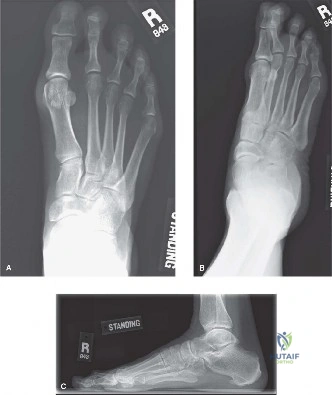
A 55-year-old female presents with progressive pain and a dorsal deformity of her second toe. She has failed 6 months of conservative management including orthotics and shoe-wear modification. On examination, you elicit a positive Lachman (Vertical Stress) test at the second MTPJ. You proceed to take weight-bearing radiographs.
Describe the primary anatomical stabilizer of the second MTPJ and explain the pathophysiological cascade that leads to the patient's current deformity.
Candidate: The primary stabilizer is the plantar plate, a fibrocartilaginous structure that attaches the metatarsal neck to the base of the proximal phalanx. When this fails, the intrinsic muscles lose their fulcrum, and the extensor digitorum longus (EDL) becomes unopposed, causing dorsal subluxation. This leads to the hammer or claw toe deformity we see clinically.
Candidates often focus solely on the "hammer toe" and ignore the role of the plantar plate. Failing to mention the specific site of failure (the proximal attachment to the metatarsal neck) or omitting the role of the intrinsic muscles (lumbricals/interossei) in maintaining the stability of the MTPJ demonstrates a lack of biomechanical depth.
A structured answer should define the plantar plate as the 'keystone' static stabilizer. Explain the cascade: (1) Overload (e.g., long 2nd metatarsal) leads to chronic attenuation/tearing of the plantar plate at the metatarsal neck. (2) This loss of constraint allows the EDL to become a deforming force, causing dorsal subluxation. (3) The loss of the 'lumbrical effect' (which normally provides MTPJ flexion) results in a fixed extension deformity of the MTPJ and secondary flexion contracture at the PIP joint (claw toe), eventually resulting in displacement of the plantar fat pad and metatarsalgia.
You have decided to proceed with surgery. You are planning a dorsal approach and a Weil osteotomy. Describe the potential complications of this specific shortening osteotomy and how you would mitigate them.
Candidate: The main complications include transfer metatarsalgia, MTPJ stiffness, and hardware irritation. To mitigate these, I would ensure accurate bone resection—typically no more than 3-4mm—to avoid over-shortening. I would also use a headless screw for fixation to minimize hardware prominence and initiate early range-of-motion exercises post-operatively.
Failing to mention the specific technical risk of the "plantar translation" of the metatarsal head. If the osteotomy is not performed parallel to the sole, the metatarsal head can sag plantarly, worsening the metatarsalgia rather than fixing it. Borderline candidates also forget to mention the risk of floating toe.
A comprehensive answer identifies: 1) Transfer metatarsalgia (mitigated by precise shortening and checking the parabola); 2) 'Floating toe' (mitigated by ensuring the plantar plate is adequately repaired/tightened to restore the flexor fulcrum); 3) Stiffness (mitigated by early, protected range-of-motion); and 4) Technical error (ensuring the Weil osteotomy is cut parallel to the floor to prevent plantar sag of the capital fragment). Mentioning that the K-wire fixation, if used, is essential to protect the repair while preventing dorsal migration of the toe is high-value.
Detailed Chapters & Topics
Dive deeper into specialized chapters regarding foot-and-ankle-cases-24