Managing Complex Open Tibia Fractures with Neurovascular Injury: A Case Study
Key Takeaway
A Gustilo Type IIIC open tibia fracture involves severe soft tissue damage, significant bone comminution, and arterial injury requiring repair. Assessment includes detailed clinical examination for neurovascular status, Gustilo-Anderson classification, and calculating the Mangled Extremity Severity Score (MESS) to guide urgent limb salvage versus amputation decisions, supported by immediate imaging.
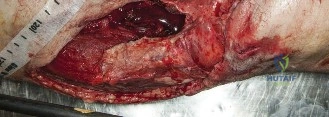
A 35-year-old male presents with a high-energy motorcycle collision. On examination, there is a 15x8 cm anteromedial wound with exposed bone and gross contamination. Distal pulses are absent, and capillary refill is delayed. You are shown the initial AP/Lateral radiographs below. How do you classify this injury and what is your immediate clinical priority?
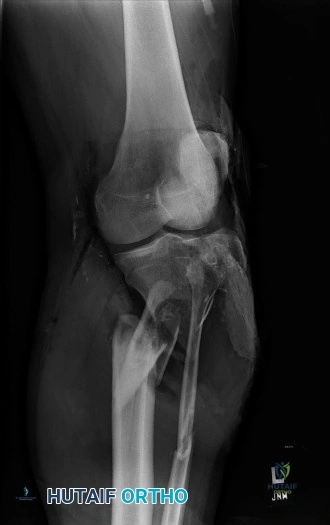
Candidate: This is a Gustilo-Anderson Type IIIC open tibial fracture. My priority is to stabilize the patient according to ATLS, control the bleeding with a tourniquet, and urgently arrange for vascular assessment and theater for debridement and revascularization.
Candidates often focus exclusively on the fracture pattern or suggest immediate internal fixation (e.g., nailing). Failing to mention the 'warm ischemia time' or the multidisciplinary team requirement (vascular/plastic surgery) shows a lack of seniority and trauma system awareness.
Systematically classify as Gustilo-Anderson Type IIIC. Define the vascular status immediately. State the 'Triple Threat': Debridement, Vascular Repair (within <6 hours), and skeletal stabilization (Damage Control Orthopaedics). Emphasize the urgency of a multidisciplinary team (Vascular/Plastics) and mention the physiological stability of the patient before surgical intervention.
Following initial resuscitation, you have performed a serial debridement. The patient is now in the OR. You have an extensive segmental defect. The patient has a high MESS score. How do you approach the stabilization of this limb and why is this method chosen over internal fixation?
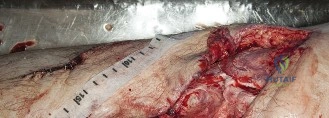
Candidate: I would use a temporary external fixator as Damage Control Orthopaedics. It is chosen because internal fixation at this stage in a heavily contaminated Type IIIC wound would carry an unacceptable risk of deep infection and osteomyelitis. This allows for soft tissue management and serial debridement.
Forgetting to discuss the 'Definitive Soft Tissue Coverage' plan. A candidate who ignores the need for a flap or the timing of bone grafting shows a failure to appreciate the "fix the envelope, then the skeleton" principle.
Structure the answer using the 'Damage Control' philosophy. Mention the absolute contraindication of early IM nailing/plating in high-grade contamination. Explicitly state the sequence: 1. Debridement, 2. Vascular restoration, 3. Temporary bridging external fixation, 4. Definitive soft tissue reconstruction (Free flap), 5. Secondary skeletal reconstruction (e.g., bone transport or internal fixation after soft tissue stabilization).
The patient has achieved soft tissue coverage with a free flap. You are now evaluating the long-term functional prognosis. What clinical and psychometric factors must be assessed before the patient is discharged to rehabilitation?
Candidate: I would assess the viability of the flap, check for signs of chronic osteomyelitis, and evaluate the patient's neurological status—specifically for foot drop or sensory deficits. Psychologically, I need to screen for PTSD and set realistic expectations for a 12-24 month rehabilitation process.
Failing to mention chronic pain management or the potential for CRPS (Complex Regional Pain Syndrome). Examiners want to see you acknowledge that limb salvage is a psychological burden, not just a surgical success.
Provide a structured "Bio-Psycho-Social" response. 1. Biologically: Flap stability, union, hardware integrity, and nerve recovery (EMG/Nerve Conduction). 2. Socially: Functional return, occupational therapy needs, and return to work. 3. Psychologically: Early referral for cognitive support to manage the protracted, high-morbidity nature of limb salvage. Acknowledge that the patient may still opt for secondary amputation if pain or non-function becomes unbearable.
