Periprosthetic Fractures: Epidemiology, Biomechanics, and Advanced ORIF Principles
Key Takeaway
Periprosthetic fractures, occurring around joint replacements, are complex due to altered bone mechanics and patient factors. Open Reduction Internal Fixation (ORIF) aims for stable fixation using principles like adequate bypass length, appropriate working length, and angular stable fixation with locking plates, especially crucial for achieving union in osteoporotic bone around rigid implants.
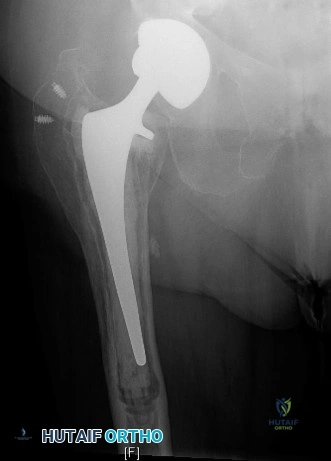
A 78-year-old patient presents with a painful thigh following a mechanical fall three weeks after a routine primary THA. Radiographs are provided below. Describe your classification and immediate management priorities.
Candidate: I would classify this using the Vancouver system. Based on the radiographs, it appears to be a Vancouver B1 fracture as the stem appears well-fixed. My priorities are to assess the stability of the implant clinically and radiographically, confirm there is no infection, and plan for ORIF using a locking plate that bypasses the stem tip.
Candidates often jump straight to "I'll use a plate and screws." They fail to explicitly mention the "3 C's": Classification, Clinical/Implant stability assessment, and Complications (specifically ruling out occult infection or subtle loosening) which are vital for a safe surgical plan.
A structured response: 1. Classification: "This is a Vancouver B1 fracture—a fracture around a well-fixed femoral stem." 2. Diagnostic Rigor: "I need to confirm implant stability by comparing these films to the post-op images. I will also assess for markers of periprosthetic joint infection, as an infected stem is a contraindication for ORIF." 3. Planning: "My goal is internal fixation with a long locking plate, ensuring it bypasses the stem tip by at least 2-3 cortical diameters to neutralize the stress riser."
You have decided to proceed with ORIF. You are now in the operating theatre. Discuss your technical approach to the femoral fixation, specifically regarding the interaction between your plate/screws and the existing prosthesis.
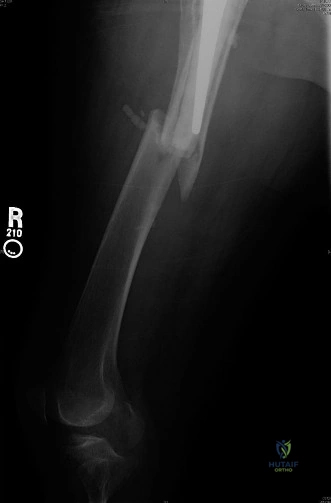
Candidate: I would use a long locking plate. I'll place it on the lateral side. I need to be careful with the screws around the stem; I will use unicortical locking screws and avoid drilling into the stem.
Missing the role of cerclage wires. Relying solely on locking screws around a prosthesis is high-risk. Examiners want to hear about the combination of cables and plates to provide circumferential compression and "gasket" stability before definitive locking fixation.
The candidate demonstrates advanced technical planning: "I will use a long lateral locking plate. Proximally, I will utilize cerclage cables to provide circumferential compression and initial stability, which effectively creates a 'gasket' effect. For screw placement around the stem, I will use fluoroscopy to ensure unicortical locking screws are placed in safe corridors, strictly avoiding the prosthetic stem. Distally, I will achieve bicortical purchase. I will ensure the construct bypasses the stem tip by 2-3 cortical diameters to avoid a new stress riser."
The surgery goes well. It is now 6 weeks post-op. The patient remains in significant pain. What are your differentials, and how do you investigate this?
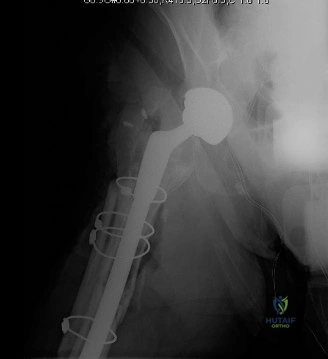
Candidate: I'd be worried about failure of fixation or infection. I would get new X-rays and do some blood tests like CRP and ESR.
Listing investigations without a logical, prioritized hierarchy. Forgetting "mechanical failure" vs "biological failure." A senior candidate must mention early mobilization expectations and the possibility of occult implant loosening.
Systematic approach: 1. Clinical Examination: Check for local signs of infection, joint range of motion, and stability. 2. Radiographic analysis: Compare to immediate post-op films to look for interval migration, screw cutout, or hardware failure. 3. Laboratory workup: Serum CRP/ESR as a screen for infection. 4. Advanced Imaging/Diagnostics: If labs are elevated or imaging is suspicious, consider aspiration of the hip to rule out low-grade periprosthetic infection, which is a major differential for "painful total joint" regardless of fracture fixation.
