Radial Shaft Fractures & DRUJ Instability: Epidemiology, Anatomy, and Management of Galeazzi Lesions
Key Takeaway
DRUJ instability in radial shaft fractures, often seen in Galeazzi lesions, is critical due to its impact on forearm function. It arises from disruption of the interosseous membrane, TFCC, or changes in radial length. Meticulous diagnosis and management are paramount to prevent chronic pain and functional impairment, ensuring optimal patient outcomes.
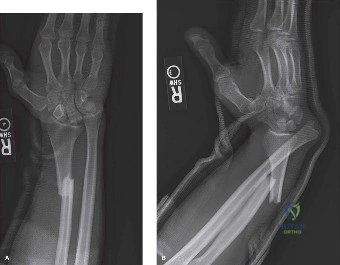
A 32-year-old male presents to the Emergency Department following a fall from a height onto his outstretched hand. He has localized pain in the mid-forearm and distal wrist. You review the provided radiographs. What is your primary diagnosis, and what crucial clinical assessment must you perform immediately?
Candidate: The X-rays show a Galeazzi fracture-dislocation. This is a radial shaft fracture with associated DRUJ instability. I need to examine the wrist for DRUJ stability using the ballottement test and check neurovascular status, specifically the integrity of the median and ulnar nerves.
Focusing only on the radial shaft fracture and failing to mention the DRUJ until prompted. Candidates often forget to mention comparing the findings to the contralateral uninjured wrist or fail to mention specific clinical tests like the 'Grind' or 'Ballottement' test.
Diagnosis: Galeazzi fracture-dislocation. Essential Assessment: 1) Clinical assessment of DRUJ stability using the ballottement test, comparing to the contralateral side. 2) Neurovascular examination of the hand (radial, median, and ulnar nerves). 3) Careful physical inspection for soft tissue injury as this is a high-energy mechanism. I would also order a CT scan of the wrist to fully characterize the DRUJ congruity if plain films are inconclusive.
You have successfully performed an ORIF of the radial shaft using a locking plate. Intra-operatively, you perform a ballottement test, and the DRUJ feels unstable. Describe your decision-making process for managing the DRUJ.
Candidate: I would first ensure the radial shaft reduction is anatomical and length is restored, as shortening is a primary cause of instability. If the radius is fixed perfectly and it remains unstable, I would consider pinning the DRUJ with K-wires in neutral or slight supination for 4 to 6 weeks.
Jumping immediately to TFCC repair or hardware. Failing to verify the adequacy of the radial shaft fixation (the "primary stabilizer") is a major procedural error. Candidates often forget to specify the position of the forearm during temporary pinning (20-30 degrees of supination).
Stepwise Approach: 1) Verify anatomical reduction and length of the radius (the "primary" fix). 2) Confirm fixation stability. 3) If still unstable, assess for TFCC avulsion. 4) Management: Temporary transfixation of the DRUJ with two 1.6mm K-wires in 20-30° of supination to allow ligamentous healing. This is the gold standard for acute management; I would only move to formal TFCC repair if a specific, repairable tear was identified and persistent instability remained.
